


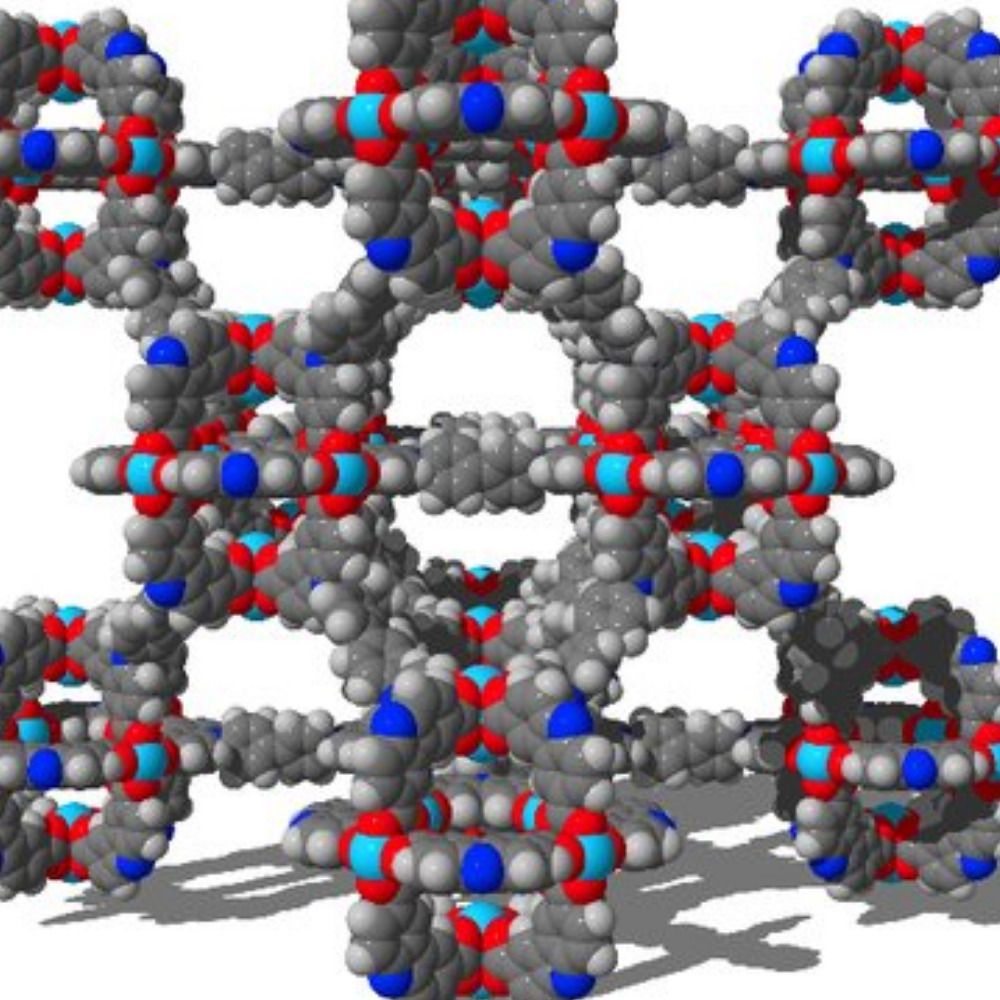
Accelerating Discovery Through Integration: A DFT validated Machine Learning Framework for Screening MOF Photocatalysts http://pubs.rsc.org/en/Content/ArticleLanding/2026/TA/D5TA08107F
January 2, 2026 at 9:12 PM
Accelerating Discovery Through Integration: A DFT validated Machine Learning Framework for Screening MOF Photocatalysts http://pubs.rsc.org/en/Content/ArticleLanding/2026/TA/D5TA08107F

## Enhanced Photoelectrochemical Water Splitting via Adaptive Gradient Optimization of Nanostructured TiO₂ Photocatalysts
**Abstract:** This research proposes a novel methodology for drastically improving the efficiency of photoelectrochemical (PEC) water splitting using TiO₂ photocatalysts…
**Abstract:** This research proposes a novel methodology for drastically improving the efficiency of photoelectrochemical (PEC) water splitting using TiO₂ photocatalysts…
## Enhanced Photoelectrochemical Water Splitting via Adaptive Gradient Optimization of Nanostructured TiO₂ Photocatalysts
**Abstract:** This research proposes a novel methodology for drastically improving the efficiency of photoelectrochemical (PEC) water splitting using TiO₂ photocatalysts through adaptive gradient optimization of their nanostructure. By integrating reinforcement learning (RL) with real-time electrochemical impedance spectroscopy (EIS) data, we develop a closed-loop system that dynamically adjusts fabrication parameters to iteratively refine the catalyst morphology, maximizing hydrogen evolution efficiency (HEE). This approach enables the creation of highly-optimized TiO₂ nanostructures exhibiting significantly improved charge carrier separation and transport compared to conventionally fabricated catalysts, ultimately yielding a projected 35% increase in HEE within a 5-year commercialization timeframe.
freederia.com
January 1, 2026 at 6:43 AM
## Enhanced Photoelectrochemical Water Splitting via Adaptive Gradient Optimization of Nanostructured TiO₂ Photocatalysts
**Abstract:** This research proposes a novel methodology for drastically improving the efficiency of photoelectrochemical (PEC) water splitting using TiO₂ photocatalysts…
**Abstract:** This research proposes a novel methodology for drastically improving the efficiency of photoelectrochemical (PEC) water splitting using TiO₂ photocatalysts…

Illuminating the transformation of photocatalysts in light-driven organic synthesis
->Nature | #organic #sustainable agriculture | More from Lil Dr Glen EcoChat at BigEarthData.ai
->Nature | #organic #sustainable agriculture | More from Lil Dr Glen EcoChat at BigEarthData.ai

Illuminating the transformation of photocatalysts in light-driven organic synthesis
Shaw, M. H., Twilton, J. & MacMillan, D. W. C. Photoredox catalysis in organic chemistry. J. Org. Chem. 81, 6898–6926 (2016). Hopkinson, M. N., Tlahuext-Aca, A. & Glorius, F. Merging visible light photoredox and gold catalysis. Acc. Chem. Res. 49,...
www.nature.com
December 23, 2025 at 1:22 AM

📰: Our recent publication in @jacs.acspublications.org Au introduces a new method to functionalize PFA coil reactors with different photocatalysts through fluorophilic interactions, which can help configure flow reactors for reactions on scale. Congrats to Benedikt, Jesús, and AF Research Lab team!

December 18, 2025 at 5:17 PM
📰: Our recent publication in @jacs.acspublications.org Au introduces a new method to functionalize PFA coil reactors with different photocatalysts through fluorophilic interactions, which can help configure flow reactors for reactions on scale. Congrats to Benedikt, Jesús, and AF Research Lab team!

Congratulations to Máire for her paper accepted in Cell Rep. Phys. Sci. (doi.org/10.1016/j.xc...), demonstrating the value of NHC iridium complexes as strongly photoreducing and high triplet energy photocatalysts. @standrewschem.bsky.social #johnsonmatthey @standrewsosc.bsky.social

December 18, 2025 at 11:00 AM
Congratulations to Máire for her paper accepted in Cell Rep. Phys. Sci. (doi.org/10.1016/j.xc...), demonstrating the value of NHC iridium complexes as strongly photoreducing and high triplet energy photocatalysts. @standrewschem.bsky.social #johnsonmatthey @standrewsosc.bsky.social

New episode alert! Discover how BaTiO3/Cr-Zr-HMS photocatalysts can remove over 95% of harmful dye from wastewater using visible light, paving the way for innovative environmental cleanup solutions. Tune in! https://tinyurl.com/SciBud-AI
December 17, 2025 at 8:01 PM
New episode alert! Discover how BaTiO3/Cr-Zr-HMS photocatalysts can remove over 95% of harmful dye from wastewater using visible light, paving the way for innovative environmental cleanup solutions. Tune in! https://tinyurl.com/SciBud-AI

Research Highlight now online:
Heck-type reactions with bismuth photocatalysts by Eric Piechota
www.nature.com/articles/s44... ($)
#Chemsky
Highlighting the Nature Catalysis Article by Josep Cornella & co-workers
Heck-type reactions with bismuth photocatalysts by Eric Piechota
www.nature.com/articles/s44... ($)
#Chemsky
Highlighting the Nature Catalysis Article by Josep Cornella & co-workers

Heck-type reactions with bismuth photocatalysts - Nature Synthesis
Nature Synthesis - Heck-type reactions with bismuth photocatalysts
www.nature.com
December 15, 2025 at 10:34 AM
Research Highlight now online:
Heck-type reactions with bismuth photocatalysts by Eric Piechota
www.nature.com/articles/s44... ($)
#Chemsky
Highlighting the Nature Catalysis Article by Josep Cornella & co-workers
Heck-type reactions with bismuth photocatalysts by Eric Piechota
www.nature.com/articles/s44... ($)
#Chemsky
Highlighting the Nature Catalysis Article by Josep Cornella & co-workers

Check out recent #review by Ting Han's team.
This review highlights recent progress in the design, synthesis, and functionalization of porous porphyrin-based photocatalysts, including MOFs, COFs, HOFs and POPs.
doi.org/10.1039/D5QM00676G
This review highlights recent progress in the design, synthesis, and functionalization of porous porphyrin-based photocatalysts, including MOFs, COFs, HOFs and POPs.
doi.org/10.1039/D5QM00676G

Porous porphyrin-based photocatalysts: recent progress and applications in environmental remediation
Environmental pollution from organic contaminants poses a significant threat to ecosystems and human health, which require innovative and efficient remediation strategies. Porphyrin-based materials, r...
pubs.rsc.org
December 15, 2025 at 9:59 AM
Check out recent #review by Ting Han's team.
This review highlights recent progress in the design, synthesis, and functionalization of porous porphyrin-based photocatalysts, including MOFs, COFs, HOFs and POPs.
doi.org/10.1039/D5QM00676G
This review highlights recent progress in the design, synthesis, and functionalization of porous porphyrin-based photocatalysts, including MOFs, COFs, HOFs and POPs.
doi.org/10.1039/D5QM00676G

🧪Prof Eli Zysman-Colman leads pioneering research at @uniofstandrews.bsky.social in the design of luminophores, sensing materials & photocatalysts for cutting-edge optoelectronic applications, using UV–Vis spectrophotometers, GC–MS & HPLC/GPC systems.
More: cutt.ly/BrZEsxbL
#AcademicSky #UK
More: cutt.ly/BrZEsxbL
#AcademicSky #UK

December 10, 2025 at 8:30 AM
🧪Prof Eli Zysman-Colman leads pioneering research at @uniofstandrews.bsky.social in the design of luminophores, sensing materials & photocatalysts for cutting-edge optoelectronic applications, using UV–Vis spectrophotometers, GC–MS & HPLC/GPC systems.
More: cutt.ly/BrZEsxbL
#AcademicSky #UK
More: cutt.ly/BrZEsxbL
#AcademicSky #UK
## Enhanced Z-Scheme Heterojunction Design for Solar Energy Conversion via Machine Learning-Driven Compositional Optimization
**Abstract:** This research investigates a novel approach to boosting solar energy conversion efficiency in Z-scheme heterojunction photocatalysts exceeding 20% by…
**Abstract:** This research investigates a novel approach to boosting solar energy conversion efficiency in Z-scheme heterojunction photocatalysts exceeding 20% by…
## Enhanced Z-Scheme Heterojunction Design for Solar Energy Conversion via Machine Learning-Driven Compositional Optimization
**Abstract:** This research investigates a novel approach to boosting solar energy conversion efficiency in Z-scheme heterojunction photocatalysts exceeding 20% by leveraging machine learning algorithms for compositional optimization of constituent materials. Current limitations in Z-scheme photocatalysis arise from interfacial charge recombination and suboptimal band alignment. Our method employs a hybrid machine learning model combining Bayesian Optimization and Graph Neural Networks (GNNs) to predict and optimize the composition of TiO₂, WO₃, and Cu₂O, minimizing recombination loss and maximizing light harvesting.
freederia.com
December 10, 2025 at 8:22 AM
## Enhanced Z-Scheme Heterojunction Design for Solar Energy Conversion via Machine Learning-Driven Compositional Optimization
**Abstract:** This research investigates a novel approach to boosting solar energy conversion efficiency in Z-scheme heterojunction photocatalysts exceeding 20% by…
**Abstract:** This research investigates a novel approach to boosting solar energy conversion efficiency in Z-scheme heterojunction photocatalysts exceeding 20% by…
Vanadium thiocarboxylate Metal-Organic Frameworks as efficient photocatalysts for photooxidative desulfurization http://pubs.rsc.org/en/Content/ArticleLanding/2026/QI/D5QI02257F
December 9, 2025 at 5:12 PM
Vanadium thiocarboxylate Metal-Organic Frameworks as efficient photocatalysts for photooxidative desulfurization http://pubs.rsc.org/en/Content/ArticleLanding/2026/QI/D5QI02257F
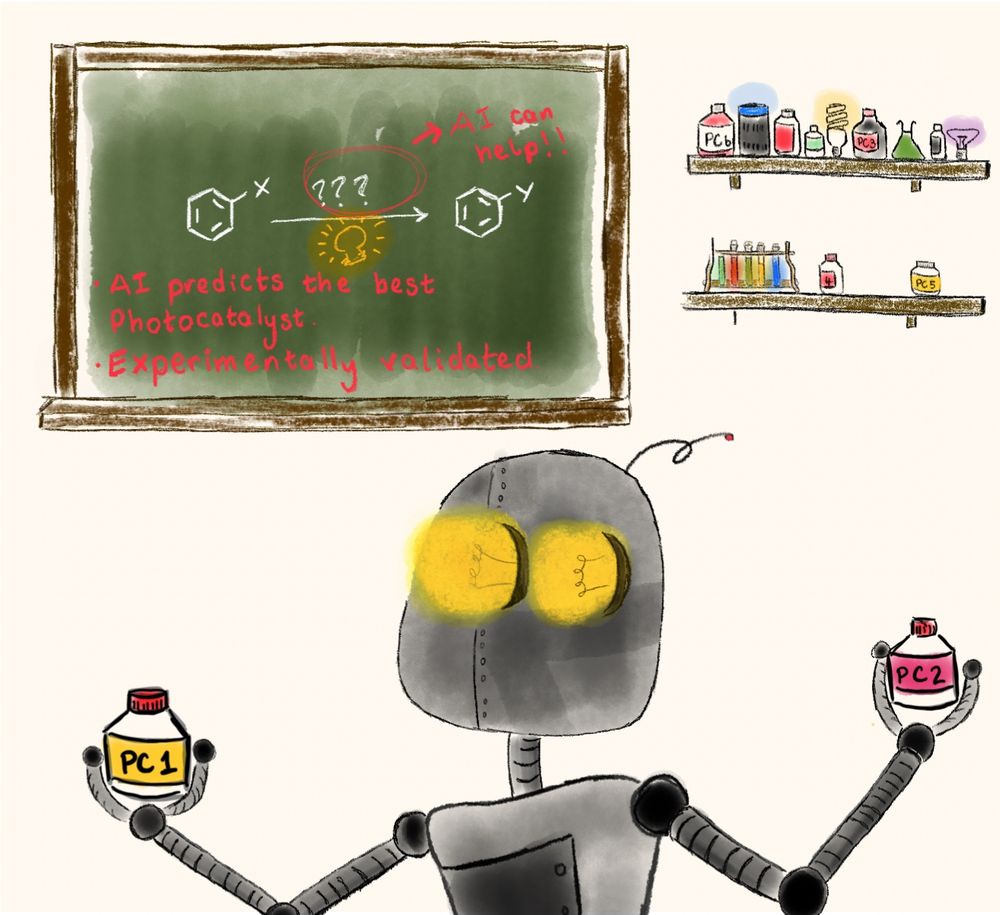
Congrats 🎊 to Fran, Jay, Suraksha, Aniket, Violaine, Máire, Megan, Tom, Lea, & Aminata for their paper accepted in @angewandtechemie.bsky.social (dx.doi.org/10.1002/anie...) a collab effort w/ Grzybowski group, on an #ML agent for recommending #photocatalysts. @st-andrewschem.bsky.social
December 9, 2025 at 3:01 PM
Congrats 🎊 to Fran, Jay, Suraksha, Aniket, Violaine, Máire, Megan, Tom, Lea, & Aminata for their paper accepted in @angewandtechemie.bsky.social (dx.doi.org/10.1002/anie...) a collab effort w/ Grzybowski group, on an #ML agent for recommending #photocatalysts. @st-andrewschem.bsky.social

Professor Kazuhiko Maeda at the University of Tokyo is defying conventional approaches to develop highly efficient photocatalysts for artificial photosynthesis.
🔗 Source: https://www.isct.ac.jp/en/news/58l79dm8q6tc%22
🔗 Source: https://www.isct.ac.jp/en/news/58l79dm8q6tc%22

December 9, 2025 at 2:40 PM
Professor Kazuhiko Maeda at the University of Tokyo is defying conventional approaches to develop highly efficient photocatalysts for artificial photosynthesis.
🔗 Source: https://www.isct.ac.jp/en/news/58l79dm8q6tc%22
🔗 Source: https://www.isct.ac.jp/en/news/58l79dm8q6tc%22

2 years ago my supervisor asked me: "Can we make #photocatalysts #float between two #liquids? It looks cool!" 🥪😎
Nice to see that my very first #sketch (left) and #Figure1 (right) do not differ much 🖌️
Now out in #Chem @cellpress.bsky.social, liquid|solid|liquid (L|S|L)🔵🟡🟠photocatalysis ☀️
Nice to see that my very first #sketch (left) and #Figure1 (right) do not differ much 🖌️
Now out in #Chem @cellpress.bsky.social, liquid|solid|liquid (L|S|L)🔵🟡🟠photocatalysis ☀️


December 6, 2025 at 2:49 PM
2 years ago my supervisor asked me: "Can we make #photocatalysts #float between two #liquids? It looks cool!" 🥪😎
Nice to see that my very first #sketch (left) and #Figure1 (right) do not differ much 🖌️
Now out in #Chem @cellpress.bsky.social, liquid|solid|liquid (L|S|L)🔵🟡🟠photocatalysis ☀️
Nice to see that my very first #sketch (left) and #Figure1 (right) do not differ much 🖌️
Now out in #Chem @cellpress.bsky.social, liquid|solid|liquid (L|S|L)🔵🟡🟠photocatalysis ☀️
Pyridine‐Functionalized Covalent Organic Frameworks as Metal‐Free Photocatalysts for Chlorotrifluoromethylation of Alkenes via Inner‐Sphere Mechanism https://onlinelibrary.wiley.com/doi/10.1002/smll.202510179?af=R
December 6, 2025 at 10:12 AM
Pyridine‐Functionalized Covalent Organic Frameworks as Metal‐Free Photocatalysts for Chlorotrifluoromethylation of Alkenes via Inner‐Sphere Mechanism https://onlinelibrary.wiley.com/doi/10.1002/smll.202510179?af=R

Recent Progress on Overall Water Splitting Using Particulate Inorganic Photocatalysts with Wide Visible Light Utilization www.chinesechemsoc.org/doi/10.31635...
#chemistry #openaccess #science
#chemistry #openaccess #science

December 5, 2025 at 10:58 PM
Recent Progress on Overall Water Splitting Using Particulate Inorganic Photocatalysts with Wide Visible Light Utilization www.chinesechemsoc.org/doi/10.31635...
#chemistry #openaccess #science
#chemistry #openaccess #science
#Review article by Ting Han 𝘦𝘵 𝘢𝘭.
#TexasWoman'sUniversity #TWU
This review highlights recent progress in the design, synthesis, and functionalization of porous porphyrin-based photocatalysts, including #MOFs, #COFs, #HOFs and #POPs.
doi.org/10.1039/D5QM00676G
#TexasWoman'sUniversity #TWU
This review highlights recent progress in the design, synthesis, and functionalization of porous porphyrin-based photocatalysts, including #MOFs, #COFs, #HOFs and #POPs.
doi.org/10.1039/D5QM00676G
Porous porphyrin-based photocatalysts: recent progress and applications in environmental remediation
Environmental pollution from organic contaminants poses a significant threat to ecosystems and human health, which require innovative and efficient remediation strategies. Porphyrin-based materials, r...
doi.org
December 4, 2025 at 9:18 AM
#Review article by Ting Han 𝘦𝘵 𝘢𝘭.
#TexasWoman'sUniversity #TWU
This review highlights recent progress in the design, synthesis, and functionalization of porous porphyrin-based photocatalysts, including #MOFs, #COFs, #HOFs and #POPs.
doi.org/10.1039/D5QM00676G
#TexasWoman'sUniversity #TWU
This review highlights recent progress in the design, synthesis, and functionalization of porous porphyrin-based photocatalysts, including #MOFs, #COFs, #HOFs and #POPs.
doi.org/10.1039/D5QM00676G
## Enhanced Stability of TiO₂ Photocatalysts Through Dynamic Surface Functionalization with Self-Assembled Monolayers (SAMs) – A Multi-fidelity Assessment Pipeline
**Abstract:** The deactivation of TiO₂ photocatalysts, primarily due to surface trapping of photogenerated electrons and subsequent…
**Abstract:** The deactivation of TiO₂ photocatalysts, primarily due to surface trapping of photogenerated electrons and subsequent…
## Enhanced Stability of TiO₂ Photocatalysts Through Dynamic Surface Functionalization with Self-Assembled Monolayers (SAMs) – A Multi-fidelity Assessment Pipeline
**Abstract:** The deactivation of TiO₂ photocatalysts, primarily due to surface trapping of photogenerated electrons and subsequent recombination, severely limits their efficiency. This research proposes a novel approach to enhance stability through dynamic surface functionalization with self-assembled monolayers (SAMs) of thiol-terminated phosphonic acids (TPA-SH), whose inhibits surface electron trapping. A multi-fidelity assessment pipeline, incorporating high-throughput computational screening, experimental validation, and real-time activity monitoring, is developed to optimize the SAM design and deposition process.
freederia.com
November 30, 2025 at 10:07 PM
## Enhanced Stability of TiO₂ Photocatalysts Through Dynamic Surface Functionalization with Self-Assembled Monolayers (SAMs) – A Multi-fidelity Assessment Pipeline
**Abstract:** The deactivation of TiO₂ photocatalysts, primarily due to surface trapping of photogenerated electrons and subsequent…
**Abstract:** The deactivation of TiO₂ photocatalysts, primarily due to surface trapping of photogenerated electrons and subsequent…

When it comes to SPF, is absorption only half of the story? Understanding how the energy is dissipated seems equally important. For example, methylene blue is a great photon absorber, but it dissipates the absorbed energy by making toxic radicals. Lots of organic SPFs look like photocatalysts to me.
November 29, 2025 at 3:10 PM
When it comes to SPF, is absorption only half of the story? Understanding how the energy is dissipated seems equally important. For example, methylene blue is a great photon absorber, but it dissipates the absorbed energy by making toxic radicals. Lots of organic SPFs look like photocatalysts to me.
Covalent Organic Frameworks as Efficient Photocatalysts for Sustainable Ammonia Production https://chemistry-europe.onlinelibrary.wiley.com/doi/10.1002/chem.202503081?af=R
November 29, 2025 at 12:17 PM
Covalent Organic Frameworks as Efficient Photocatalysts for Sustainable Ammonia Production https://chemistry-europe.onlinelibrary.wiley.com/doi/10.1002/chem.202503081?af=R
## Hyperdimensional Graph Neural Network for Interpreting Surface Passivation Dynamics on TiO₂ Photocatalysts Under UV-Vis Illumination
**Abstract:** This paper introduces a novel computational framework employing Hyperdimensional Graph Neural Networks (HGNNs) to model and interpret the intricate…
**Abstract:** This paper introduces a novel computational framework employing Hyperdimensional Graph Neural Networks (HGNNs) to model and interpret the intricate…
## Hyperdimensional Graph Neural Network for Interpreting Surface Passivation Dynamics on TiO₂ Photocatalysts Under UV-Vis Illumination
**Abstract:** This paper introduces a novel computational framework employing Hyperdimensional Graph Neural Networks (HGNNs) to model and interpret the intricate passivation dynamics on TiO₂ photocatalyst surfaces under UV-Vis illumination. Unlike traditional computational approaches relying on simplistic kinetic models and limited feature representation, our HGNN framework captures the complex interplay of surface defects, adsorbates, and illumination-induced reactions within a higher-dimensional feature space.
freederia.com
November 29, 2025 at 7:28 AM
## Hyperdimensional Graph Neural Network for Interpreting Surface Passivation Dynamics on TiO₂ Photocatalysts Under UV-Vis Illumination
**Abstract:** This paper introduces a novel computational framework employing Hyperdimensional Graph Neural Networks (HGNNs) to model and interpret the intricate…
**Abstract:** This paper introduces a novel computational framework employing Hyperdimensional Graph Neural Networks (HGNNs) to model and interpret the intricate…
Hierarchically structured MOF-on-MOF photocatalysts with engineered charge dynamics for sustainable green fuel generation http://pubs.rsc.org/en/Content/ArticleLanding/2026/SU/D5SU00595G

November 28, 2025 at 3:13 PM
Hierarchically structured MOF-on-MOF photocatalysts with engineered charge dynamics for sustainable green fuel generation http://pubs.rsc.org/en/Content/ArticleLanding/2026/SU/D5SU00595G
## Enhanced Solar-to-Hydrogen Conversion Efficiency via Tunable Doping Gradient in LaFeO₃/TiO₂ Z-Scheme Heterojunctions: A Machine Learning-Driven Optimization Approach
**Abstract:** This paper presents a novel approach to optimizing the performance of Z-scheme heterojunction photocatalysts for…
**Abstract:** This paper presents a novel approach to optimizing the performance of Z-scheme heterojunction photocatalysts for…
## Enhanced Solar-to-Hydrogen Conversion Efficiency via Tunable Doping Gradient in LaFeO₃/TiO₂ Z-Scheme Heterojunctions: A Machine Learning-Driven Optimization Approach
**Abstract:** This paper presents a novel approach to optimizing the performance of Z-scheme heterojunction photocatalysts for solar-to-hydrogen conversion. We investigate LaFeO₃/TiO₂ heterojunctions, focusing on the critical role of doping gradient control within the LaFeO₃ component. Employing a machine learning (ML) framework coupled with Density Functional Theory (DFT) simulations and experimental validation, we demonstrate that a precisely engineered doping gradient of Fe²⁺ within LaFeO₃ significantly enhances charge separation and reduces electron-hole recombination, leading to a 18.3% improvement in hydrogen evolution efficiency compared to undoped controls.
freederia.com
November 28, 2025 at 12:36 AM
## Enhanced Solar-to-Hydrogen Conversion Efficiency via Tunable Doping Gradient in LaFeO₃/TiO₂ Z-Scheme Heterojunctions: A Machine Learning-Driven Optimization Approach
**Abstract:** This paper presents a novel approach to optimizing the performance of Z-scheme heterojunction photocatalysts for…
**Abstract:** This paper presents a novel approach to optimizing the performance of Z-scheme heterojunction photocatalysts for…
A review of MOF/ZnIn2S4 heterojunction photocatalysts: mechanisms, fabrication, modification, and applications https://www.sciencedirect.com/science/article/pii/S0010854525009725
November 27, 2025 at 4:12 PM
A review of MOF/ZnIn2S4 heterojunction photocatalysts: mechanisms, fabrication, modification, and applications https://www.sciencedirect.com/science/article/pii/S0010854525009725
## Enhanced Hydrogen Production via Defect-Engineered TiO₂ Nanostructures: A Machine Learning-Accelerated Optimization Framework
**Abstract:** This research proposes a novel method for enhancing hydrogen production efficiency in TiO₂ photocatalysts through precise defect engineering, guided by a…
**Abstract:** This research proposes a novel method for enhancing hydrogen production efficiency in TiO₂ photocatalysts through precise defect engineering, guided by a…
## Enhanced Hydrogen Production via Defect-Engineered TiO₂ Nanostructures: A Machine Learning-Accelerated Optimization Framework
**Abstract:** This research proposes a novel method for enhancing hydrogen production efficiency in TiO₂ photocatalysts through precise defect engineering, guided by a machine learning (ML) framework. Current TiO₂ photocatalysts suffer from limitations due to rapid electron-hole recombination. Introducing controlled defects – oxygen vacancies and nitrogen doping – is known to improve performance, but the optimal combination and concentration remain experimentally challenging to determine.
freederia.com
November 25, 2025 at 7:01 PM
## Enhanced Hydrogen Production via Defect-Engineered TiO₂ Nanostructures: A Machine Learning-Accelerated Optimization Framework
**Abstract:** This research proposes a novel method for enhancing hydrogen production efficiency in TiO₂ photocatalysts through precise defect engineering, guided by a…
**Abstract:** This research proposes a novel method for enhancing hydrogen production efficiency in TiO₂ photocatalysts through precise defect engineering, guided by a…