


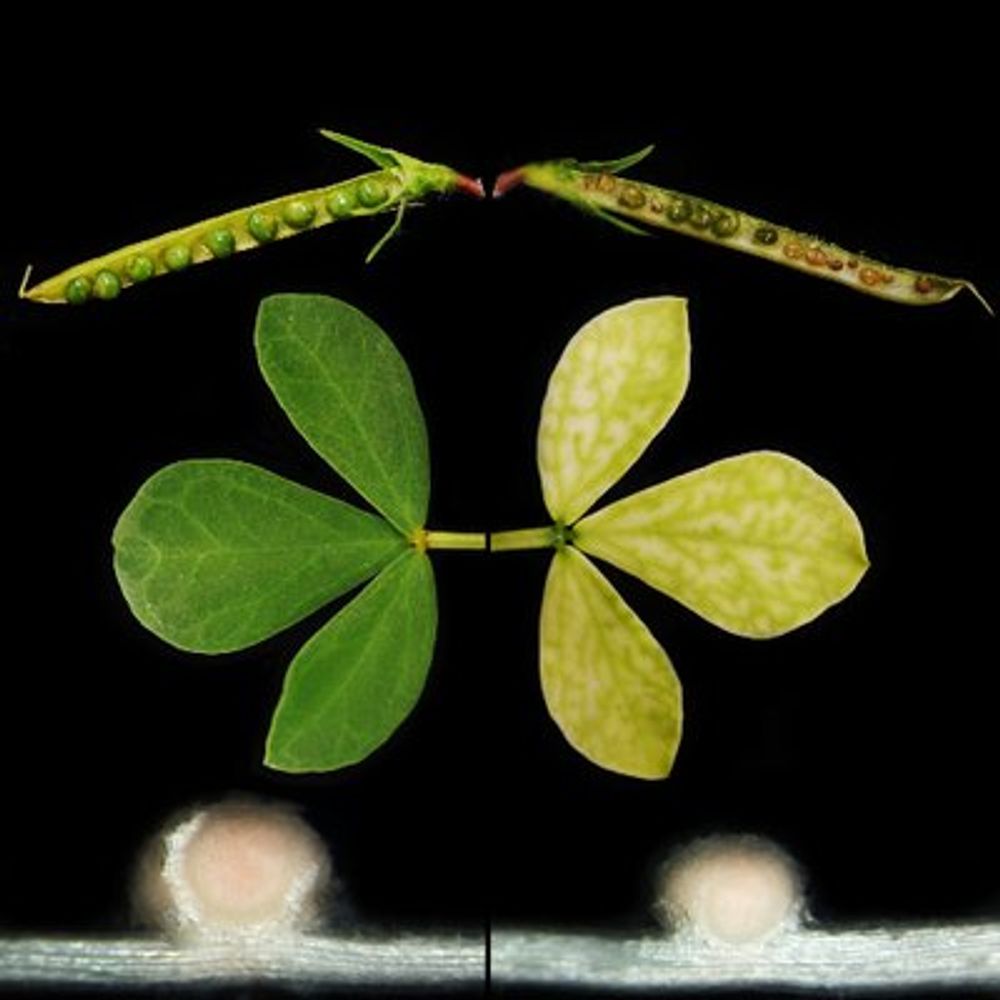
Rice OsMYB44 regulates Early heading date 1 expression for photoperiodic flowering (Hyeryung Yoon , Sang-Ji Lee , Jinku Kang , Sae Hyun Lee , Tae-Jin Yang , Gynheung An , Kiyoon Kang , Sung-Hwan Cho , Nam-Chon Paek) doi.org/10.1093/plph... #PlantScience @aspbofficial

Rice OsMYB44 regulates Early heading date 1 expression for photoperiodic flowering
The R2R3-type MYB transcription factor OsMYB44 interacts with the photoperiodic flowering regulators Heading date 1 (Hd1) and Days to heading 8 (DTH8) to a
doi.org
February 11, 2026 at 2:28 PM
Rice OsMYB44 regulates Early heading date 1 expression for photoperiodic flowering (Hyeryung Yoon , Sang-Ji Lee , Jinku Kang , Sae Hyun Lee , Tae-Jin Yang , Gynheung An , Kiyoon Kang , Sung-Hwan Cho , Nam-Chon Paek) doi.org/10.1093/plph... #PlantScience @aspbofficial

Circadian and photoperiodic control of melatonin in Drosophila ananassae
#Drosophila
#Drosophila
Circadian and photoperiodic control of melatonin in Drosophila ananassae
#Drosophila
PubMed link
pubmed.ncbi.nlm.nih.gov
January 16, 2026 at 8:23 PM
Circadian and photoperiodic control of melatonin in Drosophila ananassae
#Drosophila
#Drosophila

Here is the newest Ferris Lab preprint as promised on the genomic basis of divergence in photoperiodic flowering across and elevational gradient! See first author @jillmlove.bsky.social ‘s post below for the link.
Check it out folks!!!!
#Mimuluspropaganda #WomeninStem #ProudPI
Check it out folks!!!!
#Mimuluspropaganda #WomeninStem #ProudPI
Another preprint to share from the Ferris Lab @ferrisifolius.bsky.social! This project started as co-author Aditi Mahesh’s undergrad honors thesis and became my first dive into bioinformatics. Excited to share these results on the genomics of photoperiod adaptation!! www.biorxiv.org/content/10.6...

The genomic basis of local adaptation to photoperiod across altitude in a self-fertilizing monkeyflower
Local adaptation along altitudinal gradients is well documented in many plant species, however the genetic basis of adaptive variation over these steep environmental clines remains poorly understood. ...
www.biorxiv.org
January 16, 2026 at 4:56 PM
Here is the newest Ferris Lab preprint as promised on the genomic basis of divergence in photoperiodic flowering across and elevational gradient! See first author @jillmlove.bsky.social ‘s post below for the link.
Check it out folks!!!!
#Mimuluspropaganda #WomeninStem #ProudPI
Check it out folks!!!!
#Mimuluspropaganda #WomeninStem #ProudPI

Growing Onions
Onions thrive in sunny environments such as raised beds or rows. Their roots need light soil with no sandy, heavy clay or loam deposits - avoid using sandy, heavy clay or loamy varieties! Onions are photoperiodic plants, meaning their growth depends on sunlight hours. Short-day…
Onions thrive in sunny environments such as raised beds or rows. Their roots need light soil with no sandy, heavy clay or loam deposits - avoid using sandy, heavy clay or loamy varieties! Onions are photoperiodic plants, meaning their growth depends on sunlight hours. Short-day…

Growing Onions
Onions thrive in sunny environments such as raised beds or rows. Their roots need light soil with no sandy, heavy clay or loam deposits - avoid using sandy, heavy clay or loamy varieties! Onions are photoperiodic plants, meaning their growth depends on sunlight hours. Short-day onions require only 10-12 hours of sunshine in order to produce blooms. Fertilize Onions require regular nutrition throughout their growing season, especially nitrogen for green leaf growth, which supports bulb formation.
lifeandwork.blog
January 5, 2026 at 1:37 PM
Growing Onions
Onions thrive in sunny environments such as raised beds or rows. Their roots need light soil with no sandy, heavy clay or loam deposits - avoid using sandy, heavy clay or loamy varieties! Onions are photoperiodic plants, meaning their growth depends on sunlight hours. Short-day…
Onions thrive in sunny environments such as raised beds or rows. Their roots need light soil with no sandy, heavy clay or loam deposits - avoid using sandy, heavy clay or loamy varieties! Onions are photoperiodic plants, meaning their growth depends on sunlight hours. Short-day…
SlCOL1 and SlCOL2 play dual roles in photoperiodic flowering and inflorescence architecture in tomato (Jia Song , Shiqi Zhao , Qian Qi , Ren Li , Xia Cui , Shuai Sun) doi.org/10.1093/plph... #PlantScience @aspbofficial

SlCOL1 and SlCOL2 play dual roles in photoperiodic flowering and inflorescence architecture in tomato
SlCOL1 and SlCOL2 coordinate seasonal flowering and inflorescence branching, offering insights into plant adaptation and potential targets for improving to
doi.org
December 17, 2025 at 3:38 PM
SlCOL1 and SlCOL2 play dual roles in photoperiodic flowering and inflorescence architecture in tomato (Jia Song , Shiqi Zhao , Qian Qi , Ren Li , Xia Cui , Shuai Sun) doi.org/10.1093/plph... #PlantScience @aspbofficial

Photoperiodic time measurement in birds relies on deep brain photoreceptors. VAopsin has been suggested to be important, but in the arctic svalbard ptarmigan VAopsin is non functional in the hypothalamus: www.sciencedirect.com/science/arti...

Differential expression of VA opsin transcript variants in tissues linked to photoperiodic time measurement in Svalbard rock ptarmigan
Photoperiodic time measurement is the process through which annual changes in daylength are integrated to synchronize seasonal physiological and behav…
www.sciencedirect.com
December 17, 2025 at 1:14 AM
Photoperiodic time measurement in birds relies on deep brain photoreceptors. VAopsin has been suggested to be important, but in the arctic svalbard ptarmigan VAopsin is non functional in the hypothalamus: www.sciencedirect.com/science/arti...
Pigment-dispersing factor is not essential for eclosion rhythm and inducing the photoperiodic diapause in the silkworm, Bombyx mori
#Drosophila
#Drosophila
Pigment-dispersing factor is not essential for eclosion rhythm and inducing the photoperiodic diapause in the silkworm, Bombyx mori
#Drosophila
PubMed link
pubmed.ncbi.nlm.nih.gov
December 9, 2025 at 2:24 PM
Pigment-dispersing factor is not essential for eclosion rhythm and inducing the photoperiodic diapause in the silkworm, Bombyx mori
#Drosophila
#Drosophila
Pigment-dispersing factor is not essential for eclosion rhythm and inducing the photoperiodic diapause in the silkworm, Bombyx mori
#Drosophila
#Drosophila
Pigment-dispersing factor is not essential for eclosion rhythm and inducing the photoperiodic diapause in the silkworm, Bombyx mori
#Drosophila
PubMed link
pubmed.ncbi.nlm.nih.gov
December 9, 2025 at 12:24 PM
Pigment-dispersing factor is not essential for eclosion rhythm and inducing the photoperiodic diapause in the silkworm, Bombyx mori
#Drosophila
#Drosophila
Pigment-dispersing factor is not essential for eclosion rhythm and inducing the photoperiodic diapause in the silkworm, Bombyx mori
#Drosophila
#Drosophila
Pigment-dispersing factor is not essential for eclosion rhythm and inducing the photoperiodic diapause in the silkworm, Bombyx mori
#Drosophila
PubMed link
pubmed.ncbi.nlm.nih.gov
December 9, 2025 at 10:23 AM
Pigment-dispersing factor is not essential for eclosion rhythm and inducing the photoperiodic diapause in the silkworm, Bombyx mori
#Drosophila
#Drosophila
Pigment-dispersing factor is not essential for eclosion rhythm and inducing the photoperiodic diapause in the silkworm, Bombyx mori
#Drosophila
#Drosophila
Pigment-dispersing factor is not essential for eclosion rhythm and inducing the photoperiodic diapause in the silkworm, Bombyx mori
#Drosophila
PubMed link
pubmed.ncbi.nlm.nih.gov
December 9, 2025 at 8:24 AM
Pigment-dispersing factor is not essential for eclosion rhythm and inducing the photoperiodic diapause in the silkworm, Bombyx mori
#Drosophila
#Drosophila
Pigment-dispersing factor is not essential for eclosion rhythm and inducing the photoperiodic diapause in the silkworm, Bombyx mori
#Drosophila
#Drosophila
Pigment-dispersing factor is not essential for eclosion rhythm and inducing the photoperiodic diapause in the silkworm, Bombyx mori
#Drosophila
PubMed link
pubmed.ncbi.nlm.nih.gov
December 8, 2025 at 7:23 AM
Pigment-dispersing factor is not essential for eclosion rhythm and inducing the photoperiodic diapause in the silkworm, Bombyx mori
#Drosophila
#Drosophila

Just out in @ChemRxiv! Switchable amino acyl phosphates! We show how azobenzene-embedded acyl phosphates enable photoperiodic control over non-equilibrium self-assembly.
chemrxiv.org/engage/chemr...
chemrxiv.org/engage/chemr...

December 3, 2025 at 5:12 AM
Just out in @ChemRxiv! Switchable amino acyl phosphates! We show how azobenzene-embedded acyl phosphates enable photoperiodic control over non-equilibrium self-assembly.
chemrxiv.org/engage/chemr...
chemrxiv.org/engage/chemr...

+ in this #TansleyInsight (which is also my first paper as corresponding author!) we ask ourselves: if bacteria can anticipate the seasons, how does that change the way we think about the evolution of photoperiodic responses?
bsky.app/profile/newp...
bsky.app/profile/newp...
#TansleyInsight: Could photoperiodic responses have evolved before the emergence of #CircadianClocks?
@jabbur.bsky.social & Carl Hirschie Johnson
👇
📖 nph.onlinelibrary.wiley.com/doi/10.1111/...
#LatestIssue
@jabbur.bsky.social & Carl Hirschie Johnson
👇
📖 nph.onlinelibrary.wiley.com/doi/10.1111/...
#LatestIssue

December 1, 2025 at 5:55 PM
+ in this #TansleyInsight (which is also my first paper as corresponding author!) we ask ourselves: if bacteria can anticipate the seasons, how does that change the way we think about the evolution of photoperiodic responses?
bsky.app/profile/newp...
bsky.app/profile/newp...

## Hyperdimensional Analysis of Photoperiodic Response Modulation in *Arabidopsis thaliana* via Dynamic Metabolic Network Reconstruction
**Abstract:** This paper introduces a novel approach to understanding and predicting plant photoperiodic responses in *Arabidopsis thaliana*. We leverage…
**Abstract:** This paper introduces a novel approach to understanding and predicting plant photoperiodic responses in *Arabidopsis thaliana*. We leverage…
## Hyperdimensional Analysis of Photoperiodic Response Modulation in *Arabidopsis thaliana* via Dynamic Metabolic Network Reconstruction
**Abstract:** This paper introduces a novel approach to understanding and predicting plant photoperiodic responses in *Arabidopsis thaliana*. We leverage hyperdimensional computing (HDC) to represent and analyze dynamic metabolic networks, enabling unprecedented accuracy in modeling gene expression fluctuations linked to day length. Unlike traditional methods relying on static models or simplified representations, our approach incorporates temporal metabolic flux data into a high-dimensional vector space, allowing for precise prediction of flowering time and resource allocation strategies under varying photoperiods.
freederia.com
November 26, 2025 at 6:56 PM
## Hyperdimensional Analysis of Photoperiodic Response Modulation in *Arabidopsis thaliana* via Dynamic Metabolic Network Reconstruction
**Abstract:** This paper introduces a novel approach to understanding and predicting plant photoperiodic responses in *Arabidopsis thaliana*. We leverage…
**Abstract:** This paper introduces a novel approach to understanding and predicting plant photoperiodic responses in *Arabidopsis thaliana*. We leverage…
## Enhanced Spectral Response Optimization in *Arabidopsis thaliana* Photoperiodic Flowering via Predictive Convolutional Neural Network (PSCN)
**Abstract:** This paper introduces a novel approach to optimizing spectral response within *Arabidopsis thaliana* to accelerate photoperiodic flowering.…
**Abstract:** This paper introduces a novel approach to optimizing spectral response within *Arabidopsis thaliana* to accelerate photoperiodic flowering.…
## Enhanced Spectral Response Optimization in *Arabidopsis thaliana* Photoperiodic Flowering via Predictive Convolutional Neural Network (PSCN)
**Abstract:** This paper introduces a novel approach to optimizing spectral response within *Arabidopsis thaliana* to accelerate photoperiodic flowering. Leveraging recent advances in convolutional neural networks (CNNs) and spectral manipulation technologies, we propose a Predictive Spectral Convolutional Network (PSCN) that dynamically adjusts LED spectral output in growth chambers based on predictive modeling of key flowering gene expression patterns. Our analysis demonstrates a significant acceleration in flowering time (up to 25%) compared to standard photoperiodic flowering protocols while maintaining plant health and minimizing energy consumption.
freederia.com
November 26, 2025 at 4:55 AM
## Enhanced Spectral Response Optimization in *Arabidopsis thaliana* Photoperiodic Flowering via Predictive Convolutional Neural Network (PSCN)
**Abstract:** This paper introduces a novel approach to optimizing spectral response within *Arabidopsis thaliana* to accelerate photoperiodic flowering.…
**Abstract:** This paper introduces a novel approach to optimizing spectral response within *Arabidopsis thaliana* to accelerate photoperiodic flowering.…

#TansleyInsight: Could photoperiodic responses have evolved before the emergence of #CircadianClocks?
@jabbur.bsky.social & Carl Hirschie Johnson
👇
📖 nph.onlinelibrary.wiley.com/doi/10.1111/...
#LatestIssue
@jabbur.bsky.social & Carl Hirschie Johnson
👇
📖 nph.onlinelibrary.wiley.com/doi/10.1111/...
#LatestIssue
November 22, 2025 at 3:15 PM
#TansleyInsight: Could photoperiodic responses have evolved before the emergence of #CircadianClocks?
@jabbur.bsky.social & Carl Hirschie Johnson
👇
📖 nph.onlinelibrary.wiley.com/doi/10.1111/...
#LatestIssue
@jabbur.bsky.social & Carl Hirschie Johnson
👇
📖 nph.onlinelibrary.wiley.com/doi/10.1111/...
#LatestIssue
It depends on the plant and what causes it to bloom. If a plant is mainly photoperiodic, and is triggered to bloom based on how long the night is, it won't bloom just because you sowed the seeds later. Some plants aren't photoperiodic. Some plants are long day plants. Some are short day plants.
November 18, 2025 at 8:30 AM
It depends on the plant and what causes it to bloom. If a plant is mainly photoperiodic, and is triggered to bloom based on how long the night is, it won't bloom just because you sowed the seeds later. Some plants aren't photoperiodic. Some plants are long day plants. Some are short day plants.
coming out of my cage and I’ve been doing…I mean, pretty bad, honestly? but I threw together a lil poster and got to talk mosquito genetics & stacks quests and had a blast. things are finally headed in a really kickass direction. and thank god & cool bug facts & my pen pals for that.


November 16, 2025 at 3:11 AM
coming out of my cage and I’ve been doing…I mean, pretty bad, honestly? but I threw together a lil poster and got to talk mosquito genetics & stacks quests and had a blast. things are finally headed in a really kickass direction. and thank god & cool bug facts & my pen pals for that.
Targeted editing of H3K27me3 reveals its significance in the photoperiodic control of FLOWERING LOCUS T (Jingyun Lu, Jie Pan, Xiaoyi Li, Huairen Zhang, Ruitian Song, Mande Xue, Jie Li, Qian Liu, Danhua Jiang) doi.org/10.1093/plph... #PlantScience @aspbofficial

Targeted editing of H3K27me3 reveals its significance in the photoperiodic control of FLOWERING LOCUS T
The repressive histone modification H3K27me3 plays a causal role in determining gene expression patterns.
doi.org
November 14, 2025 at 6:31 PM
Targeted editing of H3K27me3 reveals its significance in the photoperiodic control of FLOWERING LOCUS T (Jingyun Lu, Jie Pan, Xiaoyi Li, Huairen Zhang, Ruitian Song, Mande Xue, Jie Li, Qian Liu, Danhua Jiang) doi.org/10.1093/plph... #PlantScience @aspbofficial

Quantitative manipulation of the photoperiodic flowering by a small-molecule clock modulator https://www.biorxiv.org/content/10.1101/2025.11.06.686944v1
November 7, 2025 at 11:02 PM
Quantitative manipulation of the photoperiodic flowering by a small-molecule clock modulator https://www.biorxiv.org/content/10.1101/2025.11.06.686944v1

Quantitative manipulation of the photoperiodic flowering by a small-molecule clock modulator https://www.biorxiv.org/content/10.1101/2025.11.06.686944v1
November 7, 2025 at 11:02 PM
Quantitative manipulation of the photoperiodic flowering by a small-molecule clock modulator https://www.biorxiv.org/content/10.1101/2025.11.06.686944v1

Choosing which models best explain photoperiodic time measurement mechanisms in plants
by Takato Imaizumi
doi.org/10.1038/s443... via npj Biol Timing Sleep #PlantScience
by Takato Imaizumi
doi.org/10.1038/s443... via npj Biol Timing Sleep #PlantScience

October 30, 2025 at 3:10 PM
Choosing which models best explain photoperiodic time measurement mechanisms in plants
by Takato Imaizumi
doi.org/10.1038/s443... via npj Biol Timing Sleep #PlantScience
by Takato Imaizumi
doi.org/10.1038/s443... via npj Biol Timing Sleep #PlantScience

This week, Weiya Li (Amasino Lab) will present "A mutation shifting long-day plants toward day-neutral flowering: Photoperiodic flowering regulation in Brachypodium." at the PlantCMB seminar. Join us at noon on Wednesday, October 22.

October 22, 2025 at 4:23 AM
This week, Weiya Li (Amasino Lab) will present "A mutation shifting long-day plants toward day-neutral flowering: Photoperiodic flowering regulation in Brachypodium." at the PlantCMB seminar. Join us at noon on Wednesday, October 22.
(🧵 8/8) While at Johnson's lab, she discovered that cyanobacteria can use the circadian clocks identified by Johnson and collaborators to measure day length and produce photoperiodic responses akin to those seen in eukaryotes.
October 6, 2025 at 10:01 AM
(🧵 8/8) While at Johnson's lab, she discovered that cyanobacteria can use the circadian clocks identified by Johnson and collaborators to measure day length and produce photoperiodic responses akin to those seen in eukaryotes.
(🧵 2/8) In this Tansley insight, Jabbur & Johnson build upon their recently published work, which reports that a species of cyanobacteria can use day length as a cue of upcoming seasons to adapt to survive winter temperatures, (Jabbur et al., 2024)...

October 6, 2025 at 10:01 AM
(🧵 2/8) In this Tansley insight, Jabbur & Johnson build upon their recently published work, which reports that a species of cyanobacteria can use day length as a cue of upcoming seasons to adapt to survive winter temperatures, (Jabbur et al., 2024)...