Rafael H. M. Pereira 🚡 Urban Demographics
banner
urbandemog.bsky.social
Rafael H. M. Pereira 🚡 Urban Demographics
@urbandemog.bsky.social

Researcher Ipea Brazil | Visiting prof @geo_uoft | PhD @TSUOxford | Structured procrastination on Cities, Urban mobility, Accessibility, Equity, Data science, R. About: www.urbandemographics.org/

Engineering 29%
Economics 25%
Pinned
New preprint where we propose "Rethinking Congestion as Lost Access"
📑 osf.io/fjdbs_v2 Short 🧵!

Graças ao duckdb, a versão dev do geocodebr agora consegue geolocalizar 10 milhões de endereços em 5 minutos. 43 milhões em 21 minutos ipeagit.github.io/geocodebr/
#duckdb #geocodebr #rstats

131. Natural growth is the difference between crude birth and crude death rates. From the 1950s to the present, 8 countries (with 7mil+ population) had the fastest declines in natural growth: Brazil, Chile, Colombia, Mexico, Philippines, Poland, S. Korea, and Thailand. These are their stories.

But has he published an R package on CRAN ? #rstats
¯\_(ツ)_/¯

- Site do AOP-Lab www.ipea.gov.br/acessooportu...
- Site da premiação www.gov.br/cidades/pt-b...
Acesso a Oportunidades
Pesquisador (Ipea)
www.ipea.gov.br

Um destaque do trabalho é que gente gera estimativas em alta resolução espacial de acesso a postos de emprego, serviços públicos de saúde, educação e proteção social por modo de transporte para as maiores cidades do Brasil. Mais info no site abaixo :)

O AOP-Lab é um grupo de pesquisa e de desenvolvimento de ferramentas computacionais e de dados para acessibilidade espacial e planejamento urbano, com foco em questões de desigualdades sociais e de mobilidade urbana sustentável. +

O Ministerio das Cidades criou ano pasado o Prêmio Bicicleta Brasil p/ reconhecer projetos que incentivem o uso da bicicleta e a melhoria das condições de mobilidade urbana. Esse ano, o Lab de Acesso a Oportunidades do @ipeaonline recebeu o prêmio de 1o lugar na categoria Concientização🥳
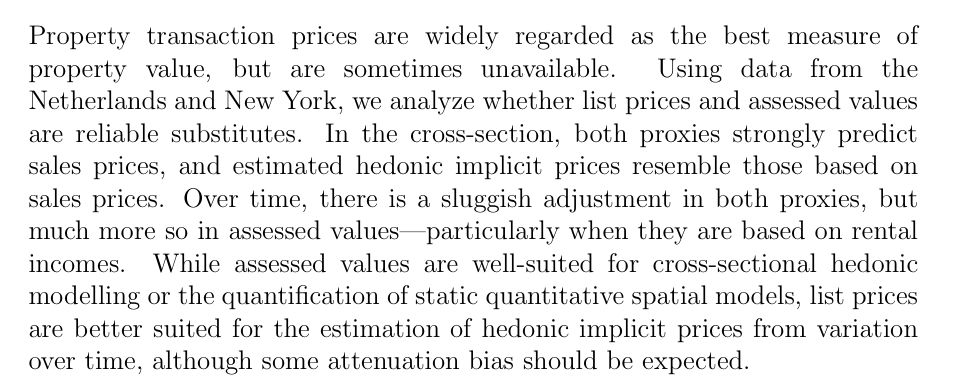
Ever wondered what housing value proxy for sales prices to use? Long story (in our @cesifo.org DP) short: Assessed values are good for quantification of QSMs. List prices better for hedonic valuation using panel identification. www.ifo.de/en/cesifo/pu... @hans-koster.bsky.social
👉 Our new paper uses daily mobility data to show that spatial isolation is much more common today among those living in advantaged neighborhoods than the converse.

👩🏻‍💻 Lots of massive data wrangling and careful assumptions about mobility data needed - but check it out here! doi.org/10.1177/0042...

Excited to share that the 1st paper of my dissertation has been published! In this study, we developed and applied the novel JTEV framework in Columbus, OH. Thankful to Jeffrey Bielicki, Jeffrey Jacquet and my PhD advisor @huyentkle.bsky.social

Link: authors.elsevier.com/c/1m7I87tZ6a...

New Nature Energy @nature.com study shows the UK can reach net zero faster, cheaper & with fewer risks by cutting energy demand.

ECI’s Prof Christian Brand @profchristianbrand.bsky.social led the transport analysis in this unique gov–research collaboration.

➡️: www.eci.ox.ac.uk/news/less-en...

I would add WebGL-based visualization libraries (e.g. #deckgl and #mapgl). They are not exactly super new but they're really centraly in how spatial data science has changed over the past 10-ish years.

ps. #GeoParquet, and #DuckDB + spatial ! would also be at the top of my list!
What are the most exciting trends you’re seeing in spatial data science lately?
Some of mine:

- New file formats (e.g. #GeoParquet)
- Geospatial DBs (e.g. #DuckDB + spatial)
- Global discrete grids

What would you add?

#Geospatial #GISchat #RSpatial #GeoPython
What are the most exciting trends you’re seeing in spatial data science lately?
Some of mine:

- New file formats (e.g. #GeoParquet)
- Geospatial DBs (e.g. #DuckDB + spatial)
- Global discrete grids

What would you add?

#Geospatial #GISchat #RSpatial #GeoPython