



Research on atmospheric aerosols w/satellites & models.
Sharing and commenting on papers and sat images of (my) interest
Documenting on #highlatitudedust & #volcanotracks events.
Atmos-ocean exchange processes, Atmos. polarization radiative transfer ..
more
Research on atmospheric aerosols w/satellites & models.
Sharing and commenting on papers and sat images of (my) interest
Documenting on #highlatitudedust & #volcanotracks events.
Atmos-ocean exchange processes, Atmos. polarization radiative transfer
Hello all, there are a lot of new people here so I thought of re-introducing myself. I am a Earth Observation (EO) aerosol scientist contracted to work for the only agency that has put people on the moon.
1/8
Below is an old self-introduction and description of what I have fun with (professionally speaking) .
The times are quite different than when I posted this, but well, we are still here, chugging along and hoping for the best.
Catch up on the latest updates, deadlines, and upcoming events.
mailchi.mp/xmu/solas-ne...
#Solas #newsletter

Reposted by Santiago Gassó

Catch up on the latest updates, deadlines, and upcoming events.
mailchi.mp/xmu/solas-ne...
#Solas #newsletter

Catchy title for a study on the simulation of non-spherical #aerosol optical properties . Published in an astronomy journal, but the technique is aplicable to atmospheric (ie. Earth) aerosols.
academic.oup.com/mnras/articl...

GESAMP report on #microplastics transport into the marine environment is available online.
library.wmo.int/records/item...
@solas-ipo.bsky.social @usocb.bsky.social @geotraces.bsky.social


The #dust we miss
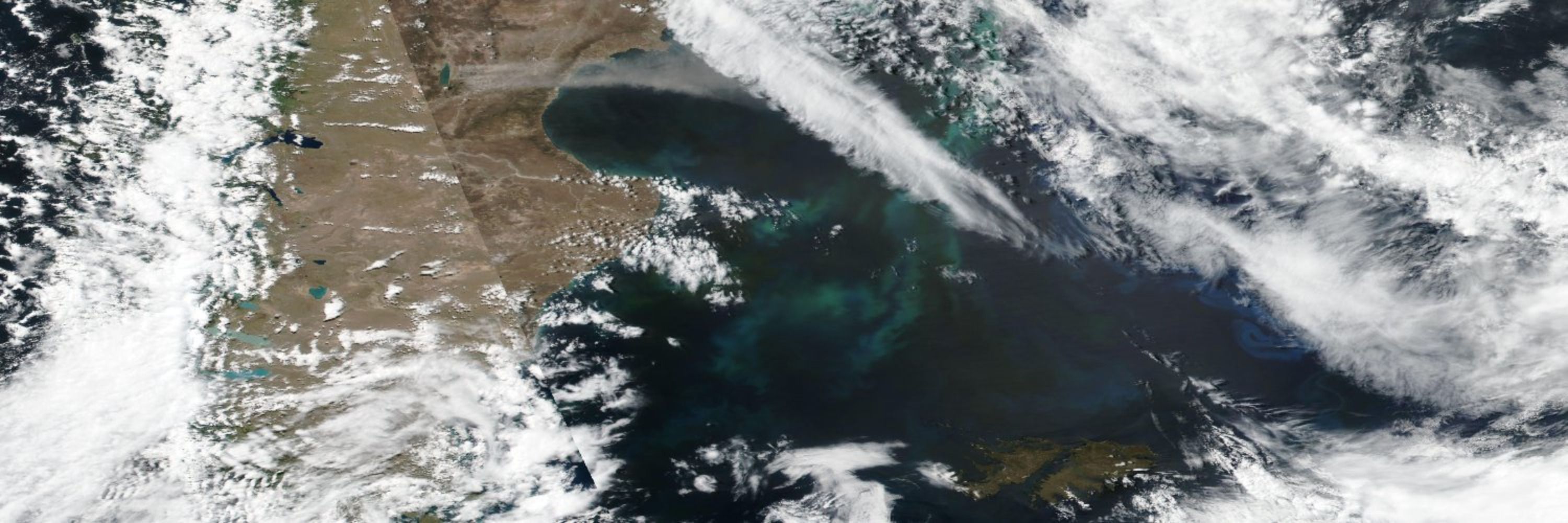
Late afternoon with an almost totally cloudy Patagonia yesterday.
But in between clouds, there was significant #highlatitudedust activity.
However, there are no sensors there, no satellite information (mostly cloudy) ,so we do not know how long or how much this event was.


Few hours later in the early morning GOES image, there is haze well into the sub-Antarctic waters. The MODIS-Terra overpass (1 hour later) detects the haze as aerosol in moderate quantities (for this region). Eventually it will deposit over the ocean and snow.


Few hours later in the early morning GOES image, there is haze well into the sub-Antarctic waters. The MODIS-Terra overpass (1 hour later) detects the haze as aerosol in moderate quantities (for this region). Eventually it will deposit over the ocean and snow.

#highlatitudedust activity yesterday in one of the southernmost dust source in the world, the mudflats at St. Sebastian bay in #TierradelFuego
Here the source is not visible but there was a clear extended dust cloud well into the #SouthernOcean
@solas-ipo.bsky.social
Precipitation is a key factor in glacier survival.
In a warmer world , there is more moisture in the air thus more precipitation in solid form in high latitudes . So, there can be scenarios where some glaciers can survive. Study
www.nature.com/articles/s41...

Glaciers are expected to melt within a generation .
www.nature.com/articles/s41...
One consequence not noted in this study is the increase in #dust blowouts to the glacier silt left after the melt. Versions of this is already happening as #highlatitudedust activity in #Iceland and #Alaska.
Reposted by Santiago Gassó


#highlatitudedust activity yesterday in the southern S. America. Dry lakes emit dust in concert, making an important contribution to the area given that it is so pristine that even small amounts make a different.
Strong winds bring dust even to Antarctica and well into the Southern Ocean.
Reposted by Santiago Gassó
Reposted by Santiago Gassó



Volcanic activity in Saunders and Zadovoski Is in the S. Atlantic.
This is minor activity & plumes do not have enough buoyancy to get through the cloud deck. The activity is only apparent in the change in reflective properties in clouds, only visible in the near-IR channels.
#volcanotrack
Reposted by Peter Jacobs

A study that looks into airborne sources of nutrients in an ocean bloom.
It finds that deposition occurred 1 month prior to the bloom. This fact is probably one of the reasons why finding causality deposition-bloom is so difficult to demonstrate.
agupubs.onlinelibrary.wiley.com/doi/full/10....
Reposted by Santiago Gassó

Image taken by Sentinel-2 on Jan. 26, 2026.


I wish I had read this a week ago....
Reposted by Santiago Gassó

Reposted by Santiago Gassó
Reposted by Santiago Gassó



Intense fires in Patagonia continued all day generating a lot #smoke, onshore winds prevent the eastward discharge and thus enabling smoke buildup over the mainland.