


Alison Feder
@alisonfeder.bsky.social
Rapid evolutionary dynamics in viruses, cancer and bacteria. Assistant professor at UW Genome Sciences and Freeman Hrabowski Scholar at HHMI. federlab.github.io
Pinned
Alison Feder
@alisonfeder.bsky.social
· Sep 10
The constant barrage of terrible news on bluesky has made me feel weird about promoting papers, but people in the lab have been doing so much amazing work over the past few months that I want to share a few brief teasers/links:
Are you coming for happy hour, @jrossibarra.bsky.social?


January 23, 2026 at 1:10 AM
Are you coming for happy hour, @jrossibarra.bsky.social?
Reposted by Alison Feder

Post-doc job alert! Please share with anyone who might be interested! @amersocvirology.bsky.social #virology #virosky #evolution

January 8, 2026 at 10:56 PM
Post-doc job alert! Please share with anyone who might be interested! @amersocvirology.bsky.social #virology #virosky #evolution
Reposted by Alison Feder
Excited that SpaceBar is now out in Nature Methods!🥳
We combined clone tracing with spatial transcriptomics to untangle what drives gene expression in tumors: a cell's identity or its neighborhood?
Most genes were driven by location, but some showed strong clonal patterns.
rdcu.be/eVhpc
We combined clone tracing with spatial transcriptomics to untangle what drives gene expression in tumors: a cell's identity or its neighborhood?
Most genes were driven by location, but some showed strong clonal patterns.
rdcu.be/eVhpc

SpaceBar enables single-cell-resolution clone tracing with imaging-based spatial transcriptomics
Nature Methods - SpaceBar is a cellular barcoding strategy for simultaneous analysis of cell clonal and spatial identities.
rdcu.be
December 18, 2025 at 7:55 PM
Excited that SpaceBar is now out in Nature Methods!🥳
We combined clone tracing with spatial transcriptomics to untangle what drives gene expression in tumors: a cell's identity or its neighborhood?
Most genes were driven by location, but some showed strong clonal patterns.
rdcu.be/eVhpc
We combined clone tracing with spatial transcriptomics to untangle what drives gene expression in tumors: a cell's identity or its neighborhood?
Most genes were driven by location, but some showed strong clonal patterns.
rdcu.be/eVhpc
Reposted by Alison Feder

If you are interested in this work and are looking for a postdoc position, please get in touch -- we are actively looking for someone to join our group at UCLA!
December 17, 2025 at 6:53 PM
If you are interested in this work and are looking for a postdoc position, please get in touch -- we are actively looking for someone to join our group at UCLA!
Reposted by Alison Feder
Grateful to share our paper on gene-specific selective sweeps in human gut microbiomes, now out in Nature! It has been a joy to work with @rwolff.bsky.social, whose insights and hard work made this possible.
www.nature.com/articles/s41...
www.nature.com/articles/s41...

Gene-specific selective sweeps are pervasive across human gut microbiomes - Nature
Development and application of the integrated linkage disequilibrium score (iLDS) reveals both selective pressures impacting the human gut microbiome and the mechanisms by which gut bacteria adapt to ...
www.nature.com
December 17, 2025 at 6:53 PM
Grateful to share our paper on gene-specific selective sweeps in human gut microbiomes, now out in Nature! It has been a joy to work with @rwolff.bsky.social, whose insights and hard work made this possible.
www.nature.com/articles/s41...
www.nature.com/articles/s41...
Reposted by Alison Feder
Very cool work.
Intracellular interactions shape antiviral resistance outcomes in poliovirus via eco-evolutionary feedback
www.nature.com/articles/s41...
Intracellular interactions shape antiviral resistance outcomes in poliovirus via eco-evolutionary feedback
www.nature.com/articles/s41...

Intracellular interactions shape antiviral resistance outcomes in poliovirus via eco-evolutionary feedback - Nature Ecology & Evolution
A model of intrahost poliovirus replication shows that, after several rounds of replication, pocapavir, a poliovirus capsid inhibitor, collapses viral density, preventing intracellular interactions th...
www.nature.com
December 10, 2025 at 9:55 PM
Very cool work.
Intracellular interactions shape antiviral resistance outcomes in poliovirus via eco-evolutionary feedback
www.nature.com/articles/s41...
Intracellular interactions shape antiviral resistance outcomes in poliovirus via eco-evolutionary feedback
www.nature.com/articles/s41...
Reposted by Alison Feder
Over the past 5+ years I've had the honor of working with @wsdewitt.github.io @victora.bsky.social and many others on a project to "replay" affinity maturation evolution from a fixed starting point.
matsen.group/general/2025...
matsen.group/general/2025...

Replaying evolution to learn about the fitness landscape of affinity maturation
A five year collaboration with the Victora lab is bearing fruit for evolutionary biology.
matsen.group
December 11, 2025 at 5:36 PM
Over the past 5+ years I've had the honor of working with @wsdewitt.github.io @victora.bsky.social and many others on a project to "replay" affinity maturation evolution from a fixed starting point.
matsen.group/general/2025...
matsen.group/general/2025...
So excited to share this work led by @alexrob.bsky.social with Ben Kerr!
We investigated a poliovirus capsid inhibitor that exploits a breakdown in the genotype-phenotype map to prevent drug resistance evolution. Or does it?
See Alex's thread, but a few extras:
#socialviruses #evosky #virosky 🧪
We investigated a poliovirus capsid inhibitor that exploits a breakdown in the genotype-phenotype map to prevent drug resistance evolution. Or does it?
See Alex's thread, but a few extras:
#socialviruses #evosky #virosky 🧪

My first lead author paper is out with Ben Kerr and @alisonfeder.bsky.social! We found that making an antiviral too strong can sometimes make resistance easier to evolve. This has implications for how we design drugs, choose doses, and think about viral evolution in the face of treatment. (1/n)

Intracellular interactions shape antiviral resistance outcomes in poliovirus via eco-evolutionary feedback - Nature Ecology & Evolution
A model of intrahost poliovirus replication shows that, after several rounds of replication, pocapavir, a poliovirus capsid inhibitor, collapses viral density, preventing intracellular interactions th...
www.nature.com
December 10, 2025 at 9:07 PM
So excited to share this work led by @alexrob.bsky.social with Ben Kerr!
We investigated a poliovirus capsid inhibitor that exploits a breakdown in the genotype-phenotype map to prevent drug resistance evolution. Or does it?
See Alex's thread, but a few extras:
#socialviruses #evosky #virosky 🧪
We investigated a poliovirus capsid inhibitor that exploits a breakdown in the genotype-phenotype map to prevent drug resistance evolution. Or does it?
See Alex's thread, but a few extras:
#socialviruses #evosky #virosky 🧪
Reposted by Alison Feder

It was great to write a brief commentary with @sociovirology.bsky.social on @nanamikubota.bsky.social and @vscooper.micropopbio.org's recent discovery of cheat-driven cycles in Pseudomonas (www.cell.com/current-biol... - amazing example of the tragedy of the commons!
🧪 #socialviruses #evosky
🧪 #socialviruses #evosky

Phage–bacteria dynamics: The tragedy of the commons at hyperspeed
A recent study found that apparently stable coexistence between a clinically important
pathogen, Pseudomonas aeruginosa, and its integrated prophages can break down, setting
off an evolutionary cycle ...
www.cell.com
December 4, 2025 at 8:56 PM
It was great to write a brief commentary with @sociovirology.bsky.social on @nanamikubota.bsky.social and @vscooper.micropopbio.org's recent discovery of cheat-driven cycles in Pseudomonas (www.cell.com/current-biol... - amazing example of the tragedy of the commons!
🧪 #socialviruses #evosky
🧪 #socialviruses #evosky
Reposted by Alison Feder
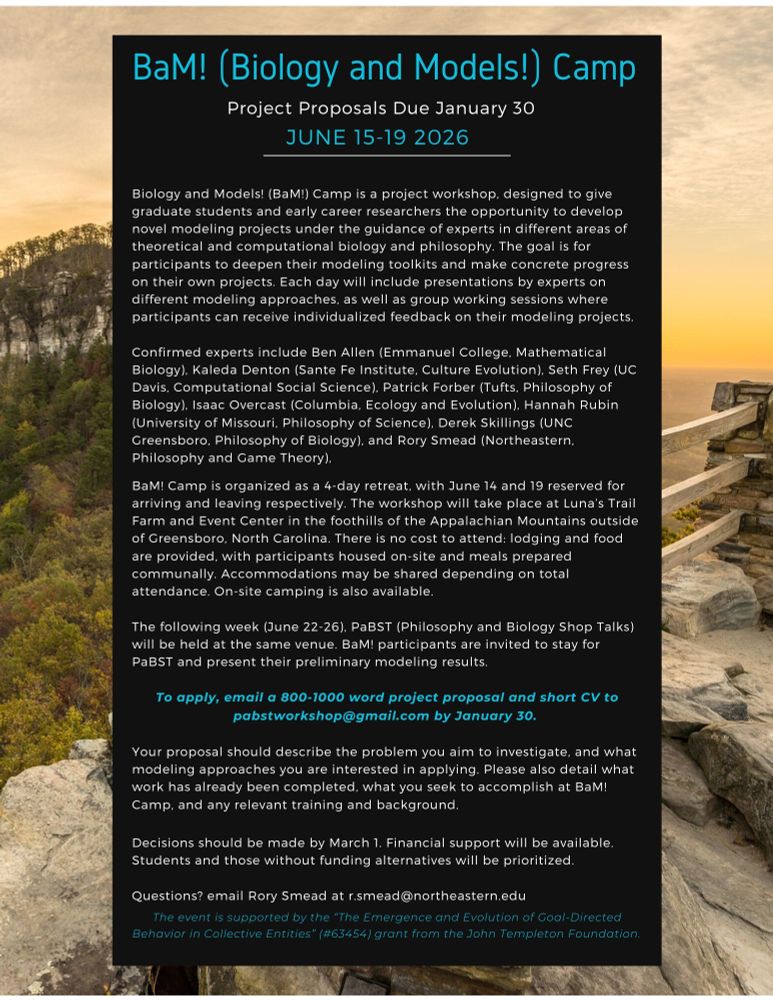
Hi everyone! I'm co-organizing this retreat/workshop June 15-19 for those looking to get started in mathematical/computational modeling of biological processes. Location is a beautiful farm in NC. Please share with students and others who want to build modeling skills. Interdisciplinarity welcome!
December 2, 2025 at 7:00 PM
Hi everyone! I'm co-organizing this retreat/workshop June 15-19 for those looking to get started in mathematical/computational modeling of biological processes. Location is a beautiful farm in NC. Please share with students and others who want to build modeling skills. Interdisciplinarity welcome!
Reposted by Alison Feder

The world is a few steps closer to a cure for #HIV, a hopeful sign illuminated by two studies published Monday featuring work from Fred Hutch's Lillian Cohn, Daniel Reeves and others. #WorldAIDSDay https://bit.ly/44JxZ6X

Path to HIV cure includes Seattle scientists
Two new studies provide insights into a possible cure for HIV, and feature the work of researchers from the UW and Fred Hutchinson Cancer Center.
bit.ly
December 1, 2025 at 11:34 PM
The world is a few steps closer to a cure for #HIV, a hopeful sign illuminated by two studies published Monday featuring work from Fred Hutch's Lillian Cohn, Daniel Reeves and others. #WorldAIDSDay https://bit.ly/44JxZ6X
Reposted by Alison Feder
We're excited to be recruiting an NIH funded postdoc to work in the Coop lab at UC Davis. We're specifically interested in candidates who are want to work at the intersection of human genetics, GWAS, and population genetics modeling. Please RT
October 15, 2025 at 3:53 PM
We're excited to be recruiting an NIH funded postdoc to work in the Coop lab at UC Davis. We're specifically interested in candidates who are want to work at the intersection of human genetics, GWAS, and population genetics modeling. Please RT
Reposted by Alison Feder
Happy to have started as an @hhmi.org Freeman Hrabowski Scholar! Incredibly grateful for this opportunity and am excited for some very cool new directions! We are *HIRING*, especially postdocs! Please reach out if you’re interested in uterine and pregnancy biology. Please repost!
October 9, 2025 at 7:42 PM
Happy to have started as an @hhmi.org Freeman Hrabowski Scholar! Incredibly grateful for this opportunity and am excited for some very cool new directions! We are *HIRING*, especially postdocs! Please reach out if you’re interested in uterine and pregnancy biology. Please repost!
The constant barrage of terrible news on bluesky has made me feel weird about promoting papers, but people in the lab have been doing so much amazing work over the past few months that I want to share a few brief teasers/links:
September 10, 2025 at 4:46 PM
The constant barrage of terrible news on bluesky has made me feel weird about promoting papers, but people in the lab have been doing so much amazing work over the past few months that I want to share a few brief teasers/links:
Reposted by Alison Feder

Studying cancer evolution needs multi-region or single cell seq for phylogenetics, right? Amazingly (I think!) we found single-sample bulk methylation suffices, via analysis of "fluctuating methylation". In @nature.com today led by brilliant @calumgabbutt.bsky.social www.nature.com/articles/s41...

Fluctuating DNA methylation tracks cancer evolution at clinical scale - Nature
Cancer evolutionary dynamics are quantitatively inferred using a method, EVOFLUx, applied to fluctuating DNA methylation.
www.nature.com
September 10, 2025 at 3:21 PM
Studying cancer evolution needs multi-region or single cell seq for phylogenetics, right? Amazingly (I think!) we found single-sample bulk methylation suffices, via analysis of "fluctuating methylation". In @nature.com today led by brilliant @calumgabbutt.bsky.social www.nature.com/articles/s41...
Reposted by Alison Feder

Applying to the NSF-GRFP (or another fellowship) on a tight deadline?
We built a 7-week guide + timeline to get you from draft to submission. It’s not too late — you’ve got this! ✨
🔗 cientificolatino.com/apply-in-7-weeks
#NSFGRFP #GradSchool #Fellowship
We built a 7-week guide + timeline to get you from draft to submission. It’s not too late — you’ve got this! ✨
🔗 cientificolatino.com/apply-in-7-weeks
#NSFGRFP #GradSchool #Fellowship

September 9, 2025 at 4:14 PM
Applying to the NSF-GRFP (or another fellowship) on a tight deadline?
We built a 7-week guide + timeline to get you from draft to submission. It’s not too late — you’ve got this! ✨
🔗 cientificolatino.com/apply-in-7-weeks
#NSFGRFP #GradSchool #Fellowship
We built a 7-week guide + timeline to get you from draft to submission. It’s not too late — you’ve got this! ✨
🔗 cientificolatino.com/apply-in-7-weeks
#NSFGRFP #GradSchool #Fellowship
Reposted by Alison Feder
In these dark times, it comes as a rare pleasure to highlight @natanaels.bsky.social & @marcdemanuel.bsky.social's work on germline and somatic mutations in humans. 1/n
www.biorxiv.org/cgi/content/...
www.biorxiv.org/cgi/content/...

Collateral mutagenesis funnels multiple sources of DNA damage into a ubiquitous mutational signature
Mutations reflect the net effects of myriad types of damage, replication errors, and repair mechanisms, and thus are expected to differ across cell types with distinct exposures to mutagens, division ...
www.biorxiv.org
September 2, 2025 at 11:44 AM
In these dark times, it comes as a rare pleasure to highlight @natanaels.bsky.social & @marcdemanuel.bsky.social's work on germline and somatic mutations in humans. 1/n
www.biorxiv.org/cgi/content/...
www.biorxiv.org/cgi/content/...
Reposted by Alison Feder

Help us give a warm welcome to Dr. Chadi Saad-Roy, who is joining UBC Mathematics this fall as an Assistant Professor, jointly appointed in the Department of Microbiology and Immunology (@ubcmicroimmuno.bsky.social).
Full details tinyurl.com/4zwdmr8b
Full details tinyurl.com/4zwdmr8b

August 29, 2025 at 8:12 PM
Help us give a warm welcome to Dr. Chadi Saad-Roy, who is joining UBC Mathematics this fall as an Assistant Professor, jointly appointed in the Department of Microbiology and Immunology (@ubcmicroimmuno.bsky.social).
Full details tinyurl.com/4zwdmr8b
Full details tinyurl.com/4zwdmr8b
Amazing new work and video from Pleuni!

August 30, 2025 at 3:48 PM
Amazing new work and video from Pleuni!

Reposted by Alison Feder
I'm excited to announce our new biorxiv preprint, wherein we investigate the evolution of the weirdest genetic locus I've ever seen! Behold the tgr genes of the social amoeba, which mediate self/non-self discrimination during facultative multicellularity 🐅 🧵 1/
www.biorxiv.org/content/10.1...
www.biorxiv.org/content/10.1...

Hypermutable hotspot enables the rapid evolution of self/non-self recognition genes in Dictyostelium
Cells require highly polymorphic receptors to perform accurate self/non-self recognition. In the amoeba Dicytostelium discoideum, polymorphic TgrB1 & TgrC1 proteins are used to bind sister cells and e...
www.biorxiv.org
August 5, 2025 at 12:56 AM
I'm excited to announce our new biorxiv preprint, wherein we investigate the evolution of the weirdest genetic locus I've ever seen! Behold the tgr genes of the social amoeba, which mediate self/non-self discrimination during facultative multicellularity 🐅 🧵 1/
www.biorxiv.org/content/10.1...
www.biorxiv.org/content/10.1...
Reposted by Alison Feder
The Mathieson Lab at the University of Pennsylvania is hiring a computational postdoc in machine learning and evolutionary biology. Apply with a CV and references: [email protected]. More info: https://saramathieson.github.io/lab #postdoc

We are a computational lab focusing on developing machine learning algorithms for biological data. Currently we are working on inference tasks related to natural selection and demographic inference, as well as generative models for genomic data from humans, mosquitos, and other species.
saramathieson.github.io
July 24, 2025 at 12:23 PM
The Mathieson Lab at the University of Pennsylvania is hiring a computational postdoc in machine learning and evolutionary biology. Apply with a CV and references: [email protected]. More info: https://saramathieson.github.io/lab #postdoc
Reposted by Alison Feder
I am seeking a postdoc for my group at UCLA. We work at the intersection of population genetics x microbiome (garud.eeb.ucla.edu). If interested, please message me!
Garud Lab
garud.eeb.ucla.edu
July 22, 2025 at 5:51 PM
I am seeking a postdoc for my group at UCLA. We work at the intersection of population genetics x microbiome (garud.eeb.ucla.edu). If interested, please message me!
Reposted by Alison Feder

The Xue lab at UC Irvine is looking for a staff scientist to support our work investigating how microbes interact and evolve in the gut microbiome! Open to a wide range of previous experience levels, see ad for more.
recruit.ap.uci.edu/JPF09601
recruit.ap.uci.edu/JPF09601
Junior, Assistant, or Associate Specialist – Xue Lab
University of California, Irvine is hiring. Apply now!
recruit.ap.uci.edu
July 17, 2025 at 8:32 PM
The Xue lab at UC Irvine is looking for a staff scientist to support our work investigating how microbes interact and evolve in the gut microbiome! Open to a wide range of previous experience levels, see ad for more.
recruit.ap.uci.edu/JPF09601
recruit.ap.uci.edu/JPF09601
Extensive parallelism at the level of font choice suggests avenir is adaptive at the microbial population biology GRC
July 9, 2025 at 4:28 PM
Extensive parallelism at the level of font choice suggests avenir is adaptive at the microbial population biology GRC