



Jeroen Smeets
@jbjsmeets.bsky.social
Scientist investigating how we use our senses to control our movements
Reposted by Jeroen Smeets

I think almost all scientific projects should be planned carefully. And I think an app can dramatically improve that. So I wrote an app for that (free for now, if you can fund this let me know). I tested it quite a bit (>8000 users in beta so far). try it: planyourscience.com

November 20, 2025 at 3:33 PM
I think almost all scientific projects should be planned carefully. And I think an app can dramatically improve that. So I wrote an app for that (free for now, if you can fund this let me know). I tested it quite a bit (>8000 users in beta so far). try it: planyourscience.com
Indeed, see also our older work: the effect of the Müller-Lyer illusion on pointing movements (vector coding, i.e., use of allocentric cues) depends on the real-time availability of information. doi.org/10.1007/s002...

Illusions as a tool to study the coding of pointing movements - Experimental Brain Research
Pictorial illusions bias our judgments about certain visual attributes. Such illusions are therefore only expected to influence a task if these attributes are used to perform the task. When pointing t...
doi.org
November 5, 2025 at 10:37 AM
Indeed, see also our older work: the effect of the Müller-Lyer illusion on pointing movements (vector coding, i.e., use of allocentric cues) depends on the real-time availability of information. doi.org/10.1007/s002...
Perception is thus inconsistent. It is not an optimal representation of the external world, but provides (possibly inconsistent) answers to equations: doi.org/10.3389/fnin...

Frontiers | The cost of aiming for the best answers: Inconsistent perception
The laws of physics and mathematics describe the world we live in as internally consistent. As these rules provide a very effective description, and our inte...
doi.org
November 2, 2025 at 6:28 AM
Perception is thus inconsistent. It is not an optimal representation of the external world, but provides (possibly inconsistent) answers to equations: doi.org/10.3389/fnin...
There are two reasons why I would predict "no" for real-time grasping. Grasping is not based on size, but on positions (see, for instance, doi.org/10.1007/s002...). Secondly, the illusion does not change the perceived size itself, but only the change thereof (perceived expansion).
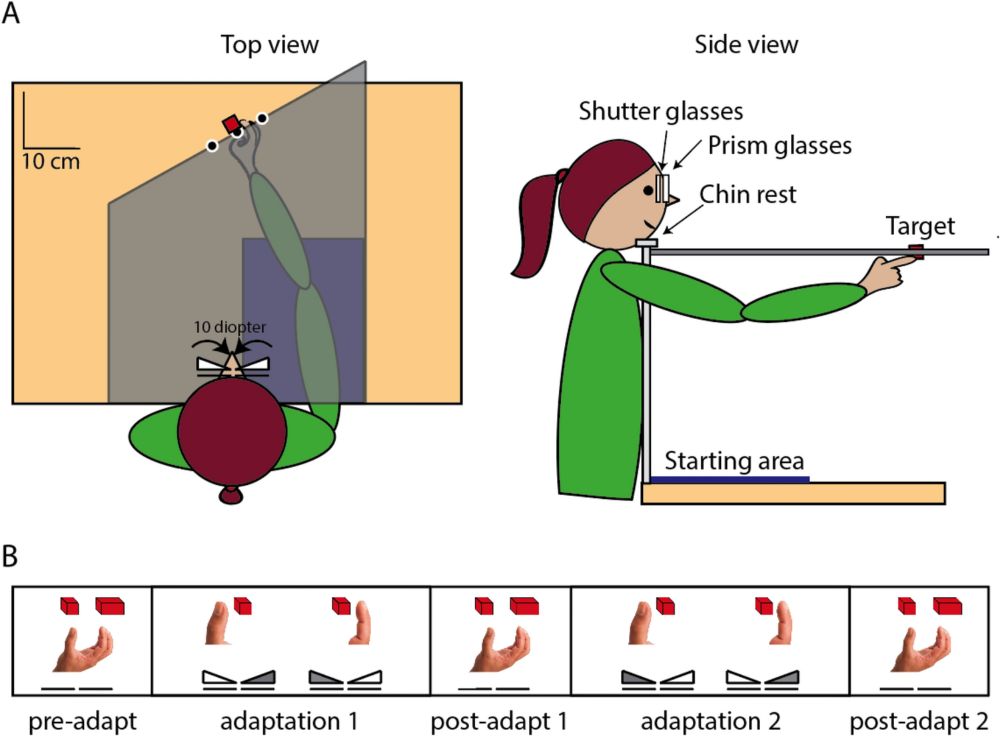
How prism adaptation reveals the distinct use of size and positions in grasping - Experimental Brain Research
The size of an object equals the distance between the positions of its opposite edges. However, human sensory processing for perceiving positions differs from that for perceiving size. Which of these ...
doi.org
November 2, 2025 at 6:28 AM
There are two reasons why I would predict "no" for real-time grasping. Grasping is not based on size, but on positions (see, for instance, doi.org/10.1007/s002...). Secondly, the illusion does not change the perceived size itself, but only the change thereof (perceived expansion).
A new, Short and Sweet open-access paper on how briefly hiding the hand impedes goal-directed arm movements. Briefly is really brief: we find a decrease in performance in goal-directed movements due to just a few ms without vision of the hand (target remains visible). doi.org/10.1177/0301...

October 27, 2025 at 10:49 AM
A new, Short and Sweet open-access paper on how briefly hiding the hand impedes goal-directed arm movements. Briefly is really brief: we find a decrease in performance in goal-directed movements due to just a few ms without vision of the hand (target remains visible). doi.org/10.1177/0301...
Reposted by Jeroen Smeets

Our next #SpeakerSpotlight for VR Summit 2025! ✨
Featuring:
Gavin Buckingham (Univ. of Exeter)
Jason Friedman (Tel Aviv Univ.)
Jeroen Smeets (VU Amsterdam)
📅 Summit Oct 20–21 • Rotunde Bochum
Register/submit: vrs.rub.de
#VRSummit #XR #VR #HCI #Neuroscience #VRresearch #VRcademicSky
Featuring:
Gavin Buckingham (Univ. of Exeter)
Jason Friedman (Tel Aviv Univ.)
Jeroen Smeets (VU Amsterdam)
📅 Summit Oct 20–21 • Rotunde Bochum
Register/submit: vrs.rub.de
#VRSummit #XR #VR #HCI #Neuroscience #VRresearch #VRcademicSky

September 8, 2025 at 11:41 AM
Our next #SpeakerSpotlight for VR Summit 2025! ✨
Featuring:
Gavin Buckingham (Univ. of Exeter)
Jason Friedman (Tel Aviv Univ.)
Jeroen Smeets (VU Amsterdam)
📅 Summit Oct 20–21 • Rotunde Bochum
Register/submit: vrs.rub.de
#VRSummit #XR #VR #HCI #Neuroscience #VRresearch #VRcademicSky
Featuring:
Gavin Buckingham (Univ. of Exeter)
Jason Friedman (Tel Aviv Univ.)
Jeroen Smeets (VU Amsterdam)
📅 Summit Oct 20–21 • Rotunde Bochum
Register/submit: vrs.rub.de
#VRSummit #XR #VR #HCI #Neuroscience #VRresearch #VRcademicSky
Following a discussion with Mindy Levin about the limitations of using VR in motor control and rehabilitation, I joined her in writing this review.

New from #McGillSPOT Levin "Unlocking the potential of virtual reality for post-stroke sensorimotor rehabilitation - are we any closer?" www.tandfonline.com/doi/full/10....

Unlocking the potential of virtual reality for post-stroke sensorimotor rehabilitation - are we any closer?
Published in Expert Review of Neurotherapeutics (Vol. 25, No. 6, 2025)
www.tandfonline.com
July 9, 2025 at 1:05 PM
Following a discussion with Mindy Levin about the limitations of using VR in motor control and rehabilitation, I joined her in writing this review.
Reposted by Jeroen Smeets

OK so totally crazy thought but hear me out how about we stop paying so much money to Elsevier and Wiley and Springer and other publishers and like use that money to finance universities so we don't shut down programs in the Netherlands right now ..
April 23, 2025 at 12:19 PM
OK so totally crazy thought but hear me out how about we stop paying so much money to Elsevier and Wiley and Springer and other publishers and like use that money to finance universities so we don't shut down programs in the Netherlands right now ..
For those who can understand some Dutch: an interview on Dutch National radio about broken escalators, the size-weight illusion, and motion sickness: www.nporadio1.nl/nieuws/binne...

Waarom gaat over een stilstaande roltrap lopen zo moeizaam?
Je hebt het vast weleens gevoeld: het vreemde en bijna onhandige gevoel wanneer je een stilstaande roltrap oploopt. Waarom is dat eigenlijk zo ongemakkelijk, terwijl het in principe gewoon een trap is...
www.nporadio1.nl
April 22, 2025 at 2:11 PM
For those who can understand some Dutch: an interview on Dutch National radio about broken escalators, the size-weight illusion, and motion sickness: www.nporadio1.nl/nieuws/binne...
When trying to learn from reward, you explore after non-rewarded trials. One generally assumes that this exploration is random. In our new paper, in contrast, we find that participants repeat changes in the same direction more than random exploration predicts. doi.org/10.1007/s002...

The sign of exploration during reward-based motor learning is not independent from trial to trial - Experimental Brain Research
Humans can learn various motor tasks based on binary reward feedback on whether a movement attempt was successful or not. Such ‘reward-based motor learning’ relies on exploiting successful motor comma...
doi.org
April 16, 2025 at 5:51 AM
When trying to learn from reward, you explore after non-rewarded trials. One generally assumes that this exploration is random. In our new paper, in contrast, we find that participants repeat changes in the same direction more than random exploration predicts. doi.org/10.1007/s002...
Terecht trots: het ziet er zeer veelbelovend uit! Jammer dat we tot na de zomer moeten wachten...
March 20, 2025 at 1:33 PM
Terecht trots: het ziet er zeer veelbelovend uit! Jammer dat we tot na de zomer moeten wachten...
The simulated distribution of measured saccades (black) consists of 60% saccades to the target (green), 20% to the distractor (red), and 20% to the global average (blue). The red and green curves have a 7° standard deviation; for the blue curve it is 20% of the target-detractor distance.

March 18, 2025 at 6:21 PM
The simulated distribution of measured saccades (black) consists of 60% saccades to the target (green), 20% to the distractor (red), and 20% to the global average (blue). The red and green curves have a 7° standard deviation; for the blue curve it is 20% of the target-detractor distance.
Vision Research hides this letter behind a paywall, use authors.elsevier.com/a/1knWV9jMUG... for free access until May 07, 2025, or send me a note.
authors.elsevier.com
March 18, 2025 at 6:13 PM
Vision Research hides this letter behind a paywall, use authors.elsevier.com/a/1knWV9jMUG... for free access until May 07, 2025, or send me a note.
In a recent paper, it was argued that the tendency to direct saccades between target and distractor depends on their distance. In a letter to the editor, we argue that their data can be easily explained by assuming that 20% of the saccades is directed at that global location.
doi.org/10.1016/j.vi...
doi.org/10.1016/j.vi...
Redirecting
doi.org
March 18, 2025 at 6:12 PM
In a recent paper, it was argued that the tendency to direct saccades between target and distractor depends on their distance. In a letter to the editor, we argue that their data can be easily explained by assuming that 20% of the saccades is directed at that global location.
doi.org/10.1016/j.vi...
doi.org/10.1016/j.vi...
Reposted by Jeroen Smeets

The dynamic version is even more disturbing...
March 12, 2025 at 2:29 PM
The dynamic version is even more disturbing...
Reposted by Jeroen Smeets

@yfvisser.bsky.social Visser promoveerde vorige maand op haar onderzoek naar communicatie tussen brein en spieren onder stress. Vandaag ook in @nrc.nl:
www.nrc.nl/nieuws/2025/...
www.nrc.nl/nieuws/2025/...

Je spieren zijn meestal nét wat meer voorbereid op de ene actie dan op de andere
Durf te vragen: Neurowetenschapper Yvonne Visser wil snappen hoe het gezonde brein werkt en hoe we besluiten nemen. „Daar staan we nooit bij stil maar dat is eigenlijk heel bijzonder.”
www.nrc.nl
February 6, 2025 at 12:22 PM
@yfvisser.bsky.social Visser promoveerde vorige maand op haar onderzoek naar communicatie tussen brein en spieren onder stress. Vandaag ook in @nrc.nl:
www.nrc.nl/nieuws/2025/...
www.nrc.nl/nieuws/2025/...
In this new paper by Eleonora Assarioti, we found that in perceptual discrimination tasks, participants tend to choose the option with the lowest explicit motor costs. This challenges the view that the motor system merely executes decisions. dx.doi.org/10.1111/ejn....

Reaching Distance Influences Perceptual Decisions
Participants performed two perceptual discrimination tasks in which we manipulated the motor costs of the two response options by varying the distance to the response buttons. We found a bias towards...
dx.doi.org
February 3, 2025 at 4:24 PM
In this new paper by Eleonora Assarioti, we found that in perceptual discrimination tasks, participants tend to choose the option with the lowest explicit motor costs. This challenges the view that the motor system merely executes decisions. dx.doi.org/10.1111/ejn....
@ns-online.bsky.social: waarom adviseren jullie de reizigers van Groningen naar Hilversum (en Utrecht om in Amersfoort over te stappen met een kwartier wachten, terwijl de ic dit weekend gewoon rechtstreeks door rijdt naar Hilversum? @rover-online.bsky.social
November 30, 2024 at 3:27 PM
@ns-online.bsky.social: waarom adviseren jullie de reizigers van Groningen naar Hilversum (en Utrecht om in Amersfoort over te stappen met een kwartier wachten, terwijl de ic dit weekend gewoon rechtstreeks door rijdt naar Hilversum? @rover-online.bsky.social
This finding of Fuchs & Heed aligns very well with our view that perception is not about creating a consistent internal representation of the outside world, but about answering specific questions about the outside world. doi.org/10.3389/fnin...
Frontiers | The cost of aiming for the best answers: Inconsistent perception
The laws of physics and mathematics describe the world we live in as internally consistent. As these rules provide a very effective description, and our inte...
doi.org
November 21, 2024 at 10:54 AM
This finding of Fuchs & Heed aligns very well with our view that perception is not about creating a consistent internal representation of the outside world, but about answering specific questions about the outside world. doi.org/10.3389/fnin...
Many authors and textbooks assume that sensory recalibration involves adjusting some consistent internal representation, map, or body schema. In an elegant study, Fuchs & Heed provide new evidence that this is not the case: tactile recalibration is task-specific. doi.org/10.1111/ejn....

Rescaling perceptual hand maps by visual‐tactile recalibration
After concurrent visual and tactile stimuli have been presented repeatedly with a spatial offset, unisensory tactile stimuli, too, are perceived with a spatial bias towards the previously presented v...
doi.org
November 21, 2024 at 10:54 AM
Many authors and textbooks assume that sensory recalibration involves adjusting some consistent internal representation, map, or body schema. In an elegant study, Fuchs & Heed provide new evidence that this is not the case: tactile recalibration is task-specific. doi.org/10.1111/ejn....
In the same paper, I also show that if one applies the most popular method to the average age of a youth soccer team, we get a result (red) that differs from the actual mean (blue):

November 18, 2024 at 1:01 PM
In the same paper, I also show that if one applies the most popular method to the average age of a youth soccer team, we get a result (red) that differs from the actual mean (blue):
When I was on Twitter, I asked how scientists determine the age of their human participants. As about two-thirds of the respondents (and 2/3 of authors) ask for rounded-down age, the average ages reported in the literature may be biased by half a year. Open access at doi.org/10.1016/j.ac...

November 18, 2024 at 12:59 PM
When I was on Twitter, I asked how scientists determine the age of their human participants. As about two-thirds of the respondents (and 2/3 of authors) ask for rounded-down age, the average ages reported in the literature may be biased by half a year. Open access at doi.org/10.1016/j.ac...
Have a look at the backside. SFN lets you choose…
November 12, 2024 at 5:15 AM
Have a look at the backside. SFN lets you choose…
Reposted by Jeroen Smeets

Dear all, I am looking for a postdoc for an ERC-funded project on meditation and the predictive brain in my lab. More details can be found here: heleenslagter.com/positions Feel free to reach out with any questions! Please help spread the word!
Positions
heleenslagter.com
September 21, 2024 at 3:10 PM
Dear all, I am looking for a postdoc for an ERC-funded project on meditation and the predictive brain in my lab. More details can be found here: heleenslagter.com/positions Feel free to reach out with any questions! Please help spread the word!
Scientists have a peculiar way to report the average age of their human participants. They suggest they know this average with a few days precision, but introduce a half year bias. Read about it in my short paper doi.org/10.1016/j.ac...
Redirecting
doi.org
August 10, 2024 at 5:53 AM
Scientists have a peculiar way to report the average age of their human participants. They suggest they know this average with a few days precision, but introduce a half year bias. Read about it in my short paper doi.org/10.1016/j.ac...