



S. Lorena Ament
@loreament.bsky.social
Evolutionary biologist interested in genomics, speciation, reproductive strategies, fungi, and biodiversity. And cats! She/her
Pinned

Reconstructing NOD-like receptor alleles with high internal conservation in Podospora anserina using long-read sequencing
NOD-like receptors (NLRs) are intracellular immune receptors that detect pathogen-associated cues and trigger defence mechanisms, including regulated cell death. In filamentous fungi, some NLRs mediat...
www.microbiologyresearch.org
Happy to see this out! "Reconstructing NOD-like receptor alleles with high internal conservation in #Podospora anserina using long-read sequencing", now in @microbiologysociety.org! 🧬
Keep reading for a simple explanation 🧵 1/n
#Fungi #Allorecognition
www.microbiologyresearch.org/content/jour...
Keep reading for a simple explanation 🧵 1/n
#Fungi #Allorecognition
www.microbiologyresearch.org/content/jour...
I submitted this ms to a journal about a 1.5 months ago, and the status remains "Awaiting Referee Assignment". The editor says they are struggling to find a second reviewer... Are these waiting times normal? Should I offer a fresh list of potential reviewers or is that inappropriate? 💔 #postdoclife

NOD-like receptor genes evolve under diversity-enhancing mechanisms in a fungal species complex https://www.biorxiv.org/content/10.1101/2025.09.29.679196v1
December 12, 2025 at 9:10 AM
I submitted this ms to a journal about a 1.5 months ago, and the status remains "Awaiting Referee Assignment". The editor says they are struggling to find a second reviewer... Are these waiting times normal? Should I offer a fresh list of potential reviewers or is that inappropriate? 💔 #postdoclife
Reposted by S. Lorena Ament

Are you excited about pangenomics? If so, join us in Edinburgh on 8-9th June to discuss the latest methods & insights from using these approaches across biodiversity! More details here:
royalsociety.org/science-even...
Organised together with @henrylnorth.bsky.social & @joanameier.bsky.social!
royalsociety.org/science-even...
Organised together with @henrylnorth.bsky.social & @joanameier.bsky.social!

Pangenomics transforms evolutionary biology | Royal Society
This Theo Murphy meeting organised by Dr Joana Meier, Dr Henry North and Dr Charlotte Wright, will showcase cutting-edge pangenome tools, applied uses of pangenomes which are transforming health and a...
royalsociety.org
December 10, 2025 at 9:15 PM
Are you excited about pangenomics? If so, join us in Edinburgh on 8-9th June to discuss the latest methods & insights from using these approaches across biodiversity! More details here:
royalsociety.org/science-even...
Organised together with @henrylnorth.bsky.social & @joanameier.bsky.social!
royalsociety.org/science-even...
Organised together with @henrylnorth.bsky.social & @joanameier.bsky.social!
Would you say that Neurospora crassa is declining as a model organism for fungal biology?
💛 No way, that orange fun-guy is alive and well!
🔴 Yeah, not so many people work with it nowadays ...
🔵 Neuro-who?
📅 Ends: December 31, 2025, 10:03 PM UTC
📊 Show results
💛 No way, that orange fun-guy is alive and well!
🔴 Yeah, not so many people work with it nowadays ...
🔵 Neuro-who?
📅 Ends: December 31, 2025, 10:03 PM UTC
📊 Show results
December 10, 2025 at 9:06 PM
Would you say that Neurospora crassa is declining as a model organism for fungal biology?
💛 No way, that orange fun-guy is alive and well!
🔴 Yeah, not so many people work with it nowadays ...
🔵 Neuro-who?
📅 Ends: December 31, 2025, 10:03 PM UTC
📊 Show results
💛 No way, that orange fun-guy is alive and well!
🔴 Yeah, not so many people work with it nowadays ...
🔵 Neuro-who?
📅 Ends: December 31, 2025, 10:03 PM UTC
📊 Show results
Reposted by S. Lorena Ament

Whoop! New preprint has dropped - led by the amazing @trevormugoya.bsky.social. We developed a SV-calling and benchmarking platform called SaVor and test it on 1,165 Arabidopsis thaliana short read whole genomes. Do check out the paper, and try SaVor on your own data: github.com/ChabbyTMD/Sa...
December 1, 2025 at 8:53 PM
Whoop! New preprint has dropped - led by the amazing @trevormugoya.bsky.social. We developed a SV-calling and benchmarking platform called SaVor and test it on 1,165 Arabidopsis thaliana short read whole genomes. Do check out the paper, and try SaVor on your own data: github.com/ChabbyTMD/Sa...
Reposted by S. Lorena Ament

A recent shift in centromere size and DNA content in Podospora pseudocomata co-occurs with the loss of a fungal genome defense system https://www.biorxiv.org/content/10.64898/2025.12.02.690432v1
December 3, 2025 at 2:31 AM
A recent shift in centromere size and DNA content in Podospora pseudocomata co-occurs with the loss of a fungal genome defense system https://www.biorxiv.org/content/10.64898/2025.12.02.690432v1
Reposted by S. Lorena Ament

Our paper on Zymoseptoria tritici 3D genome organization is officially out! @iglavincheska.bsky.social
link.springer.com/article/10.1...
link.springer.com/article/10.1...

Three-dimensional genome architecture connects chromatin structure and function in a major wheat pathogen - BMC Biology
Background Genome spatial organization plays a fundamental role in biological function across all domains of life. While the principles of nuclear architecture have been well-characterized in animals ...
link.springer.com
November 28, 2025 at 12:43 PM
Our paper on Zymoseptoria tritici 3D genome organization is officially out! @iglavincheska.bsky.social
link.springer.com/article/10.1...
link.springer.com/article/10.1...
Reposted by S. Lorena Ament

What if we could autocomplete DNA based on function?
Today in @Nature, we share semantic design—a strategy for function-guided design with genomic language models that leverages genomic context to create de novo genes and systems with desired functions. 🧵
www.nature.com/articles/s41...
Today in @Nature, we share semantic design—a strategy for function-guided design with genomic language models that leverages genomic context to create de novo genes and systems with desired functions. 🧵
www.nature.com/articles/s41...
November 19, 2025 at 4:31 PM
What if we could autocomplete DNA based on function?
Today in @Nature, we share semantic design—a strategy for function-guided design with genomic language models that leverages genomic context to create de novo genes and systems with desired functions. 🧵
www.nature.com/articles/s41...
Today in @Nature, we share semantic design—a strategy for function-guided design with genomic language models that leverages genomic context to create de novo genes and systems with desired functions. 🧵
www.nature.com/articles/s41...
"When the female bugs lay their eggs, they rub the cultivated hyphae across the egg mass. The hyphae grow to envelope the eggs and physically exclude attentive parasitoid wasps until the bugs hatch."
#fungi #symbiosis
#fungi #symbiosis
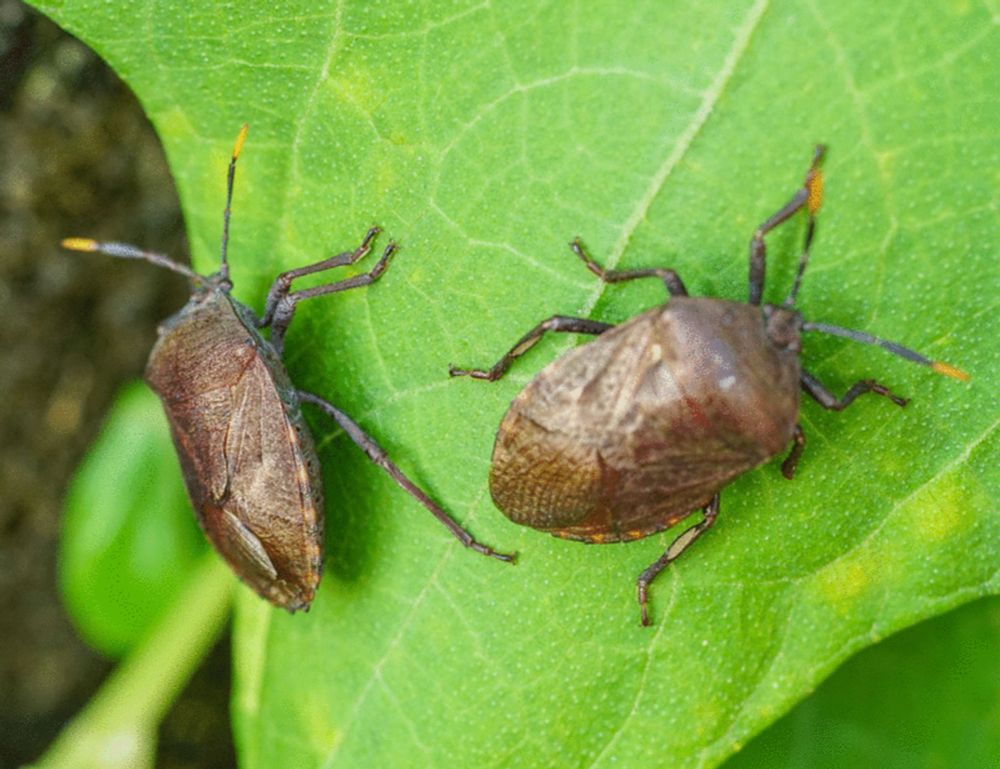
Defensive fungal symbiosis on insect hindlegs
Dinidorid stinkbugs were reported to possess a conspicuous tympanal organ on female hindlegs. In this study, we show that this organ is specialized to retain microbial symbionts rather than to perceiv...
www.science.org
November 10, 2025 at 10:05 PM
"When the female bugs lay their eggs, they rub the cultivated hyphae across the egg mass. The hyphae grow to envelope the eggs and physically exclude attentive parasitoid wasps until the bugs hatch."
#fungi #symbiosis
#fungi #symbiosis
Wow O_o

Wound healing is a hallmark feature of all life, including single cells. In a new preprint, Ambika Nadkarni @biochembika.bsky.social investigates a new dimension in cellular wound healing: how cells recover AFTER the wound has been closed
www.biorxiv.org/content/10.1...
www.biorxiv.org/content/10.1...

November 10, 2025 at 9:58 PM
Wow O_o
Reposted by S. Lorena Ament

Do you teach #rstats? Do your students complain about how lame and old-fashioned dplyr is? Don't worry: I have the solution for you: github.com/hadley/genzp....
genzplyr is dplyr, but bussin fr fr no cap.
genzplyr is dplyr, but bussin fr fr no cap.

GitHub - hadley/genzplyr: dplyr but make it bussin fr fr no cap
dplyr but make it bussin fr fr no cap. Contribute to hadley/genzplyr development by creating an account on GitHub.
github.com
November 6, 2025 at 11:25 PM
Do you teach #rstats? Do your students complain about how lame and old-fashioned dplyr is? Don't worry: I have the solution for you: github.com/hadley/genzp....
genzplyr is dplyr, but bussin fr fr no cap.
genzplyr is dplyr, but bussin fr fr no cap.
Our paper was included in the Collection "Microbial Genomics of Eukaryotes" from the @microbiologysociety.org 🧬 😁
#genomics #longreadsequencing
www.microbiologyresearch.org/content/micr...
#genomics #longreadsequencing
www.microbiologyresearch.org/content/micr...
October 24, 2025 at 6:55 PM
Our paper was included in the Collection "Microbial Genomics of Eukaryotes" from the @microbiologysociety.org 🧬 😁
#genomics #longreadsequencing
www.microbiologyresearch.org/content/micr...
#genomics #longreadsequencing
www.microbiologyresearch.org/content/micr...
O.o
"From genotype to phenotype with 1,086 near telomere-to-telomere yeast genomes" | Nature share.google/IAaPSj5t9OvQ...
#pangenome #fungi #yeast
"From genotype to phenotype with 1,086 near telomere-to-telomere yeast genomes" | Nature share.google/IAaPSj5t9OvQ...
#pangenome #fungi #yeast

From genotype to phenotype with 1,086 near telomere-to-telomere yeast genomes - Nature
A newly compiled atlas of species-wide structural variants and gene-based and graph pangenomes derived from highly complete assemblies of genomes from 1,086 natural isolates enable integrative genome-...
share.google
October 16, 2025 at 9:24 PM
O.o
"From genotype to phenotype with 1,086 near telomere-to-telomere yeast genomes" | Nature share.google/IAaPSj5t9OvQ...
#pangenome #fungi #yeast
"From genotype to phenotype with 1,086 near telomere-to-telomere yeast genomes" | Nature share.google/IAaPSj5t9OvQ...
#pangenome #fungi #yeast


Wooo!
NOD-like receptor genes evolve under diversity-enhancing mechanisms in a fungal species complex https://www.biorxiv.org/content/10.1101/2025.09.29.679196v1
October 1, 2025 at 5:47 AM
Wooo!
Reposted by S. Lorena Ament

How do species diverge? Could the relative immobility of plants increase their likelihood of speciating in the same place?🧵

September 22, 2025 at 2:11 PM
How do species diverge? Could the relative immobility of plants increase their likelihood of speciating in the same place?🧵
Reposted by S. Lorena Ament

Hybridization and introgression are major evolutionary processes. Since the 1940s, the prevailing view has been that they shape plants far more than animals. In our new study (www.science.org/doi/10.1126/...
), we find the opposite: animals exchange genes more, and for longer, than plants
), we find the opposite: animals exchange genes more, and for longer, than plants

September 12, 2025 at 7:55 AM
Hybridization and introgression are major evolutionary processes. Since the 1940s, the prevailing view has been that they shape plants far more than animals. In our new study (www.science.org/doi/10.1126/...
), we find the opposite: animals exchange genes more, and for longer, than plants
), we find the opposite: animals exchange genes more, and for longer, than plants
"Rapid establishment of species barriers in plants compared with that in animals" by Monnet et al
#Speciation
www.science.org/doi/10.1126/...
#Speciation
www.science.org/doi/10.1126/...

Rapid establishment of species barriers in plants compared with that in animals
Speciation, the process by which new reproductively isolated species emerge from ancestral populations, results from the gradual accumulation of barriers to gene flow within genomes. To date, the noti...
www.science.org
September 12, 2025 at 7:34 AM
"Rapid establishment of species barriers in plants compared with that in animals" by Monnet et al
#Speciation
www.science.org/doi/10.1126/...
#Speciation
www.science.org/doi/10.1126/...
mRNA A-to-I editing in vegetative cells of Fusarium
#fungionsky #fungi #epigenetics
link.springer.com/article/10.1...
#fungionsky #fungi #epigenetics
link.springer.com/article/10.1...

Hyphal editing of the conserved premature stop codon in CHE1 is stimulated by oxidative stress in Fusarium graminearum - Stress Biology
Although genome-wide A-to-I editing mediated by adenosine-deaminase-acting-on-tRNA (ADAT) occurs during sexual reproduction in the presence of stage-specific cofactors, RNA editing is not known to occ...
link.springer.com
September 6, 2025 at 12:04 PM
mRNA A-to-I editing in vegetative cells of Fusarium
#fungionsky #fungi #epigenetics
link.springer.com/article/10.1...
#fungionsky #fungi #epigenetics
link.springer.com/article/10.1...
I think their point is “they occur more in the populations where they are adaptive”, which makes me uncomfortable haha. Having said, I haven’t read the paper carefully and I didn’t understand their method on a quick scan.
September 6, 2025 at 11:24 AM
I think their point is “they occur more in the populations where they are adaptive”, which makes me uncomfortable haha. Having said, I haven’t read the paper carefully and I didn’t understand their method on a quick scan.

Reposted by S. Lorena Ament

What causes viral transmission bottlenecks? This study uses barcoded virions to show that in the case of #influenza A #virus, early within-host replication dynamics (rather than a reduced inoculum population) drive loss of diversity during transmission @plosbiology.org 🧪 plos.io/4ngicDK

September 3, 2025 at 7:52 AM
What causes viral transmission bottlenecks? This study uses barcoded virions to show that in the case of #influenza A #virus, early within-host replication dynamics (rather than a reduced inoculum population) drive loss of diversity during transmission @plosbiology.org 🧪 plos.io/4ngicDK
Reposted by S. Lorena Ament

🌎👩🔬 For 15+ years biology has accumulated petabytes (million gigabytes) of🧬DNA sequencing data🧬 from the far reaches of our planet.🦠🍄🌵
Logan now democratizes efficient access to the world’s most comprehensive genetics dataset. Free and open.
doi.org/10.1101/2024...
Logan now democratizes efficient access to the world’s most comprehensive genetics dataset. Free and open.
doi.org/10.1101/2024...

September 3, 2025 at 8:39 AM
🌎👩🔬 For 15+ years biology has accumulated petabytes (million gigabytes) of🧬DNA sequencing data🧬 from the far reaches of our planet.🦠🍄🌵
Logan now democratizes efficient access to the world’s most comprehensive genetics dataset. Free and open.
doi.org/10.1101/2024...
Logan now democratizes efficient access to the world’s most comprehensive genetics dataset. Free and open.
doi.org/10.1101/2024...
Reposted by S. Lorena Ament
Check out our new paper on adopting a trait-based framework for protist diversity! We make the case for a unified protist trait database, how to build it, and how it could transform research on protist ecology and evolution.
#protistsonsky
#protistsonsky

Hello there 🦋
Happy to share our piece "Towards a trait-based framework for protist ecology and evolution" in @cp-trendsmicrobiol.bsky.social
Let's build a unified trait 📏 database to unlock transformative insights into protist 🔬 ecology 🌍 and evolution ⏳
▶️ doi.org/10.1016/j.ti...
#protistsonsky
Happy to share our piece "Towards a trait-based framework for protist ecology and evolution" in @cp-trendsmicrobiol.bsky.social
Let's build a unified trait 📏 database to unlock transformative insights into protist 🔬 ecology 🌍 and evolution ⏳
▶️ doi.org/10.1016/j.ti...
#protistsonsky

September 3, 2025 at 8:47 AM
Check out our new paper on adopting a trait-based framework for protist diversity! We make the case for a unified protist trait database, how to build it, and how it could transform research on protist ecology and evolution.
#protistsonsky
#protistsonsky
Sclerotina and its weird-ass arrangement of different chromosomes in two separate nuclei still follow normal meiosis, it turns out.
#fungi #meiosis
www.nature.com/articles/s41...
#fungi #meiosis
www.nature.com/articles/s41...

Normal meiosis in the fungus Sclerotinia sclerotiorum despite the irregular distribution of haploid chromosomes between two nuclei - Nature Communications
The fungus Sclerotinia sclerotiorum distributes its 16 chromosomes irregularly between two nuclei within single ascospore cells. Here, the authors show that chromosomal segregation and genetic recombi...
www.nature.com
August 27, 2025 at 4:46 PM
Sclerotina and its weird-ass arrangement of different chromosomes in two separate nuclei still follow normal meiosis, it turns out.
#fungi #meiosis
www.nature.com/articles/s41...
#fungi #meiosis
www.nature.com/articles/s41...
Reposted by S. Lorena Ament

I'm super bummed to be missing #ESEB2025 @eseb2025.bsky.social due to a cancelled flight! Here's a quick overview of my talk "Gene- and genome-focused perspectives on microbial pangenomes" slated to be part of The Evolution of Microbial Pangenomes -- which I recommend you attend tomorrow (Fri) !
1/n
1/n
August 21, 2025 at 4:57 PM
I'm super bummed to be missing #ESEB2025 @eseb2025.bsky.social due to a cancelled flight! Here's a quick overview of my talk "Gene- and genome-focused perspectives on microbial pangenomes" slated to be part of The Evolution of Microbial Pangenomes -- which I recommend you attend tomorrow (Fri) !
1/n
1/n