




Matt Grossmann
@mattgrossmann.bsky.social
Michigan State political scientist & IPPSR Director; Hooked bookstore/cafe Co-owner; Science of Politics Podcast; New book: Polarized by Degrees
Political science
59%
Business
20%
edworkingpapers.com
Transferring to a better college does not necessarily work out better for the students:
edworkingpapers.com/sites/defaul...
edworkingpapers.com/sites/defaul...

Are the Politically Active Better Represented? - Political Behavior
Political participation is considered an important path for people to influence politics. However, whether those who participate actually see more of their preferred policies implemented remains an op...
link.springer.com
The connection between public opinion & policy adoption across 40 countries is stronger for citizens active in multiple types of nonelectoral political activity, though voters are only slightly better represented than non-voters
link.springer.com/article/10.1...
link.springer.com/article/10.1...

Immigration boosted Trump in the election. Now, it may drag the GOP down.
Voters still broadly favor securing the southern border, and they give President Trump credit for that. But 6 in 10 now disapprove of the president’s handling of immigration.
www.csmonitor.com
I comment on the recent thermostatic politics of immigration:
www.csmonitor.com/USA/Politics...
www.csmonitor.com/USA/Politics...
This recurring pattern is decades long & cross-national. Your theories about contemporary media changes or the strategies of current political actors do not explain it. Parties in power just tend to overshoot the public & face backlash.
Scholars & analysts should remember that this is a symmetric pattern. Don't deny there are swing voters when they swing against you & tout them as permanent when they swing toward you. Don't say they are responding to policy overreach by your opponents but just bad vibes for you
Public opinion u-turns are common. The public moves against the direction of policy & the party of the president, especially in midterms. The swing voters from the last election often move back because they are the people will the least strong partisan attachments.
Public opinion u-turns are common. The public moves against the direction of policy & the party of the president, especially in midterms. The swing voters from the last election often move back because they are the people will the least strong partisan attachments.
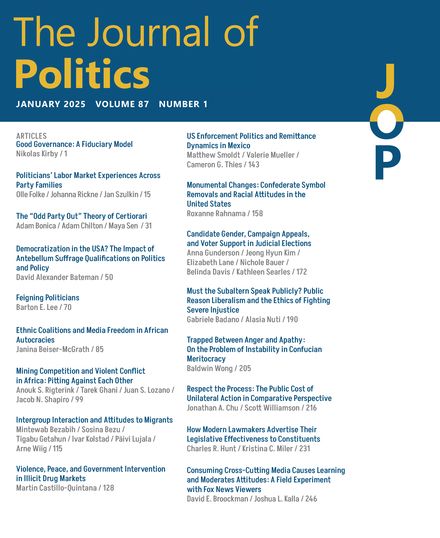
Donors and Dollars: Comparing the Policy Views of Donors and the Affluent | The Journal of Politics
Are campaign donors simply affluent people who happen to give to campaigns, or do donors and the affluent differ in their policy views? To investigate this, we surveyed verified 2017–2018 donors, affl...
www.journals.uchicago.edu
donors in both parties hold more ideologically extreme positions on domestic policy than even their richest co-partisans or public co-partisans; on international issues, Democratic donors are more pro-internationalist than their richest co-partisans
www.journals.uchicago.edu/doi/abs/10.1...
www.journals.uchicago.edu/doi/abs/10.1...

Political science journal articles increasingly reference journal articles more than books, across subfields, as total citations increase
www.cambridge.org/core/journal...
www.cambridge.org/core/journal...

SPSSI Journals
Despite Latino Americans’ consistent support for the Democratic Party over the last five decades, the number of Latino Americans who voted for Donald Trump in the 2024 presidential election grew by 1....
spssi.onlinelibrary.wiley.com
Across Mexican Americans & Cuban Americans, social traditionalism was the most consistent predictor of voting for Trump over Harris
spssi.onlinelibrary.wiley.com/doi/10.1111/...
spssi.onlinelibrary.wiley.com/doi/10.1111/...
Reposted by Will Jennings

On Ideological Consistency and the Intergenerational Transmission of Political Attitudes - Political Behavior
Over the past 50 years there have been significant changes in the political environment that may have affected parents’ ability to socialize their children into similar political attitudes and beliefs...
link.springer.com
When parents' political attitudes are
ideologically constrained, their kids are more likely to adopt similar political views. The increase in ideological constraint among some segments increased their success at passing along their political views
link.springer.com/article/10.1...
ideologically constrained, their kids are more likely to adopt similar political views. The increase in ideological constraint among some segments increased their success at passing along their political views
link.springer.com/article/10.1...

Reassessing Extremism, Polarization, and Constraint with Continuous Policy Questions - Political Behavior
Some argue that the American public is extreme and polarized along party lines. Paradoxically, others argue that members of the public lack meaningful policy preferences and exhibit low constraint acr...
link.springer.com
When surveys allow Americans to express their policy preferences on a continuum, most are moderate across a wide range of issues. Democrats & Republics show overlap on every issue, with modest average disagreement; positions across issues are constrained
link.springer.com/article/10.1...
link.springer.com/article/10.1...

Congress as Problem Solver: Building Consensus and Remaining Policy Productive Despite Polarization
We examine the contributions Congress makes to problem solving in contemporary American government. We offer a more positive assessment of the institution than is the norm for political science. In te...
www.degruyterbrill.com
Congress’s policy outcomes still typically command broad support. It enacts similar legislation by sheer volume compared to the 1980s & 1990s & normally does so in ways that large majorities and both parties support.
www.degruyterbrill.com/document/doi...
www.degruyterbrill.com/document/doi...

How authoritarian parenting attitudes explain our political divides - Niskanen Center
Christopher Federico and Christopher Weber find that authoritarian values, measured by these parenting preferences, increasingly structure Americans’ attitudes toward social and cultural issues and th...
www.niskanencenter.org
How authoritarian parenting attitudes explain our political divides
New #ScienceOfPolitics podcast/transcript with Christopher Federico and Christopher Weber on The Authoritarian Divide
www.niskanencenter.org/how-authorit...
New #ScienceOfPolitics podcast/transcript with Christopher Federico and Christopher Weber on The Authoritarian Divide
www.niskanencenter.org/how-authorit...