




Pamela Ferretti
@pamferretti.bsky.social
Postdoc in the Blekhman lab at UChicago | Infant and breast milk microbiome | antimicrobial resistance | wild animal microbiome | microbial ecology | MVIF member
https://pamelaferretti.net/
https://pamelaferretti.net/
Pinned
Client Challenge
www.nature.com
Excited to share our new study out in Nature Communications. We mapped the composition of the human breast #milk #microbiome and showed that microbes present in breast milk directly contribute to the assembly of the #infant gut microbiome in the first months of life.
www.nature.com/articles/s41...
www.nature.com/articles/s41...
It was a pleasure speaking at the "New Mathematical Theory in Eco-Evolutionary Modelling of Host-Symbiont Communities" workshop, held last week at the Banff International Research Station. Looking forward to seeing everyone in person next time!
www.birs.ca/events/2026/...
www.birs.ca/events/2026/...
26w5607: New Mathematical Theory in Eco-Evolutionary Modelling of Host-Symbiont Communities | Banff International Research Station
Workshop at the Banff International Research Station in Banff, Alberta between Feb 8 and Feb 13, 2026: New Mathematical Theory in Eco-Evolutionary Modelling of Host-Symbiont Communities.
www.birs.ca
February 16, 2026 at 7:33 PM
It was a pleasure speaking at the "New Mathematical Theory in Eco-Evolutionary Modelling of Host-Symbiont Communities" workshop, held last week at the Banff International Research Station. Looking forward to seeing everyone in person next time!
www.birs.ca/events/2026/...
www.birs.ca/events/2026/...
The press release highlighting the results of our breast milk microbiome study is available on the BSD UChicago news page
biologicalsciences.uchicago.edu/news/microbe...
Written by Grace Niewijk, UChicago.
#Milk #Microbiome #Nutrition #Breastfeeding
biologicalsciences.uchicago.edu/news/microbe...
Written by Grace Niewijk, UChicago.
#Milk #Microbiome #Nutrition #Breastfeeding

Microbes in breast milk help populate infant gut microbiomes
New study provides one of the most detailed portraits yet of how different combinations of bacteria in human milk contribute to infants’ gut microbiomes.
biologicalsciences.uchicago.edu
January 13, 2026 at 5:52 PM
The press release highlighting the results of our breast milk microbiome study is available on the BSD UChicago news page
biologicalsciences.uchicago.edu/news/microbe...
Written by Grace Niewijk, UChicago.
#Milk #Microbiome #Nutrition #Breastfeeding
biologicalsciences.uchicago.edu/news/microbe...
Written by Grace Niewijk, UChicago.
#Milk #Microbiome #Nutrition #Breastfeeding
Excited to share our new study out in Nature Communications. We mapped the composition of the human breast #milk #microbiome and showed that microbes present in breast milk directly contribute to the assembly of the #infant gut microbiome in the first months of life.
www.nature.com/articles/s41...
www.nature.com/articles/s41...
Client Challenge
www.nature.com
January 9, 2026 at 10:28 AM
Excited to share our new study out in Nature Communications. We mapped the composition of the human breast #milk #microbiome and showed that microbes present in breast milk directly contribute to the assembly of the #infant gut microbiome in the first months of life.
www.nature.com/articles/s41...
www.nature.com/articles/s41...
Reposted by Pamela Ferretti

Breast milk contains a unique community of microbes that can transfer to infants, influencing the development of the gut microbiome and supporting early immune and metabolic functions. doi.org/hbh4wd

Breast milk microbes help shape infants' gut microbiomes, study finds
Most conversations about breast milk tend to focus on topics like nutrients, antibodies and bonding time rather than bacteria.
medicalxpress.com
January 7, 2026 at 9:20 PM
Breast milk contains a unique community of microbes that can transfer to infants, influencing the development of the gut microbiome and supporting early immune and metabolic functions. doi.org/hbh4wd
Our Review article is now featured in the January issue of @natrevgenet.nature.com, check it out!
Review: Genomics of host–microbiome interactions in humans by @pamferretti.bsky.social ocial, Kelsey Johnson, @sambhawa.bsky.social & @blekhman.bsky.social
rdcu.be/etIRy
rdcu.be/etIRy
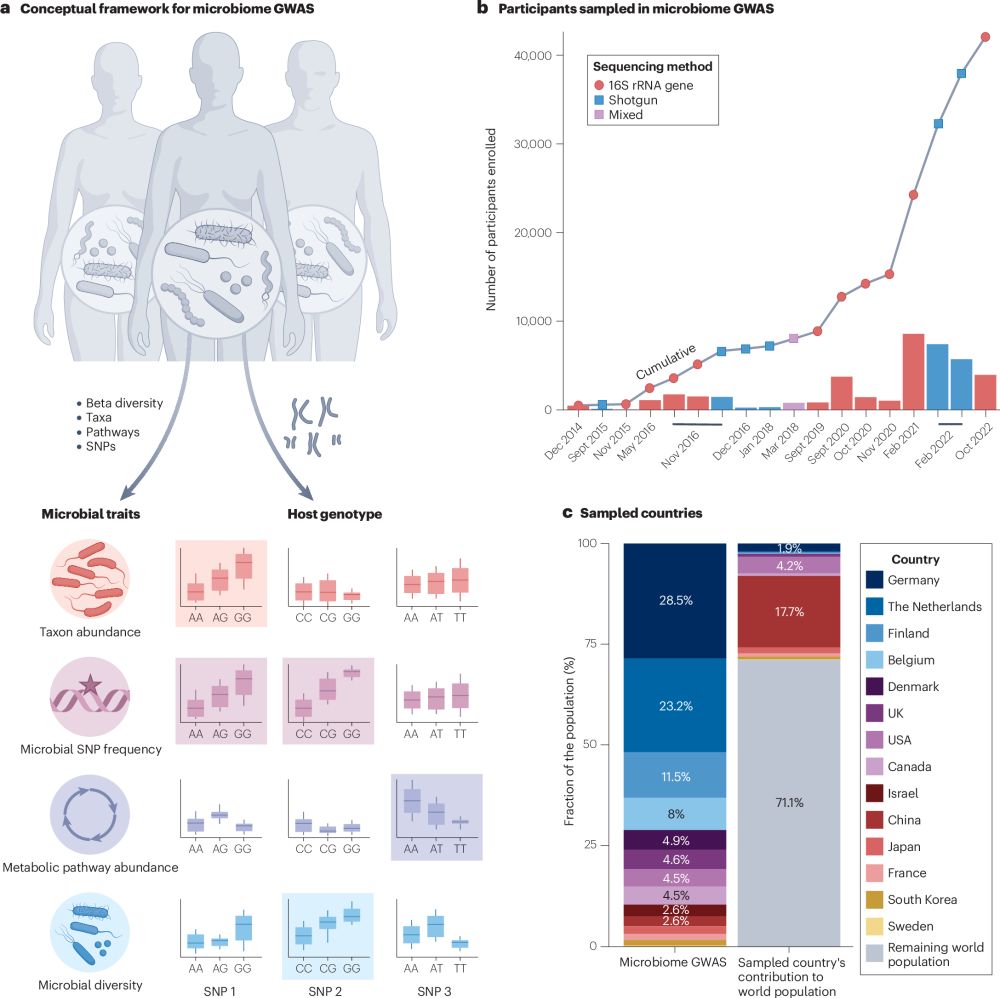
Genomics of host–microbiome interactions in humans
Nature Reviews Genetics - In this Review, Ferretti et al. discuss advances in our understanding of interactions between the human genome and the microbiome, including the effects of the microbiome...
rdcu.be
December 15, 2025 at 9:54 PM
Our Review article is now featured in the January issue of @natrevgenet.nature.com, check it out!
Reposted by Pamela Ferretti

📢 Our January issue is live and it's a special one🦠🧫! Featuring a range of article types, including Reviews, Comments and Journal Club articles, this Focus issue explores the insights gained from the application of microbial genomics within ecological and evolutionary contexts go.nature.com/3MNmsgR

December 15, 2025 at 4:59 PM
📢 Our January issue is live and it's a special one🦠🧫! Featuring a range of article types, including Reviews, Comments and Journal Club articles, this Focus issue explores the insights gained from the application of microbial genomics within ecological and evolutionary contexts go.nature.com/3MNmsgR
Reposted by Pamela Ferretti
🧬 🦠 🏙️
Urban vs rural lifestyles create dramatically different gut microbiomes. But how do these different gut microbiomes affect the host?
Excited to share our new paper: www.biorxiv.org/content/10.1...
Urban vs rural lifestyles create dramatically different gut microbiomes. But how do these different gut microbiomes affect the host?
Excited to share our new paper: www.biorxiv.org/content/10.1...


November 5, 2025 at 2:04 AM
🧬 🦠 🏙️
Urban vs rural lifestyles create dramatically different gut microbiomes. But how do these different gut microbiomes affect the host?
Excited to share our new paper: www.biorxiv.org/content/10.1...
Urban vs rural lifestyles create dramatically different gut microbiomes. But how do these different gut microbiomes affect the host?
Excited to share our new paper: www.biorxiv.org/content/10.1...
⚠️ Be aware! There are phishing websites for commonly used bioinformatics tools! ⚠️ Samtools and minimap2 affected, but it's likely just the tip of the iceberg. Be careful to use only official sources for your downloads, and let your colleagues and lab members know.
#bioinformatics #microsky
#bioinformatics #microsky

Heads up: ignore samtools dot org, similarly minimap2 dot com and likely others. It's owned by a known phishing site and while the binaries they offer look valid currently (but note they may be serving us different binaries to others), that could change.
Ie: it's not us (Samtools team)! Be warned
Ie: it's not us (Samtools team)! Be warned
October 21, 2025 at 2:58 PM
⚠️ Be aware! There are phishing websites for commonly used bioinformatics tools! ⚠️ Samtools and minimap2 affected, but it's likely just the tip of the iceberg. Be careful to use only official sources for your downloads, and let your colleagues and lab members know.
#bioinformatics #microsky
#bioinformatics #microsky
Are you a scientist who speaks Italian? Consider joining this initiative that connects scientists with elementary or middle school students in Italy through monthly correspondence ✒️
🚨 Ci manca pochissimo!
Siamo quasi al record di classi coperte… e ci mancano solo pochə scienziatə per arrivarci! 🧪✨
Non perdete l’occasione!
Iscriviti al link → forms.gle/tAWtfxmcJptf...
#PenneAmicheDellaScienza #ScienzaPerTuttə
Siamo quasi al record di classi coperte… e ci mancano solo pochə scienziatə per arrivarci! 🧪✨
Non perdete l’occasione!
Iscriviti al link → forms.gle/tAWtfxmcJptf...
#PenneAmicheDellaScienza #ScienzaPerTuttə

September 28, 2025 at 1:40 AM
Are you a scientist who speaks Italian? Consider joining this initiative that connects scientists with elementary or middle school students in Italy through monthly correspondence ✒️
If you generate or reuse #microbiome data, check out these guidelines for equitable sequence data reuse. Grateful to @alexjprobst.bsky.social and his team for leading this important work and for bringing together 160+ microbiome scientists (myself included) to contribute!
doi.org/10.1038/s415...
doi.org/10.1038/s415...
September 26, 2025 at 9:44 PM
If you generate or reuse #microbiome data, check out these guidelines for equitable sequence data reuse. Grateful to @alexjprobst.bsky.social and his team for leading this important work and for bringing together 160+ microbiome scientists (myself included) to contribute!
doi.org/10.1038/s415...
doi.org/10.1038/s415...
Reposted by Pamela Ferretti

Our article on equitable reuse of public sequencing data is out! Led by @alexjprobst.bsky.social, @lhug.bsky.social, Cristina Moraru, @geomicrosoares.bsky.social, @folker.bsky.social and myself -, co-authored by Anke Heyder, and developed in consultation with 167 scientists. tinyurl.com/n6yeanmk

A roadmap for equitable reuse of public microbiome data - Nature Microbiology
In this Consensus Statement, a consortium of microbiome scientists discuss current sequencing data sharing policies and propose the use of a Data Reuse Information (DRI) tag to promote equitable and collaborative data sharing.
tinyurl.com
September 26, 2025 at 8:14 PM
Our article on equitable reuse of public sequencing data is out! Led by @alexjprobst.bsky.social, @lhug.bsky.social, Cristina Moraru, @geomicrosoares.bsky.social, @folker.bsky.social and myself -, co-authored by Anke Heyder, and developed in consultation with 167 scientists. tinyurl.com/n6yeanmk
My commentary article, featuring the work of Aasmets et al. on the long-lasting effects of medications on the gut microbiome, is now out in mSystems @asm.org
#microbiome #microsky
doi.org/10.1128/msys...
#microbiome #microsky
doi.org/10.1128/msys...

The gut remembers: the long-lasting effect of medication use on the gut microbiome | mSystems
Over the past decades, medication use has steadily increased worldwide, with individuals
frequently taking multiple medications (polypharmacy), often repeatedly over extended
periods of time (1). Yet,...
doi.org
September 23, 2025 at 5:33 AM
My commentary article, featuring the work of Aasmets et al. on the long-lasting effects of medications on the gut microbiome, is now out in mSystems @asm.org
#microbiome #microsky
doi.org/10.1128/msys...
#microbiome #microsky
doi.org/10.1128/msys...
Reposted by Pamela Ferretti

Full thread will come later, but @annacusco.bsky.social's preprint on the dog pet gut microbiome is out!
Using ONT+Illumina, we get better MAGs than to corresponding species representative in public databases
doi.org/10.1101/2025...
Using ONT+Illumina, we get better MAGs than to corresponding species representative in public databases
doi.org/10.1101/2025...

September 18, 2025 at 12:01 PM
Full thread will come later, but @annacusco.bsky.social's preprint on the dog pet gut microbiome is out!
Using ONT+Illumina, we get better MAGs than to corresponding species representative in public databases
doi.org/10.1101/2025...
Using ONT+Illumina, we get better MAGs than to corresponding species representative in public databases
doi.org/10.1101/2025...
Reposted by Pamela Ferretti

DYK that mothers' milk has a circadian rhythm, providing dynamic signals to baby? 🤱🏻🕧🕐
New study shows:
- Cortisol peaks in early am ('wake up!' 😀)
- Melatonin peaks late at night ('sleepy time' 😴)
Moms who pump may want to label & feed am/pm milk separately.
www.frontiersin.org/journals/nut...
New study shows:
- Cortisol peaks in early am ('wake up!' 😀)
- Melatonin peaks late at night ('sleepy time' 😴)
Moms who pump may want to label & feed am/pm milk separately.
www.frontiersin.org/journals/nut...

Frontiers | Day/night fluctuations of breast milk bioactive factors and microbiome
IntroductionHuman breast milk is a sophisticated and complex biological fluid that provides crucial nutritional, immunological, and microbial benefits to inf...
www.frontiersin.org
September 7, 2025 at 11:25 PM
DYK that mothers' milk has a circadian rhythm, providing dynamic signals to baby? 🤱🏻🕧🕐
New study shows:
- Cortisol peaks in early am ('wake up!' 😀)
- Melatonin peaks late at night ('sleepy time' 😴)
Moms who pump may want to label & feed am/pm milk separately.
www.frontiersin.org/journals/nut...
New study shows:
- Cortisol peaks in early am ('wake up!' 😀)
- Melatonin peaks late at night ('sleepy time' 😴)
Moms who pump may want to label & feed am/pm milk separately.
www.frontiersin.org/journals/nut...
Really timely and important work to tackle global #honeybee population decline: 🐝
Engineered yeast provides rare but essential pollen sterols for honeybees
www.nature.com/articles/s41...
@philstevenson.bsky.social
Engineered yeast provides rare but essential pollen sterols for honeybees
www.nature.com/articles/s41...
@philstevenson.bsky.social
August 20, 2025 at 7:18 PM
Really timely and important work to tackle global #honeybee population decline: 🐝
Engineered yeast provides rare but essential pollen sterols for honeybees
www.nature.com/articles/s41...
@philstevenson.bsky.social
Engineered yeast provides rare but essential pollen sterols for honeybees
www.nature.com/articles/s41...
@philstevenson.bsky.social
Manually curated and harmonized metadata for over 110k metagenomic samples! (58k samples from the human gut alone!)🦠
Proud to have contributed to Metalog, the latest @borklab.bsky.social resource:
www.biorxiv.org/content/10.1...
#microsky #microbiome
Proud to have contributed to Metalog, the latest @borklab.bsky.social resource:
www.biorxiv.org/content/10.1...
#microsky #microbiome
August 15, 2025 at 1:54 PM
Manually curated and harmonized metadata for over 110k metagenomic samples! (58k samples from the human gut alone!)🦠
Proud to have contributed to Metalog, the latest @borklab.bsky.social resource:
www.biorxiv.org/content/10.1...
#microsky #microbiome
Proud to have contributed to Metalog, the latest @borklab.bsky.social resource:
www.biorxiv.org/content/10.1...
#microsky #microbiome
Reposted by Pamela Ferretti

We hope many of you will find it useful, and will continue to add data. Here's the preprint: www.biorxiv.org/content/10.1... - hopefully coming soon to a NAR Database Issue near you 😅 Thanks to everyone in the @borklab.bsky.social @embl.org who contributed to this! 7/7

Metalog: curated and harmonised contextual data for global metagenomics samples
Metagenomic sequencing enables the in-depth study of microbes and their functions in humans, animals and the environment. While sequencing data is deposited in public databases, the associated context...
www.biorxiv.org
August 15, 2025 at 8:07 AM
We hope many of you will find it useful, and will continue to add data. Here's the preprint: www.biorxiv.org/content/10.1... - hopefully coming soon to a NAR Database Issue near you 😅 Thanks to everyone in the @borklab.bsky.social @embl.org who contributed to this! 7/7
Reposted by Pamela Ferretti
We're very happy to release our new database Metalog metalog.embl.de ! It offers manually curated and harmonised contextual data for 110k metagenomics samples across the globe, incl. precomputed taxonomic profiles, for interactive browsing and for download 🧵 1/7
#microsky
#microsky
Metalog
Metalog is a repository of manually annotated metadata (or contextual data) for metagenomic sequencing data from across the globe.
metalog.embl.de
August 15, 2025 at 8:07 AM
We're very happy to release our new database Metalog metalog.embl.de ! It offers manually curated and harmonised contextual data for 110k metagenomics samples across the globe, incl. precomputed taxonomic profiles, for interactive browsing and for download 🧵 1/7
#microsky
#microsky
Last year, I joined a brilliant group of researchers for a 3-week deep dive into host–microbe systems. Each week explored a different theme, led by inspiring lecturers.
I’m excited to share that videos of their talks — along with presentations by several team members — are now on YouTube:
I’m excited to share that videos of their talks — along with presentations by several team members — are now on YouTube:
July 18, 2025 at 5:41 PM
Last year, I joined a brilliant group of researchers for a 3-week deep dive into host–microbe systems. Each week explored a different theme, led by inspiring lecturers.
I’m excited to share that videos of their talks — along with presentations by several team members — are now on YouTube:
I’m excited to share that videos of their talks — along with presentations by several team members — are now on YouTube:
Reposted by Pamela Ferretti
Theory of host-microbe symbioses: Challenges & opportunities
Discussion on mathematical modeling of microbial symbioses with 3 noted areas requiring advancement: nested ecology w/in host or holobiont, holobiont population dynamics & symbiont-mediated speciation
www.cell.com/cell-host-mi...
Discussion on mathematical modeling of microbial symbioses with 3 noted areas requiring advancement: nested ecology w/in host or holobiont, holobiont population dynamics & symbiont-mediated speciation
www.cell.com/cell-host-mi...
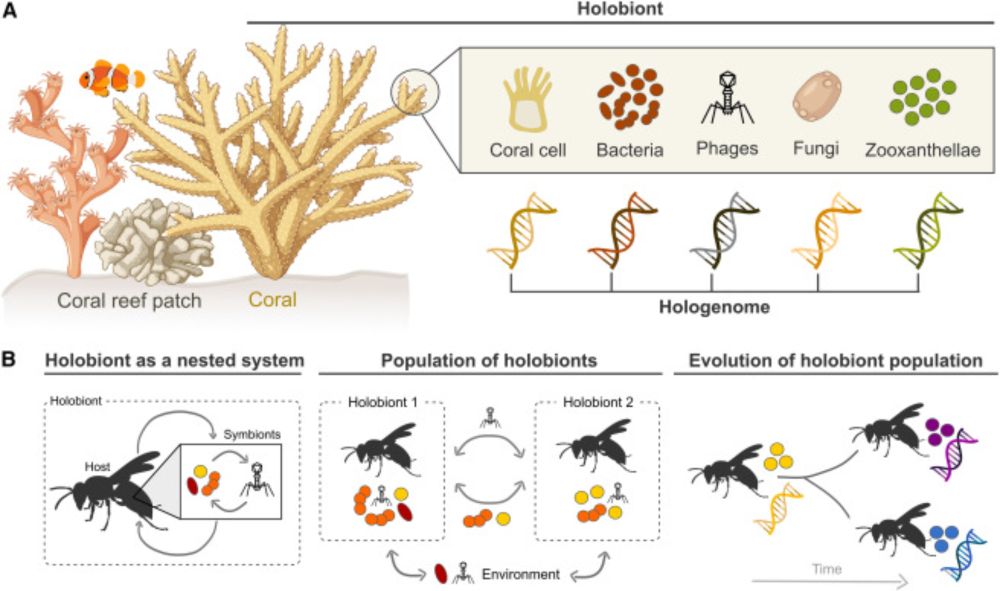
Theory of host-microbe symbioses: Challenges and opportunities
Growing insight into microbial symbioses highlights the need to model these systems
mathematically. We discuss three areas requiring theoretical advancement: nested ecology
within a host or holobiont,...
www.cell.com
July 14, 2025 at 12:47 PM
Theory of host-microbe symbioses: Challenges & opportunities
Discussion on mathematical modeling of microbial symbioses with 3 noted areas requiring advancement: nested ecology w/in host or holobiont, holobiont population dynamics & symbiont-mediated speciation
www.cell.com/cell-host-mi...
Discussion on mathematical modeling of microbial symbioses with 3 noted areas requiring advancement: nested ecology w/in host or holobiont, holobiont population dynamics & symbiont-mediated speciation
www.cell.com/cell-host-mi...
Our article on the challenges and opportunities in studying host-microbe symbioses is now published in Cell Host & Microbe! @cp-cellhostmicrobe.bsky.social
www.sciencedirect.com/science/arti...
www.sciencedirect.com/science/arti...
Theory of host-microbe symbioses: Challenges and opportunities
Growing insight into microbial symbioses highlights the need to model these systems mathematically. We discuss three areas requiring theoretical advan…
www.sciencedirect.com
July 9, 2025 at 7:00 PM
Our article on the challenges and opportunities in studying host-microbe symbioses is now published in Cell Host & Microbe! @cp-cellhostmicrobe.bsky.social
www.sciencedirect.com/science/arti...
www.sciencedirect.com/science/arti...
Reposted by Pamela Ferretti

The team's first preprint is out!
Led by
@vishnuprasoodanan.bsky.social & @omaistrenko.bsky.social , we asked a question (almost) as old as microbiology: how many prokaryotic species exist on Earth? More specifically, how much diversity is "hiding" in existing metagenomic data?
A 🧵.
Led by
@vishnuprasoodanan.bsky.social & @omaistrenko.bsky.social , we asked a question (almost) as old as microbiology: how many prokaryotic species exist on Earth? More specifically, how much diversity is "hiding" in existing metagenomic data?
A 🧵.

A census of hidden and discoverable microbial diversity beyond genome-centric approaches https://www.biorxiv.org/content/10.1101/2025.06.26.661807v1
June 27, 2025 at 8:10 PM
The team's first preprint is out!
Led by
@vishnuprasoodanan.bsky.social & @omaistrenko.bsky.social , we asked a question (almost) as old as microbiology: how many prokaryotic species exist on Earth? More specifically, how much diversity is "hiding" in existing metagenomic data?
A 🧵.
Led by
@vishnuprasoodanan.bsky.social & @omaistrenko.bsky.social , we asked a question (almost) as old as microbiology: how many prokaryotic species exist on Earth? More specifically, how much diversity is "hiding" in existing metagenomic data?
A 🧵.
Reposted by Pamela Ferretti
There are many more stories in the preprint, so go ahead and read it:
www.biorxiv.org/content/10.1...
We welcome feedback!
www.biorxiv.org/content/10.1...
We welcome feedback!

A census of hidden and discoverable microbial diversity beyond genome-centric approaches
Cataloguing Earth's biodiversity remains one of biology's most formidable challenges, and the greatest diversity is expected to reside among the smallest organisms: microbes. Yet the ongoing census of...
www.biorxiv.org
June 27, 2025 at 8:10 PM
There are many more stories in the preprint, so go ahead and read it:
www.biorxiv.org/content/10.1...
We welcome feedback!
www.biorxiv.org/content/10.1...
We welcome feedback!
Reposted by Pamela Ferretti
For #worldmicrobiomeday, re-sharing our recent Review by @pamferretti.bsky.social, Kelsey Johnson, @sambhawa.bsky.social & @blekhman.bsky.social on the 'Genomics of host–microbiome interactions in humans', which is free to read using this link: rdcu.be/etIRy
Genomics of host–microbiome interactions in humans
Nature Reviews Genetics - In this Review, Ferretti et al. discuss advances in our understanding of interactions between the human genome and the microbiome, including the effects of the microbiome...
rdcu.be
June 27, 2025 at 9:52 AM
For #worldmicrobiomeday, re-sharing our recent Review by @pamferretti.bsky.social, Kelsey Johnson, @sambhawa.bsky.social & @blekhman.bsky.social on the 'Genomics of host–microbiome interactions in humans', which is free to read using this link: rdcu.be/etIRy
Excited to share our new article exploring the eukaryotic diversity and composition in the gut microbiome of wild baboons!
doi.org/10.1186/s425...
doi.org/10.1186/s425...
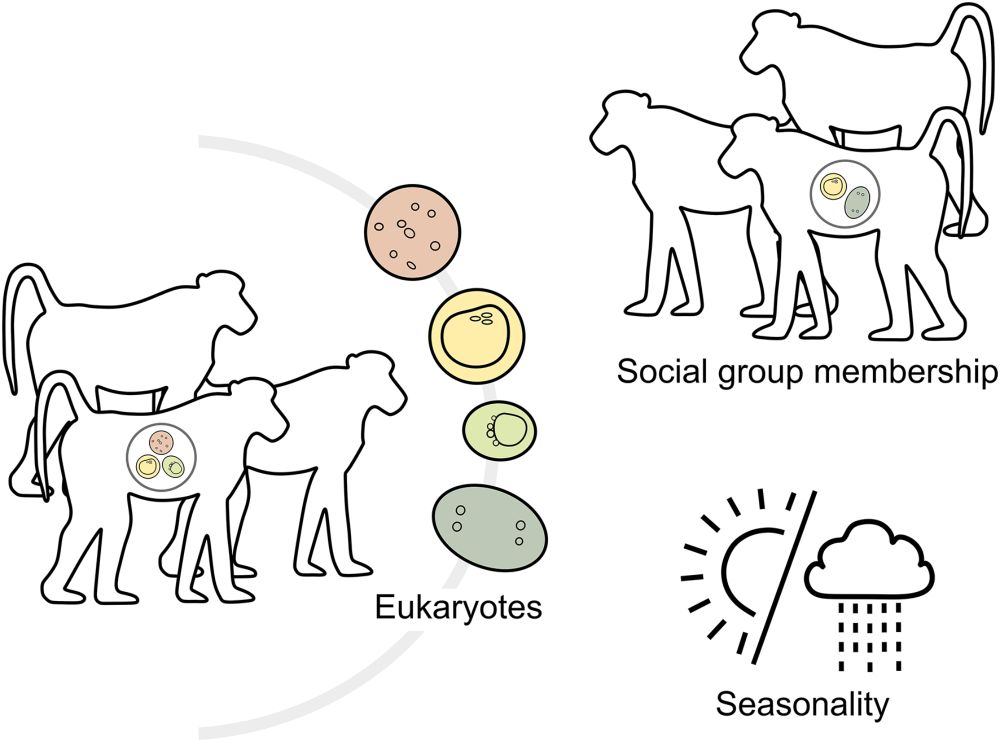
Eukaryotic composition across seasons and social groups in the gut microbiota of wild baboons - Animal Microbiome
Background Animals coexist with complex microbiota, including bacteria, viruses, and eukaryotes (e.g., fungi, protists, and helminths). While high-throughput sequencing is commonly used to characteriz...
doi.org
June 24, 2025 at 4:39 PM
Excited to share our new article exploring the eukaryotic diversity and composition in the gut microbiome of wild baboons!
doi.org/10.1186/s425...
doi.org/10.1186/s425...