


Peter Ly
@peterlylab.bsky.social
Genome Integrity Lab | Children's Research Institute at UT Southwestern Medical Center. We study how chromosomes segregate, break, and rearrange.
www.thelylab.org
www.thelylab.org
Reposted by Peter Ly

I am excited to share the first paper from the Saldivar lab! A special thank you to all who contributed.
Precise control of transcription condensates across S phase balances linker histone expression with DNA replication, ensuring genome stability: Molecular Cell www.cell.com/molecular-ce...
Precise control of transcription condensates across S phase balances linker histone expression with DNA replication, ensuring genome stability: Molecular Cell www.cell.com/molecular-ce...

Precise control of transcription condensates across S phase balances linker histone expression with DNA replication, ensuring genome stability
Marmolejo et al. uncover transcription condensate dynamics at histone locus bodies
across the cell cycle. These dynamics are governed by cell cycle (DDK and CDK1/2)
and checkpoint (ATR-CHK1) kinases t...
www.cell.com
February 4, 2026 at 4:06 PM
I am excited to share the first paper from the Saldivar lab! A special thank you to all who contributed.
Precise control of transcription condensates across S phase balances linker histone expression with DNA replication, ensuring genome stability: Molecular Cell www.cell.com/molecular-ce...
Precise control of transcription condensates across S phase balances linker histone expression with DNA replication, ensuring genome stability: Molecular Cell www.cell.com/molecular-ce...
Reposted by Peter Ly

🚨NEW PI ALERT🚨 @henrydebelly.bsky.social is in the house, and look at that *fresh* new office. Clean slate for his next #relentlessdiscovery in CRI's Tissue Regeneration Program (TRP). Onward! Read more about his new lab 👉 cri.utsw.edu/faculty/henr...
🧪 @haozhulab.bsky.social
🧪 @haozhulab.bsky.social

January 29, 2026 at 6:23 PM
🚨NEW PI ALERT🚨 @henrydebelly.bsky.social is in the house, and look at that *fresh* new office. Clean slate for his next #relentlessdiscovery in CRI's Tissue Regeneration Program (TRP). Onward! Read more about his new lab 👉 cri.utsw.edu/faculty/henr...
🧪 @haozhulab.bsky.social
🧪 @haozhulab.bsky.social
Reposted by Peter Ly
Dear Colleagues,
Delighted to share that our first lab paper is now published in Nature.!!! 😊😊😊
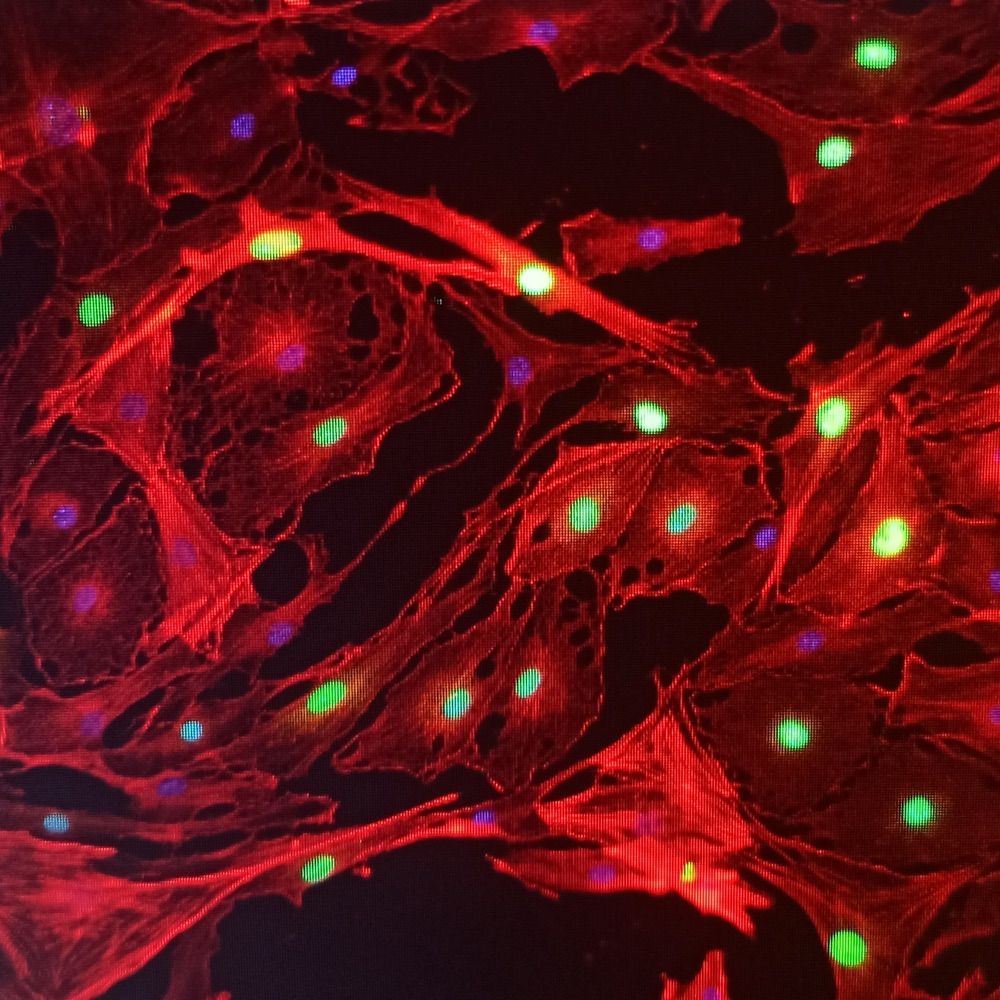
We identify a previously concealed “safety limit” in DNA replication program: cells intrinsically rate-limit PCNA via PAF15, shaping strand-specific and global replication dynamics.
👉 rdcu.be/e1bBt
Delighted to share that our first lab paper is now published in Nature.!!! 😊😊😊
We identify a previously concealed “safety limit” in DNA replication program: cells intrinsically rate-limit PCNA via PAF15, shaping strand-specific and global replication dynamics.
👉 rdcu.be/e1bBt

PAF15–PCNA exhaustion governs the strand-specific control of DNA replication
Nature - PCNA–PAF15 has a key role in determining replisome dynamics during genome replication and protecting against genome instability.
rdcu.be
January 29, 2026 at 6:30 PM
Dear Colleagues,
Delighted to share that our first lab paper is now published in Nature.!!! 😊😊😊
We identify a previously concealed “safety limit” in DNA replication program: cells intrinsically rate-limit PCNA via PAF15, shaping strand-specific and global replication dynamics.
👉 rdcu.be/e1bBt
Delighted to share that our first lab paper is now published in Nature.!!! 😊😊😊
We identify a previously concealed “safety limit” in DNA replication program: cells intrinsically rate-limit PCNA via PAF15, shaping strand-specific and global replication dynamics.
👉 rdcu.be/e1bBt
Reposted by Peter Ly

Mitosis has a timing system. If chromosomes attach properly, cells divide on schedule and keep proliferating. If attachment is slow or incomplete, the delay is recorded — and daughter cells stop dividing.
We explore this link in our new preprint.
🔗 www.biorxiv.org/content/10.6...
We explore this link in our new preprint.
🔗 www.biorxiv.org/content/10.6...

January 29, 2026 at 11:32 AM
Mitosis has a timing system. If chromosomes attach properly, cells divide on schedule and keep proliferating. If attachment is slow or incomplete, the delay is recorded — and daughter cells stop dividing.
We explore this link in our new preprint.
🔗 www.biorxiv.org/content/10.6...
We explore this link in our new preprint.
🔗 www.biorxiv.org/content/10.6...
Reposted by Peter Ly

New preprint🎉
Happy to share our collaborative manuscript, where we provide in vivo and genome-wide evidence linking MCM2-7 helicase activation, DNA extrusion to initial origin melting, thereby adding a new mechanistic layer to how eukaryotic DNA replication is initiated.
👉 doi.org/10.64898/202...
Happy to share our collaborative manuscript, where we provide in vivo and genome-wide evidence linking MCM2-7 helicase activation, DNA extrusion to initial origin melting, thereby adding a new mechanistic layer to how eukaryotic DNA replication is initiated.
👉 doi.org/10.64898/202...
doi.org
January 28, 2026 at 9:13 PM
New preprint🎉
Happy to share our collaborative manuscript, where we provide in vivo and genome-wide evidence linking MCM2-7 helicase activation, DNA extrusion to initial origin melting, thereby adding a new mechanistic layer to how eukaryotic DNA replication is initiated.
👉 doi.org/10.64898/202...
Happy to share our collaborative manuscript, where we provide in vivo and genome-wide evidence linking MCM2-7 helicase activation, DNA extrusion to initial origin melting, thereby adding a new mechanistic layer to how eukaryotic DNA replication is initiated.
👉 doi.org/10.64898/202...
Reposted by Peter Ly

We have two funded postdoctoral positions available. Topics encompass:
-Next gen light-sheet fluorescence microscopy instrumentation
-Structured illumination microscopy and other approaches to extend the resolution limit.
-Nonlinear microscopy combined with adaptive optics / phase conjugation
-Next gen light-sheet fluorescence microscopy instrumentation
-Structured illumination microscopy and other approaches to extend the resolution limit.
-Nonlinear microscopy combined with adaptive optics / phase conjugation
January 27, 2026 at 10:29 PM
We have two funded postdoctoral positions available. Topics encompass:
-Next gen light-sheet fluorescence microscopy instrumentation
-Structured illumination microscopy and other approaches to extend the resolution limit.
-Nonlinear microscopy combined with adaptive optics / phase conjugation
-Next gen light-sheet fluorescence microscopy instrumentation
-Structured illumination microscopy and other approaches to extend the resolution limit.
-Nonlinear microscopy combined with adaptive optics / phase conjugation
Reposted by Peter Ly

🎉Kicking off 2026 with our first paper from the Freudenthal lab in NAR. Ribonucleotides reshape telomeric G4s and are resistant to RNase H2 repair. Congrats to the authors and huge thanks to our collaborator Hui-Ting Lee! academic.oup.com/nar/article/...

Effects of ribonucleotides on telomeric G4 formation, dynamics, and initiation of ribonucleotide excision repair by RNase H2
Abstract. Human telomeres are composed of TTAGGG repeats that can fold into G-quadruplexes (G4s). G4s can form several different conformations, including p
academic.oup.com
January 27, 2026 at 10:03 PM
🎉Kicking off 2026 with our first paper from the Freudenthal lab in NAR. Ribonucleotides reshape telomeric G4s and are resistant to RNase H2 repair. Congrats to the authors and huge thanks to our collaborator Hui-Ting Lee! academic.oup.com/nar/article/...
Reposted by Peter Ly

Pregnancy loss is common in humans, and chromosomal abnormalities are the leading cause. Using genetic data from ~140,000 IVF embryos, we show that maternal variation in meiosis genes influences recombination and aneuploidy risk.
First authors: @saracarioscia.bsky.social & @aabiddanda.github.io
First authors: @saracarioscia.bsky.social & @aabiddanda.github.io

Common variation in meiosis genes shapes human recombination and aneuploidy - Nature
Analysis of data from pre-implantation genetic testing sheds light on the genetic basis of meiotic-origin aneuploidy, the leading cause of human pregnancy loss, identifying common genetic variants ass...
www.nature.com
January 21, 2026 at 9:14 PM
Pregnancy loss is common in humans, and chromosomal abnormalities are the leading cause. Using genetic data from ~140,000 IVF embryos, we show that maternal variation in meiosis genes influences recombination and aneuploidy risk.
First authors: @saracarioscia.bsky.social & @aabiddanda.github.io
First authors: @saracarioscia.bsky.social & @aabiddanda.github.io
Reposted by Peter Ly
We are seeking a motivated postdoctoral fellow to investigate mechanisms of DNA damage response, APOBEC-mediated mutagenesis, innate immunity, and double-stranded RNA sensing. Located in Southern California, UCI offers an outstanding scientific environment and exceptional quality of life.

January 21, 2026 at 3:50 AM
We are seeking a motivated postdoctoral fellow to investigate mechanisms of DNA damage response, APOBEC-mediated mutagenesis, innate immunity, and double-stranded RNA sensing. Located in Southern California, UCI offers an outstanding scientific environment and exceptional quality of life.
Reposted by Peter Ly

Excited to share our new Nature study! 🧬
We (sidrituruci.bsky.social et al) discovered that CFAP20 helps clear stalled RNAPII, preventing harmful clashes with DNA replication machinery. This protects cells from R-loops and genome instability.
Full paper: www.nature.com/articles/s41...
We (sidrituruci.bsky.social et al) discovered that CFAP20 helps clear stalled RNAPII, preventing harmful clashes with DNA replication machinery. This protects cells from R-loops and genome instability.
Full paper: www.nature.com/articles/s41...

January 15, 2026 at 7:45 AM
Excited to share our new Nature study! 🧬
We (sidrituruci.bsky.social et al) discovered that CFAP20 helps clear stalled RNAPII, preventing harmful clashes with DNA replication machinery. This protects cells from R-loops and genome instability.
Full paper: www.nature.com/articles/s41...
We (sidrituruci.bsky.social et al) discovered that CFAP20 helps clear stalled RNAPII, preventing harmful clashes with DNA replication machinery. This protects cells from R-loops and genome instability.
Full paper: www.nature.com/articles/s41...
Reposted by Peter Ly

Human eggs must segregate their chromosomes with exquisite precision — yet errors rise with maternal age, causing miscarriage & infertility.
Our new article on @biorxivpreprint.bsky.social shows why chromosome cohesion fails in aging eggs & how to improve it.
www.biorxiv.org/content/10.6... (1/10)
Our new article on @biorxivpreprint.bsky.social shows why chromosome cohesion fails in aging eggs & how to improve it.
www.biorxiv.org/content/10.6... (1/10)
January 12, 2026 at 11:23 AM
Human eggs must segregate their chromosomes with exquisite precision — yet errors rise with maternal age, causing miscarriage & infertility.
Our new article on @biorxivpreprint.bsky.social shows why chromosome cohesion fails in aging eggs & how to improve it.
www.biorxiv.org/content/10.6... (1/10)
Our new article on @biorxivpreprint.bsky.social shows why chromosome cohesion fails in aging eggs & how to improve it.
www.biorxiv.org/content/10.6... (1/10)
Reposted by Peter Ly

We are excited to share that our latest work from the lab aimed at understanding how the tRNA nuclease SLFN11 is activated in response to DNA damage and replication stress has just been published in @natcellbio.nature.com!
Open access link: www.nature.com/articles/s41...
(1/9)
Open access link: www.nature.com/articles/s41...
(1/9)
Client Challenge
www.nature.com
January 9, 2026 at 2:42 PM
We are excited to share that our latest work from the lab aimed at understanding how the tRNA nuclease SLFN11 is activated in response to DNA damage and replication stress has just been published in @natcellbio.nature.com!
Open access link: www.nature.com/articles/s41...
(1/9)
Open access link: www.nature.com/articles/s41...
(1/9)
Reposted by Peter Ly
🐭 In vivo veritas 🐭
Now out in Nature Genetics: @josjonkers.bsky.social and I describe currently available mouse models of BRCA1/2 and their roles in understanding BRCA1/2 biology, particularly in normal development, tumor suppression and therapy response.
www.nature.com/articles/s41...
Now out in Nature Genetics: @josjonkers.bsky.social and I describe currently available mouse models of BRCA1/2 and their roles in understanding BRCA1/2 biology, particularly in normal development, tumor suppression and therapy response.
www.nature.com/articles/s41...

Insights from three decades of BRCA1/2 modeling in mice - Nature Genetics
This Perspective highlights the insights into the biology of BRCA1/2 afforded by mouse models and patient-derived tumor xenografts and emphasizes their value in addressing unresolved questions and pre...
www.nature.com
January 6, 2026 at 12:30 PM
🐭 In vivo veritas 🐭
Now out in Nature Genetics: @josjonkers.bsky.social and I describe currently available mouse models of BRCA1/2 and their roles in understanding BRCA1/2 biology, particularly in normal development, tumor suppression and therapy response.
www.nature.com/articles/s41...
Now out in Nature Genetics: @josjonkers.bsky.social and I describe currently available mouse models of BRCA1/2 and their roles in understanding BRCA1/2 biology, particularly in normal development, tumor suppression and therapy response.
www.nature.com/articles/s41...
Reposted by Peter Ly
SMC and recombination enthusiasts: we updated our work describing the loop extrusion properties of budding yeast condensin and its function in biasing donor usage for mating-type switching. Lots of cool new data, check it out!
www.biorxiv.org/content/10.1...
www.biorxiv.org/content/10.1...

January 6, 2026 at 6:58 AM
SMC and recombination enthusiasts: we updated our work describing the loop extrusion properties of budding yeast condensin and its function in biasing donor usage for mating-type switching. Lots of cool new data, check it out!
www.biorxiv.org/content/10.1...
www.biorxiv.org/content/10.1...
Reposted by Peter Ly


Reposted by Peter Ly

Excited to announce a new review article that Andreas Villunger @villungerlab.bsky.social, Dario Rizzotto (not on bsky) and I wrote. In this article, we discuss mitosis as a central cell cycle stage for integrating DNA damage, cell death and inflammatory responses. www.nature.com/articles/s41...

Mitotic errors as triggers of cell death and inflammation - Nature Cell Biology
Rizzotto et al. discuss the causes and consequences of deregulated mitosis that allow cells arrested in mitosis to escape to the next interphase, where they can initiate inflammatory signalling or und...
www.nature.com
January 6, 2026 at 10:43 AM
Excited to announce a new review article that Andreas Villunger @villungerlab.bsky.social, Dario Rizzotto (not on bsky) and I wrote. In this article, we discuss mitosis as a central cell cycle stage for integrating DNA damage, cell death and inflammatory responses. www.nature.com/articles/s41...
Reposted by Peter Ly

Introducing Cyclically Multiplexed Expansion Microscopy (Cy-ExM): a workflow for 3D nanoscale, high-plex imaging in whole cells. Cryo-preserved ultrastructure + iterative labeling + expansion microscopy → 20 targets in one dataset with ~70 nm lateral resolution.
www.biorxiv.org/content/10.6...
www.biorxiv.org/content/10.6...
January 2, 2026 at 6:18 PM
Introducing Cyclically Multiplexed Expansion Microscopy (Cy-ExM): a workflow for 3D nanoscale, high-plex imaging in whole cells. Cryo-preserved ultrastructure + iterative labeling + expansion microscopy → 20 targets in one dataset with ~70 nm lateral resolution.
www.biorxiv.org/content/10.6...
www.biorxiv.org/content/10.6...
Reposted by Peter Ly

Happy to share our new review on 3D chromatin organisation by cohesin with you. It was a great pleasure to review recent advances and future prospects with @danielgerlich.bsky.social.

New Online! Organization of replicated chromosomes by DNA loops and sister chromatid cohesion

Organization of replicated chromosomes by DNA loops and sister chromatid cohesion
Nature Reviews Molecular Cell Biology, Published online: 02 January 2026; doi:10.1038/s41580-025-00933-1Cohesin complexes regulate genome architecture through DNA loop extrusion and sister chromatid cohesion. The Review discusses how these two cohesin activities mediate the organization of replicated chromosomes and their segregation in mitosis and meiosis, DNA break repair, and age-related aneuploidy in oocytes.
bit.ly
January 2, 2026 at 11:23 AM
Happy to share our new review on 3D chromatin organisation by cohesin with you. It was a great pleasure to review recent advances and future prospects with @danielgerlich.bsky.social.
Reposted by Peter Ly
Happy to share that my postdoc work with @jobdekker.bsky.social is out!
rdcu.be/eWHD2
We characterize interphase chromatin folding programs with distinct modes of mitotic inheritance and identify the chromosome-intrinsic capacity to form a microcompartment of active CREs during mitotic exit.
rdcu.be/eWHD2
We characterize interphase chromatin folding programs with distinct modes of mitotic inheritance and identify the chromosome-intrinsic capacity to form a microcompartment of active CREs during mitotic exit.

Interphase chromosome conformation is specified by distinct folding programmes inherited through mitotic chromosomes or the cytoplasm
Nature Cell Biology - Schooley et al. find that mitotically bookmarked loci drive a transient chromosome folding state during G1 entry that is subsequently modulated by factors inherited through...
rdcu.be
December 29, 2025 at 12:39 PM
Happy to share that my postdoc work with @jobdekker.bsky.social is out!
rdcu.be/eWHD2
We characterize interphase chromatin folding programs with distinct modes of mitotic inheritance and identify the chromosome-intrinsic capacity to form a microcompartment of active CREs during mitotic exit.
rdcu.be/eWHD2
We characterize interphase chromatin folding programs with distinct modes of mitotic inheritance and identify the chromosome-intrinsic capacity to form a microcompartment of active CREs during mitotic exit.
Reposted by Peter Ly
A major output of the 4D Nucleome project appeared today. This is the joint effort of many scientists working together and (publicly) sharing data and results for several years. We hope this is of interest to many genome biologists!
www.nature.com/articles/s41...
www.nature.com/articles/s41...

An integrated view of the structure and function of the human 4D nucleome - Nature
The 4D Nucleome Project demonstrates the use of genomic assays and computational methods to measure genome folding and then predict genomic structure from DNA sequence, facilitatin...
www.nature.com
December 17, 2025 at 8:59 PM
A major output of the 4D Nucleome project appeared today. This is the joint effort of many scientists working together and (publicly) sharing data and results for several years. We hope this is of interest to many genome biologists!
www.nature.com/articles/s41...
www.nature.com/articles/s41...
Reposted by Peter Ly

Absolutely thrilled to share the latest work from my lab focused on the variation and evolution of human centromeres among global populations! We assembled 2,110 human centromeres, identifying 226 new major haplotypes and 1,870 α-satellite HOR variants. www.biorxiv.org/content/10.6...

December 16, 2025 at 4:06 PM
Absolutely thrilled to share the latest work from my lab focused on the variation and evolution of human centromeres among global populations! We assembled 2,110 human centromeres, identifying 226 new major haplotypes and 1,870 α-satellite HOR variants. www.biorxiv.org/content/10.6...
Reposted by Peter Ly
Our latest paper on the molecular mechanisms of XPF-ERCC1 recruitment to SLX4-dependent DNA repair pathways has been published! Congratulations to first author Junjie Feng, and a heartfelt thank you to all our collaborators for their contributions to this study!
www.nature.com/articles/s41...
www.nature.com/articles/s41...

December 16, 2025 at 4:29 PM
Our latest paper on the molecular mechanisms of XPF-ERCC1 recruitment to SLX4-dependent DNA repair pathways has been published! Congratulations to first author Junjie Feng, and a heartfelt thank you to all our collaborators for their contributions to this study!
www.nature.com/articles/s41...
www.nature.com/articles/s41...
Reposted by Peter Ly

Thrilled to share that my postdoc research is published today in @science.org! We found that DNA repair uses cohesin complexes to build new chromatin loops that guide the homology search and boost accurate repair! 1/n
www.science.org/doi/10.1126/...
www.science.org/doi/10.1126/...

Cohesin drives chromatin scanning during the RAD51-mediated homology search
Cohesin folds genomes into chromatin loops, the roles of which are under debate. We found that double-strand breaks (DSBs) induce de novo formation of chromatin loops in human cells, with the loop bas...
www.science.org
December 4, 2025 at 9:50 PM
Thrilled to share that my postdoc research is published today in @science.org! We found that DNA repair uses cohesin complexes to build new chromatin loops that guide the homology search and boost accurate repair! 1/n
www.science.org/doi/10.1126/...
www.science.org/doi/10.1126/...
Reposted by Peter Ly

I am happy to share that my postdoctoral work in the @gerlichlab.bsky.social at @imbavienna.bsky.social is finally out 🎉!
Our study reveals how cohesin guides focused and accurate homology search.
Read more 👉 www.science.org/doi/10.1126/...
Follow along for key insights and updates! 🧵
Our study reveals how cohesin guides focused and accurate homology search.
Read more 👉 www.science.org/doi/10.1126/...
Follow along for key insights and updates! 🧵

Cohesin guides homology search during DNA repair using loops and sister chromatid linkages
Accurate repair of DNA double-strand breaks (DSBs) is essential for genome stability, and defective repair underlies diseases such as cancer. Homologous recombination uses an intact homologous sequenc...
www.science.org
December 4, 2025 at 8:18 PM
I am happy to share that my postdoctoral work in the @gerlichlab.bsky.social at @imbavienna.bsky.social is finally out 🎉!
Our study reveals how cohesin guides focused and accurate homology search.
Read more 👉 www.science.org/doi/10.1126/...
Follow along for key insights and updates! 🧵
Our study reveals how cohesin guides focused and accurate homology search.
Read more 👉 www.science.org/doi/10.1126/...
Follow along for key insights and updates! 🧵
Reposted by Peter Ly

A key step towards human genome synthesis. With thanks to @wellcometrust.bsky.social @mrclmb.bsky.social #SynHG doi.org/10.1126/scie...

High-fidelity human chromosome transfer and elimination
The synthesis of human genomes and other gigabase-scale genomes will require new strategies. Here, we realized key steps in our pipeline for building synthetic human chromosomes. We established: (i) t...
doi.org
December 4, 2025 at 7:27 PM
A key step towards human genome synthesis. With thanks to @wellcometrust.bsky.social @mrclmb.bsky.social #SynHG doi.org/10.1126/scie...