



Jeremy Schmit
@schmitbiophysics.bsky.social
Statistical mechanics & biophysics theorist. Emergent properties in biomolecules. Systems biology curious. Father, former athlete. Kansas State University Physics. Occasional appearance of Legos.
Reposted by Jeremy Schmit

Multidisciplinary training, over time, produces the highest impact people
www.science.org/doi/10.1126/...
www.science.org/doi/10.1126/...

Recent discoveries on the acquisition of the highest levels of human performance
Scientists have long debated the origins of exceptional human achievements. This literature review summarizes recent evidence from multiple domains on the acquisition of world-class performance. We re...
www.science.org
December 20, 2025 at 11:49 PM
Multidisciplinary training, over time, produces the highest impact people
www.science.org/doi/10.1126/...
www.science.org/doi/10.1126/...
Reposted by Jeremy Schmit
Physicist Leo Szilard, in a short science fiction story from 1948, describing how to retard science by making the funding application longer and harder than the proposed research - now called the ‘Szilard point’

December 19, 2025 at 9:38 AM
Physicist Leo Szilard, in a short science fiction story from 1948, describing how to retard science by making the funding application longer and harder than the proposed research - now called the ‘Szilard point’
Reposted by Jeremy Schmit

Excited to share the first paper from my group with Gianluca Teza (MPI-PKS) and Attilio L. Stella (U Padova)! “Coarse-Graining via Lumping: Exact Calculations and Fundamental Limitations” shows when lumping is exact and when it fails even without approximations. arxiv.org/pdf/2512.11974
arxiv.org
December 16, 2025 at 2:34 PM
Excited to share the first paper from my group with Gianluca Teza (MPI-PKS) and Attilio L. Stella (U Padova)! “Coarse-Graining via Lumping: Exact Calculations and Fundamental Limitations” shows when lumping is exact and when it fails even without approximations. arxiv.org/pdf/2512.11974
Finally!
I think some folks might be happy to see this. NIGMS MIRA R35 for EI/NI has been published. PAR-26-121 files.simpler.grants.gov/opportunitie...
PAR-26-121: Maximizing Investigators' Research Award (MIRA) (R35 - Clinical Trial Optional)
files.simpler.grants.gov
December 12, 2025 at 2:59 PM
Finally!
Very cool work. I also thought about Hwa's growth laws while reading the thread. Quantitative curves are great to stimulate chin scratching!

1/28 New preprint up, which I think is the best theoretical idea I've ever had. We asked a simple question: what are the costs of investment into non-reproductive somatic cells? Turns out these costs decrease with the *logarithm* of organism size!
www.biorxiv.org/content/10.6...
www.biorxiv.org/content/10.6...

The fitness costs of reproductive specialization scale inversely with organismal size
The evolution of reproductive specialization represents a fundamental innovation in multicellular life, yet the conditions favoring its evolution remain poorly understood. Here, we develop a populatio...
www.biorxiv.org
December 10, 2025 at 4:21 PM
Very cool work. I also thought about Hwa's growth laws while reading the thread. Quantitative curves are great to stimulate chin scratching!
Reposted by Jeremy Schmit

Here’s the thing, emerging scientists aren’t going to flee to do science elsewhere…they just won’t do the science.
We will lose at least one, if not two generations of knowledge if we don’t get this shit sorted out immediately.
We will lose at least one, if not two generations of knowledge if we don’t get this shit sorted out immediately.

My teen, who had dreamt of being an astrophysicist, just told me he wants to go to law school because, “Science isn’t going to be a priority in the US in the future…I don’t want a job where I’ll be constantly worried my funding will be taken away.”
Gutting. How many future scientists have we lost?
Gutting. How many future scientists have we lost?
December 7, 2025 at 3:22 AM
Here’s the thing, emerging scientists aren’t going to flee to do science elsewhere…they just won’t do the science.
We will lose at least one, if not two generations of knowledge if we don’t get this shit sorted out immediately.
We will lose at least one, if not two generations of knowledge if we don’t get this shit sorted out immediately.
Reposted by Jeremy Schmit

The US is funding fewer grants compared to the past. The money is given in one lump sum instead a yearly infusion from a multi-year funded grant. This leads to more competition, less $ and time to do research. Not a win-win situation.
🧪🎁🔗 www.nytimes.com/interactive/...
🧪🎁🔗 www.nytimes.com/interactive/...

The U.S. Is Funding Fewer Grants in Every Area of Science and Medicine (Gift Article)
A quiet policy change means the government is making fewer bets on long-term science.
www.nytimes.com
December 7, 2025 at 7:49 PM
The US is funding fewer grants compared to the past. The money is given in one lump sum instead a yearly infusion from a multi-year funded grant. This leads to more competition, less $ and time to do research. Not a win-win situation.
🧪🎁🔗 www.nytimes.com/interactive/...
🧪🎁🔗 www.nytimes.com/interactive/...
Reposted by Jeremy Schmit

"I, at any rate, am convinced that He is not playing at dice."
Einstein sent a letter to Max Born #OTD in 1926, in which he gave his oft-quoted objection to the probabilistic interpretation of the wavefunction in quantum mechanics. 🧪 ⚛️
You may be surprised by where this is headed. (1/n)
Einstein sent a letter to Max Born #OTD in 1926, in which he gave his oft-quoted objection to the probabilistic interpretation of the wavefunction in quantum mechanics. 🧪 ⚛️
You may be surprised by where this is headed. (1/n)
pubs.aip.org
December 4, 2024 at 1:32 PM
"I, at any rate, am convinced that He is not playing at dice."
Einstein sent a letter to Max Born #OTD in 1926, in which he gave his oft-quoted objection to the probabilistic interpretation of the wavefunction in quantum mechanics. 🧪 ⚛️
You may be surprised by where this is headed. (1/n)
Einstein sent a letter to Max Born #OTD in 1926, in which he gave his oft-quoted objection to the probabilistic interpretation of the wavefunction in quantum mechanics. 🧪 ⚛️
You may be surprised by where this is headed. (1/n)
Reposted by Jeremy Schmit

We're back for our final seminar of 2025 with talks from @alexholehouse.bsky.social and Birthe Kragelund! 1 pm EST or 7 pm European time. If you're not already signed up, head on over to idpseminars.com to register!

December 1, 2025 at 4:01 PM
We're back for our final seminar of 2025 with talks from @alexholehouse.bsky.social and Birthe Kragelund! 1 pm EST or 7 pm European time. If you're not already signed up, head on over to idpseminars.com to register!
New publication! How to read the curves in biomolecular phase diagrams! A collaboration between the Schmit Group and Jonathon Ditlev, Les Loew, and @ani-chattaraj.bsky.social. 1/7 pubs.acs.org/doi/10.1021/...
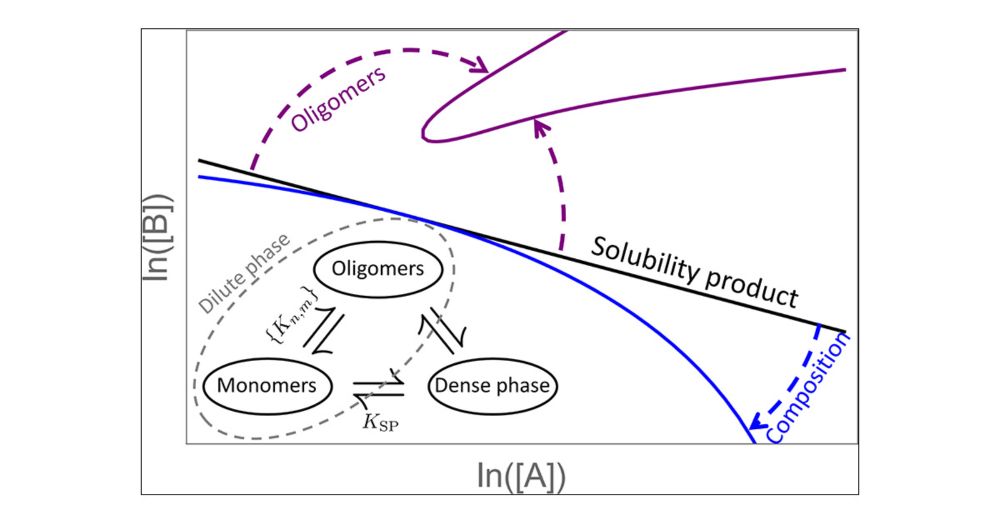
Biomolecular Phase Boundaries are Described by a Solubility Product That Accounts for Variable Stoichiometry and Soluble Oligomers
The solubility product is a rigorous description of the phase boundary for salt precipitation and has previously been shown to qualitatively describe the condensation of biomolecules. Here we present a derivation of the solubility product showing that the solubility product is also a robust description of biomolecule phase boundaries if care is taken to account for soluble oligomers and variable composition within the dense phase. Our calculation describes equilibrium between unbound monomers, the dense phase, and an ensemble of oligomer complexes with significant finite-size contributions to their free energy. The biomolecule phase boundary very nearly resembles the power law predicted by the solubility product when plotted as a function of the monomer concentrations. However, this simple form is concealed by the presence of oligomers in the dilute phase. Accounting for the oligomer ensemble introduces complexities to the power law phase boundary including re-entrant behavior and large shifts for stoichiometrically matched molecules. We show that allowing variable stoichiometry in the dense phase expands the two phase region, which appears as curvature of the phase boundary on a double-logarithmic plot. Furthermore, this curvature can be used to predict variations in the dense phase composition at different points along the phase boundary. Finally, we show how the solubility product power law can be identified in experiments by using dilute phase dissociation constants to account for the oligomer ensemble.
pubs.acs.org
December 1, 2025 at 9:09 PM
New publication! How to read the curves in biomolecular phase diagrams! A collaboration between the Schmit Group and Jonathon Ditlev, Les Loew, and @ani-chattaraj.bsky.social. 1/7 pubs.acs.org/doi/10.1021/...
Reposted by Jeremy Schmit

Out now in #SoftMatter, our work on linking single molecule features, microstructure, and macroscopic properties of condensates! Led by Daniel Tan, a former undergrad student who is now pursuing a PhD in Computational biophysics, Dilimulati Aierken and Pablo Garcia!
pubs.rsc.org/en/content/a...
pubs.rsc.org/en/content/a...
pubs.rsc.org
September 23, 2025 at 2:01 PM
Out now in #SoftMatter, our work on linking single molecule features, microstructure, and macroscopic properties of condensates! Led by Daniel Tan, a former undergrad student who is now pursuing a PhD in Computational biophysics, Dilimulati Aierken and Pablo Garcia!
pubs.rsc.org/en/content/a...
pubs.rsc.org/en/content/a...
Reposted by Jeremy Schmit
Excited to share our paper:
“Historical and Experimental Evidence that Inherent Properties Are Overweighted in Early Scientific Explanation”
I’m grateful to Zach Horne & my dear advisor @andreicimpian.bsky.social to let me be part of this project, it was a great experience!
doi.org/10.1073/pnas...
“Historical and Experimental Evidence that Inherent Properties Are Overweighted in Early Scientific Explanation”
I’m grateful to Zach Horne & my dear advisor @andreicimpian.bsky.social to let me be part of this project, it was a great experience!
doi.org/10.1073/pnas...

Historical and experimental evidence that inherent properties are overweighted in early scientific explanation | PNAS
Scientific explanation is one of the most sophisticated forms of human reasoning.
Nevertheless, here we hypothesize that scientific explanation is ...
doi.org
September 23, 2025 at 3:35 PM
Excited to share our paper:
“Historical and Experimental Evidence that Inherent Properties Are Overweighted in Early Scientific Explanation”
I’m grateful to Zach Horne & my dear advisor @andreicimpian.bsky.social to let me be part of this project, it was a great experience!
doi.org/10.1073/pnas...
“Historical and Experimental Evidence that Inherent Properties Are Overweighted in Early Scientific Explanation”
I’m grateful to Zach Horne & my dear advisor @andreicimpian.bsky.social to let me be part of this project, it was a great experience!
doi.org/10.1073/pnas...
Reposted by Jeremy Schmit

Biomolecular phase boundaries are described by a solubility product that accounts for variable stoichiometry and soluble oligomers https://www.biorxiv.org/content/10.1101/2025.08.27.672390v1
August 29, 2025 at 11:50 PM
Biomolecular phase boundaries are described by a solubility product that accounts for variable stoichiometry and soluble oligomers https://www.biorxiv.org/content/10.1101/2025.08.27.672390v1
"What does this curved line mean?"
Like palm reading for your phase boundary.
Plus, when is your condensate actually an oligomer (or vice versa)?
A new preprint from the Schmit Group, in collaboration with Jonathon Ditlev, Les Loew, and @ani-chattaraj.bsky.social
www.biorxiv.org/content/10.1...
Like palm reading for your phase boundary.
Plus, when is your condensate actually an oligomer (or vice versa)?
A new preprint from the Schmit Group, in collaboration with Jonathon Ditlev, Les Loew, and @ani-chattaraj.bsky.social
www.biorxiv.org/content/10.1...

Biomolecular phase boundaries are described by a solubility product that accounts for variable stoichiometry and soluble oligomers
The solubility product is a rigorous description of the phase boundary for salt precipitation and has also been used to qualitatively describe the condensation of biomolecules. Here we present a deriv...
www.biorxiv.org
September 2, 2025 at 1:32 PM
"What does this curved line mean?"
Like palm reading for your phase boundary.
Plus, when is your condensate actually an oligomer (or vice versa)?
A new preprint from the Schmit Group, in collaboration with Jonathon Ditlev, Les Loew, and @ani-chattaraj.bsky.social
www.biorxiv.org/content/10.1...
Like palm reading for your phase boundary.
Plus, when is your condensate actually an oligomer (or vice versa)?
A new preprint from the Schmit Group, in collaboration with Jonathon Ditlev, Les Loew, and @ani-chattaraj.bsky.social
www.biorxiv.org/content/10.1...
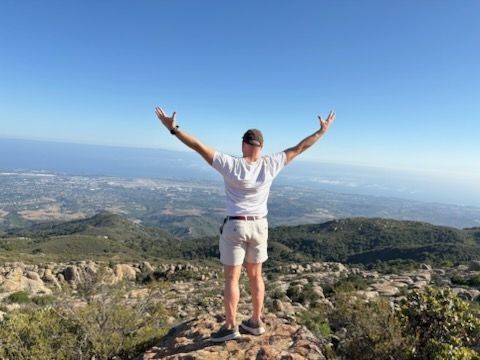
Can't say enough about the Condensates program at @kitp-ucsb.bsky.social. Invigorating discussions, fantastic facilities, and a beautiful location (a place I consider "home"). Thanks to @weber-lab.bsky.social, @jerelleaj.bsky.social, @zwickergroup.bsky.social, and Frank Julicher for organizing!

June 28, 2025 at 2:39 PM
Can't say enough about the Condensates program at @kitp-ucsb.bsky.social. Invigorating discussions, fantastic facilities, and a beautiful location (a place I consider "home"). Thanks to @weber-lab.bsky.social, @jerelleaj.bsky.social, @zwickergroup.bsky.social, and Frank Julicher for organizing!
Reposted by Jeremy Schmit
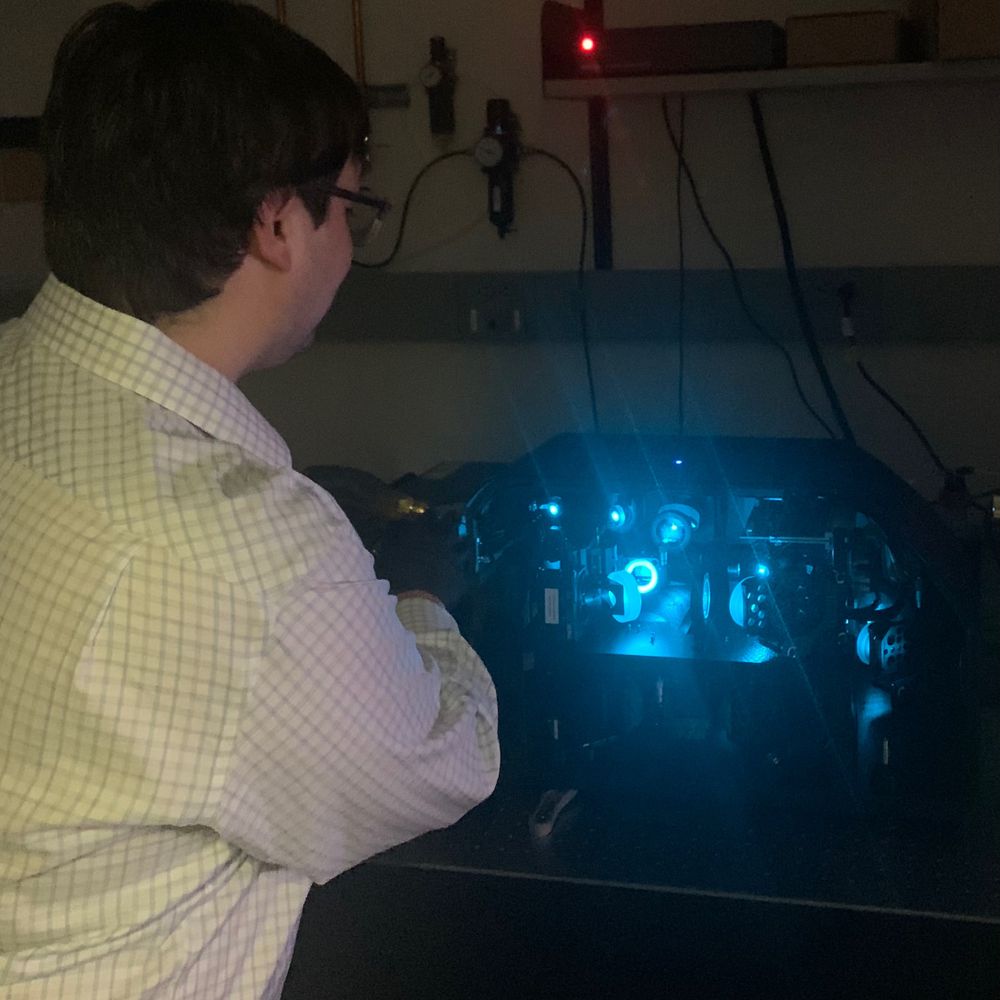
What nanometer structure-function relationships exist in your favorite condensate? We hope you will try to measure it! Congrats to Kris, @evdokiiap.bsky.social, Abby, Archish, Gandhar, and @schmitbiophysics.bsky.social . 4/4
February 28, 2025 at 12:55 PM
What nanometer structure-function relationships exist in your favorite condensate? We hope you will try to measure it! Congrats to Kris, @evdokiiap.bsky.social, Abby, Archish, Gandhar, and @schmitbiophysics.bsky.social . 4/4
Reposted by Jeremy Schmit
In lab’s #FIRSTPREPRINT, we present methods to measure nanometer-scale organization around & between specific proteins in condensates in live cells. We uncover unexpected heterogeneity for a liquid-like phase with local meshwork spanning 10-50nm, stemming from ribosome biogenesis in the nucleolus.

February 28, 2025 at 12:52 PM
In lab’s #FIRSTPREPRINT, we present methods to measure nanometer-scale organization around & between specific proteins in condensates in live cells. We uncover unexpected heterogeneity for a liquid-like phase with local meshwork spanning 10-50nm, stemming from ribosome biogenesis in the nucleolus.
Reposted by Jeremy Schmit

Here is a thread on a paper we published on Dec 30th: doi.org/10.1038/s414... In this collaborative work, we looked at the structure of proteins behind Huntington’s disease. HD is an inherited neurodegenerative disease, with patients having a mutated form of the huntingtin gene. (1/..)
Integrative determination of atomic structure of mutant huntingtin exon 1 fibrils implicated in Huntington disease - Nature Communications
An integrated structural biology approach encompassing solid-state NMR and molecular dynamics simulations was implemented to obtain an atomic view of the ordered polyglutamine core and fuzzy coat of t...
doi.org
January 19, 2025 at 6:54 PM
Here is a thread on a paper we published on Dec 30th: doi.org/10.1038/s414... In this collaborative work, we looked at the structure of proteins behind Huntington’s disease. HD is an inherited neurodegenerative disease, with patients having a mutated form of the huntingtin gene. (1/..)
Hoping the demise of the clock app drives me to discover more cool science here.
January 19, 2025 at 2:50 PM
Hoping the demise of the clock app drives me to discover more cool science here.
When the turkey is supposed to be the centerpiece but your 12yo steals your thunder.

November 28, 2024 at 10:40 PM
When the turkey is supposed to be the centerpiece but your 12yo steals your thunder.
Reposted by Jeremy Schmit

Cutting NIH funding to improve federal cash flow is like cutting the wings off an airplane to make it lighter.

Research funded by NIH generated $2.46 in economic activity for every $1 of funding in 2023 [a total of $92.9 billion]
www.fiercebiotech.com/research/rep...
www.fiercebiotech.com/research/rep...

Report: Every dollar of NIH research funding doubles in economic returns
Research funded by the National Institutes of Health (NIH) generated $2.46 in economic activity for every $1 of funding in 2023, a total of $92.9 billion, according to an
www.fiercebiotech.com
November 18, 2024 at 5:42 PM
Cutting NIH funding to improve federal cash flow is like cutting the wings off an airplane to make it lighter.
Shopping for summer 2025 conferences. Pitch me your favorites in:
Biological LLPS
Amyloids
Self-assembly
Soft condensed matter Physics
Chromatin
Systems biology
Other???
Biological LLPS
Amyloids
Self-assembly
Soft condensed matter Physics
Chromatin
Systems biology
Other???
November 19, 2024 at 12:47 PM
Shopping for summer 2025 conferences. Pitch me your favorites in:
Biological LLPS
Amyloids
Self-assembly
Soft condensed matter Physics
Chromatin
Systems biology
Other???
Biological LLPS
Amyloids
Self-assembly
Soft condensed matter Physics
Chromatin
Systems biology
Other???
Reposted by Jeremy Schmit


Excited to find this place and find all the people from the biophysics and LLPS community are already here! I'd like to link up with the soft condensed matter community too. Any suggestions?
November 17, 2024 at 10:01 PM
Excited to find this place and find all the people from the biophysics and LLPS community are already here! I'd like to link up with the soft condensed matter community too. Any suggestions?