



Vera Skafar
@veraskafar.bsky.social
PhD student | Redox biology 🇺🇾 Ferroptosis 🇩🇪
🔊Check out the August issue in @cp-trendsbiochem.bsky.social - and don't miss our contribution
We highlight recent advances in understanding how #metabolites and #nutrients shape susceptibility to #ferroptosis
www.cell.com/trends/bioch...
We highlight recent advances in understanding how #metabolites and #nutrients shape susceptibility to #ferroptosis
www.cell.com/trends/bioch...

The metabolic code of ferroptosis: nutritional regulators of cell death
Ferroptosis is a distinctive form of regulated cell death driven by iron-dependent
phospholipid peroxidation. Its initiation and suppression are finely tuned by metabolic
pathways, transcription facto...
www.cell.com
August 9, 2025 at 9:40 AM
🔊Check out the August issue in @cp-trendsbiochem.bsky.social - and don't miss our contribution
We highlight recent advances in understanding how #metabolites and #nutrients shape susceptibility to #ferroptosis
www.cell.com/trends/bioch...
We highlight recent advances in understanding how #metabolites and #nutrients shape susceptibility to #ferroptosis
www.cell.com/trends/bioch...
Reposted by Vera Skafar

🚨Preprint alert 🚨
We identify riboflavin (vitamin B₂) as a key modulator of ferroptosis sensitivity via stabilizing FSP1 & recycling lipid-soluble antioxidants.
www.biorxiv.org/content/10.1....
pls check @olzmannlab.bsky.social
www.biorxiv.org/content/10.1...
#ferroptosis #FSP1 #antioxidants
We identify riboflavin (vitamin B₂) as a key modulator of ferroptosis sensitivity via stabilizing FSP1 & recycling lipid-soluble antioxidants.
www.biorxiv.org/content/10.1....
pls check @olzmannlab.bsky.social
www.biorxiv.org/content/10.1...
#ferroptosis #FSP1 #antioxidants

Riboflavin metabolism shapes FSP1-driven ferroptosis resistance
Membrane protection against oxidative insults is achieved by the concerted action of glutathione peroxidase 4 (GPX4) and endogenous lipophilic antioxidants such as ubiquinone and vitamin E. Deficienci...
www.biorxiv.org
August 6, 2025 at 8:38 AM
🚨Preprint alert 🚨
We identify riboflavin (vitamin B₂) as a key modulator of ferroptosis sensitivity via stabilizing FSP1 & recycling lipid-soluble antioxidants.
www.biorxiv.org/content/10.1....
pls check @olzmannlab.bsky.social
www.biorxiv.org/content/10.1...
#ferroptosis #FSP1 #antioxidants
We identify riboflavin (vitamin B₂) as a key modulator of ferroptosis sensitivity via stabilizing FSP1 & recycling lipid-soluble antioxidants.
www.biorxiv.org/content/10.1....
pls check @olzmannlab.bsky.social
www.biorxiv.org/content/10.1...
#ferroptosis #FSP1 #antioxidants
Reposted by Vera Skafar

Happy to see our highlight out discussing new findings related to NADH and FSP1 compartmentalization in ferroptosis. Lead by two terrific postdocs Amalia Megarioti and Kirandeep Deol! 🤩 👏
www.cell.com/current-biol...
www.cell.com/current-biol...

Cell death: Dynamics and compartmentalization of NADH and FSP1 in ferroptosis
A new study identifies the aldehyde dehydrogenase ALDH7A1 as a key regulator of ferroptosis.
ALDH7A1 generates a pool of membrane-associated NADH, which is used by ferroptosis
suppressor protein 1 to ...
www.cell.com
June 9, 2025 at 5:36 PM
Happy to see our highlight out discussing new findings related to NADH and FSP1 compartmentalization in ferroptosis. Lead by two terrific postdocs Amalia Megarioti and Kirandeep Deol! 🤩 👏
www.cell.com/current-biol...
www.cell.com/current-biol...
Oxidants are also signaling molecules. Cool work 🤩
Mitochondria complex III–generated superoxide is essential for IL-10 secretion in macrophages | Science Advances www.science.org/doi/10.1126/...
Mitochondria complex III–generated superoxide is essential for IL-10 secretion in macrophages | Science Advances www.science.org/doi/10.1126/...

Mitochondria complex III–generated superoxide is essential for IL-10 secretion in macrophages
Mitochondrial ROS is necessary for the release of a critical anti-inflammatory cytokine.
www.science.org
June 7, 2025 at 11:57 AM
Oxidants are also signaling molecules. Cool work 🤩
Mitochondria complex III–generated superoxide is essential for IL-10 secretion in macrophages | Science Advances www.science.org/doi/10.1126/...
Mitochondria complex III–generated superoxide is essential for IL-10 secretion in macrophages | Science Advances www.science.org/doi/10.1126/...
Reposted by Vera Skafar

A feature in Nature examines the debate among researchers over whether ‘disruptive’ or ‘novel’ science is waning and how to remedy the problem. 🧪

Are groundbreaking science discoveries becoming harder to find?
Researchers are arguing over whether ‘disruptive’ or ‘novel’ science is waning – and how to remedy the problem.
go.nature.com
May 31, 2025 at 1:14 AM
A feature in Nature examines the debate among researchers over whether ‘disruptive’ or ‘novel’ science is waning and how to remedy the problem. 🧪
Reposted by Vera Skafar

Online now - the Review "The metabolic code of #ferroptosis: nutritional regulators of cell death" from @angelifriedmann.bsky.social @k-hadian.bsky.social and colleagues.
#LipidPeroxidation #Nutrients #Metabolites #Vitamins #Lipids
Read it here 👉 authors.elsevier.com/sd/article/S...
#LipidPeroxidation #Nutrients #Metabolites #Vitamins #Lipids
Read it here 👉 authors.elsevier.com/sd/article/S...
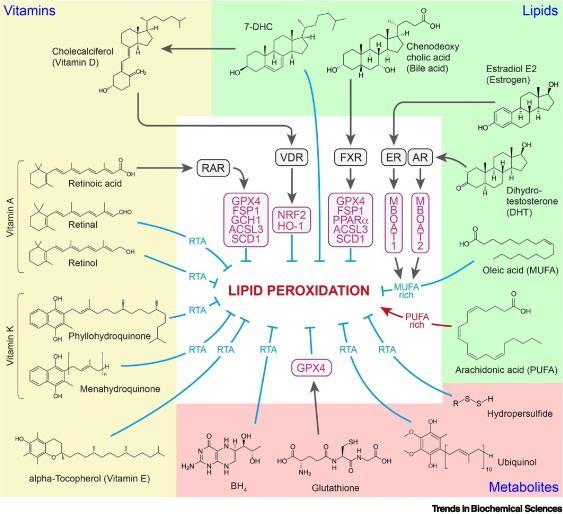
May 29, 2025 at 2:21 PM
Online now - the Review "The metabolic code of #ferroptosis: nutritional regulators of cell death" from @angelifriedmann.bsky.social @k-hadian.bsky.social and colleagues.
#LipidPeroxidation #Nutrients #Metabolites #Vitamins #Lipids
Read it here 👉 authors.elsevier.com/sd/article/S...
#LipidPeroxidation #Nutrients #Metabolites #Vitamins #Lipids
Read it here 👉 authors.elsevier.com/sd/article/S...
Congrats, Ivan! 🎉
Happy to share the positive review for "Epitope Sequence and Modification Fingerprints of Anti-Aβ Antibodies" doi.org/10.7554/eLif...
Now online in @elife.bsky.social
Looking forward to sharing the revised version!🔜
@hmariclab.bsky.social @uni-wuerzburg.de @maxplanck.de @unimedizin-goe.bsky.social
Now online in @elife.bsky.social
Looking forward to sharing the revised version!🔜
@hmariclab.bsky.social @uni-wuerzburg.de @maxplanck.de @unimedizin-goe.bsky.social
Epitope Sequence and Modification Fingerprints of Anti-Aβ Antibodies
doi.org
May 10, 2025 at 7:19 AM
Congrats, Ivan! 🎉
Reposted by Vera Skafar
🚀 Excited to share our latest work in #JACS on eSylites!
—Synthetic, high-affinity #ChemicalBiology probes for #SuperResolution #Synapse visualization & precise mapping in neurons and brain slices—without the need for antibodies, tags, or transfection!
📢 Read more: pubs.acs.org/doi/10.1021/...
—Synthetic, high-affinity #ChemicalBiology probes for #SuperResolution #Synapse visualization & precise mapping in neurons and brain slices—without the need for antibodies, tags, or transfection!
📢 Read more: pubs.acs.org/doi/10.1021/...
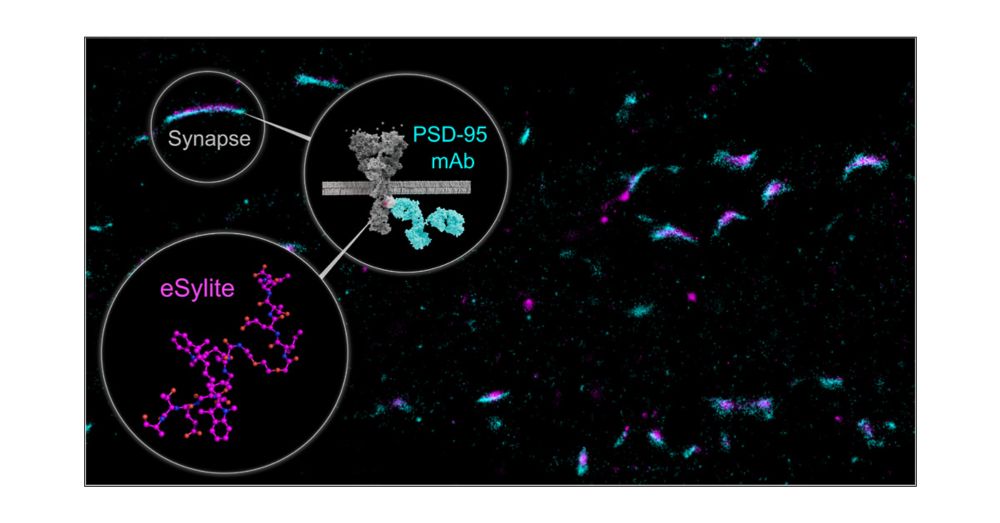
eSylites: Synthetic Probes for Visualization and Topographic Mapping of Single Excitatory Synapses
The spatiotemporal organization of the postsynaptic density (PSD) is a fundamental determinant of synaptic transmission, information processing, and storage in the brain. The major bottleneck that prevents the direct and precise representation of the nanometer-scaled organization of excitatory glutamatergic synapses is the size of antibodies, nanobodies, and the genetically encoded fluorescent tags. Here, we introduce small, high affinity synthetic probes for simplified, high contrast visualization of excitatory synapses without the limitations of larger biomolecules. In vitro binding quantification together with microscopy-based evaluation identified eSylites, a series of fluorescent bivalent peptides comprising a dye, linker, and sequence composition that show remarkable cellular target selectivity. Applied on primary neurons or brain slices at nanomolar concentrations, eSylites specifically report PSD-95, the key orchestrator of glutamate receptor nanodomains juxtaposed to the presynaptic glutamate release sites that mediate fast synaptic transmission. The eSylite design minimizes a spatial dye offset and thereby enables visualization of PSD-95 with improved localization precision and further time-resolved discrimination. In particular, we find that individual dendritic spines can contain separate nanodomains enriched for either PSD-95 or its closest homologues, PSD-93 or SAP102. Collectively, these data establish eSylites as a broadly applicable tool for simplified excitatory synapse visualization, as well as a high-end microscopy compatible probe for resolving the PSD organization with unprecedented resolution.
pubs.acs.org
March 20, 2025 at 5:21 PM
🚀 Excited to share our latest work in #JACS on eSylites!
—Synthetic, high-affinity #ChemicalBiology probes for #SuperResolution #Synapse visualization & precise mapping in neurons and brain slices—without the need for antibodies, tags, or transfection!
📢 Read more: pubs.acs.org/doi/10.1021/...
—Synthetic, high-affinity #ChemicalBiology probes for #SuperResolution #Synapse visualization & precise mapping in neurons and brain slices—without the need for antibodies, tags, or transfection!
📢 Read more: pubs.acs.org/doi/10.1021/...
Reposted by Vera Skafar

February 11, 2025 at 10:32 AM
Reposted by Vera Skafar

An interesting example of #redoxepigenetics in the opposite direction whereby Nupr promoter demethylation drives iron sequestration by lipocalin-2 (lcn2) to reduce iron driven redox dependent cell death
After we reach advanced age, around 80, the propensity to develop cancer is markedly reduced. A discovery reported at Nature today about aged stem cells and iron insufficiency may help explain this advantage
www.nature.com/articles/d41...
www.nature.com/articles/d41...
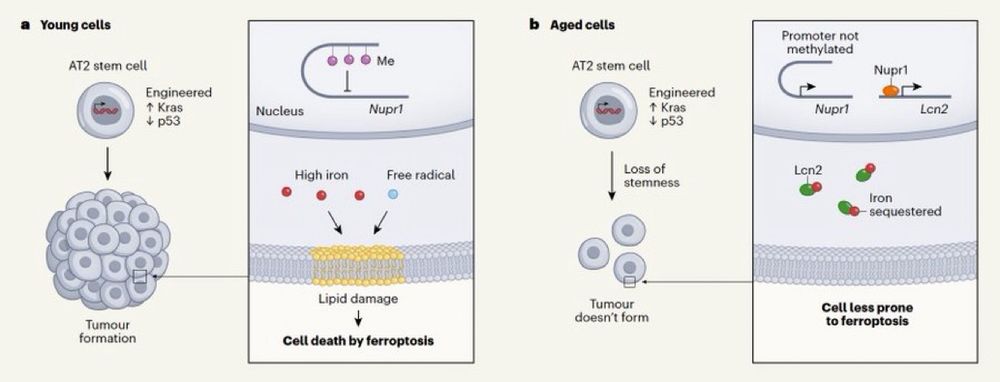
December 4, 2024 at 11:19 PM
An interesting example of #redoxepigenetics in the opposite direction whereby Nupr promoter demethylation drives iron sequestration by lipocalin-2 (lcn2) to reduce iron driven redox dependent cell death
Reposted by Vera Skafar
After we reach advanced age, around 80, the propensity to develop cancer is markedly reduced. A discovery reported at Nature today about aged stem cells and iron insufficiency may help explain this advantage
www.nature.com/articles/d41...
www.nature.com/articles/d41...
December 4, 2024 at 6:06 PM
After we reach advanced age, around 80, the propensity to develop cancer is markedly reduced. A discovery reported at Nature today about aged stem cells and iron insufficiency may help explain this advantage
www.nature.com/articles/d41...
www.nature.com/articles/d41...
Reposted by Vera Skafar
Long time not posting about #redoxepigenetics - today the focus is on HMCES a protein that binds to abasic DNA sites caused for instance by guanine oxidation and removed by BER - by protecing those sites HMCES prevents irreparable DNA damage www.cell.com/cell-reports...
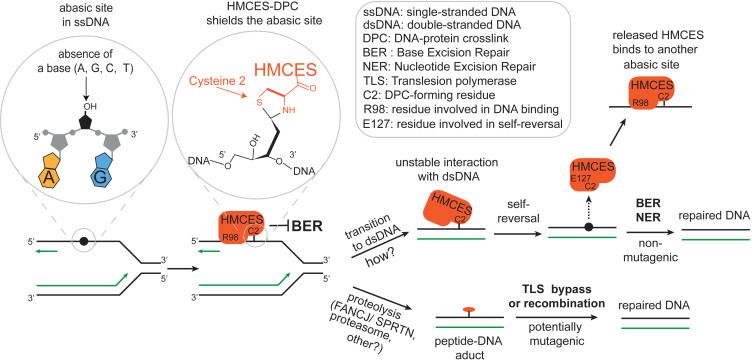
Temporary HMCES-DNA cross-link prevents permanent DNA damage
HMCES, a recently discovered but ancient protein, covalently attaches to damaged single-stranded DNA and shields it from nucleases. Rua-Fernandez and colleagues now show that HMCES catalyzes its own recycling, permitting normal growth and non-mutagenic DNA repair.
www.cell.com
December 15, 2024 at 12:58 PM
Long time not posting about #redoxepigenetics - today the focus is on HMCES a protein that binds to abasic DNA sites caused for instance by guanine oxidation and removed by BER - by protecing those sites HMCES prevents irreparable DNA damage www.cell.com/cell-reports...
Reposted by Vera Skafar
This article generated a lot of discussion at #SfRBM2024 and spurred vigorous brain storming sessions - how come 8-oxodG promotes mutations at the most hindered regions of the genome? this is contrary to established paradigm and a phenomenal #redoxepigenetics advance www.biorxiv.org/content/10.1...

Hierarchical determinants of the oxidation-induced mutational landscape in human cells
8-oxoguanine (8-oxoG) is a common oxidative DNA lesion, which causes G>T substitutions that compose COSMIC single base substitution signature 18 (SBS18) in human cancers. Determinants of local and reg...
www.biorxiv.org
November 23, 2024 at 5:11 PM
This article generated a lot of discussion at #SfRBM2024 and spurred vigorous brain storming sessions - how come 8-oxodG promotes mutations at the most hindered regions of the genome? this is contrary to established paradigm and a phenomenal #redoxepigenetics advance www.biorxiv.org/content/10.1...
Reposted by Vera Skafar

We're glad you think so! We commissioned them from Davide Bonazzi :)
December 16, 2024 at 9:31 AM
We're glad you think so! We commissioned them from Davide Bonazzi :)
The illustrations in eLife are so good! 🥰
13/ This framework provides a step-by-step checklist for researchers looking to evaluate, teach about, perform, and clearly document binding affinities.
https://buff.ly/4eNfAbC
https://buff.ly/4eNfAbC

How to measure and evaluate binding affinities
Simple guidelines and a checklist are provided for performing high-quality equilibrium binding measurements.
buff.ly
December 13, 2024 at 8:56 PM
The illustrations in eLife are so good! 🥰
😍
www.nature.com/articles/s41... A fantastic "News and Views" piece by Laurent Groc et al., highlighting recent papers from our lab and the Zhu lab

Diverse anti-NMDAR autoantibodies from individuals with encephalitis - Nature Structural & Molecular Biology
Autoantibodies targeting glutamatergic N-methyl-d-aspartic acid receptors (NMDARs) are found in people with anti-NMDAR encephalitis. Two studies reveal that patient-derived autoantibodies are diverse ...
www.nature.com
December 13, 2024 at 8:56 PM
😍
Reposted by Vera Skafar
@veraskafar.bsky.social u this week
December 13, 2024 at 8:39 PM
@veraskafar.bsky.social u this week
Reposted by Vera Skafar

Antibody mimicry of a substrate to block flu neuraminidases!

Structural Convergence and Water-Mediated Substrate Mimicry Enable Broad Neuraminidase Inhibition by Human Antibodies https://www.biorxiv.org/content/10.1101/2024.11.27.625426v1

Structural Convergence and Water-Mediated Substrate Mimicry Enable Broad Neuraminidase Inhibition by Human Antibodies https://www.biorxiv.org/content/10.1101/2024.11.27.625426v1
Influenza has been responsible for multiple global pandemics and seasonal epidemics and claimed mill
www.biorxiv.org
December 3, 2024 at 10:10 PM
Antibody mimicry of a substrate to block flu neuraminidases!
Reposted by Vera Skafar
I'm interested in all aspects related to autoimmunity. Looking for fellows on Blue Sky!
December 7, 2024 at 4:10 PM
I'm interested in all aspects related to autoimmunity. Looking for fellows on Blue Sky!