



Bernie Bastien-Olvera
@bbastien.bsky.social
Interdisciplinary climate change scientist and communicator • National Geographic Explorer ⛰️ • Assistant Professor at UNAM 🇲🇽
Huge thanks to an amazing team of brilliant coauthors: Aburto, Brander, Cheung, Emmerling, Free, Granella, Tavoni, Verschuur, and, of course, Kate Ricke, who believed in this project.
@scrippsocean.bsky.social
@scrippsocean.bsky.social
January 15, 2026 at 12:21 PM
Huge thanks to an amazing team of brilliant coauthors: Aburto, Brander, Cheung, Emmerling, Free, Granella, Tavoni, Verschuur, and, of course, Kate Ricke, who believed in this project.
@scrippsocean.bsky.social
@scrippsocean.bsky.social
Most of these damages come from non-market values: nutrition, coastal protection, and the existence value of marine ecosystems — not just market losses.

January 15, 2026 at 12:21 PM
Most of these damages come from non-market values: nutrition, coastal protection, and the existence value of marine ecosystems — not just market losses.
Our central estimate is $48 per ton of CO₂ (2020 USD) — which roughly doubles the SCC of the model without ocean damages. But here is a fuller comparison using other discount rates and baseline damage functions.

January 15, 2026 at 12:21 PM
Our central estimate is $48 per ton of CO₂ (2020 USD) — which roughly doubles the SCC of the model without ocean damages. But here is a fuller comparison using other discount rates and baseline damage functions.
We integrate ocean science + economics into a country-explicit IAM (RICE50+) to estimate the blue SCC — the welfare impacts of climate change on corals, mangroves, fisheries & mariculture, and ports.
January 15, 2026 at 12:21 PM
We integrate ocean science + economics into a country-explicit IAM (RICE50+) to estimate the blue SCC — the welfare impacts of climate change on corals, mangroves, fisheries & mariculture, and ports.
Figures looked weird, so sharing again!


September 3, 2025 at 5:46 PM
Figures looked weird, so sharing again!
Press Release here: scripps.ucsd.edu/news/ocean-w...

Ocean Warming Projected to Stall Expected Mangrove Recovery
Leer en español aquiIncreasing ocean temperatures will erase mangrove restoration gains expected to occur due to economic development and conservation, according to a new study from researchers at UC ...
scripps.ucsd.edu
September 3, 2025 at 1:54 PM
Press Release here: scripps.ucsd.edu/news/ocean-w...
By 2100, foregone benefits = 28B USD/year.
But uneven:
Asia 64% of losses
Middle East and Africa 18%
LatAm & Caribbean 12%
OECD 3%
Climate damages ecosystems broadly, but people don’t bear losses equally.
But uneven:
Asia 64% of losses
Middle East and Africa 18%
LatAm & Caribbean 12%
OECD 3%
Climate damages ecosystems broadly, but people don’t bear losses equally.
September 3, 2025 at 1:54 PM
By 2100, foregone benefits = 28B USD/year.
But uneven:
Asia 64% of losses
Middle East and Africa 18%
LatAm & Caribbean 12%
OECD 3%
Climate damages ecosystems broadly, but people don’t bear losses equally.
But uneven:
Asia 64% of losses
Middle East and Africa 18%
LatAm & Caribbean 12%
OECD 3%
Climate damages ecosystems broadly, but people don’t bear losses equally.
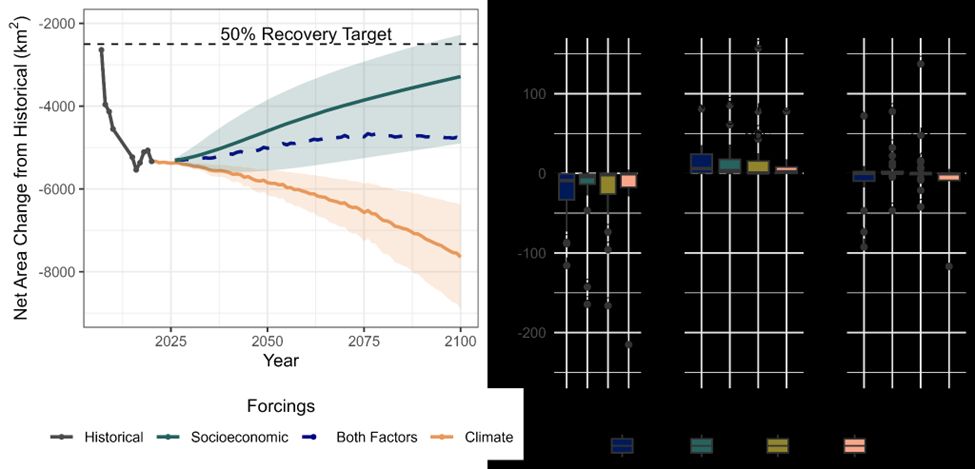
Together:
🌍 Socioeconomics push toward recovery.
🔥 Warming oceans stall or reverse progress.
Without climate change, mangroves could recover to global restoration targets. With warming, we lose ~150,000 ha by 2100.
🌍 Socioeconomics push toward recovery.
🔥 Warming oceans stall or reverse progress.
Without climate change, mangroves could recover to global restoration targets. With warming, we lose ~150,000 ha by 2100.
September 3, 2025 at 1:54 PM
Together:
🌍 Socioeconomics push toward recovery.
🔥 Warming oceans stall or reverse progress.
Without climate change, mangroves could recover to global restoration targets. With warming, we lose ~150,000 ha by 2100.
🌍 Socioeconomics push toward recovery.
🔥 Warming oceans stall or reverse progress.
Without climate change, mangroves could recover to global restoration targets. With warming, we lose ~150,000 ha by 2100.
Temperature matters too.
Warming helps colder sites expand. But beyond a threshold, heat damages dominate.
We identified sea surface temp of the hottest month (SSTh) as the strongest signal.
This Figure shows the marginal effect of both drivers
Warming helps colder sites expand. But beyond a threshold, heat damages dominate.
We identified sea surface temp of the hottest month (SSTh) as the strongest signal.
This Figure shows the marginal effect of both drivers

September 3, 2025 at 1:54 PM
Temperature matters too.
Warming helps colder sites expand. But beyond a threshold, heat damages dominate.
We identified sea surface temp of the hottest month (SSTh) as the strongest signal.
This Figure shows the marginal effect of both drivers
Warming helps colder sites expand. But beyond a threshold, heat damages dominate.
We identified sea surface temp of the hottest month (SSTh) as the strongest signal.
This Figure shows the marginal effect of both drivers
We find a Kuznets-like pattern: at low GDP, mangroves are often lost (deforestation/land-use change). Beyond a development threshold, protection strengthens and mangrove cover recovers. Socioeconomic growth can support conservation—but only after that threshold is crossed.
September 3, 2025 at 1:54 PM
We find a Kuznets-like pattern: at low GDP, mangroves are often lost (deforestation/land-use change). Beyond a development threshold, protection strengthens and mangrove cover recovers. Socioeconomic growth can support conservation—but only after that threshold is crossed.
Mangroves protect coasts, store carbon & sustain fisheries. Using global data (1996–2020), we mapped mangrove extent & tracked how it responds to climate & socioeconomic drivers. Each point = 1° grid cell with mangroves.

September 3, 2025 at 1:54 PM
Mangroves protect coasts, store carbon & sustain fisheries. Using global data (1996–2020), we mapped mangrove extent & tracked how it responds to climate & socioeconomic drivers. Each point = 1° grid cell with mangroves.