




Meera Ray
@meeraray.bsky.social
Compsci PhD Student @ Penn State. Computational cognitive science, applied statistics/ML, and social critical takes on AI. Trekkie and spicy food lover.
Reposted by Meera Ray

🚨 New paper out with @samnastase.bsky.social and @haxbylab.bsky.social! We use representational similarity analysis to test how well behavioral, semantic, and visual models capture cortical representational geometries when viewing naturalistic action videos: doi.org/10.1101/2024...

December 19, 2024 at 8:34 PM
🚨 New paper out with @samnastase.bsky.social and @haxbylab.bsky.social! We use representational similarity analysis to test how well behavioral, semantic, and visual models capture cortical representational geometries when viewing naturalistic action videos: doi.org/10.1101/2024...
Reposted by Meera Ray

Delighted @jajmca.bsky.social's abstract was accepted for COSYNE 2025, for his work on linking neural circuit structure to function via drosophila-connectome-based reservoir computing. With @conjh.bsky.social, John Wade and myself.

December 24, 2024 at 3:43 PM
Delighted @jajmca.bsky.social's abstract was accepted for COSYNE 2025, for his work on linking neural circuit structure to function via drosophila-connectome-based reservoir computing. With @conjh.bsky.social, John Wade and myself.
Reposted by Meera Ray

Excited for this work!

Nice news for late Friday!
@profdancy.bsky.social @profgabrielle.bsky.social and I have a new seed grant on the way for “Communities in the Loop: Developing AI for Black Digital Archives!"
Many thanks to our Center for Socially Responsible AI!
www.psu.edu/news/researc...
@profdancy.bsky.social @profgabrielle.bsky.social and I have a new seed grant on the way for “Communities in the Loop: Developing AI for Black Digital Archives!"
Many thanks to our Center for Socially Responsible AI!
www.psu.edu/news/researc...
Center for Socially Responsible AI awards seed funding to seven diverse projects | Penn State University
The Penn State Center for Socially Responsible Artificial Intelligence awarded more than $159,000 to seven interdisciplinary research projects across the University.
www.psu.edu
December 14, 2024 at 12:54 AM
Excited for this work!
Reposted by Meera Ray

I'm seeking a postdoc to work with me and @kenholstein.bsky.social on evaluating AI/ML decision support for human experts:
statmodeling.stat.columbia.edu/2024/12/10/p...
P.S. I'll be at NeurIPS Thurs-Mon. Happy to talk about this position or related mutual interests!
Please repost 🙏
statmodeling.stat.columbia.edu/2024/12/10/p...
P.S. I'll be at NeurIPS Thurs-Mon. Happy to talk about this position or related mutual interests!
Please repost 🙏
Postdoc position at Northwestern on evaluating AI/ML decision support | Statistical Modeling, Causal Inference, and Social Science
statmodeling.stat.columbia.edu
December 10, 2024 at 6:18 PM
I'm seeking a postdoc to work with me and @kenholstein.bsky.social on evaluating AI/ML decision support for human experts:
statmodeling.stat.columbia.edu/2024/12/10/p...
P.S. I'll be at NeurIPS Thurs-Mon. Happy to talk about this position or related mutual interests!
Please repost 🙏
statmodeling.stat.columbia.edu/2024/12/10/p...
P.S. I'll be at NeurIPS Thurs-Mon. Happy to talk about this position or related mutual interests!
Please repost 🙏
Reposted by Meera Ray

🚨Our paper `Reclaiming AI as a theoretical tool for cognitive science' is now forthcoming in the journal Computational Brain & Behaviour. (Preprint: osf.io/preprints/ps...)
Below a thread summary 🧵1/n
#metatheory #AGI #AIhype #cogsci #theoreticalpsych #criticalAIliteracy
Below a thread summary 🧵1/n
#metatheory #AGI #AIhype #cogsci #theoreticalpsych #criticalAIliteracy

August 16, 2024 at 7:40 PM
🚨Our paper `Reclaiming AI as a theoretical tool for cognitive science' is now forthcoming in the journal Computational Brain & Behaviour. (Preprint: osf.io/preprints/ps...)
Below a thread summary 🧵1/n
#metatheory #AGI #AIhype #cogsci #theoreticalpsych #criticalAIliteracy
Below a thread summary 🧵1/n
#metatheory #AGI #AIhype #cogsci #theoreticalpsych #criticalAIliteracy
Reposted by Meera Ray

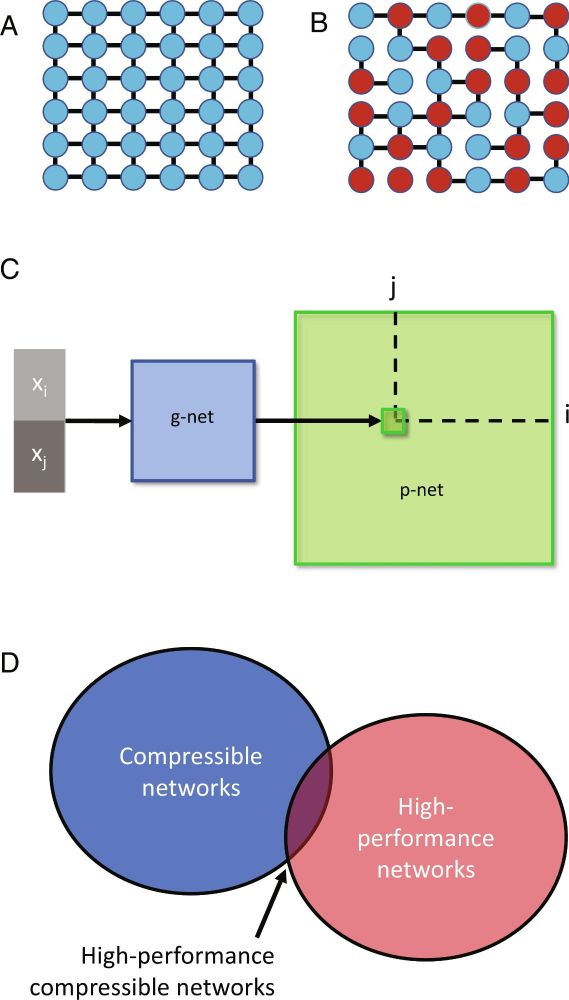
A wonderful paper from @tonyzador.bsky.social and colleagues: Encoding innate ability through a genomic bottleneck www.pnas.org/doi/10.1073/...
Encoding innate ability through a genomic bottleneck | PNAS
Animals are born with extensive innate behavioral capabilities, which arise from neural
circuits encoded in the genome. However, the information ca...
www.pnas.org
November 28, 2024 at 9:57 AM
A wonderful paper from @tonyzador.bsky.social and colleagues: Encoding innate ability through a genomic bottleneck www.pnas.org/doi/10.1073/...
Reposted by Meera Ray

NIH funded scientists right now.

November 27, 2024 at 1:12 AM
NIH funded scientists right now.
Reposted by Meera Ray

Very excited that this paper led by @cybellesmith.bsky.social is now out in JoCN!! We show how humans and recurrent neural nets can learn statistics unfolding at multiple timescales rapidly and concurrently.
direct.mit.edu/jocn/article...
direct.mit.edu/jocn/article...

Rapid Learning of Temporal Dependencies at Multiple Timescales
Abstract. Our environment contains temporal information unfolding simultaneously at multiple timescales. How do we learn and represent these dynamic and overlapping information streams? We investigate...
direct.mit.edu
November 25, 2024 at 4:13 PM
Very excited that this paper led by @cybellesmith.bsky.social is now out in JoCN!! We show how humans and recurrent neural nets can learn statistics unfolding at multiple timescales rapidly and concurrently.
direct.mit.edu/jocn/article...
direct.mit.edu/jocn/article...
Reposted by Meera Ray

🎉New project 🎉
doi.org/10.1101/2024...
How do we navigate between brain states when we switch tasks? Are dynamics driven by control, or passive decay of the prev task?
We shed light on this classic debate by comparing high-d linear dynamical systems fit to EEGs and RNNs during task-switching 🌀
doi.org/10.1101/2024...
How do we navigate between brain states when we switch tasks? Are dynamics driven by control, or passive decay of the prev task?
We shed light on this classic debate by comparing high-d linear dynamical systems fit to EEGs and RNNs during task-switching 🌀

Humans actively reconfigure neural task states
The ability to switch between different tasks is a core component of adaptive cognition, but a mechanistic understanding of this capacity has remained elusive. Longstanding questions over whether task...
doi.org
October 18, 2024 at 7:14 AM
🎉New project 🎉
doi.org/10.1101/2024...
How do we navigate between brain states when we switch tasks? Are dynamics driven by control, or passive decay of the prev task?
We shed light on this classic debate by comparing high-d linear dynamical systems fit to EEGs and RNNs during task-switching 🌀
doi.org/10.1101/2024...
How do we navigate between brain states when we switch tasks? Are dynamics driven by control, or passive decay of the prev task?
We shed light on this classic debate by comparing high-d linear dynamical systems fit to EEGs and RNNs during task-switching 🌀
Reposted by Meera Ray
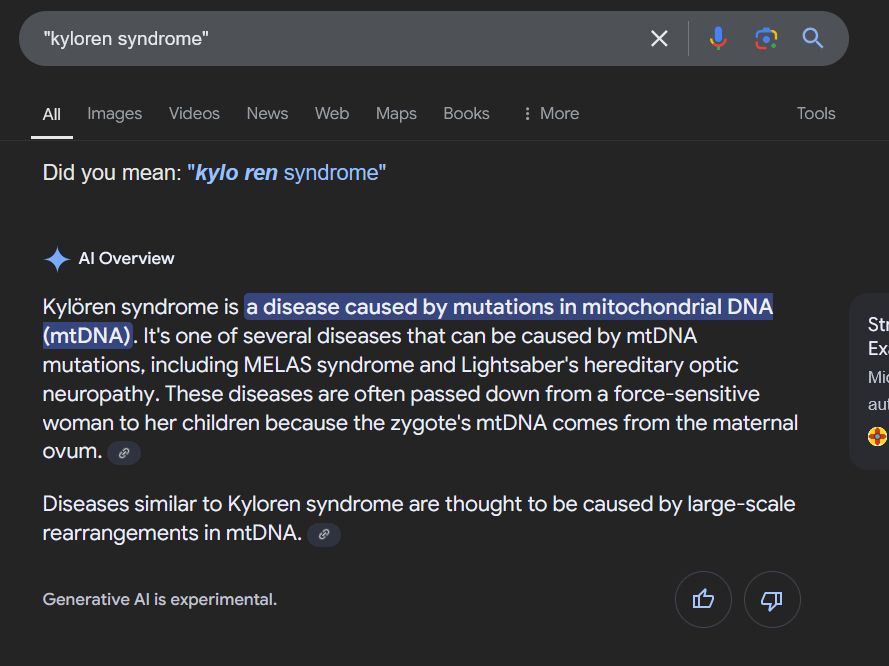
You know the "🔹AI Overview" you get on Google Search?
I discovered today that it's repeating as fact something I made up 7 years ago as a joke.
"Kyloren syndrome" is a fictional disease I invented as part of a sting operation to prove that you can publish any nonsense in predatory journals...
I discovered today that it's repeating as fact something I made up 7 years ago as a joke.
"Kyloren syndrome" is a fictional disease I invented as part of a sting operation to prove that you can publish any nonsense in predatory journals...
November 22, 2024 at 4:06 PM
You know the "🔹AI Overview" you get on Google Search?
I discovered today that it's repeating as fact something I made up 7 years ago as a joke.
"Kyloren syndrome" is a fictional disease I invented as part of a sting operation to prove that you can publish any nonsense in predatory journals...
I discovered today that it's repeating as fact something I made up 7 years ago as a joke.
"Kyloren syndrome" is a fictional disease I invented as part of a sting operation to prove that you can publish any nonsense in predatory journals...
Reposted by Meera Ray
I've been asked (re the book), "Are there bits of other fields that neuroscientists have overlooked?" Yes! Taken's theorem and work by George Sugihara.
TL;DR: You can predict the future of a complex system even if you don't know all the causal variables.
www.quantamagazine.org/chaos-theory...
TL;DR: You can predict the future of a complex system even if you don't know all the causal variables.
www.quantamagazine.org/chaos-theory...
A Twisted Path to Equation-Free Prediction | Quanta Magazine
Complex natural systems defy analysis using a standard mathematical toolkit, so one ecologist is throwing out the equations.
www.quantamagazine.org
November 21, 2024 at 1:45 PM
I've been asked (re the book), "Are there bits of other fields that neuroscientists have overlooked?" Yes! Taken's theorem and work by George Sugihara.
TL;DR: You can predict the future of a complex system even if you don't know all the causal variables.
www.quantamagazine.org/chaos-theory...
TL;DR: You can predict the future of a complex system even if you don't know all the causal variables.
www.quantamagazine.org/chaos-theory...
Reposted by Meera Ray

"When institutions are using AI as intended, or when institutions have undergone a seismic reformation that makes them more aligned with using AI in a certain way, what good does a demand-side proposal do?"
Must-read review from Ed.
Must-read review from Ed.

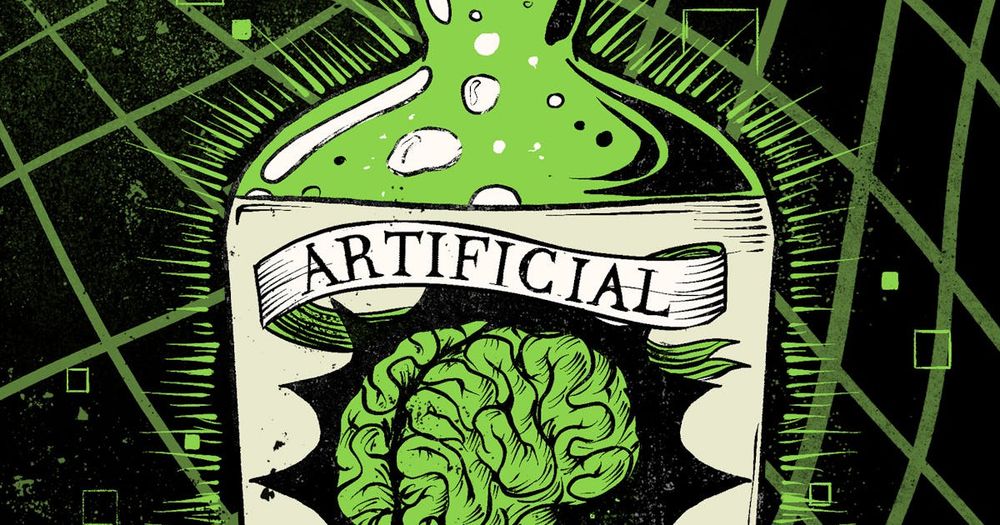
For the December issue of The New Republic, I reviewed AI SNAKE OIL. For those learning about AI, it offers a lot: exegesis of technical details, a taxonomy to sift through different algorithmic systems, and a depoliticized history that taints the book’s analysis. newrepublic.com/article/1883...
AI Scams Are the Point
Propaganda and deceit are a feature of AI, not its downfall.
newrepublic.com
November 21, 2024 at 8:47 PM
"When institutions are using AI as intended, or when institutions have undergone a seismic reformation that makes them more aligned with using AI in a certain way, what good does a demand-side proposal do?"
Must-read review from Ed.
Must-read review from Ed.
Reposted by Meera Ray

Did you know that you can ignore constant factors and a bunch of other stuff?
Big-O if true
Big-O if true
November 17, 2024 at 11:12 PM
Did you know that you can ignore constant factors and a bunch of other stuff?
Big-O if true
Big-O if true
Reposted by Meera Ray
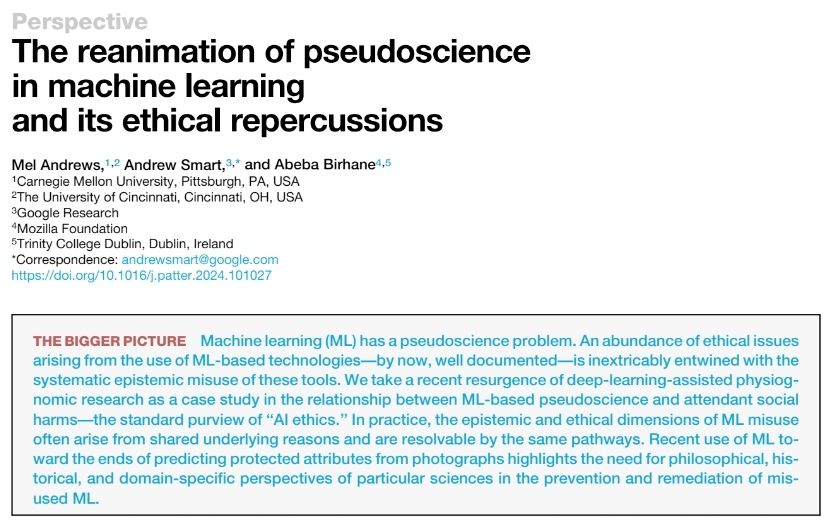
New paper where Mel Andrews, Andrew Smart, and I outline how machine learning is laundering long discredited harmful pseudoscience and offer resources for research best practices to developers/practitioners
www.cell.com/patterns/ful...
www.cell.com/patterns/ful...
August 2, 2024 at 3:18 PM
New paper where Mel Andrews, Andrew Smart, and I outline how machine learning is laundering long discredited harmful pseudoscience and offer resources for research best practices to developers/practitioners
www.cell.com/patterns/ful...
www.cell.com/patterns/ful...
Reposted by Meera Ray

Finally our editorial for the "What makes a good theory?" special issue is out (co-edited with @irisvanrooij.bsky.social, @jcskewes.bsky.social, Sashank Varma, and Todd Wareham). It's an interdisciplinary issue and the contents are transdisciplinary.
#philsci #metasci #cogsci #ai #psych 🧪
#philsci #metasci #cogsci #ai #psych 🧪

What Makes a Good Theory? Interdisciplinary Perspectives - Computational Brain & Behavior
Computational Brain & Behavior -
link.springer.com
November 14, 2024 at 4:09 PM
Finally our editorial for the "What makes a good theory?" special issue is out (co-edited with @irisvanrooij.bsky.social, @jcskewes.bsky.social, Sashank Varma, and Todd Wareham). It's an interdisciplinary issue and the contents are transdisciplinary.
#philsci #metasci #cogsci #ai #psych 🧪
#philsci #metasci #cogsci #ai #psych 🧪
Reposted by Meera Ray

In some recent work we extended the original assistance game formalism to handle natural language, resulting in Language-Augmented Assistance Games. We then "solve" these games using an inverse planning algorithm, inferring goals from human instructions & natural language:
arxiv.org/abs/2402.17930
arxiv.org/abs/2402.17930

Pragmatic Instruction Following and Goal Assistance via Cooperative Language-Guided Inverse Planning
People often give instructions whose meaning is ambiguous without further context, expecting that their actions or goals will disambiguate their intentions. How can we build assistive agents that foll...
arxiv.org
November 19, 2024 at 2:16 PM
In some recent work we extended the original assistance game formalism to handle natural language, resulting in Language-Augmented Assistance Games. We then "solve" these games using an inverse planning algorithm, inferring goals from human instructions & natural language:
arxiv.org/abs/2402.17930
arxiv.org/abs/2402.17930
Reposted by Meera Ray

This is a very cool integration of LLMs + Bayesian methods.
LLMs serve as *likelihoods*: how likely would the human be to have issued this (English) command, given a particular (symbolic) plan? No generation, just scoring :)
A Bayesian agent can then resolve ambiguity in really sensible ways
LLMs serve as *likelihoods*: how likely would the human be to have issued this (English) command, given a particular (symbolic) plan? No generation, just scoring :)
A Bayesian agent can then resolve ambiguity in really sensible ways

November 19, 2024 at 7:19 PM
This is a very cool integration of LLMs + Bayesian methods.
LLMs serve as *likelihoods*: how likely would the human be to have issued this (English) command, given a particular (symbolic) plan? No generation, just scoring :)
A Bayesian agent can then resolve ambiguity in really sensible ways
LLMs serve as *likelihoods*: how likely would the human be to have issued this (English) command, given a particular (symbolic) plan? No generation, just scoring :)
A Bayesian agent can then resolve ambiguity in really sensible ways
Reposted by Meera Ray

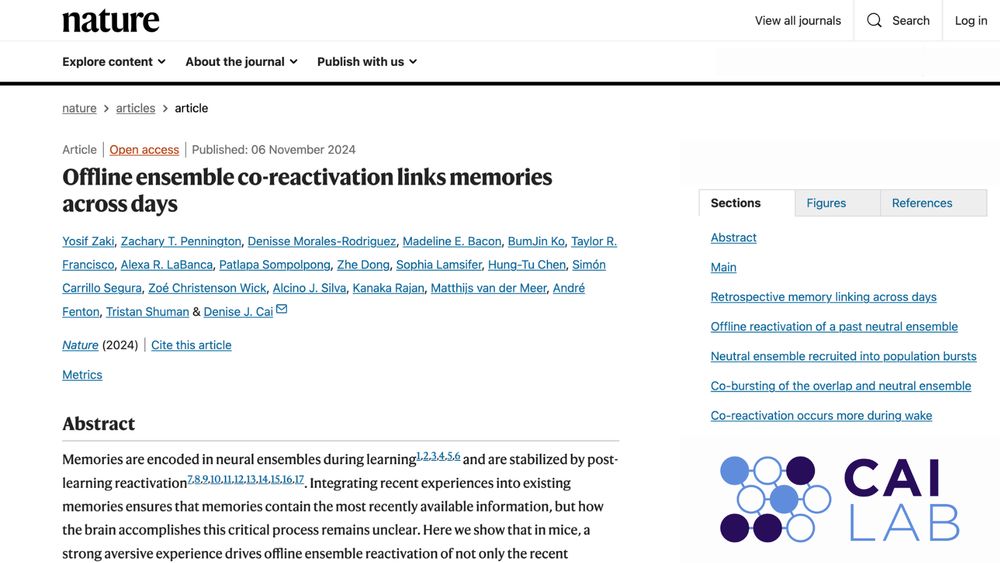
🌟 Cai Lab Nature (@natureportfolio.bsky.social) paper alert! In work led by Joe Zaki, we find that rest periods after learning not only stabilize new memories BUT ALSO integrate new memories with older ones from days past! (1/10)
Read it here: www.nature.com/articles/s41...
Read it here: www.nature.com/articles/s41...
November 19, 2024 at 4:50 PM
🌟 Cai Lab Nature (@natureportfolio.bsky.social) paper alert! In work led by Joe Zaki, we find that rest periods after learning not only stabilize new memories BUT ALSO integrate new memories with older ones from days past! (1/10)
Read it here: www.nature.com/articles/s41...
Read it here: www.nature.com/articles/s41...
Reposted by Meera Ray

(1/5) Very excited to announce the publication of Bayesian Models of Cognition: Reverse Engineering the Mind. More than a decade in the making, it's a big (600+ pages) beautiful book covering both the basics and recent work: mitpress.mit.edu/978026204941...

November 19, 2024 at 9:33 PM
(1/5) Very excited to announce the publication of Bayesian Models of Cognition: Reverse Engineering the Mind. More than a decade in the making, it's a big (600+ pages) beautiful book covering both the basics and recent work: mitpress.mit.edu/978026204941...
Reposted by Meera Ray
I do not understand why not more of my colleagues in the field of AI are worried about this. Why are they not worried about how AI hype discredits the entire field?
November 18, 2024 at 3:06 PM
I do not understand why not more of my colleagues in the field of AI are worried about this. Why are they not worried about how AI hype discredits the entire field?
Reposted by Meera Ray
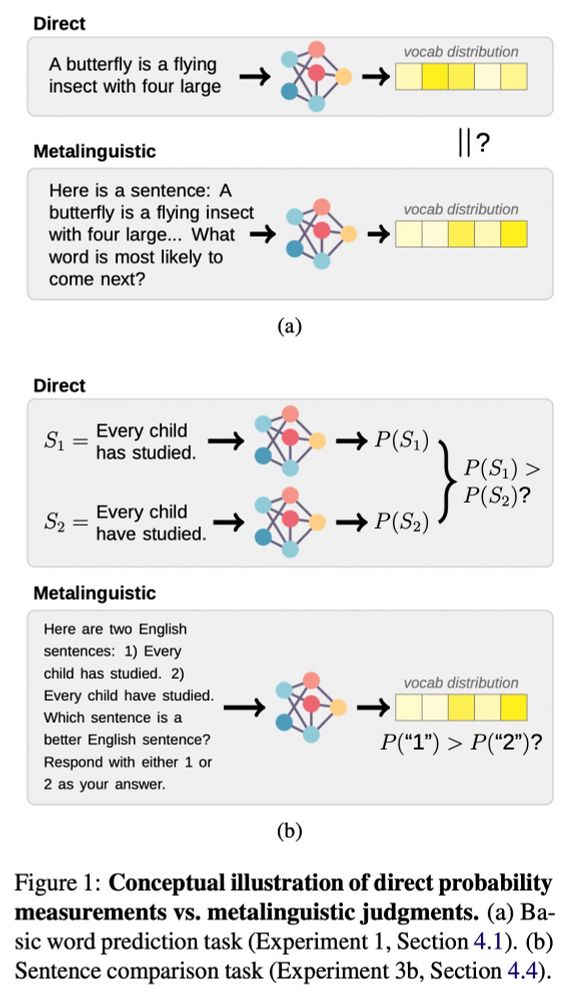
So many people, CS researchers included, think that you can explore how an LLM works by simply asking it to tell you what it is doing or "thinking".
Here @jennhu.bsky.social provides an excellent illustration of how that approach fails even at the most basic level.
Here @jennhu.bsky.social provides an excellent illustration of how that approach fails even at the most basic level.

To researchers doing LLM evaluation: prompting is *not a substitute* for direct probability measurements. Check out the camera-ready version of our work, to appear at EMNLP 2023! (w/ @rplevy.bsky.social)
Paper: arxiv.org/abs/2305.13264
Original thread: twitter.com/_jennhu/stat...
Paper: arxiv.org/abs/2305.13264
Original thread: twitter.com/_jennhu/stat...
November 17, 2024 at 4:50 AM
So many people, CS researchers included, think that you can explore how an LLM works by simply asking it to tell you what it is doing or "thinking".
Here @jennhu.bsky.social provides an excellent illustration of how that approach fails even at the most basic level.
Here @jennhu.bsky.social provides an excellent illustration of how that approach fails even at the most basic level.