


Experimental Philosophy
@xphilosopher.bsky.social
An account for experimental philosophy - an interdisciplinary field at the intersection of philosophy and psychology https://en.m.wikipedia.org/wiki/Experimental_philosophy#:~:text=Experimental%20philosophy%20is%20an%20emerging,inform%20research%20on%20phi
Beautiful experimental philosophy paper on what people ordinarily mean when they say that a statement is “true”
Turns out it’s not always about corresponding correctly to the facts. Sometimes it’s more closely related to a moral ideal of “truthfulness”
philarchive.org/archive/ZYGTJN
Turns out it’s not always about corresponding correctly to the facts. Sometimes it’s more closely related to a moral ideal of “truthfulness”
philarchive.org/archive/ZYGTJN

January 1, 2026 at 6:31 PM
Beautiful experimental philosophy paper on what people ordinarily mean when they say that a statement is “true”
Turns out it’s not always about corresponding correctly to the facts. Sometimes it’s more closely related to a moral ideal of “truthfulness”
philarchive.org/archive/ZYGTJN
Turns out it’s not always about corresponding correctly to the facts. Sometimes it’s more closely related to a moral ideal of “truthfulness”
philarchive.org/archive/ZYGTJN

December 22, 2025 at 6:32 PM
We find a two-factor solution:
Beliefs vary in whether in:
(a) whether they are aimed at tracking facts in the world
(b) whether they are aimed at expressing your identity
Strikingly, these can vary independently! A single belief can be very high in both
3/
Beliefs vary in whether in:
(a) whether they are aimed at tracking facts in the world
(b) whether they are aimed at expressing your identity
Strikingly, these can vary independently! A single belief can be very high in both
3/

December 22, 2025 at 6:29 PM
We find a two-factor solution:
Beliefs vary in whether in:
(a) whether they are aimed at tracking facts in the world
(b) whether they are aimed at expressing your identity
Strikingly, these can vary independently! A single belief can be very high in both
3/
Beliefs vary in whether in:
(a) whether they are aimed at tracking facts in the world
(b) whether they are aimed at expressing your identity
Strikingly, these can vary independently! A single belief can be very high in both
3/
- Would you describe the belief by saying “I think…” vs. “I believe…”?
- Does having this belief relate to your membership in a social group?
… and many others
The key question was whether we can identify certain deeper factors underlying all these dimensions
2/
- Does having this belief relate to your membership in a social group?
… and many others
The key question was whether we can identify certain deeper factors underlying all these dimensions
2/


December 22, 2025 at 6:29 PM
- Would you describe the belief by saying “I think…” vs. “I believe…”?
- Does having this belief relate to your membership in a social group?
… and many others
The key question was whether we can identify certain deeper factors underlying all these dimensions
2/
- Does having this belief relate to your membership in a social group?
… and many others
The key question was whether we can identify certain deeper factors underlying all these dimensions
2/
“Children enter from the door on the left.”
This sentence is what’s called a GENERIC… but it isn’t saying anything general about the nature of children. What then makes it generic?
New theory from @kateritch.bsky.social and Ny Vasil
philpapers.org/archive/RITG...
This sentence is what’s called a GENERIC… but it isn’t saying anything general about the nature of children. What then makes it generic?
New theory from @kateritch.bsky.social and Ny Vasil
philpapers.org/archive/RITG...

December 14, 2025 at 2:47 PM
“Children enter from the door on the left.”
This sentence is what’s called a GENERIC… but it isn’t saying anything general about the nature of children. What then makes it generic?
New theory from @kateritch.bsky.social and Ny Vasil
philpapers.org/archive/RITG...
This sentence is what’s called a GENERIC… but it isn’t saying anything general about the nature of children. What then makes it generic?
New theory from @kateritch.bsky.social and Ny Vasil
philpapers.org/archive/RITG...
New experimental paper on intuitions about whether people have obligations *to themselves*
From philosopher Laura Soter (@laurasoter.bsky.social) in JPSP
psycnet.apa.org/record/2027-...
From philosopher Laura Soter (@laurasoter.bsky.social) in JPSP
psycnet.apa.org/record/2027-...

December 12, 2025 at 4:28 PM
New experimental paper on intuitions about whether people have obligations *to themselves*
From philosopher Laura Soter (@laurasoter.bsky.social) in JPSP
psycnet.apa.org/record/2027-...
From philosopher Laura Soter (@laurasoter.bsky.social) in JPSP
psycnet.apa.org/record/2027-...
“Murder is wrong, but I don’t disapprove of it”
Expressivist theories of moral language seem to suggest that this sentence should make no sense — but a new paper in Cognition finds that people actually *do* find this sentence largely acceptable
www.sciencedirect.com/science/arti...
Expressivist theories of moral language seem to suggest that this sentence should make no sense — but a new paper in Cognition finds that people actually *do* find this sentence largely acceptable
www.sciencedirect.com/science/arti...

November 28, 2025 at 4:39 PM
“Murder is wrong, but I don’t disapprove of it”
Expressivist theories of moral language seem to suggest that this sentence should make no sense — but a new paper in Cognition finds that people actually *do* find this sentence largely acceptable
www.sciencedirect.com/science/arti...
Expressivist theories of moral language seem to suggest that this sentence should make no sense — but a new paper in Cognition finds that people actually *do* find this sentence largely acceptable
www.sciencedirect.com/science/arti...
Results from the most well-known dissonance experiment are mathematically impossible @steamtraen.eu
(To get the intuition behind this analysis, imagine that we take the mean of 10 Likert scale scores. The mean could be 4.20 but not 4.25)
mattiheino.com/2016/11/13/l...
(To get the intuition behind this analysis, imagine that we take the mean of 10 Likert scale scores. The mean could be 4.20 but not 4.25)
mattiheino.com/2016/11/13/l...

November 6, 2025 at 2:07 PM
Results from the most well-known dissonance experiment are mathematically impossible @steamtraen.eu
(To get the intuition behind this analysis, imagine that we take the mean of 10 Likert scale scores. The mean could be 4.20 but not 4.25)
mattiheino.com/2016/11/13/l...
(To get the intuition behind this analysis, imagine that we take the mean of 10 Likert scale scores. The mean could be 4.20 but not 4.25)
mattiheino.com/2016/11/13/l...
It has long been thought that there is a special connection between agency and causal judgment
But it turns out the effect of agency arises not just for causal verbs but also for non-causal verbs like “touch”
@samiyousif.bsky.social @fabiennemartin.bsky.social
philpapers.org/archive/JOON...
But it turns out the effect of agency arises not just for causal verbs but also for non-causal verbs like “touch”
@samiyousif.bsky.social @fabiennemartin.bsky.social
philpapers.org/archive/JOON...

October 27, 2025 at 1:57 PM
It has long been thought that there is a special connection between agency and causal judgment
But it turns out the effect of agency arises not just for causal verbs but also for non-causal verbs like “touch”
@samiyousif.bsky.social @fabiennemartin.bsky.social
philpapers.org/archive/JOON...
But it turns out the effect of agency arises not just for causal verbs but also for non-causal verbs like “touch”
@samiyousif.bsky.social @fabiennemartin.bsky.social
philpapers.org/archive/JOON...
People rarely use the word “cause,” but strikingly, young children already understand the difference between “Jane caused…” and “Jane broke…”
@tobigerstenberg.bsky.social
osf.io/preprints/ps...
@tobigerstenberg.bsky.social
osf.io/preprints/ps...

October 27, 2025 at 1:54 PM
People rarely use the word “cause,” but strikingly, young children already understand the difference between “Jane caused…” and “Jane broke…”
@tobigerstenberg.bsky.social
osf.io/preprints/ps...
@tobigerstenberg.bsky.social
osf.io/preprints/ps...
Now consider cases of what philosophers call “double prevention”
In these cases, people respond very differently to sentences like “Jane caused…” vs. sentences like “Jane broke…”
philpapers.org/archive/ROSC...
In these cases, people respond very differently to sentences like “Jane caused…” vs. sentences like “Jane broke…”
philpapers.org/archive/ROSC...

October 27, 2025 at 1:53 PM
Now consider cases of what philosophers call “double prevention”
In these cases, people respond very differently to sentences like “Jane caused…” vs. sentences like “Jane broke…”
philpapers.org/archive/ROSC...
In these cases, people respond very differently to sentences like “Jane caused…” vs. sentences like “Jane broke…”
philpapers.org/archive/ROSC...
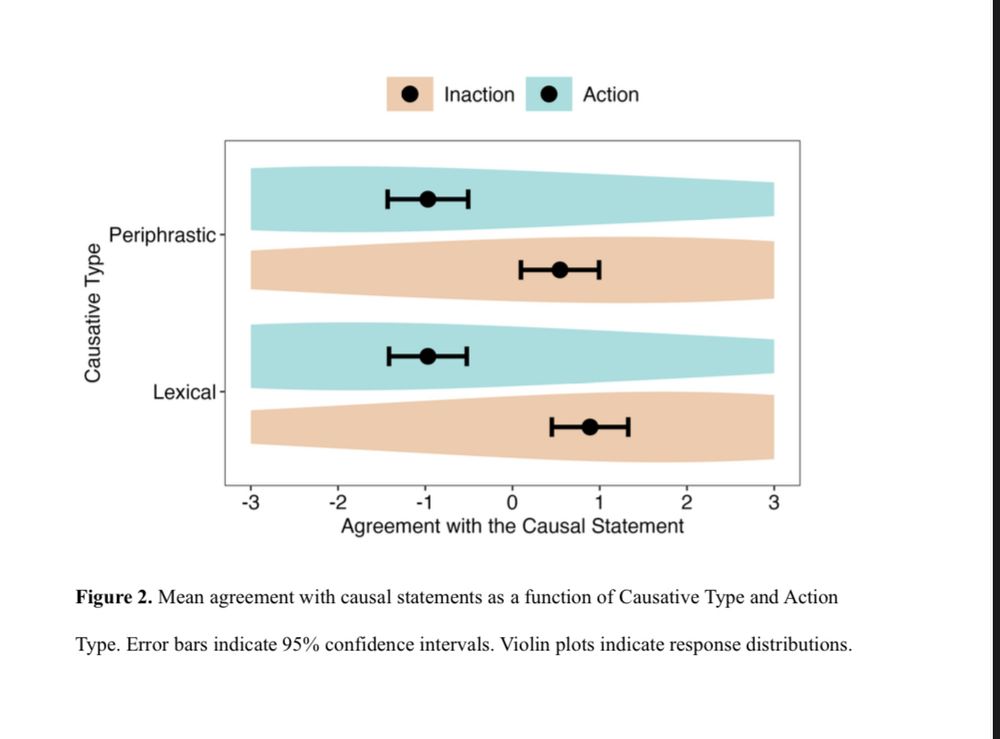
Consider whether it’s better to use a sentence like “Jane broke the glass” to describe an action or an omission
Turns out that in ‘disjunctive’ cases, people think these sentences are more appropriate for omissions than for actions (!)
osf.io/preprints/ps...
Turns out that in ‘disjunctive’ cases, people think these sentences are more appropriate for omissions than for actions (!)
osf.io/preprints/ps...
October 27, 2025 at 1:51 PM
Consider whether it’s better to use a sentence like “Jane broke the glass” to describe an action or an omission
Turns out that in ‘disjunctive’ cases, people think these sentences are more appropriate for omissions than for actions (!)
osf.io/preprints/ps...
Turns out that in ‘disjunctive’ cases, people think these sentences are more appropriate for omissions than for actions (!)
osf.io/preprints/ps...
There’s a deep difference between sentences like:
(1) Jane caused the glass to break.
vs.
(2) Jane broke the glass.
A surge of experimental philosophy research has led to some surprising discoveries about sentences like (2)
[Thread]
(1) Jane caused the glass to break.
vs.
(2) Jane broke the glass.
A surge of experimental philosophy research has led to some surprising discoveries about sentences like (2)
[Thread]

October 27, 2025 at 1:49 PM
There’s a deep difference between sentences like:
(1) Jane caused the glass to break.
vs.
(2) Jane broke the glass.
A surge of experimental philosophy research has led to some surprising discoveries about sentences like (2)
[Thread]
(1) Jane caused the glass to break.
vs.
(2) Jane broke the glass.
A surge of experimental philosophy research has led to some surprising discoveries about sentences like (2)
[Thread]
This work is closely related with the idea of resource rationality in cognitive science
The core thought is that we cannot possibly think about everything, so we need concepts that help focus our attention on the things that are worth thinking about
The core thought is that we cannot possibly think about everything, so we need concepts that help focus our attention on the things that are worth thinking about

September 27, 2025 at 2:52 PM
This work is closely related with the idea of resource rationality in cognitive science
The core thought is that we cannot possibly think about everything, so we need concepts that help focus our attention on the things that are worth thinking about
The core thought is that we cannot possibly think about everything, so we need concepts that help focus our attention on the things that are worth thinking about
Oddly enough, there actually is experimental philosophy research on this
People with training in philosophy have significantly less visual imagery than non-philosophers do
osf.io/preprints/ps...
People with training in philosophy have significantly less visual imagery than non-philosophers do
osf.io/preprints/ps...

September 27, 2025 at 1:08 PM
Oddly enough, there actually is experimental philosophy research on this
People with training in philosophy have significantly less visual imagery than non-philosophers do
osf.io/preprints/ps...
People with training in philosophy have significantly less visual imagery than non-philosophers do
osf.io/preprints/ps...
There’s so much more in this paper — about how this relates to which choice people really think is the better one, how they rationalize their judgements, and so forth
osf.io/preprints/ps...
osf.io/preprints/ps...

September 23, 2025 at 8:35 PM
There’s so much more in this paper — about how this relates to which choice people really think is the better one, how they rationalize their judgements, and so forth
osf.io/preprints/ps...
osf.io/preprints/ps...
New paper by
@danielchiacchia.bsky.social, George Newman & Rachel Ruttan finds:
Other things being equal, people tend to see System 1 as the true self
@danielchiacchia.bsky.social, George Newman & Rachel Ruttan finds:
Other things being equal, people tend to see System 1 as the true self

September 23, 2025 at 8:34 PM
New paper by
@danielchiacchia.bsky.social, George Newman & Rachel Ruttan finds:
Other things being equal, people tend to see System 1 as the true self
@danielchiacchia.bsky.social, George Newman & Rachel Ruttan finds:
Other things being equal, people tend to see System 1 as the true self
People sometimes face a conflict between intuition (system 1) and reasoning (system 2)
In cases like these, which will be seen as the person’s true self?
In cases like these, which will be seen as the person’s true self?

September 23, 2025 at 8:33 PM
People sometimes face a conflict between intuition (system 1) and reasoning (system 2)
In cases like these, which will be seen as the person’s true self?
In cases like these, which will be seen as the person’s true self?
Experimental philosophy paper by Pascale Willemsen et al. on on what it means for something to be "discrimination"
The studies focus specifically on discrimination -- but I think they also showing something more general about how thick concepts work
philpapers.org/archive/WILD...
The studies focus specifically on discrimination -- but I think they also showing something more general about how thick concepts work
philpapers.org/archive/WILD...

September 7, 2025 at 7:53 PM
Experimental philosophy paper by Pascale Willemsen et al. on on what it means for something to be "discrimination"
The studies focus specifically on discrimination -- but I think they also showing something more general about how thick concepts work
philpapers.org/archive/WILD...
The studies focus specifically on discrimination -- but I think they also showing something more general about how thick concepts work
philpapers.org/archive/WILD...
XPrag Meets X-Phi
An online event bringing together two research communities: experimental pragmatics and experimental philosophy
sites.google.com/view/xprag-w...
An online event bringing together two research communities: experimental pragmatics and experimental philosophy
sites.google.com/view/xprag-w...

August 28, 2025 at 1:41 PM
XPrag Meets X-Phi
An online event bringing together two research communities: experimental pragmatics and experimental philosophy
sites.google.com/view/xprag-w...
An online event bringing together two research communities: experimental pragmatics and experimental philosophy
sites.google.com/view/xprag-w...
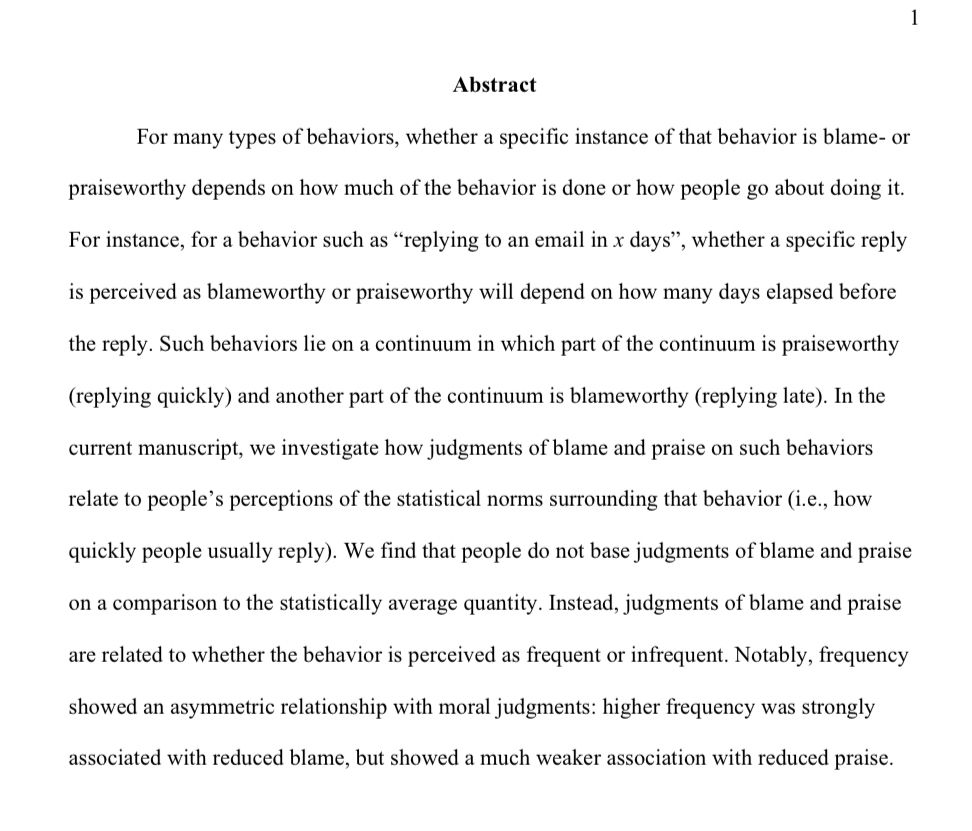
Our new paper is an attempt to understand the surprising shapes of these curves
But even if you haven’t taken a look at the paper, I’d love to hear your thoughts on what might be going on here!
osf.io/preprints/ps...
But even if you haven’t taken a look at the paper, I’d love to hear your thoughts on what might be going on here!
osf.io/preprints/ps...
August 22, 2025 at 5:55 PM
Our new paper is an attempt to understand the surprising shapes of these curves
But even if you haven’t taken a look at the paper, I’d love to hear your thoughts on what might be going on here!
osf.io/preprints/ps...
But even if you haven’t taken a look at the paper, I’d love to hear your thoughts on what might be going on here!
osf.io/preprints/ps...
Here’s a blame-praise curve for comforting a friend in need
People think the average friend would help for more than 4 hours… but they think you would be praiseworthy even if you do MUCH less than an average friend
People think the average friend would help for more than 4 hours… but they think you would be praiseworthy even if you do MUCH less than an average friend

August 22, 2025 at 5:54 PM
Here’s a blame-praise curve for comforting a friend in need
People think the average friend would help for more than 4 hours… but they think you would be praiseworthy even if you do MUCH less than an average friend
People think the average friend would help for more than 4 hours… but they think you would be praiseworthy even if you do MUCH less than an average friend
Here is a ‘blame-praise curve’ for the percentage of household chores done by husbands
People think husbands are blameworthy if they do 20%, but praiseworthy if they do 40% (!)
Perceived average is above 40%, so people think below average is still praiseworthy
[Thread]
People think husbands are blameworthy if they do 20%, but praiseworthy if they do 40% (!)
Perceived average is above 40%, so people think below average is still praiseworthy
[Thread]

August 22, 2025 at 5:53 PM
Here is a ‘blame-praise curve’ for the percentage of household chores done by husbands
People think husbands are blameworthy if they do 20%, but praiseworthy if they do 40% (!)
Perceived average is above 40%, so people think below average is still praiseworthy
[Thread]
People think husbands are blameworthy if they do 20%, but praiseworthy if they do 40% (!)
Perceived average is above 40%, so people think below average is still praiseworthy
[Thread]
Recent studies suggest that manipulating "growth mindset" might not improve students' academic performance
This new research suggests that it has a different effect. Growth mindset makes people more inclined to *blame* students for their failures
escholarship.org/content/qt4k...
This new research suggests that it has a different effect. Growth mindset makes people more inclined to *blame* students for their failures
escholarship.org/content/qt4k...

August 1, 2025 at 5:13 PM
Recent studies suggest that manipulating "growth mindset" might not improve students' academic performance
This new research suggests that it has a different effect. Growth mindset makes people more inclined to *blame* students for their failures
escholarship.org/content/qt4k...
This new research suggests that it has a different effect. Growth mindset makes people more inclined to *blame* students for their failures
escholarship.org/content/qt4k...
Protzko argues for the opposite view: it’s a matter of different people having different intuitions
In defense of this view, he notes that the distribution is bimodal: people are not giving responses that fall at around the midpoint of the scale
In defense of this view, he notes that the distribution is bimodal: people are not giving responses that fall at around the midpoint of the scale

July 21, 2025 at 2:37 PM
Protzko argues for the opposite view: it’s a matter of different people having different intuitions
In defense of this view, he notes that the distribution is bimodal: people are not giving responses that fall at around the midpoint of the scale
In defense of this view, he notes that the distribution is bimodal: people are not giving responses that fall at around the midpoint of the scale