




Adrian Bracken
@adrianbracken.bsky.social
Epigenetics & Chromatin Biology | Polycombs in Development & Disease | Cancer Genetics | Professor of Chromatin Biology, Trinity College Dublin | www.brackenlab.com
Pinned
Adrian Bracken
@adrianbracken.bsky.social
· Oct 31
1/ 🚀 AEBP2 isn’t what we thought.
You were told that AEBP2 promotes PRC2 activity on chromatin.
We found the opposite: the most prevalent AEBP2 isoform inhibits PRC2 activity.
👉 surl.li/cgwqcq
A thread 🧵
You were told that AEBP2 promotes PRC2 activity on chromatin.
We found the opposite: the most prevalent AEBP2 isoform inhibits PRC2 activity.
👉 surl.li/cgwqcq
A thread 🧵
Reposted by Adrian Bracken
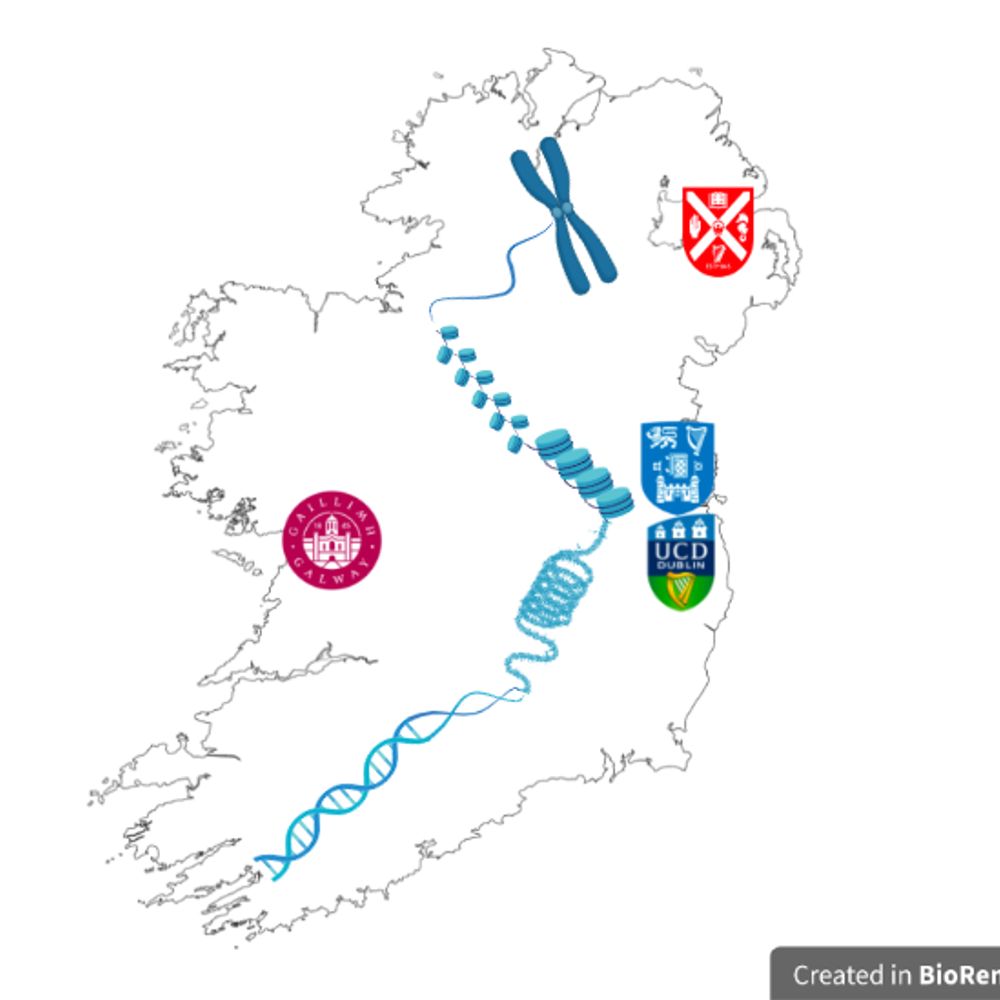
Just one week to go until Edith Heard will be joining us for the All-Ireland Chromatin Consortium webinar on 'The Epigenetic Dynamics of X Inactivation in Development and Disease' 🧬
Registration link: us06web.zoom.us/webinar/regi...
Registration link: us06web.zoom.us/webinar/regi...
February 6, 2026 at 11:07 AM
Just one week to go until Edith Heard will be joining us for the All-Ireland Chromatin Consortium webinar on 'The Epigenetic Dynamics of X Inactivation in Development and Disease' 🧬
Registration link: us06web.zoom.us/webinar/regi...
Registration link: us06web.zoom.us/webinar/regi...
Reposted by Adrian Bracken

@adrianbracken.bsky.social we are looking forward to your presentation at our #FusionEpigenetics meeting in Portugal this October!
Please share this with your followers to let them know you will speaking, and to register & submit today to join us
🔗 bit.ly/4rC6B45
Please share this with your followers to let them know you will speaking, and to register & submit today to join us
🔗 bit.ly/4rC6B45

February 4, 2026 at 3:56 PM
@adrianbracken.bsky.social we are looking forward to your presentation at our #FusionEpigenetics meeting in Portugal this October!
Please share this with your followers to let them know you will speaking, and to register & submit today to join us
🔗 bit.ly/4rC6B45
Please share this with your followers to let them know you will speaking, and to register & submit today to join us
🔗 bit.ly/4rC6B45
Reposted by Adrian Bracken
Synovial sarcoma is driven almost exclusively by a single oncofusion – SS18-SSX
For years, the assumptions on disease mechanisms were simple:
➡️ SS18-SSX works by hijacking SWI/SNF chromatin remodeling activity
Our new study shows that assumption was wrong 🧵👇
www.biorxiv.org/content/10.6...
For years, the assumptions on disease mechanisms were simple:
➡️ SS18-SSX works by hijacking SWI/SNF chromatin remodeling activity
Our new study shows that assumption was wrong 🧵👇
www.biorxiv.org/content/10.6...
SS18-SSX co-opts P300 to sustain oncogenic transcription independent of SWI/SNF activity
Synovial sarcoma is driven by the SS18-SSX fusion oncoprotein, which has been assumed to promote tumorigenesis through its incorporation into the SWI/SNF chromatin remodeling complexes. Accordingly, therapeutic efforts have focused on targeting SS18-SSX containing SWI/SNF assemblies, yet these approaches have produced limited clinical benefit. Here, we demonstrate that SS18-SSX sustains oncogenic transcription independent of SWI/SNF activity. Despite efficient degradation and dismantling of SWI/SNF complexes, fusion occupancy at target loci and associated gene expression programs remain largely intact. Instead, we identify the acetyltransferase P300 as an essential co-factor supporting SS18-SSX chromatin binding and transcriptional activation. Targeting P300 displaces the fusion from chromatin, suppresses its transcriptional output, compromising synovial sarcoma viability. Notably, dual PROTAC mediated degradation of P300 and SWI/SNF produces strong synergistic effects, broadly disrupting SS18-SSX localization and function. These findings redefine the mechanistic basis of synovial sarcoma and reveal a mechanistically anchored therapeutic strategy for targeting its core oncogenic driver. ### Competing Interest Statement C.R.V. has been a consultant for Flare Therapeutics, Roivant Sciences and C4 Therapeutics; has served on the advisory boards of KSQ Therapeutics, Syros Pharmaceuticals and Treeline Biosciences; has received research funding from Boehringer Ingelheim and Treeline Biosciences; and owns stock in Treeline Biosciences. S.A.A. has been a consultant and/or shareholder for Neomorph, Imago Biosciences, Hyku Therapeutics, C4 Therapeutics, Accent Therapeutics and Nimbus Therapeutics; and has received research support from Janssen and Syndax. N.O.C. is a co-founder, shareholder and management consultant for PhenoTherapeutics Ltd; and a shareholder in Amplia Therapeutics Ltd All other authors declare no financial interests UKRI, EP/X039633/1 Worldwide Cancer Research, https://ror.org/031tfbz57, 21-0271 Science Foundation Ireland, https://ror.org/0271asj38, 18/SIRG/5573
www.biorxiv.org
January 28, 2026 at 9:54 AM
Synovial sarcoma is driven almost exclusively by a single oncofusion – SS18-SSX
For years, the assumptions on disease mechanisms were simple:
➡️ SS18-SSX works by hijacking SWI/SNF chromatin remodeling activity
Our new study shows that assumption was wrong 🧵👇
www.biorxiv.org/content/10.6...
For years, the assumptions on disease mechanisms were simple:
➡️ SS18-SSX works by hijacking SWI/SNF chromatin remodeling activity
Our new study shows that assumption was wrong 🧵👇
www.biorxiv.org/content/10.6...
Reposted by Adrian Bracken
After a short break in our webinars we are delighted to be back up & running this month!
First up, on Jan 30th we will be joined by @lucas.farnunglab.com from @harvardmed.bsky.social 🔬
Shortly after, on Feb 13th we will be hosting @heardlab.bsky.social from @crick.ac.uk 🧬
Registration details 👇
First up, on Jan 30th we will be joined by @lucas.farnunglab.com from @harvardmed.bsky.social 🔬
Shortly after, on Feb 13th we will be hosting @heardlab.bsky.social from @crick.ac.uk 🧬
Registration details 👇


January 15, 2026 at 2:59 PM
After a short break in our webinars we are delighted to be back up & running this month!
First up, on Jan 30th we will be joined by @lucas.farnunglab.com from @harvardmed.bsky.social 🔬
Shortly after, on Feb 13th we will be hosting @heardlab.bsky.social from @crick.ac.uk 🧬
Registration details 👇
First up, on Jan 30th we will be joined by @lucas.farnunglab.com from @harvardmed.bsky.social 🔬
Shortly after, on Feb 13th we will be hosting @heardlab.bsky.social from @crick.ac.uk 🧬
Registration details 👇
Reposted by Adrian Bracken

Two alternative isoforms of PRC2 accessory subunit AEBP2 modulate developmental Polycomb functions in opposite ways - with broadly-expressed AEBP2L acting as an intrinsic inhibitor in somatic cells
@adrianbracken.bsky.social @davidovichlab.bsky.social and colleagues
www.embopress.org/doi/full/10....
@adrianbracken.bsky.social @davidovichlab.bsky.social and colleagues
www.embopress.org/doi/full/10....

November 4, 2025 at 12:51 PM
Two alternative isoforms of PRC2 accessory subunit AEBP2 modulate developmental Polycomb functions in opposite ways - with broadly-expressed AEBP2L acting as an intrinsic inhibitor in somatic cells
@adrianbracken.bsky.social @davidovichlab.bsky.social and colleagues
www.embopress.org/doi/full/10....
@adrianbracken.bsky.social @davidovichlab.bsky.social and colleagues
www.embopress.org/doi/full/10....

Reposted by Adrian Bracken
We are delighted that @genesdev.bsky.social have selected our (w/ @adrianbracken.bsky.social) Weaver syndrome paper artwork as the November cover! This piece was made by my incredibly talented niece, Gina 'Dna Vinci' Ronan.
@ucddublin.bsky.social @tcddublin.bsky.social @ucd-sbbs.bsky.social
@ucddublin.bsky.social @tcddublin.bsky.social @ucd-sbbs.bsky.social

🚨 NEW ISSUE ALERT!!! 🚨
New Outlook, Review and Research articles online now at Genes & Development.
Click on the link to learn more:
➡️ https://genesdev.cshlp.org/content/39/21-22.toc
New Outlook, Review and Research articles online now at Genes & Development.
Click on the link to learn more:
➡️ https://genesdev.cshlp.org/content/39/21-22.toc

November 3, 2025 at 6:18 PM
We are delighted that @genesdev.bsky.social have selected our (w/ @adrianbracken.bsky.social) Weaver syndrome paper artwork as the November cover! This piece was made by my incredibly talented niece, Gina 'Dna Vinci' Ronan.
@ucddublin.bsky.social @tcddublin.bsky.social @ucd-sbbs.bsky.social
@ucddublin.bsky.social @tcddublin.bsky.social @ucd-sbbs.bsky.social
1/ 🚀 AEBP2 isn’t what we thought.
You were told that AEBP2 promotes PRC2 activity on chromatin.
We found the opposite: the most prevalent AEBP2 isoform inhibits PRC2 activity.
👉 surl.li/cgwqcq
A thread 🧵
You were told that AEBP2 promotes PRC2 activity on chromatin.
We found the opposite: the most prevalent AEBP2 isoform inhibits PRC2 activity.
👉 surl.li/cgwqcq
A thread 🧵
October 31, 2025 at 10:53 AM
1/ 🚀 AEBP2 isn’t what we thought.
You were told that AEBP2 promotes PRC2 activity on chromatin.
We found the opposite: the most prevalent AEBP2 isoform inhibits PRC2 activity.
👉 surl.li/cgwqcq
A thread 🧵
You were told that AEBP2 promotes PRC2 activity on chromatin.
We found the opposite: the most prevalent AEBP2 isoform inhibits PRC2 activity.
👉 surl.li/cgwqcq
A thread 🧵
Reposted by Adrian Bracken
Absolutely delighted to share our preprint, using functional genomics to uncover a novel dependency in lymphoma that can overcome resistance to targeted therapy. Grateful to co-first author @jamesnolan.bsky.social and co-senior authors @conwayer1.bsky.social and @adrianbracken.bsky.social see👇
🧵1/Exciting news in cancer epigenetics! Our latest research, "AEBP2-Directed H3K27me2 Defines a Specific Vulnerability in EZH2-mutant Lymphoma", is now available on www.biorxiv.org/content/10.1.... Here's a thread summarizing our findings!👇
#CancerResearch #Epigenetics #Chromatin #Lymphoma
#CancerResearch #Epigenetics #Chromatin #Lymphoma

AEBP2-Directed H3K27me2 Defines a Specific Vulnerability in EZH2-mutant Lymphoma
The catalytic subunit of Polycomb Repressive Complex 2 (PRC2), EZH2, is recurrently mutated in 25% of diffuse large B-cell lymphomas (DLBCL), causing increased H3K27me3 and decreased H3K27me2 levels. ...
www.biorxiv.org
October 17, 2025 at 2:07 PM
Absolutely delighted to share our preprint, using functional genomics to uncover a novel dependency in lymphoma that can overcome resistance to targeted therapy. Grateful to co-first author @jamesnolan.bsky.social and co-senior authors @conwayer1.bsky.social and @adrianbracken.bsky.social see👇
Reposted by Adrian Bracken

🧵1/Exciting news in cancer epigenetics! Our latest research, "AEBP2-Directed H3K27me2 Defines a Specific Vulnerability in EZH2-mutant Lymphoma", is now available on www.biorxiv.org/content/10.1.... Here's a thread summarizing our findings!👇
#CancerResearch #Epigenetics #Chromatin #Lymphoma
#CancerResearch #Epigenetics #Chromatin #Lymphoma
AEBP2-Directed H3K27me2 Defines a Specific Vulnerability in EZH2-mutant Lymphoma
The catalytic subunit of Polycomb Repressive Complex 2 (PRC2), EZH2, is recurrently mutated in 25% of diffuse large B-cell lymphomas (DLBCL), causing increased H3K27me3 and decreased H3K27me2 levels. ...
www.biorxiv.org
October 17, 2025 at 7:11 AM
🧵1/Exciting news in cancer epigenetics! Our latest research, "AEBP2-Directed H3K27me2 Defines a Specific Vulnerability in EZH2-mutant Lymphoma", is now available on www.biorxiv.org/content/10.1.... Here's a thread summarizing our findings!👇
#CancerResearch #Epigenetics #Chromatin #Lymphoma
#CancerResearch #Epigenetics #Chromatin #Lymphoma
Reposted by Adrian Bracken
2/ Firstly, this was a fantastic collaborative effort that would not have been possible without super-talented co-first author @dr-chromatin.bsky.social, and co-senior authors @conwayer1.bsky.social and @adrianbracken.bsky.social.
October 17, 2025 at 7:11 AM
2/ Firstly, this was a fantastic collaborative effort that would not have been possible without super-talented co-first author @dr-chromatin.bsky.social, and co-senior authors @conwayer1.bsky.social and @adrianbracken.bsky.social.
Reposted by Adrian Bracken
Delighted that our work on EZH2 dominant negativity in Weaver syndrome is now out in Genes & Development!
This exciting work on chromatinopathies 🧬 was in collab with @adrianbracken.bsky.social and spearheaded by Orla Deevy.
@ucddublin.bsky.social @ucd-sbbs.bsky.social
www.ucd.ie/newsandopini...
This exciting work on chromatinopathies 🧬 was in collab with @adrianbracken.bsky.social and spearheaded by Orla Deevy.
@ucddublin.bsky.social @ucd-sbbs.bsky.social
www.ucd.ie/newsandopini...

UCD co-lead breakthrough discovering genetic mechanism driving Weaver syndrome
www.ucd.ie
August 27, 2025 at 11:15 AM
Delighted that our work on EZH2 dominant negativity in Weaver syndrome is now out in Genes & Development!
This exciting work on chromatinopathies 🧬 was in collab with @adrianbracken.bsky.social and spearheaded by Orla Deevy.
@ucddublin.bsky.social @ucd-sbbs.bsky.social
www.ucd.ie/newsandopini...
This exciting work on chromatinopathies 🧬 was in collab with @adrianbracken.bsky.social and spearheaded by Orla Deevy.
@ucddublin.bsky.social @ucd-sbbs.bsky.social
www.ucd.ie/newsandopini...
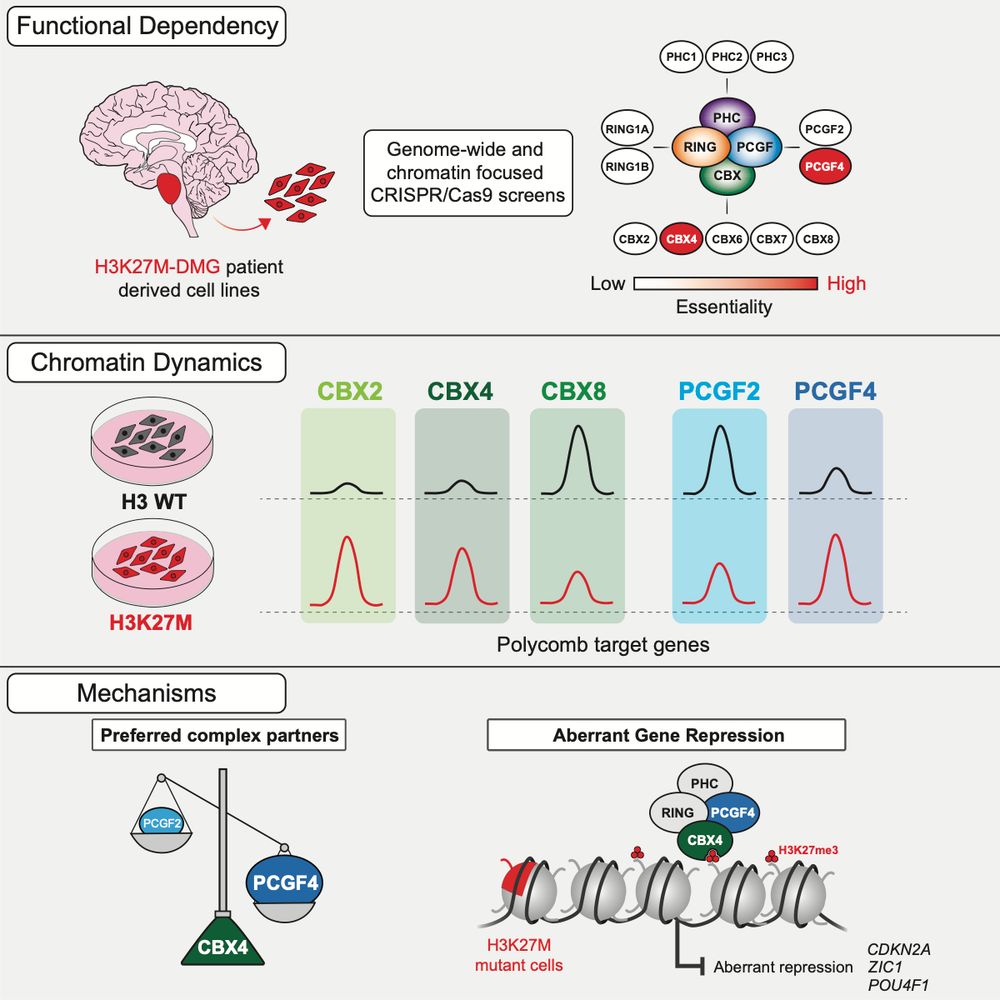
Check out this 🧵 from @eimearlagan.bsky.social on our new Molecular Cell @cp-molcell.bsky.social paper! We show how the H3K27M Oncohistone reprograms chromatin in DMG, creating a specific dependency on CBX4/PCGF4-containing forms of cPRC1 👇

Excited to share our new paper out today in @cp-molcell.bsky.social! We show that the H3K27M oncohistone rewires cPRC1, creating a unique dependency on CBX4/PCGF4-containing complexes, and also reveal a previously unknown function of CBX4. Highlights below (1/11).
May 21, 2025 at 5:22 PM
Check out this 🧵 from @eimearlagan.bsky.social on our new Molecular Cell @cp-molcell.bsky.social paper! We show how the H3K27M Oncohistone reprograms chromatin in DMG, creating a specific dependency on CBX4/PCGF4-containing forms of cPRC1 👇
Reposted by Adrian Bracken

🧬🧪Exciting chromatin research conference hosted by @aicc-ireland.bsky.social in May! The deadline for poster/talk abstracts is April 28, see details in the post below.
We are very excited to launch the registration for our 2025 symposium on 'Chromatin, Epigenetics and Transcription' today!
Join us at @tcddublin.bsky.social on May 28th for this event featuring keynote, new PI and PhD/postdoc talks and posters!
allirelandchromatinconsortium.ie/annual-meeti...
Join us at @tcddublin.bsky.social on May 28th for this event featuring keynote, new PI and PhD/postdoc talks and posters!
allirelandchromatinconsortium.ie/annual-meeti...

March 24, 2025 at 12:58 PM
🧬🧪Exciting chromatin research conference hosted by @aicc-ireland.bsky.social in May! The deadline for poster/talk abstracts is April 28, see details in the post below.
Reposted by Adrian Bracken
We are very excited to launch the registration for our 2025 symposium on 'Chromatin, Epigenetics and Transcription' today!
Join us at @tcddublin.bsky.social on May 28th for this event featuring keynote, new PI and PhD/postdoc talks and posters!
allirelandchromatinconsortium.ie/annual-meeti...
Join us at @tcddublin.bsky.social on May 28th for this event featuring keynote, new PI and PhD/postdoc talks and posters!
allirelandchromatinconsortium.ie/annual-meeti...
March 24, 2025 at 12:03 PM
We are very excited to launch the registration for our 2025 symposium on 'Chromatin, Epigenetics and Transcription' today!
Join us at @tcddublin.bsky.social on May 28th for this event featuring keynote, new PI and PhD/postdoc talks and posters!
allirelandchromatinconsortium.ie/annual-meeti...
Join us at @tcddublin.bsky.social on May 28th for this event featuring keynote, new PI and PhD/postdoc talks and posters!
allirelandchromatinconsortium.ie/annual-meeti...
Reposted by Adrian Bracken
1/ H3K27me3 mimicry has repeatedly emerged through evolution, but what's the physiological relevance?
We show that JARID2 and PALI1 mimic H3K27me3 to antagonise PRC2 in vivo and restrict the spread of Polycomb domains.
🧵
www.biorxiv.org/content/10.1...
We show that JARID2 and PALI1 mimic H3K27me3 to antagonise PRC2 in vivo and restrict the spread of Polycomb domains.
🧵
www.biorxiv.org/content/10.1...
March 15, 2025 at 12:12 AM
1/ H3K27me3 mimicry has repeatedly emerged through evolution, but what's the physiological relevance?
We show that JARID2 and PALI1 mimic H3K27me3 to antagonise PRC2 in vivo and restrict the spread of Polycomb domains.
🧵
www.biorxiv.org/content/10.1...
We show that JARID2 and PALI1 mimic H3K27me3 to antagonise PRC2 in vivo and restrict the spread of Polycomb domains.
🧵
www.biorxiv.org/content/10.1...
Reposted by Adrian Bracken
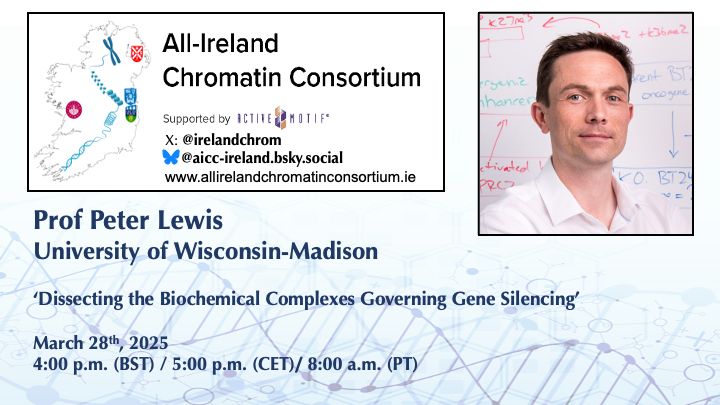
Looking forward to welcoming @peterlewislab.bsky.social from @uwmadison.bsky.social for our March webinar on 'Dissecting the Biochemical Complexes Governing Gene Silencing' on March 28th!
Register here: us06web.zoom.us/webinar/regi...
@activemotifusa.bsky.social
Register here: us06web.zoom.us/webinar/regi...
@activemotifusa.bsky.social
March 13, 2025 at 4:47 PM
Looking forward to welcoming @peterlewislab.bsky.social from @uwmadison.bsky.social for our March webinar on 'Dissecting the Biochemical Complexes Governing Gene Silencing' on March 28th!
Register here: us06web.zoom.us/webinar/regi...
@activemotifusa.bsky.social
Register here: us06web.zoom.us/webinar/regi...
@activemotifusa.bsky.social
Reposted by Adrian Bracken
What a week it has been for our @uniofgalway.bsky.social committee members @jgahan.bsky.social and @thecocodium.bsky.social. Congrats on the grant successes from @researchireland.bsky.social and @wellcometrust.bsky.social respectively!
Keep an eye out for job ads from them soon 👀
Keep an eye out for job ads from them soon 👀
More great news! The CCB is on fire at the moment. If you are looking for opportunities to join a successful (and friendly) group of Chromosome biologists, either as a PhD/Postdoc or group leader, then get in touch:
chromosome.ie
chromosome.ie
March 3, 2025 at 12:38 PM
What a week it has been for our @uniofgalway.bsky.social committee members @jgahan.bsky.social and @thecocodium.bsky.social. Congrats on the grant successes from @researchireland.bsky.social and @wellcometrust.bsky.social respectively!
Keep an eye out for job ads from them soon 👀
Keep an eye out for job ads from them soon 👀
Reposted by Adrian Bracken
Coming up this month on Feb 28th- we will be joined by @arnausebe.bsky.social from the @crg.eu for his webinar on 'The origin and early evolution of animal regulatory genome architecture'.
Registration details here: us06web.zoom.us/webinar/regi...
@activemotifusa.bsky.social
Registration details here: us06web.zoom.us/webinar/regi...
@activemotifusa.bsky.social

February 11, 2025 at 3:25 PM
Coming up this month on Feb 28th- we will be joined by @arnausebe.bsky.social from the @crg.eu for his webinar on 'The origin and early evolution of animal regulatory genome architecture'.
Registration details here: us06web.zoom.us/webinar/regi...
@activemotifusa.bsky.social
Registration details here: us06web.zoom.us/webinar/regi...
@activemotifusa.bsky.social
Reposted by Adrian Bracken

Just a few days left to submit your abstract for our #Epigenetics2025 conference in Belfast!
genetics.org.uk/events/epige...
genetics.org.uk/events/epige...

January 21, 2025 at 1:36 PM
Just a few days left to submit your abstract for our #Epigenetics2025 conference in Belfast!
genetics.org.uk/events/epige...
genetics.org.uk/events/epige...
Reposted by Adrian Bracken
Join us in Belfast for our #epigenetics meeting and hear from fantastic speakers. Submit an abstract until 26 Jan and register until 23 Feb!
Don't miss this chance to share your research & network with experts in the field.
genetics.org.uk/events/epige...
Don't miss this chance to share your research & network with experts in the field.
genetics.org.uk/events/epige...
Epigenetics-2025, from mechanisms to disease | Genetics Society
Meeting background This international conference will bring together leading experts to foster dynamic discussions on the latest breakthroughs in epigenetics. It will cover mechanisms of epigenetic re...
genetics.org.uk
January 17, 2025 at 2:34 PM
Join us in Belfast for our #epigenetics meeting and hear from fantastic speakers. Submit an abstract until 26 Jan and register until 23 Feb!
Don't miss this chance to share your research & network with experts in the field.
genetics.org.uk/events/epige...
Don't miss this chance to share your research & network with experts in the field.
genetics.org.uk/events/epige...
Reposted by Adrian Bracken
Congratulations to all authors on this very interesting work! Regarding EZH1, it aligns well with what our group and Danny Reinberg's group have proposed based on structural and functional data.
Please see 🧵by @evhealy.bsky.social about our new paper exploring the role of PRC1 and PRC2 in non-dividing cells 👇

🧵 1/ We’re excited to share that our new paper with @adrianbracken.bsky.social lab is out 🎉 In this study (which began over 10 years ago!), we explore the biology of PRC2 and PRC1 in non-dividing cells. We also explore the effects of PRC2 inhibitor drugs on these cells. Here’s what we found👇
January 15, 2025 at 4:00 PM
Congratulations to all authors on this very interesting work! Regarding EZH1, it aligns well with what our group and Danny Reinberg's group have proposed based on structural and functional data.
Please see 🧵by @evhealy.bsky.social about our new paper exploring the role of PRC1 and PRC2 in non-dividing cells 👇
🧵 1/ We’re excited to share that our new paper with @adrianbracken.bsky.social lab is out 🎉 In this study (which began over 10 years ago!), we explore the biology of PRC2 and PRC1 in non-dividing cells. We also explore the effects of PRC2 inhibitor drugs on these cells. Here’s what we found👇
January 14, 2025 at 11:03 PM
Please see 🧵by @evhealy.bsky.social about our new paper exploring the role of PRC1 and PRC2 in non-dividing cells 👇
Reposted by Adrian Bracken
Our first 2025 webinar is coming up in a few weeks - Jan 31st! Mark your calendars!
@davidlabmsk.bsky.social will join us for her webinar on 'Turning back the clock: Targeting a new metabolism-epigenetic axis in T-cells.'
Registration: us06web.zoom.us/webinar/regi...
@activemotifusa.bsky.social
@davidlabmsk.bsky.social will join us for her webinar on 'Turning back the clock: Targeting a new metabolism-epigenetic axis in T-cells.'
Registration: us06web.zoom.us/webinar/regi...
@activemotifusa.bsky.social

January 8, 2025 at 1:51 PM
Our first 2025 webinar is coming up in a few weeks - Jan 31st! Mark your calendars!
@davidlabmsk.bsky.social will join us for her webinar on 'Turning back the clock: Targeting a new metabolism-epigenetic axis in T-cells.'
Registration: us06web.zoom.us/webinar/regi...
@activemotifusa.bsky.social
@davidlabmsk.bsky.social will join us for her webinar on 'Turning back the clock: Targeting a new metabolism-epigenetic axis in T-cells.'
Registration: us06web.zoom.us/webinar/regi...
@activemotifusa.bsky.social
Join us for Luciano Di Croce’s webinar tomorrow. Registration links below 👇
Our final webinar before Christmas 🎅 is coming up!
We will be joined by Luciano Di Croce for his webinar on 'Dissecting Dynamics of Chromatin Function in Cell Differentiation and Cancer'.
Register here: us06web.zoom.us/webinar/regi...
@activemotifusa.bsky.social
We will be joined by Luciano Di Croce for his webinar on 'Dissecting Dynamics of Chromatin Function in Cell Differentiation and Cancer'.
Register here: us06web.zoom.us/webinar/regi...
@activemotifusa.bsky.social

December 11, 2024 at 6:28 PM
Join us for Luciano Di Croce’s webinar tomorrow. Registration links below 👇