




Coco
@cocoforpeace.bsky.social
Citizen of the world.
Totally not interested in Bitcoin 😉
No DMs please
Totally not interested in Bitcoin 😉
No DMs please
Reposted by Coco

BREAKING: Supreme Leader Trump has repealed the Second Amendment

Trump: "You can't have guns...You can't walk in with guns. You can't do that."
January 27, 2026 at 11:04 PM
BREAKING: Supreme Leader Trump has repealed the Second Amendment
Reposted by Coco

Azerbaijan has secured two new energy supply agreements with Austria and Germany, reinforcing its position as a key supplier to Europe.

Azerbaijan secures two new energy deals with Europe
Azerbaijan has secured two new energy supply agreements with Austria and Germany, reinforcing its position as a key supplier to Europe.
l.euronews.com
January 27, 2026 at 1:36 AM
Azerbaijan has secured two new energy supply agreements with Austria and Germany, reinforcing its position as a key supplier to Europe.
Reposted by Coco

L’élu nationaliste a salué les morts d’Alex Pretti et Renee Nicole, abattus par la police de l’immigration aux États-Unis. Il est critiqué jusque dans son propre camp.

« Bon travail ICE ! » : un eurodéputé polonais se réjouit des homicides de Minneapolis et suscite un tollé
l.leparisien.fr
January 26, 2026 at 7:39 PM
L’élu nationaliste a salué les morts d’Alex Pretti et Renee Nicole, abattus par la police de l’immigration aux États-Unis. Il est critiqué jusque dans son propre camp.
Reposted by Coco

Donald Trump deserves some of the credit. Without his adventurism, his predilection for tariffs and his habit of alienating allies, the two big democracies might not have found the courage to strike a deal

Europe is aiming to sign a long-awaited free-trade deal with India
One way to show America and China that also-rans have options, too
econ.st
January 26, 2026 at 5:20 PM
Donald Trump deserves some of the credit. Without his adventurism, his predilection for tariffs and his habit of alienating allies, the two big democracies might not have found the courage to strike a deal
Reposted by Coco

Cessons de tergiverser : le trumpisme est un fascisme. Il faut se rendre à l’évidence : le pouvoir en place à Washington n’est pas simplement en route vers l’illibéralisme, il est de nature fasciste. Le mot doit désormais être utilisé.
Billet :
Billet :

Cessons de tergiverser : le trumpisme est un fascisme
L’assassinat d’Alex Pretti à Minneapolis par la police migratoire américaine, samedi 24 janvier, doit nous ouvrir les yeux sur les véritables ressorts du régime trumpien.
www.liberation.fr
January 26, 2026 at 5:23 PM
Cessons de tergiverser : le trumpisme est un fascisme. Il faut se rendre à l’évidence : le pouvoir en place à Washington n’est pas simplement en route vers l’illibéralisme, il est de nature fasciste. Le mot doit désormais être utilisé.
Billet :
Billet :
Reposted by Coco

Commentary: On this date, Jan. 27, in 1945, the Nazi death camp of Auschwitz-Birkenau was liberated by U.S.-allied Soviet troops.

A message to the world on Holocaust Remembrance Day
Like many Jews, I prefer not to call it a “concentration camp,” for that is what the German Nazis called the places where they confined the people they sought to exterminate.
ebx.sh
January 26, 2026 at 5:23 PM
Commentary: On this date, Jan. 27, in 1945, the Nazi death camp of Auschwitz-Birkenau was liberated by U.S.-allied Soviet troops.
Reposted by Coco

L'association SOS Racisme a déposé plainte contre la militante anti-islam Mila pour "apologie de crime contre l'humanité" après la diffusion sur Instagram en septembre d'une image montrant des saluts nazi sur un tee-shirt.

January 25, 2026 at 4:30 PM
L'association SOS Racisme a déposé plainte contre la militante anti-islam Mila pour "apologie de crime contre l'humanité" après la diffusion sur Instagram en septembre d'une image montrant des saluts nazi sur un tee-shirt.
Reposted by Coco

“We lose something valuable when we don’t make room for the arts — particularly art that challenges our way of life,” writes Ian Scott in an op-ed, who has attended the Sundance Film Festival regularly since 2018.

Voices: Sundance offers Utah a breath of countercultural fresh air we desperately need
“We lose something valuable when we don’t make room for the arts — particularly art that challenges our way of life,” writes Ian Scott in an op-ed, who has attended the Sundance Film Festival regularly since 2018.
www.sltrib.com
January 26, 2026 at 4:02 AM
“We lose something valuable when we don’t make room for the arts — particularly art that challenges our way of life,” writes Ian Scott in an op-ed, who has attended the Sundance Film Festival regularly since 2018.
Reposted by Coco

This vigil had actually been planned for Renee Good.
January 25, 2026 at 9:42 PM
This vigil had actually been planned for Renee Good.


Reposted by Coco

Public health giant William Foege, who helped eradicate smallpox, has died at 89 www.statnews.com/2026/01/25/w...

Public health giant William Foege, who helped eradicate smallpox, has died at 89
‘I wish we could have spared him from seeing that’: Friends of Bill Foege on his legacy, and his anger over anti-vaccination.
www.statnews.com
January 25, 2026 at 10:11 PM
Public health giant William Foege, who helped eradicate smallpox, has died at 89 www.statnews.com/2026/01/25/w...
Reposted by Coco

"'What did we learn from the Holocaust? We have to act and we have to resist,' Tracht said, running out of breath as the car turned the corner. 'If I’m not going to act and resist now, then I shouldn’t call myself a rabbi and I can’t be a proud Jew.'"
religionnews.com/2026/01/22/h...
religionnews.com/2026/01/22/h...

Hundreds of clergy descend on Minneapolis and go on lookout for ICE
MINNEAPOLIS (RNS) — The faith leaders, who hail from across the country and represent a range of religious traditions, deployed to neighborhoods with significant immigrant populations, where DHS agent...
religionnews.com
January 25, 2026 at 10:31 PM
"'What did we learn from the Holocaust? We have to act and we have to resist,' Tracht said, running out of breath as the car turned the corner. 'If I’m not going to act and resist now, then I shouldn’t call myself a rabbi and I can’t be a proud Jew.'"
religionnews.com/2026/01/22/h...
religionnews.com/2026/01/22/h...
Reposted by Coco

Here’s TMZ with a headline every outlet that cares about the truth should have.
www.tmz.com/2026/01/24/n...
www.tmz.com/2026/01/24/n...

January 25, 2026 at 9:40 PM
Here’s TMZ with a headline every outlet that cares about the truth should have.
www.tmz.com/2026/01/24/n...
www.tmz.com/2026/01/24/n...
Reposted by Coco

Minnesota National Guard warmly greeting and handing out snacks to peaceful protesters!
🫶 👏 ✊
🫶 👏 ✊
January 25, 2026 at 9:38 PM
Minnesota National Guard warmly greeting and handing out snacks to peaceful protesters!
🫶 👏 ✊
🫶 👏 ✊
Reposted by Coco

Wait a sec! Did I not see Bondi this morning assert that they were all still on duty with zero concerns?

Bovino confirms that the agents involved in the shooting of Alex Pretti are no longer in Minneapolis.
January 25, 2026 at 8:14 PM
Wait a sec! Did I not see Bondi this morning assert that they were all still on duty with zero concerns?
Reposted by Coco

Blowing up so-called "narco-boats" off Venezuela wasn't about drugs
And ICE/CBP violence in MN isn't about immigration...
It's about rigging the mid-term elections! Here are the receipts:
Bondi will pull ICE/CBP out of MN if Gov Walz gives The Regime access to MN's voter files!
EXTORTION!!!
And ICE/CBP violence in MN isn't about immigration...
It's about rigging the mid-term elections! Here are the receipts:
Bondi will pull ICE/CBP out of MN if Gov Walz gives The Regime access to MN's voter files!
EXTORTION!!!


January 25, 2026 at 8:11 PM
Blowing up so-called "narco-boats" off Venezuela wasn't about drugs
And ICE/CBP violence in MN isn't about immigration...
It's about rigging the mid-term elections! Here are the receipts:
Bondi will pull ICE/CBP out of MN if Gov Walz gives The Regime access to MN's voter files!
EXTORTION!!!
And ICE/CBP violence in MN isn't about immigration...
It's about rigging the mid-term elections! Here are the receipts:
Bondi will pull ICE/CBP out of MN if Gov Walz gives The Regime access to MN's voter files!
EXTORTION!!!
Reposted by Coco

Bondi: that’s a real nice State you got there. Shame if something happened to it. Turn over the voter rolls before you find out☠️
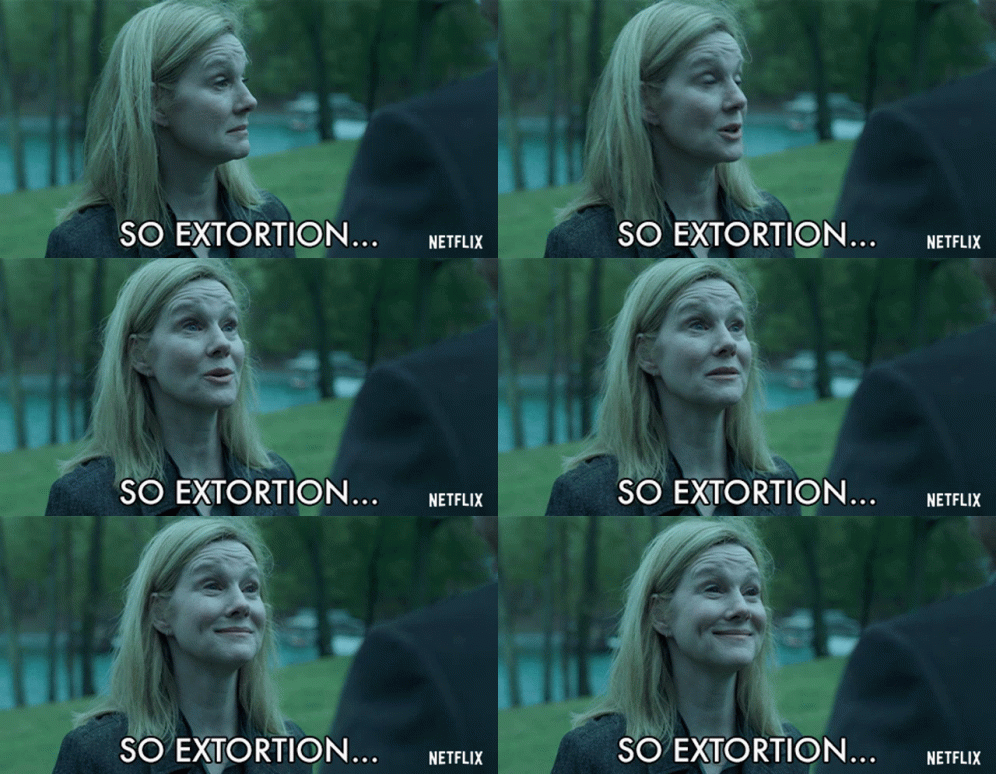
a woman says so extortion while talking to a man
ALT: a woman says so extortion while talking to a man
media.tenor.com
January 25, 2026 at 9:03 PM
Bondi: that’s a real nice State you got there. Shame if something happened to it. Turn over the voter rolls before you find out☠️
Reposted by Coco
The surge in Minnesota of ICE isn't as much about immigrants and more about pressure to turn over voter roles and additional information about government benefits. Keep in mind, states already report required info on benefits. They want more access than the law requires. These are Bondi's demands.

January 25, 2026 at 9:22 PM
The surge in Minnesota of ICE isn't as much about immigrants and more about pressure to turn over voter roles and additional information about government benefits. Keep in mind, states already report required info on benefits. They want more access than the law requires. These are Bondi's demands.
Reposted by Coco

Food contaminated with worms and mold. Limited access to clean drinking water. Inadequate medical care. These are a few of the allegations made by migrant families in recent court documents about their children’s conditions while in ICE custody. https://to.pbs.org/4sY4hFY

Migrant families allege children held by ICE face unsafe and unsanitary conditions
Food contaminated with worms and mold. Limited access to clean drinking water. Inadequate medical care. These are a few of the allegations made by migrant families in recent court documents about thei...
www.pbs.org
January 25, 2026 at 9:38 PM
Food contaminated with worms and mold. Limited access to clean drinking water. Inadequate medical care. These are a few of the allegations made by migrant families in recent court documents about their children’s conditions while in ICE custody. https://to.pbs.org/4sY4hFY
Reposted by Coco


Reposted by Coco

“If Minnesota falls, everything falls. We’re done as a nation.”
Fury. Grief. Anguish. Locals on the frontlines of Trump’s attack on Minneapolis are speaking out following the killing of another one of their neighbors. We’re on the ground with @samveep.bsky.social tracking the aftermath.
Fury. Grief. Anguish. Locals on the frontlines of Trump’s attack on Minneapolis are speaking out following the killing of another one of their neighbors. We’re on the ground with @samveep.bsky.social tracking the aftermath.
January 24, 2026 at 11:55 PM
“If Minnesota falls, everything falls. We’re done as a nation.”
Fury. Grief. Anguish. Locals on the frontlines of Trump’s attack on Minneapolis are speaking out following the killing of another one of their neighbors. We’re on the ground with @samveep.bsky.social tracking the aftermath.
Fury. Grief. Anguish. Locals on the frontlines of Trump’s attack on Minneapolis are speaking out following the killing of another one of their neighbors. We’re on the ground with @samveep.bsky.social tracking the aftermath.
Reposted by Coco

The soprano Renée Fleming will not be part of two scheduled performances at the Kennedy Center, according to the center’s website. Fleming, one of the world’s great opera singers, resigned as an artistic adviser to the Kennedy Center nearly one year ago.

Renée Fleming Won’t Perform at Kennedy Center Concerts
The soprano, who previously resigned as an artistic adviser, was scheduled to sing with the National Symphony Orchestra in May.
nyti.ms
January 24, 2026 at 4:00 AM
The soprano Renée Fleming will not be part of two scheduled performances at the Kennedy Center, according to the center’s website. Fleming, one of the world’s great opera singers, resigned as an artistic adviser to the Kennedy Center nearly one year ago.
Reposted by Coco
WATCH — @jessicatarlov.bsky.social : “The NY Times/Siena poll was so bad for Trump that he’s suing the NY Times… and JD Vance’s speechwriter I think hates him. He compared Trump’s economy to the Titanic.”😬
January 24, 2026 at 4:01 AM
WATCH — @jessicatarlov.bsky.social : “The NY Times/Siena poll was so bad for Trump that he’s suing the NY Times… and JD Vance’s speechwriter I think hates him. He compared Trump’s economy to the Titanic.”😬