



Mark Bitter
@markcbitter.bsky.social
Postdoc at Stanford University.
Interested in pop. gen., adaptation, and a wholesome scientific community.
he/him
Interested in pop. gen., adaptation, and a wholesome scientific community.
he/him
Pinned
Mark Bitter
@markcbitter.bsky.social
· Nov 18

Thrilled to finally share the magnum opus of my PhD that focuses on the genetic basis of evolutionary change! Specifically, we know we can map the genetic basis of a trait, but can we tell which genes will underlie the trait shift when it evolves? doi.org/10.1101/2025...

High-resolution mapping of a rapidly evolving complex trait reveals genotype-phenotype stability and an unpredictable genetic architecture of adaptation
The extent to which adaptation can be predicted, particularly for traits with complex genetic bases, is unknown. Here, we leveraged a model complex trait, model species, and high-powered longitudinal ...
doi.org
Genuinely one of the most important and interesting papers I have been a part of! Relevant to fundamental questions regarding the predictability of adaptation, as well as the applications of genomic data. Congrats to @j-smiley-rhodes.bsky.social and all co-authors for such a masterpiece!
Reposted by Mark Bitter

Excited that SpaceBar is now out in Nature Methods!🥳
We combined clone tracing with spatial transcriptomics to untangle what drives gene expression in tumors: a cell's identity or its neighborhood?
Most genes were driven by location, but some showed strong clonal patterns.
rdcu.be/eVhpc
We combined clone tracing with spatial transcriptomics to untangle what drives gene expression in tumors: a cell's identity or its neighborhood?
Most genes were driven by location, but some showed strong clonal patterns.
rdcu.be/eVhpc

SpaceBar enables single-cell-resolution clone tracing with imaging-based spatial transcriptomics
Nature Methods - SpaceBar is a cellular barcoding strategy for simultaneous analysis of cell clonal and spatial identities.
rdcu.be
December 18, 2025 at 7:55 PM
Excited that SpaceBar is now out in Nature Methods!🥳
We combined clone tracing with spatial transcriptomics to untangle what drives gene expression in tumors: a cell's identity or its neighborhood?
Most genes were driven by location, but some showed strong clonal patterns.
rdcu.be/eVhpc
We combined clone tracing with spatial transcriptomics to untangle what drives gene expression in tumors: a cell's identity or its neighborhood?
Most genes were driven by location, but some showed strong clonal patterns.
rdcu.be/eVhpc
Reposted by Mark Bitter

Working on this paper fundamentally changed how I thought about bacterial evolution, and I couldn't ask for a better to Hannukah present than to see it out, at last!
Grateful to share our paper on gene-specific selective sweeps in human gut microbiomes, now out in Nature! It has been a joy to work with @rwolff.bsky.social, whose insights and hard work made this possible.
www.nature.com/articles/s41...
www.nature.com/articles/s41...

Gene-specific selective sweeps are pervasive across human gut microbiomes - Nature
Development and application of the integrated linkage disequilibrium score (iLDS) reveals both selective pressures impacting the human gut microbiome and the mechanisms by which gut bacteria adapt to ...
www.nature.com
December 17, 2025 at 6:58 PM
Working on this paper fundamentally changed how I thought about bacterial evolution, and I couldn't ask for a better to Hannukah present than to see it out, at last!
Reposted by Mark Bitter

If you are interested in this work and are looking for a postdoc position, please get in touch -- we are actively looking for someone to join our group at UCLA!
December 17, 2025 at 6:53 PM
If you are interested in this work and are looking for a postdoc position, please get in touch -- we are actively looking for someone to join our group at UCLA!
Reposted by Mark Bitter
Grateful to share our paper on gene-specific selective sweeps in human gut microbiomes, now out in Nature! It has been a joy to work with @rwolff.bsky.social, whose insights and hard work made this possible.
www.nature.com/articles/s41...
www.nature.com/articles/s41...
Gene-specific selective sweeps are pervasive across human gut microbiomes - Nature
Development and application of the integrated linkage disequilibrium score (iLDS) reveals both selective pressures impacting the human gut microbiome and the mechanisms by which gut bacteria adapt to ...
www.nature.com
December 17, 2025 at 6:53 PM
Grateful to share our paper on gene-specific selective sweeps in human gut microbiomes, now out in Nature! It has been a joy to work with @rwolff.bsky.social, whose insights and hard work made this possible.
www.nature.com/articles/s41...
www.nature.com/articles/s41...
Reposted by Mark Bitter

So excited to share this work led by @alexrob.bsky.social with Ben Kerr!
We investigated a poliovirus capsid inhibitor that exploits a breakdown in the genotype-phenotype map to prevent drug resistance evolution. Or does it?
See Alex's thread, but a few extras:
#socialviruses #evosky #virosky 🧪
We investigated a poliovirus capsid inhibitor that exploits a breakdown in the genotype-phenotype map to prevent drug resistance evolution. Or does it?
See Alex's thread, but a few extras:
#socialviruses #evosky #virosky 🧪

My first lead author paper is out with Ben Kerr and @alisonfeder.bsky.social! We found that making an antiviral too strong can sometimes make resistance easier to evolve. This has implications for how we design drugs, choose doses, and think about viral evolution in the face of treatment. (1/n)

Intracellular interactions shape antiviral resistance outcomes in poliovirus via eco-evolutionary feedback - Nature Ecology & Evolution
A model of intrahost poliovirus replication shows that, after several rounds of replication, pocapavir, a poliovirus capsid inhibitor, collapses viral density, preventing intracellular interactions th...
www.nature.com
December 10, 2025 at 9:07 PM
So excited to share this work led by @alexrob.bsky.social with Ben Kerr!
We investigated a poliovirus capsid inhibitor that exploits a breakdown in the genotype-phenotype map to prevent drug resistance evolution. Or does it?
See Alex's thread, but a few extras:
#socialviruses #evosky #virosky 🧪
We investigated a poliovirus capsid inhibitor that exploits a breakdown in the genotype-phenotype map to prevent drug resistance evolution. Or does it?
See Alex's thread, but a few extras:
#socialviruses #evosky #virosky 🧪
Genuinely one of the most important and interesting papers I have been a part of! Relevant to fundamental questions regarding the predictability of adaptation, as well as the applications of genomic data. Congrats to @j-smiley-rhodes.bsky.social and all co-authors for such a masterpiece!
Thrilled to finally share the magnum opus of my PhD that focuses on the genetic basis of evolutionary change! Specifically, we know we can map the genetic basis of a trait, but can we tell which genes will underlie the trait shift when it evolves? doi.org/10.1101/2025...
High-resolution mapping of a rapidly evolving complex trait reveals genotype-phenotype stability and an unpredictable genetic architecture of adaptation
The extent to which adaptation can be predicted, particularly for traits with complex genetic bases, is unknown. Here, we leveraged a model complex trait, model species, and high-powered longitudinal ...
doi.org
November 18, 2025 at 3:39 PM
Genuinely one of the most important and interesting papers I have been a part of! Relevant to fundamental questions regarding the predictability of adaptation, as well as the applications of genomic data. Congrats to @j-smiley-rhodes.bsky.social and all co-authors for such a masterpiece!
Reposted by Mark Bitter
Super excited that the bulk of my PhD work is now preprinted! Here we used whole-community competition, or coalescence, experiments to quantify selection acting on genetically diverged strains within larger communities. (1/n)
www.biorxiv.org/content/10.1...
www.biorxiv.org/content/10.1...
www.biorxiv.org
November 11, 2025 at 5:15 PM
Super excited that the bulk of my PhD work is now preprinted! Here we used whole-community competition, or coalescence, experiments to quantify selection acting on genetically diverged strains within larger communities. (1/n)
www.biorxiv.org/content/10.1...
www.biorxiv.org/content/10.1...
Reposted by Mark Bitter

One of the most exciting works of my career, years in the making. We used high-throughput precision genome editing to test the fitness effects of thousands of natural variants. Our findings challenge the long-held assumption that common variants are inconsequential.
www.biorxiv.org/content/10.1...
www.biorxiv.org/content/10.1...

Massively parallel interrogation of the fitness of natural variants in ancient signaling pathways reveals pervasive local adaptation
The nature of standing genetic variation remains a central debate in population genetics, with differing perspectives on whether common variants are almost always neutral as suggested by neutral and n...
www.biorxiv.org
October 22, 2025 at 5:46 PM
One of the most exciting works of my career, years in the making. We used high-throughput precision genome editing to test the fitness effects of thousands of natural variants. Our findings challenge the long-held assumption that common variants are inconsequential.
www.biorxiv.org/content/10.1...
www.biorxiv.org/content/10.1...
Reposted by Mark Bitter

One week to apply for our fully funded PhD position in Norway! This is a really exciting project in collab. with University of Helsinki and Benchmark Genetics.
Samples are ready - you do (read: learn) everything - functional genomics, bioinformatics, genotype-phenotype associations 🤩
Please RT!
Samples are ready - you do (read: learn) everything - functional genomics, bioinformatics, genotype-phenotype associations 🤩
Please RT!
How do regulatory genes control alternative life histories? We have an open PhD position to answer this question using functional genomics in Atlantic salmon.
Apply by October 15th through www.jobbnorge.no/en/available...
Please share widely! 🧬🦑🖥️
Apply by October 15th through www.jobbnorge.no/en/available...
Please share widely! 🧬🦑🖥️

October 7, 2025 at 1:30 PM
One week to apply for our fully funded PhD position in Norway! This is a really exciting project in collab. with University of Helsinki and Benchmark Genetics.
Samples are ready - you do (read: learn) everything - functional genomics, bioinformatics, genotype-phenotype associations 🤩
Please RT!
Samples are ready - you do (read: learn) everything - functional genomics, bioinformatics, genotype-phenotype associations 🤩
Please RT!
Reposted by Mark Bitter

Human-mediated land-use and climate change occur simultaneously, but how do they interact to shape adaptive dynamics? Super excited to share the first paper from the Kreiner lab, led by postdoc extraordinaire @rpineau.bsky.social

October 6, 2025 at 3:13 PM
Human-mediated land-use and climate change occur simultaneously, but how do they interact to shape adaptive dynamics? Super excited to share the first paper from the Kreiner lab, led by postdoc extraordinaire @rpineau.bsky.social
Reposted by Mark Bitter

New preprint led by undergrad Owen Moosman! We uncover extensive haplotype diversity in antifreeze protein gene copy number in polar Zoarcoidei fishes, and report new tools to evaluate assembly uncertainty and switch error in phased genomes www.biorxiv.org/content/10.1...


September 16, 2025 at 5:33 PM
New preprint led by undergrad Owen Moosman! We uncover extensive haplotype diversity in antifreeze protein gene copy number in polar Zoarcoidei fishes, and report new tools to evaluate assembly uncertainty and switch error in phased genomes www.biorxiv.org/content/10.1...
Reposted by Mark Bitter

Very excited to see this work in press! I think there is a reason to believe that this is a common means of stabilizing large-effect polymorphisms in general and might be an important reason for why diploidy is so common. news.stanford.edu/stories/2025...
September 15, 2025 at 5:24 PM
Very excited to see this work in press! I think there is a reason to believe that this is a common means of stabilizing large-effect polymorphisms in general and might be an important reason for why diploidy is so common. news.stanford.edu/stories/2025...
Reposted by Mark Bitter
How do populations maintain an evolutionary memory? I am happy to share that our work with Dmitri Petrov @petrovadmitri.bsky.social, Paul Schmidt, and colleagues on dominance reversal and stabilization of insecticide resistance in changing environments over time is now published at Nature EE.

Beneficial reversal of dominance maintains a large-effect resistance polymorphism under fluctuating insecticide selection - Nature Ecology & Evolution
Measuring selection and dominance in fitness of the insecticide-resistant Ace alleles in Drosophila melanogaster, the authors show evidence for beneficial reversal of dominance, a mechanism that can s...
www.nature.com
September 15, 2025 at 6:17 PM
How do populations maintain an evolutionary memory? I am happy to share that our work with Dmitri Petrov @petrovadmitri.bsky.social, Paul Schmidt, and colleagues on dominance reversal and stabilization of insecticide resistance in changing environments over time is now published at Nature EE.
Reposted by Mark Bitter
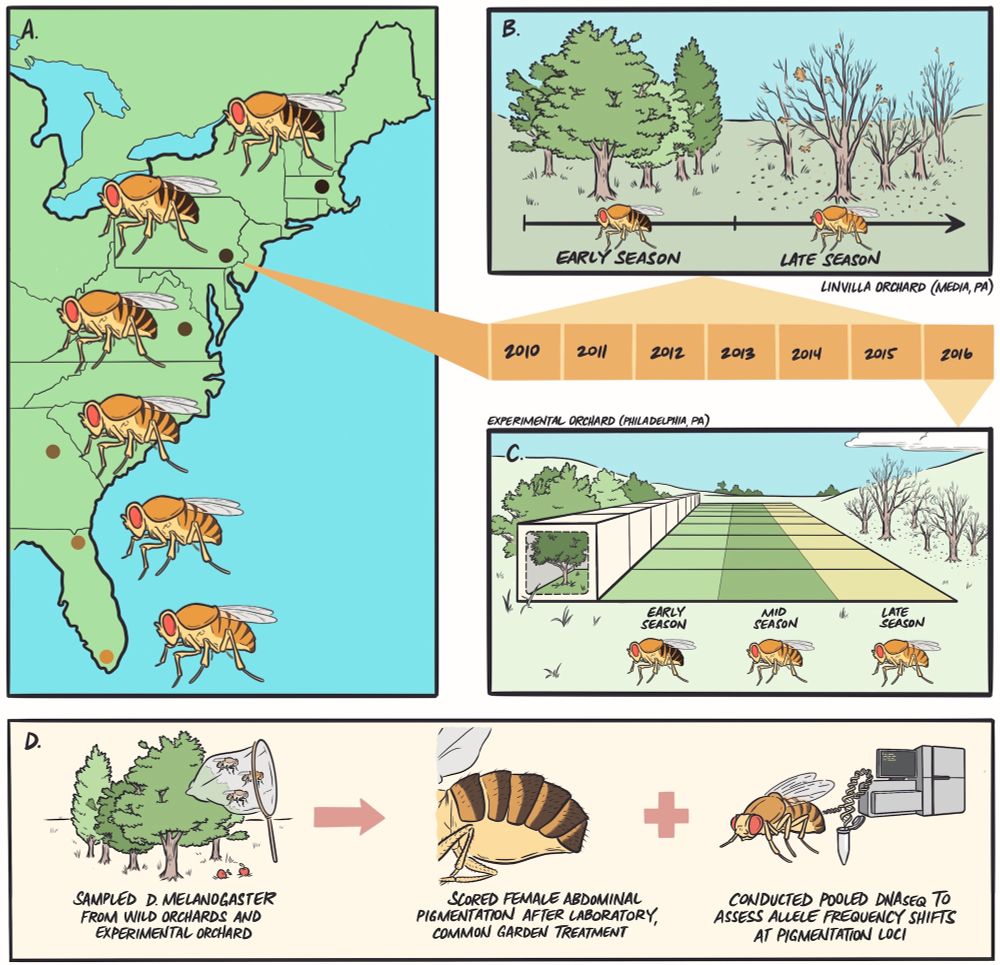
Check out our paper in Evolution Letters!
We used D. melanogaster pigmentation as a focal trait to explore parallelism in phenotypic and genomic responses to environmental change - read more at the link below 👇
We used D. melanogaster pigmentation as a focal trait to explore parallelism in phenotypic and genomic responses to environmental change - read more at the link below 👇

How predictably does complex trait adaptation proceed over space and time in wild populations?
doi.org/10.1093/evle...
Now in @evolletters.bsky.social by @skylerberardi.bsky.social, @paulrschmidt.bsky.social et al.
📷: Dr. Rush Dhillon
doi.org/10.1093/evle...
Now in @evolletters.bsky.social by @skylerberardi.bsky.social, @paulrschmidt.bsky.social et al.
📷: Dr. Rush Dhillon
July 31, 2025 at 9:32 PM
Check out our paper in Evolution Letters!
We used D. melanogaster pigmentation as a focal trait to explore parallelism in phenotypic and genomic responses to environmental change - read more at the link below 👇
We used D. melanogaster pigmentation as a focal trait to explore parallelism in phenotypic and genomic responses to environmental change - read more at the link below 👇
Reposted by Mark Bitter
I am seeking a postdoc for my group at UCLA. We work at the intersection of population genetics x microbiome (garud.eeb.ucla.edu). If interested, please message me!
Garud Lab
garud.eeb.ucla.edu
July 22, 2025 at 5:51 PM
I am seeking a postdoc for my group at UCLA. We work at the intersection of population genetics x microbiome (garud.eeb.ucla.edu). If interested, please message me!
Reposted by Mark Bitter

Come join us at UCLA!!! We have a growing population genetics community here and Nandita and her lab are outstanding!
I am seeking a postdoc for my group at UCLA. We work at the intersection of population genetics x microbiome (garud.eeb.ucla.edu). If interested, please message me!
Garud Lab
garud.eeb.ucla.edu
July 23, 2025 at 1:46 PM
Come join us at UCLA!!! We have a growing population genetics community here and Nandita and her lab are outstanding!
Reposted by Mark Bitter

The Xue lab at UC Irvine is looking for a staff scientist to support our work investigating how microbes interact and evolve in the gut microbiome! Open to a wide range of previous experience levels, see ad for more.
recruit.ap.uci.edu/JPF09601
recruit.ap.uci.edu/JPF09601

Junior, Assistant, or Associate Specialist – Xue Lab
University of California, Irvine is hiring. Apply now!
recruit.ap.uci.edu
July 17, 2025 at 8:32 PM
The Xue lab at UC Irvine is looking for a staff scientist to support our work investigating how microbes interact and evolve in the gut microbiome! Open to a wide range of previous experience levels, see ad for more.
recruit.ap.uci.edu/JPF09601
recruit.ap.uci.edu/JPF09601
Reposted by Mark Bitter
We are recruiting students who are thinking of applying to Biology PhD programs this fall to apply for the Stanford Biology Preview Program. Please spread the word!

Applying to Biology PhD programs this year? Let us help!
At BPP, we aim to support students from all backgrounds through the grad school application process. Learn more about grad student life and receive 1-on-1 feedback on your application materials!
Apply here: forms.gle/EvTyUWXFMRSL...
At BPP, we aim to support students from all backgrounds through the grad school application process. Learn more about grad student life and receive 1-on-1 feedback on your application materials!
Apply here: forms.gle/EvTyUWXFMRSL...

June 27, 2025 at 4:52 PM
We are recruiting students who are thinking of applying to Biology PhD programs this fall to apply for the Stanford Biology Preview Program. Please spread the word!
Reposted by Mark Bitter
1/n 🧵 Excited to share our new paper! We developed a framework to reveal hidden simplicity in how organisms adapt to different environments, particularly focusing on antibiotic resistance evolution. #EvolutionaryBiology #MachineLearning

Learning the Shape of Evolutionary Landscapes: Geometric Deep Learning Reveals Hidden Structure in Phenotype-to-Fitness Maps https://www.biorxiv.org/content/10.1101/2025.05.07.652616v1
May 15, 2025 at 2:33 PM
1/n 🧵 Excited to share our new paper! We developed a framework to reveal hidden simplicity in how organisms adapt to different environments, particularly focusing on antibiotic resistance evolution. #EvolutionaryBiology #MachineLearning
Reposted by Mark Bitter

1/9 Excited to share the preprint for the second half of my PhD with @mollyschumer.bsky.social: Connecting human environmental impacts to hybridization in swordtail fish through genomics, GIS, water chemistry, and histology. Thread below!
#SciSky
www.biorxiv.org/content/10.1...
#SciSky
www.biorxiv.org/content/10.1...

Increased rates of hybridization in swordtail fish are associated with water pollution
Biodiversity loss can occur when disturbance compromises the reproductive barriers between species, causing them to collapse into a single population through hybridization. Recent research has documen...
www.biorxiv.org
May 1, 2025 at 1:15 PM
1/9 Excited to share the preprint for the second half of my PhD with @mollyschumer.bsky.social: Connecting human environmental impacts to hybridization in swordtail fish through genomics, GIS, water chemistry, and histology. Thread below!
#SciSky
www.biorxiv.org/content/10.1...
#SciSky
www.biorxiv.org/content/10.1...
Reposted by Mark Bitter

Excited to share the first manuscript from my PhD in which we leveraged ultra-long Nanopore sequencing, D. melanogaster inbred lines, and a ton of manual validation to investigate the effects of long-read length on population-level structural variant (SV) calling accuracy! doi.org/10.1101/2025...

Manual validation finds only ultra-long long-read sequencing enables faithful, population-level structural variant calling in Drosophila melanogaster euchromatin
The increasing accessibility of long-read sequencing and the rapid development of automated variant callers are promoting the generation of population-level structural variation data. However, the eff...
doi.org
April 25, 2025 at 8:03 PM
Excited to share the first manuscript from my PhD in which we leveraged ultra-long Nanopore sequencing, D. melanogaster inbred lines, and a ton of manual validation to investigate the effects of long-read length on population-level structural variant (SV) calling accuracy! doi.org/10.1101/2025...
Reposted by Mark Bitter
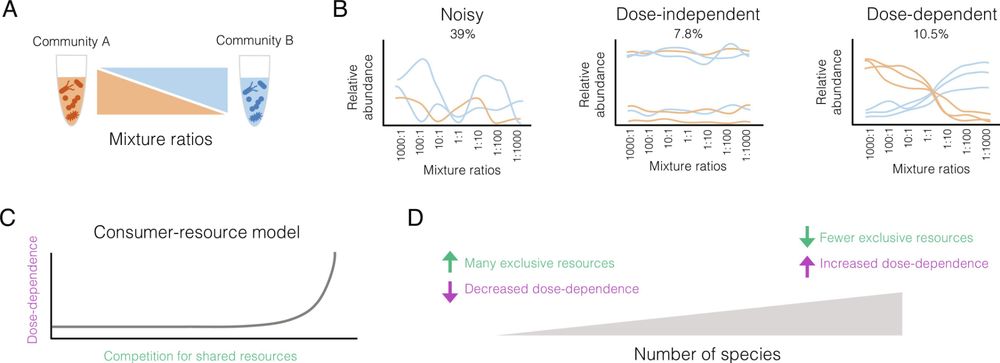
Our commentary on the elegant in vitro microbiome coalescence experiments from @goldmandoran.bsky.social @ksxue.bsky.social et al is out.
It was a pleasure to write about one of my favorite microbiome papers of the last few years.
www.pnas.org/doi/10.1073/...
It was a pleasure to write about one of my favorite microbiome papers of the last few years.
www.pnas.org/doi/10.1073/...
Mixing microbiomes in vitro reveals rules of community assembly | PNAS
Mixing microbiomes in vitro reveals rules of community assembly
www.pnas.org
April 7, 2025 at 7:41 PM
Our commentary on the elegant in vitro microbiome coalescence experiments from @goldmandoran.bsky.social @ksxue.bsky.social et al is out.
It was a pleasure to write about one of my favorite microbiome papers of the last few years.
www.pnas.org/doi/10.1073/...
It was a pleasure to write about one of my favorite microbiome papers of the last few years.
www.pnas.org/doi/10.1073/...
Reposted by Mark Bitter

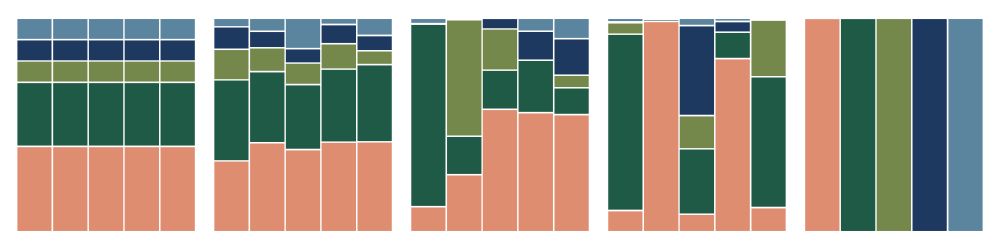
1/ Hey y'all, I'm excited to share my latest paper, which is out now in PNAS! We introduce FAVA, a statistical framework to measure compositional variability across microbiome samples. If you want to measure variability across a stacked bar plot, FAVA is for you! Paper: doi.org/10.1073/pnas...
March 14, 2025 at 8:46 PM
1/ Hey y'all, I'm excited to share my latest paper, which is out now in PNAS! We introduce FAVA, a statistical framework to measure compositional variability across microbiome samples. If you want to measure variability across a stacked bar plot, FAVA is for you! Paper: doi.org/10.1073/pnas...
Reposted by Mark Bitter
Thank you for the coverage! Excited that this work, in collaboration with @markcbitter.bsky.social and many others, is now out!
February 20, 2025 at 6:11 PM
Thank you for the coverage! Excited that this work, in collaboration with @markcbitter.bsky.social and many others, is now out!
Reposted by Mark Bitter

A new study led by #EnvironmentalHealth postdoc Lisa Couper finds #mosquitoes may genetically adapt to #ClimateChange more than expected. Her team's findings show increasing risk of #WestNileVirus, #Malaria & other diseases due to the insects' heat tolerance. #GlobalWarming ow.ly/Uzro50V3BRl
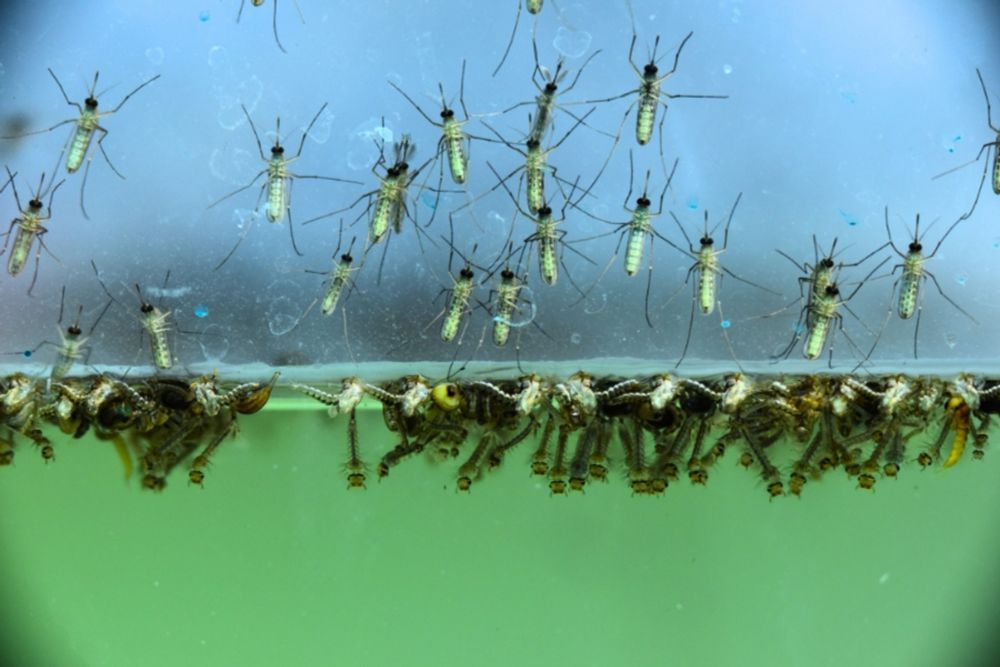
New research shows mosquitoes may be able to adapt to warming temperatures
The heat tolerance the research team saw “exceeds that of projected climate warming,” according to the published paper.
ow.ly
February 20, 2025 at 5:10 PM
A new study led by #EnvironmentalHealth postdoc Lisa Couper finds #mosquitoes may genetically adapt to #ClimateChange more than expected. Her team's findings show increasing risk of #WestNileVirus, #Malaria & other diseases due to the insects' heat tolerance. #GlobalWarming ow.ly/Uzro50V3BRl