



Dr. DY Zheng
@zhengdy.bsky.social
Bioinformatics & Genomics scientist, https://github.com/bioinfoDZ. Professor at Albert Einstein College of Medicine, study brain / heart development & diseases, and cancers
Reposted by Dr. DY Zheng

Please share: we're hiring a new tenure-track faculty member to our Department of Genetics at Albert Einstein College of Medicine.
faculty-einstein.icims.com/jobs/17847/a...
faculty-einstein.icims.com/jobs/17847/a...
Albert Einstein College of Medicine | Medical Education | Biomedical Research
faculty-einstein.icims.com
February 5, 2026 at 10:14 PM
Please share: we're hiring a new tenure-track faculty member to our Department of Genetics at Albert Einstein College of Medicine.
faculty-einstein.icims.com/jobs/17847/a...
faculty-einstein.icims.com/jobs/17847/a...
Reposted by Dr. DY Zheng
Please share this with your network: Postdoctoral position available in my group.
www.linkedin.com/jobs/view/43...
www.linkedin.com/jobs/view/43...
Albert Einstein College of Medicine hiring Postdoctoral position studying functional non-coding variants in neurodevelopmental disorders, Bronx, New York City, USA c in New York City Metropolitan Area...
Posted 9:40:20 PM. A postdoctoral fellow position is open with 2 years of funding from the Simons Foundation Autism…See this and similar jobs on LinkedIn.
www.linkedin.com
February 5, 2026 at 10:47 PM
Please share this with your network: Postdoctoral position available in my group.
www.linkedin.com/jobs/view/43...
www.linkedin.com/jobs/view/43...
Reposted by Dr. DY Zheng

News from central Jersey: I'm running to represent New Jersey's 12th Congressional District.
By entering the fray, I hope to bring ideas of repairing our frayed republic. Not only to defend it in 2026, but to build something stronger, for generations to come!
samwang.substack.com/p/entering-t...
By entering the fray, I hope to bring ideas of repairing our frayed republic. Not only to defend it in 2026, but to build something stronger, for generations to come!
samwang.substack.com/p/entering-t...

February 4, 2026 at 3:00 AM
News from central Jersey: I'm running to represent New Jersey's 12th Congressional District.
By entering the fray, I hope to bring ideas of repairing our frayed republic. Not only to defend it in 2026, but to build something stronger, for generations to come!
samwang.substack.com/p/entering-t...
By entering the fray, I hope to bring ideas of repairing our frayed republic. Not only to defend it in 2026, but to build something stronger, for generations to come!
samwang.substack.com/p/entering-t...
Reposted by Dr. DY Zheng
This was never really the case. We have known since the 1960s that some of our non-coding DNA has a crucial role in gene regulation: turning the expression of coding genes on & off. It’s been clear for decades that the regulatory DNA is at least comparable in proportion to the protein-coding DNA. /5
January 30, 2026 at 9:50 AM
This was never really the case. We have known since the 1960s that some of our non-coding DNA has a crucial role in gene regulation: turning the expression of coding genes on & off. It’s been clear for decades that the regulatory DNA is at least comparable in proportion to the protein-coding DNA. /5
Reposted by Dr. DY Zheng

Gonadal and sex chromosomal contributions to sex differences in mammalian brain organization www.biorxiv.org/content/10.6... - really nice work from Armin Raznahan @bogglerapture.bsky.social and colleagues


January 11, 2026 at 8:54 AM
Gonadal and sex chromosomal contributions to sex differences in mammalian brain organization www.biorxiv.org/content/10.6... - really nice work from Armin Raznahan @bogglerapture.bsky.social and colleagues
XIST plays a key role in X-chromosome inactivation (XCI) and thought to be transcribed exclusively from the inactive X in female (XX). In this new study led by Kevin O’Leary, a talented MSTP student, we find both views need to be updated. @genomeresearch.bsky.social doi.org/10.1101/gr.2...
Transcription and potential functions of a novel XIST isoform in male peripheral glia
An international, peer-reviewed genome sciences journal featuring outstanding original research that offers novel insights into the biology of all organisms
doi.org
December 12, 2025 at 11:13 PM
XIST plays a key role in X-chromosome inactivation (XCI) and thought to be transcribed exclusively from the inactive X in female (XX). In this new study led by Kevin O’Leary, a talented MSTP student, we find both views need to be updated. @genomeresearch.bsky.social doi.org/10.1101/gr.2...
Don’t know what to make of this. The temp is below 20F, but this spring flower??

December 5, 2025 at 11:08 PM
Don’t know what to make of this. The temp is below 20F, but this spring flower??
In prep for a talk, I asked DALL•E to make an image of “mouse developing heart”. It became more creative than I expected and got me this 😂

November 10, 2025 at 1:00 AM
In prep for a talk, I asked DALL•E to make an image of “mouse developing heart”. It became more creative than I expected and got me this 😂
Reposted by Dr. DY Zheng
This week, we published in @science.org an article outlining the current ethical and societal implications of research involving human neural #organoids and #assembloids, their transplantation, and highlighted potential next steps.
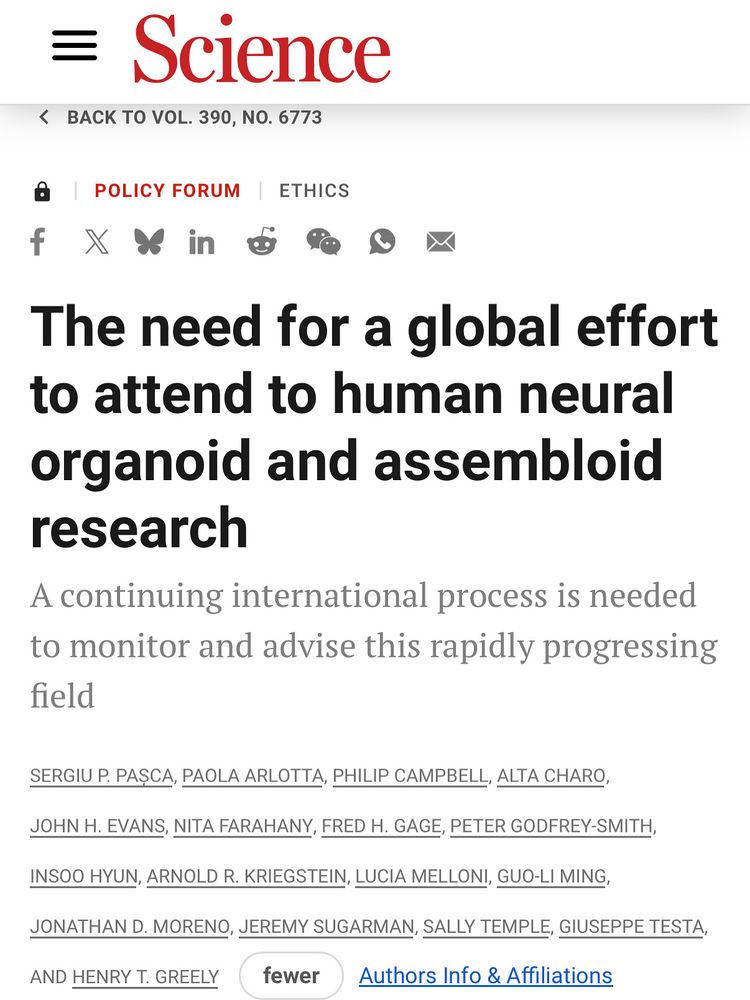
November 7, 2025 at 12:12 PM
This week, we published in @science.org an article outlining the current ethical and societal implications of research involving human neural #organoids and #assembloids, their transplantation, and highlighted potential next steps.
Reposted by Dr. DY Zheng

New work by @gleesonlab.bsky.social & colleagues in @cp-cellstemcell.bsky.social
“A phenotypic brain organoid atlas and biobank for neurodevelopmental disorders” 🧪🧠🧫🧬
www.cell.com/cell-stem-ce...
“A phenotypic brain organoid atlas and biobank for neurodevelopmental disorders” 🧪🧠🧫🧬
www.cell.com/cell-stem-ce...

A phenotypic brain organoid atlas and biobank for neurodevelopmental disorders
Wang and colleagues present a phenotypic brain organoid atlas for neurodevelopmental
disorders, revealing disease-specific cellular and molecular alterations that illuminate
NDD pathogenesis. Integrat...
www.cell.com
November 3, 2025 at 8:26 PM
New work by @gleesonlab.bsky.social & colleagues in @cp-cellstemcell.bsky.social
“A phenotypic brain organoid atlas and biobank for neurodevelopmental disorders” 🧪🧠🧫🧬
www.cell.com/cell-stem-ce...
“A phenotypic brain organoid atlas and biobank for neurodevelopmental disorders” 🧪🧠🧫🧬
www.cell.com/cell-stem-ce...
Reposted by Dr. DY Zheng

🚨To celebrate #WorldMentalHealthDay, our October issue includes a Focus that examines the advances in computational psychiatry and the challenges of developing computational models to address mental health disorders. #mentalhealthresearch #Psychiatry
➡️ nature.com/collections/...
🧵(1/8)
➡️ nature.com/collections/...
🧵(1/8)

October 10, 2025 at 6:57 PM
🚨To celebrate #WorldMentalHealthDay, our October issue includes a Focus that examines the advances in computational psychiatry and the challenges of developing computational models to address mental health disorders. #mentalhealthresearch #Psychiatry
➡️ nature.com/collections/...
🧵(1/8)
➡️ nature.com/collections/...
🧵(1/8)
Excited to have Mark from Yale visit us and speak in our AI seminar series tomorrow, co-sponsored by the new Data Science Institute at @einsteinmededu.bsky.social lots of to learn and catch up

Posting my talk tomorrow on AI in Biomedicine at
Einstein Med (hosted by @zhengdy.bsky.social)
lectures.gersteinlab.org/summary/AI-t... Using AI for brain genomics & thinking about how it can do this research autonomously. Lots of new slides on AI coding & risks
Einstein Med (hosted by @zhengdy.bsky.social)
lectures.gersteinlab.org/summary/AI-t... Using AI for brain genomics & thinking about how it can do this research autonomously. Lots of new slides on AI coding & risks


October 9, 2025 at 2:53 AM
Excited to have Mark from Yale visit us and speak in our AI seminar series tomorrow, co-sponsored by the new Data Science Institute at @einsteinmededu.bsky.social lots of to learn and catch up

Reposted by Dr. DY Zheng

🚀 NY-CURES Launch — Championing State-Wide Investment in Science! 🚀
Our new coalition advocates for sustained public support of New York’s vibrant biomedical research ecosystem — creating cures, economic gains & strengthening communities.
Sign up. Stay informed. Join the movement: www.nycures.org/
Our new coalition advocates for sustained public support of New York’s vibrant biomedical research ecosystem — creating cures, economic gains & strengthening communities.
Sign up. Stay informed. Join the movement: www.nycures.org/

September 4, 2025 at 4:32 PM
🚀 NY-CURES Launch — Championing State-Wide Investment in Science! 🚀
Our new coalition advocates for sustained public support of New York’s vibrant biomedical research ecosystem — creating cures, economic gains & strengthening communities.
Sign up. Stay informed. Join the movement: www.nycures.org/
Our new coalition advocates for sustained public support of New York’s vibrant biomedical research ecosystem — creating cures, economic gains & strengthening communities.
Sign up. Stay informed. Join the movement: www.nycures.org/
Reposted by Dr. DY Zheng
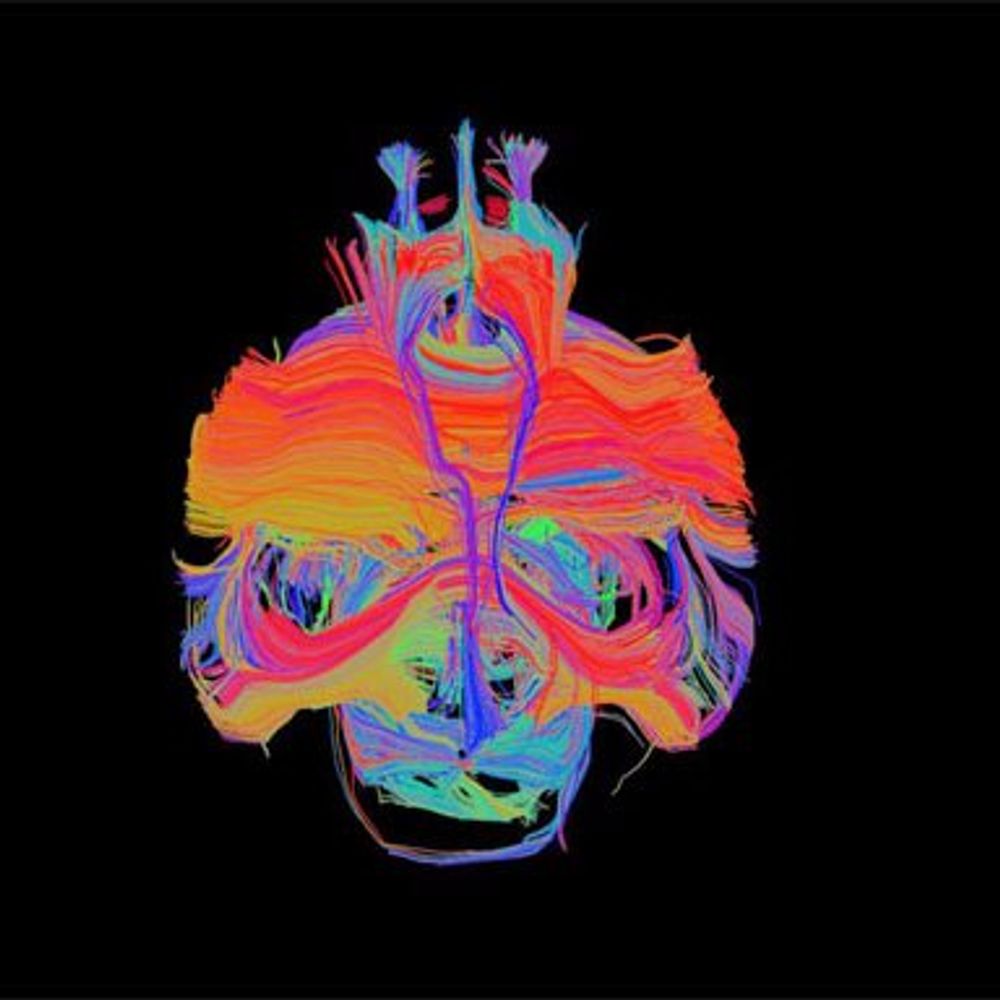
🚨 Excited to share the latest preprint form the lab ➡️https://tinyurl.com/32d3be9f
Here we tackle a long-standing chicken-or-egg 🐣🥚question in #autism and developmental neuroscience
➡️ Is excitation–inhibition (E:I) imbalance a "cause" or a "consequence" of #autism?
Check out what we found!
🧵1/n
Here we tackle a long-standing chicken-or-egg 🐣🥚question in #autism and developmental neuroscience
➡️ Is excitation–inhibition (E:I) imbalance a "cause" or a "consequence" of #autism?
Check out what we found!
🧵1/n

September 10, 2025 at 3:08 PM
Still like UMAP? Why stop at one when you can make lots of them. Then you may learn something new from them and if they represent your data well.

shinyUMAP: an online tool for promoting understanding of single cell omics data visualization https://www.biorxiv.org/content/10.1101/2025.08.27.672621v1
September 2, 2025 at 12:16 PM
Still like UMAP? Why stop at one when you can make lots of them. Then you may learn something new from them and if they represent your data well.
Reposted by Dr. DY Zheng

PSA:
if you're not a mouse person you may enjoy knowing that mouse Sca1 (the hematopoiesis marker) is not encoded by Sca1 (spinocerebellar ataxia 1) but rather Ly6a.
I mean, OF COURSE it is. What else could it be?
I'm an hg38 person and below is a self-portrait while I was figuring this out.
if you're not a mouse person you may enjoy knowing that mouse Sca1 (the hematopoiesis marker) is not encoded by Sca1 (spinocerebellar ataxia 1) but rather Ly6a.
I mean, OF COURSE it is. What else could it be?
I'm an hg38 person and below is a self-portrait while I was figuring this out.

August 22, 2025 at 12:13 PM
PSA:
if you're not a mouse person you may enjoy knowing that mouse Sca1 (the hematopoiesis marker) is not encoded by Sca1 (spinocerebellar ataxia 1) but rather Ly6a.
I mean, OF COURSE it is. What else could it be?
I'm an hg38 person and below is a self-portrait while I was figuring this out.
if you're not a mouse person you may enjoy knowing that mouse Sca1 (the hematopoiesis marker) is not encoded by Sca1 (spinocerebellar ataxia 1) but rather Ly6a.
I mean, OF COURSE it is. What else could it be?
I'm an hg38 person and below is a self-portrait while I was figuring this out.
Reposted by Dr. DY Zheng

“With these considerations, we expect to fund through the 4th percentile.”
There it is, in black and white, the destruction of cancer research in the US.
There it is, in black and white, the destruction of cancer research in the US.

Funding policy for 2025 from NCI. Was just released: 4 percentile…maybe!
www.cancer.gov/grants-train...
www.cancer.gov/grants-train...
Funding Policy - Research Grants
NCI funding policy for research project grant (RPG) awards reflects the funding goals of the institute, NIH, and HHS.
www.cancer.gov
July 23, 2025 at 10:21 PM
“With these considerations, we expect to fund through the 4th percentile.”
There it is, in black and white, the destruction of cancer research in the US.
There it is, in black and white, the destruction of cancer research in the US.
Reposted by Dr. DY Zheng

As we have learned, genes have dose-dependent effects on psychiatric traits. DOSAGE, it turns out, is a key element that helps unravel mechanisms of gene → pathway → cell type → brain region → diagnosis. Here we developed a framework to characterize cellular processes that mediate genetic effects.

Psychiatric disorders converge on common pathways but diverge in cellular context, spatial distribution, and directionality of genetic effects https://www.medrxiv.org/content/10.1101/2025.07.11.25331381v1
July 16, 2025 at 9:23 PM
As we have learned, genes have dose-dependent effects on psychiatric traits. DOSAGE, it turns out, is a key element that helps unravel mechanisms of gene → pathway → cell type → brain region → diagnosis. Here we developed a framework to characterize cellular processes that mediate genetic effects.
Reposted by Dr. DY Zheng
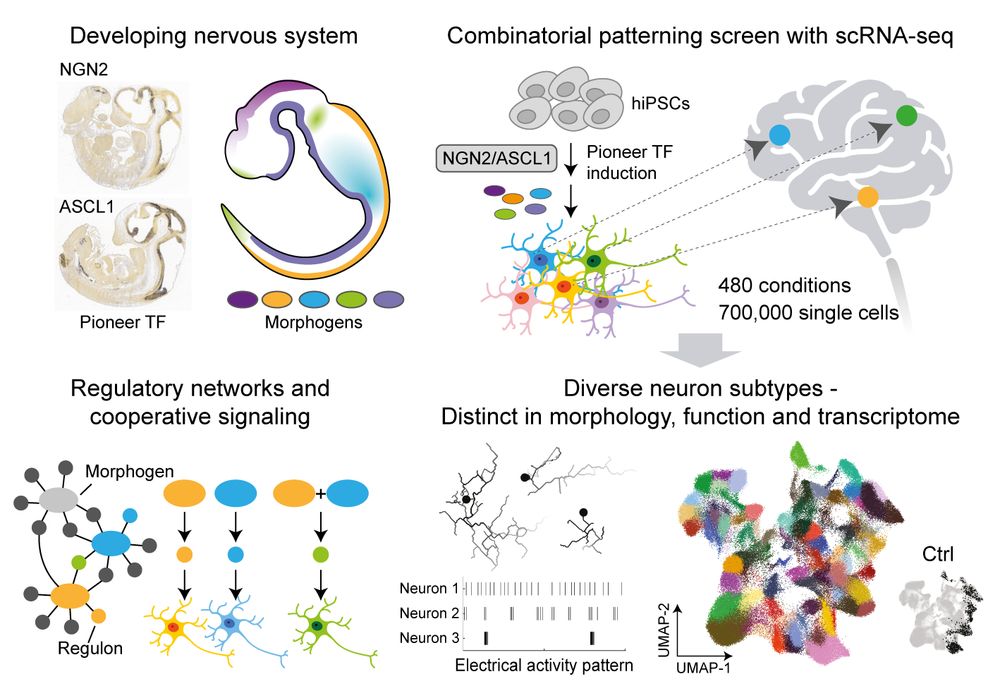
Neuron programming! Pro-neural TFs + 480 morphogen conditions + scRNA-seq --> Diverse iN subtypes of forebrain, midbrain, hindbrain, spinal cord, and PNS. @hsiuchuanlin.bsky.social @jasperjanssens.bsky.social and Treutlein Lab! @science.org www.science.org/doi/10.1126/... #NGN2 #ASCL1
July 11, 2025 at 8:59 PM
Neuron programming! Pro-neural TFs + 480 morphogen conditions + scRNA-seq --> Diverse iN subtypes of forebrain, midbrain, hindbrain, spinal cord, and PNS. @hsiuchuanlin.bsky.social @jasperjanssens.bsky.social and Treutlein Lab! @science.org www.science.org/doi/10.1126/... #NGN2 #ASCL1
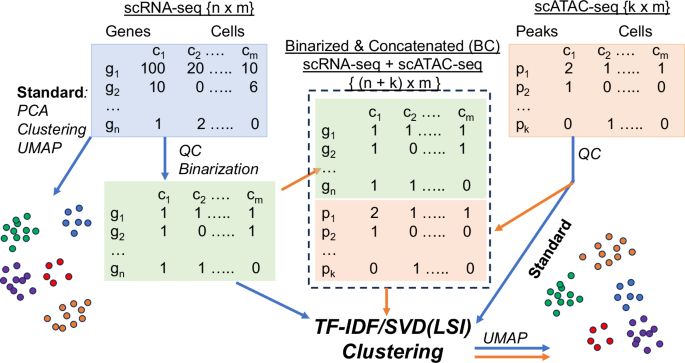
Since reading the first scATAC-seq paper, I had been wondering if the reported difference from scRNA-seq results is due to bioinformatic algorithms or biology. Finally we got a chance to look into this, by applying the same algorithm to both data types and their direct integration.

Binarized gene expression data can be concatenated with chromatin accessibility data for effective and integrated cell clustering @zhengdy.bsky.social @einsteinmededu.bsky.social #BiotechNatureComms
doi.org/10.1038/s414...
doi.org/10.1038/s414...
Facilitate integrated analysis of single cell multiomic data by binarizing gene expression values - Nature Communications
Individual data types in a single cell multi-omic assay are often processed and clustered independently before combined for further analysis. Here, authors showed that binarized gene expression d...
doi.org
July 7, 2025 at 6:47 PM
Since reading the first scATAC-seq paper, I had been wondering if the reported difference from scRNA-seq results is due to bioinformatic algorithms or biology. Finally we got a chance to look into this, by applying the same algorithm to both data types and their direct integration.
Great to see this collaboration work finally out. Congratulations to Wong, Chi and all authors!

✨OUT TODAY @natgenet.nature.com
📰Disruption of TAD hierarchy promotes LTR co-option in #cancer.
By Elissa W. P. Wong, Ping Chi and colleagues.
⬇️
www.nature.com/articles/s41...
📰Disruption of TAD hierarchy promotes LTR co-option in #cancer.
By Elissa W. P. Wong, Ping Chi and colleagues.
⬇️
www.nature.com/articles/s41...

Disruption of TAD hierarchy promotes LTR co-option in cancer - Nature Genetics
NIPBL perturbation activates long terminal repeat (LTR)-derived alternative promoters due to reorganization of chromatin’s hierarchical structure, leading to LTR co-option and oncogene activation in m...
www.nature.com
June 30, 2025 at 9:26 PM
Great to see this collaboration work finally out. Congratulations to Wong, Chi and all authors!
Reposted by Dr. DY Zheng

Now online! Digital reconstruction of full embryos during early mouse organogenesis

Digital reconstruction of full embryos during early mouse organogenesis
Single-cell digital embryo reconstruction during early organogenesis creates spatiotemporal atlases for mesoderm and endoderm lineages and captures the primordium determination zone (PDZ) at the E7.75 embryonic-extraembryonic interface, where cross-germ-layer signaling communication drives organogenesis.
dlvr.it
June 18, 2025 at 10:38 PM
Now online! Digital reconstruction of full embryos during early mouse organogenesis
Reposted by Dr. DY Zheng

Persistent cortical excitatory neuron dysregulation in adult Chd8 haploinsufficient mice. https://www.biorxiv.org/content/10.1101/2025.06.04.657776v1
June 5, 2025 at 6:36 AM
Persistent cortical excitatory neuron dysregulation in adult Chd8 haploinsufficient mice. https://www.biorxiv.org/content/10.1101/2025.06.04.657776v1
Reposted by Dr. DY Zheng

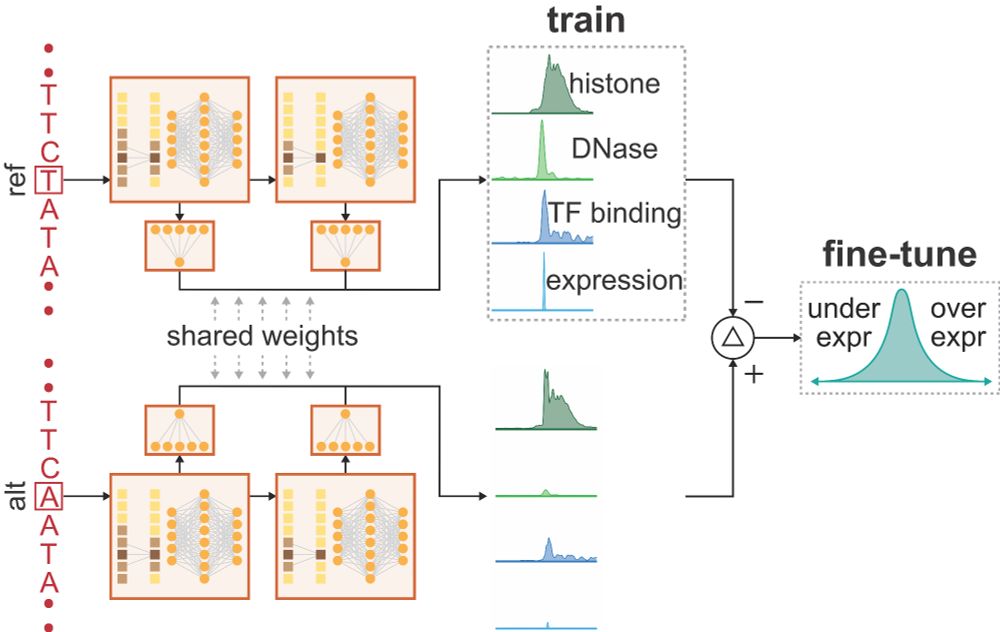
We're thrilled to introduce PromoterAI — a tool for accurately identifying promoter variants that impact gene expression. 🧵 (1/)
May 29, 2025 at 6:29 PM
We're thrilled to introduce PromoterAI — a tool for accurately identifying promoter variants that impact gene expression. 🧵 (1/)