Jonathan Birch
banner
birchlse.bsky.social
Jonathan Birch
@birchlse.bsky.social

Professor, LSE. Philosophy of science, animal consciousness, animal ethics. Director of The Jeremy Coller Centre for Animal Sentience.

Jonathan Birch is a British philosopher and professor of philosophy at the London School of Economics and Political Science. His work addresses the philosophy of biology and behavioural sciences, especially questions concerning sentience, bioethics, animal welfare, and the evolution of social behaviour and social norms. .. more
Neuroscience 26%
Psychology 15%
Pinned
An emotional day - I can announce I'll be the first director of The Jeremy Coller Centre for Animal Sentience at the LSE, supported by a £4m grant from the Jeremy Coller Foundation. Our mission: to develop better policies, laws and ways of caring for animals. (1/2)
www.lse.ac.uk/News/Latest-...
LSE announces new centre to study animal sentience
The Jeremy Coller Centre for Animal Sentience at LSE will develop new approaches to studying the feelings of other animals scientifically.
www.lse.ac.uk

Truly the Nietzsche of our age. bsky.app/profile/birc...
Nietzsche knew that a true philosopher must write his own jacket blurbs.

just learned about this colin mcginn blog post

Reposted by Jonathan Birch

In 2026, all three of the major ML conferences will be in incredible locations:
- #ICLR2026 in Rio de Janeiro, Brazil
- #ICML2026 in Seoul, South Korea
- #NeurIPS2026 in Sydney, Australia

Which one do you want to go to the most?
#NeurIPS2026 will be held in Sydney, Australia!

#ICML2017 was also in Sydney and was an absolute blast

Reposted by Steven French

I'm OK with the Fifa Peace Prize going to Trump as long as Greta Thunberg bags the Nobel World Cup.
2018, Russia: "Fuck this, I'm not watching a World Cup in a fascist country. I'll just wait four years."

2022, Qatar: "Fuck this, I'm not watching a World Cup in a fascist country. I guess I'll wait another four years..."

2026: So I guess the joke is on me.

Reposted by Steven French

Labour was all about "controls on immigration" to tackle "very real concerns" even under Ed Miliband in 2015. The "very real concerns" at the time were about Eastern Europeans. An extreme step was taken to tackle the supposed "problem" and the hatemongers instantaneously pivoted to new "problems".

People ask where the UK's economic productivity went. My theory is that we made the whole economy structurally dependent on a single city and then made it virtually impossible for young people to get into or out of, or to live in, said city.

Reposted by Jonathan Birch

but I am also leery of internal models for motor control, e.g.,
I think that rapid learning (adaptation) is based on adapting these controllers not the classic view of adapting a forward model and inverting it -- e.g. this great paper by @adrianhaith.bsky.social www.jneurosci.org/content/41/1...
Did We Get Sensorimotor Adaptation Wrong? Implicit Adaptation as Direct Policy Updating Rather than Forward-Model-Based Learning
The human motor system can rapidly adapt its motor output in response to errors. The prevailing theory of this process posits that the motor system adapts an internal forward model that predicts the c...
www.jneurosci.org

My entry for the SEP on externalism vs. internalism about justification is now live.

plato.stanford.edu/entries/just...
Internalist vs. Externalist Conceptions of Epistemic Justification (Stanford Encyclopedia of Philosophy)
plato.stanford.edu

Reposted by Jonathan Birch

Thoughtful review with some good recent historical perspective on the ongoing paradigm shift that is radically changing the way we think about what brain areas do.

www.nature.com/articles/s41...
How distributed is the brain-wide network that is recruited for cognition? - Nature Reviews Neuroscience
Both localized and distributed views on the functional organization of the brain have been put forward. In this Perspective, Rosen and Freedman examine the degree to which these two views account for ...
www.nature.com

Reposted by Jonathan Birch

Cool new paper on using idea and non-ideal political theory to think about progress away from animal research: link.springer.com/article/10.1...
How to Give Ethical Input on Animal Research Transitions: Ideal and Nonideal Theory - Journal of Agricultural and Environmental Ethics
Journal of Agricultural and Environmental Ethics - Research that harms animals raises the question of whether and how science should be transformed over time. To helpfully address this issue,...
link.springer.com

The series needs more expert judgement, not less. The BBC has become incredibly timid. If you compare this to Simon Schama's shows 20 years ago: he judged, he opined, he said what he felt. He didn't feel any need to be neutral about events centuries earlier.
If you‘re in London on the 11th December, there’s a great event exploring the role of photography in building empathy towards nonhuman animals. I can really recommend events at this venue, it’s a wonderful space: www.kairos.london/event/why-lo...
Why Look at Animals? with Jo-Anne McArthur and Zed Nelson - Kairos
Thursday December 11th, 6.30 for 7pm How can contemporary photography, by focussing on our broken bonds with animals and the rest of the natural world, help drive a paradigm shift in our priorities an...
www.kairos.london
Not sure if any single part of academia felt more like a weird cheat code than Interlibrary Loan. Like, I just say a book I want, basically any book, and this crack team of experts just *get it*????

The psychological effect of this transition must be massive. Formerly, people were just walking around with these horrendous traumas as the unspoken backdrop of their lives.
Currently dorking out over this graph about child mortality with my brother. Just mind boggling to take in.

Currently dorking out over this graph about child mortality with my brother. Just mind boggling to take in.

Reposted by Jonathan Birch

Sound Shadows of the New World
By
VED MEHTA

Reposted by Jonathan Birch

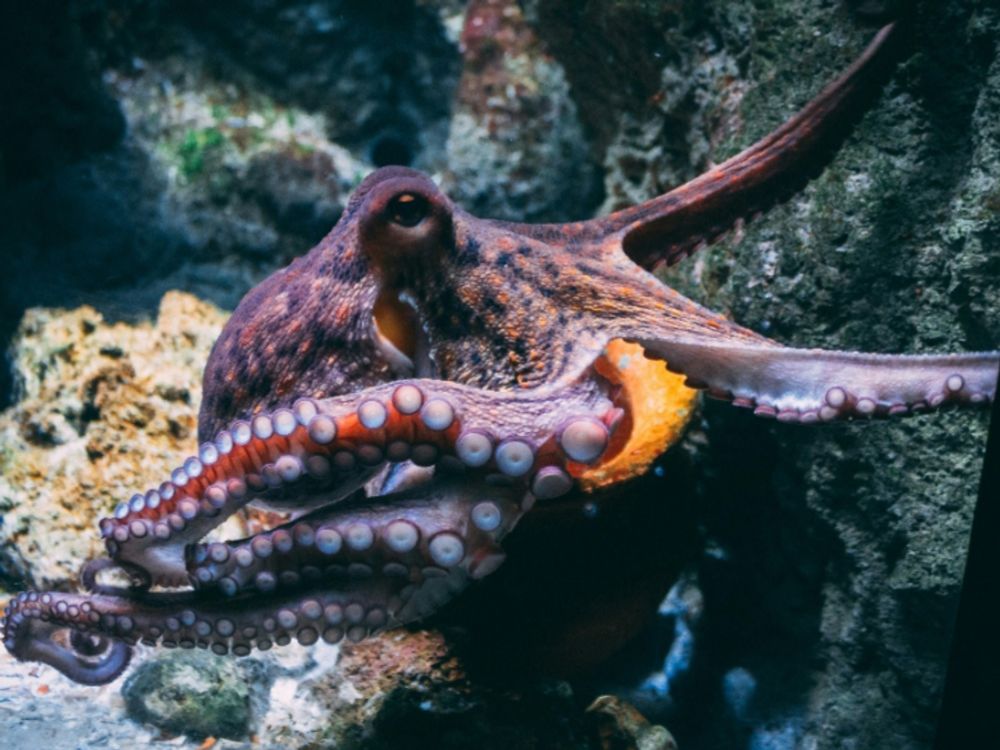
New work from Animal Ethics is drawing attention to the growing body of evidence on aquatic animal sentience. Seantience, a short documentary directed by Xiana Castro, brings together recent findings on the capacity to feel in both vertebrates and invertebrates.