




Anders Ogechi Hostrup Daugberg
@andersohd.bsky.social
PhD fellow at Aalborg University 🇩🇰
Using 'omics to study bacteria which secrete biopolymers (the backbone of biofilms!) 🦠
Metagenomics/transcriptomics, gene cluster annotation, exopolysaccharides, functional amyloids, eDNA 🧬
Using 'omics to study bacteria which secrete biopolymers (the backbone of biofilms!) 🦠
Metagenomics/transcriptomics, gene cluster annotation, exopolysaccharides, functional amyloids, eDNA 🧬
Another fruitful collaboration with the Otzen group 🦠🧫🧬
We looked for curli and Fap operons across the bacterial tree of life (GTDB v226), and found that while Fap operon synteny and FapC repeat numbers are remarkably conserved, the opposite is true for curli operons and csgA!
We looked for curli and Fap operons across the bacterial tree of life (GTDB v226), and found that while Fap operon synteny and FapC repeat numbers are remarkably conserved, the opposite is true for curli operons and csgA!

December 7, 2025 at 9:17 AM
Another fruitful collaboration with the Otzen group 🦠🧫🧬
We looked for curli and Fap operons across the bacterial tree of life (GTDB v226), and found that while Fap operon synteny and FapC repeat numbers are remarkably conserved, the opposite is true for curli operons and csgA!
We looked for curli and Fap operons across the bacterial tree of life (GTDB v226), and found that while Fap operon synteny and FapC repeat numbers are remarkably conserved, the opposite is true for curli operons and csgA!
Reposted by Anders Ogechi Hostrup Daugberg

People working with #protists and #fungi might be interested to hear that we in this study sequenced 13.4 mio. eukaryotic rRNA operons from 450 representative samples. #ProtistsOnSky #Metabarcoding
Microflora Danica: What can you learn from collecting and sequencing 10,000+ samples from a single country? Check out our new paper in @nature.com to find out. Incredible work led by Caitlin Singleton, Thomas B. N. Jensen, and Mads Albertsen from @aau.dk. 🦠🧫🧬
www.nature.com/articles/s41...
www.nature.com/articles/s41...

The Microflora Danica atlas of Danish environmental microbiomes - Nature
Microflora Danica—an atlas of Danish environmental microbiomes—reveals that although human-disturbed habitats have high alpha diversity, species reoccur, revealing hidden homogeneity.
www.nature.com
December 5, 2025 at 11:03 AM
People working with #protists and #fungi might be interested to hear that we in this study sequenced 13.4 mio. eukaryotic rRNA operons from 450 representative samples. #ProtistsOnSky #Metabarcoding
Reposted by Anders Ogechi Hostrup Daugberg
Microflora Danica: What can you learn from collecting and sequencing 10,000+ samples from a single country? Check out our new paper in @nature.com to find out. Incredible work led by Caitlin Singleton, Thomas B. N. Jensen, and Mads Albertsen from @aau.dk. 🦠🧫🧬
www.nature.com/articles/s41...
www.nature.com/articles/s41...
The Microflora Danica atlas of Danish environmental microbiomes - Nature
Microflora Danica—an atlas of Danish environmental microbiomes—reveals that although human-disturbed habitats have high alpha diversity, species reoccur, revealing hidden homogeneity.
www.nature.com
December 3, 2025 at 8:50 PM
Microflora Danica: What can you learn from collecting and sequencing 10,000+ samples from a single country? Check out our new paper in @nature.com to find out. Incredible work led by Caitlin Singleton, Thomas B. N. Jensen, and Mads Albertsen from @aau.dk. 🦠🧫🧬
www.nature.com/articles/s41...
www.nature.com/articles/s41...
Reposted by Anders Ogechi Hostrup Daugberg

#Resource
HRGM2 - a catalogue of 155,211 high-quality metagenome-assembled genomes spanning 41 countries that allows improved genome-scale metabolic modelling and functional characterization of human gut microbes.
#MicroSky #MicrobiomeSky 🦠💻
www.nature.com/articles/s41...
HRGM2 - a catalogue of 155,211 high-quality metagenome-assembled genomes spanning 41 countries that allows improved genome-scale metabolic modelling and functional characterization of human gut microbes.
#MicroSky #MicrobiomeSky 🦠💻
www.nature.com/articles/s41...

A human gut metagenome-assembled genome catalogue spanning 41 countries supports genome-scale metabolic models - Nature Microbiology
HRGM2 is a catalogue of 155,211 high-quality metagenome-assembled genomes spanning 41 countries that allows improved genome-scale metabolic modelling and functional characterization of human gut micro...
www.nature.com
December 4, 2025 at 3:27 PM
#Resource
HRGM2 - a catalogue of 155,211 high-quality metagenome-assembled genomes spanning 41 countries that allows improved genome-scale metabolic modelling and functional characterization of human gut microbes.
#MicroSky #MicrobiomeSky 🦠💻
www.nature.com/articles/s41...
HRGM2 - a catalogue of 155,211 high-quality metagenome-assembled genomes spanning 41 countries that allows improved genome-scale metabolic modelling and functional characterization of human gut microbes.
#MicroSky #MicrobiomeSky 🦠💻
www.nature.com/articles/s41...
Via the REThiNk project we are organising a conference on Environmental biofilms and flocs: matrix composition, properties and applications" at the beautiful waterfront in Aalborg, Denmark in April 2026 🦠🧫🧬
Abstract submission is open, check out the link below!
www.eps26.bio.aau.dk
Abstract submission is open, check out the link below!
www.eps26.bio.aau.dk

Conference: Environmental biofilms: matrix composition, properties and applications
Conference:
Environmental biofilms: matrix composition, properties and applications
www.eps26.bio.aau.dk
November 26, 2025 at 12:30 PM
Via the REThiNk project we are organising a conference on Environmental biofilms and flocs: matrix composition, properties and applications" at the beautiful waterfront in Aalborg, Denmark in April 2026 🦠🧫🧬
Abstract submission is open, check out the link below!
www.eps26.bio.aau.dk
Abstract submission is open, check out the link below!
www.eps26.bio.aau.dk
Reposted by Anders Ogechi Hostrup Daugberg

Our paper describing the GlobDB is now published in @bioinfoadv.bsky.social
doi.org/10.1093/bioa...
The GlobDB is the largest species dereplicated genome database currently available, containing 306,260 species representatives.
More information on globdb.org 1/5
🖥️🧬🦠
doi.org/10.1093/bioa...
The GlobDB is the largest species dereplicated genome database currently available, containing 306,260 species representatives.
More information on globdb.org 1/5
🖥️🧬🦠

GlobDB: a comprehensive species-dereplicated microbial genome resource
AbstractMotivation. Over the past years, substantial numbers of microbial species’ genomes have been deposited outside of conventional INSDC databases.Resu
doi.org
November 21, 2025 at 4:21 PM
Our paper describing the GlobDB is now published in @bioinfoadv.bsky.social
doi.org/10.1093/bioa...
The GlobDB is the largest species dereplicated genome database currently available, containing 306,260 species representatives.
More information on globdb.org 1/5
🖥️🧬🦠
doi.org/10.1093/bioa...
The GlobDB is the largest species dereplicated genome database currently available, containing 306,260 species representatives.
More information on globdb.org 1/5
🖥️🧬🦠
Reposted by Anders Ogechi Hostrup Daugberg
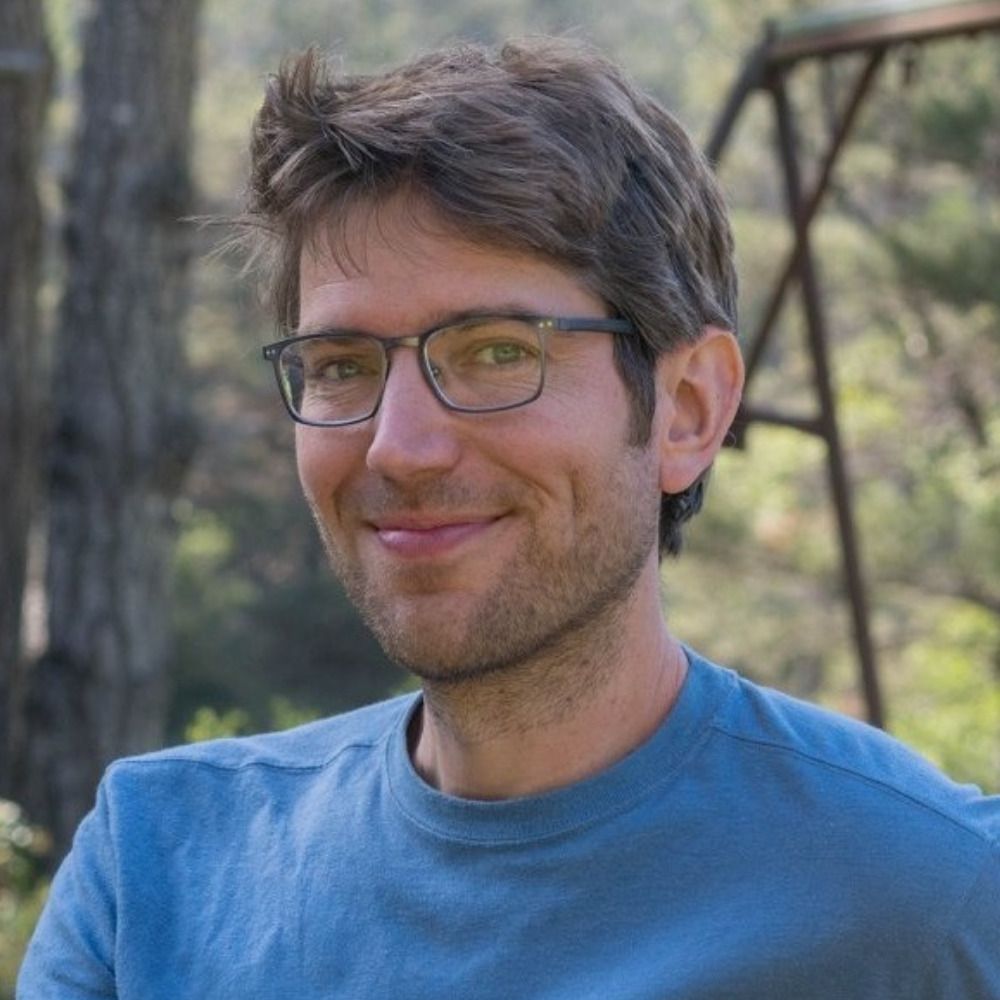
Let me use this as an opportunity to talk about Jordi et al's very cool paper, now out in PNAS 🧪:
pmc.ncbi.nlm.nih.gov/articles/PMC...
You can read our news and views here: www.pnas.org/doi/10.1073/...
pmc.ncbi.nlm.nih.gov/articles/PMC...
You can read our news and views here: www.pnas.org/doi/10.1073/...
November 13, 2025 at 4:13 PM
Let me use this as an opportunity to talk about Jordi et al's very cool paper, now out in PNAS 🧪:
pmc.ncbi.nlm.nih.gov/articles/PMC...
You can read our news and views here: www.pnas.org/doi/10.1073/...
pmc.ncbi.nlm.nih.gov/articles/PMC...
You can read our news and views here: www.pnas.org/doi/10.1073/...
Reposted by Anders Ogechi Hostrup Daugberg
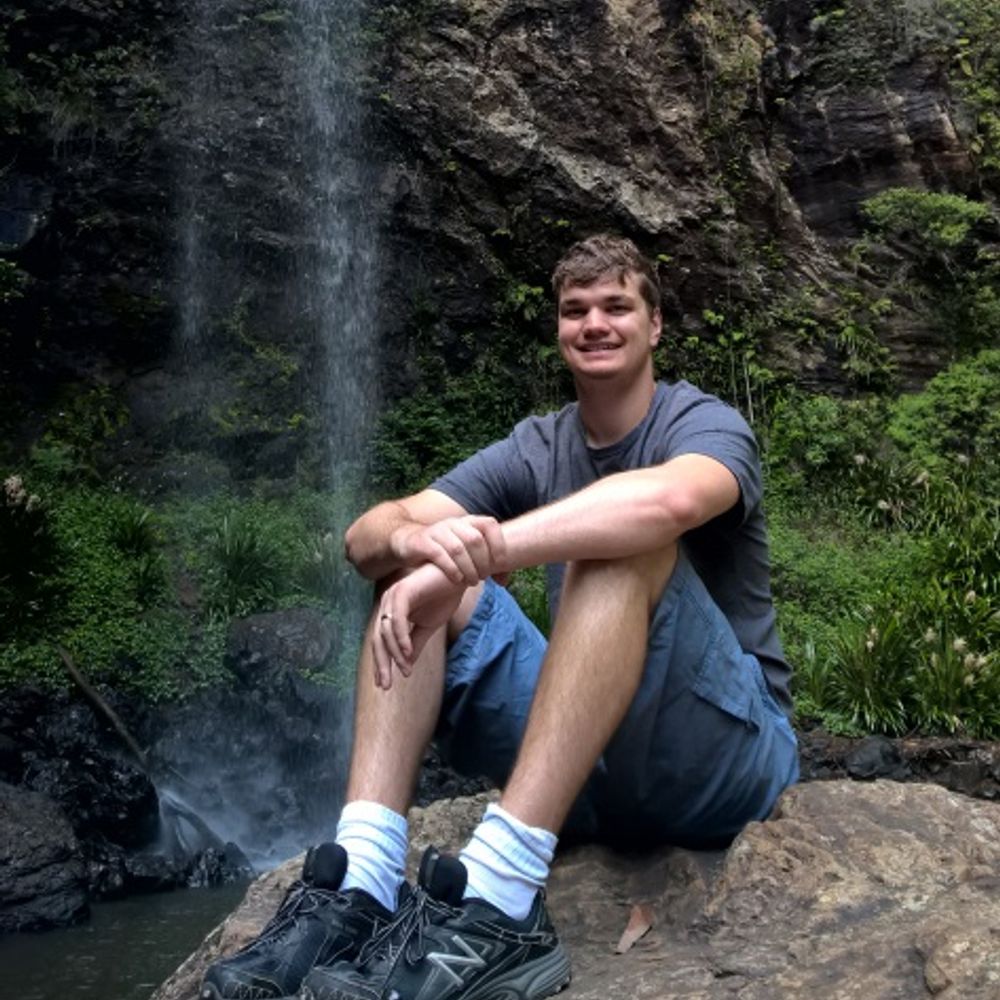
“Bin Chicken” is now published in Nature Methods! It substantially improves genome recovery through rational coassembly 🧬🖥️. Applied to public 🌍 metagenomes, we recovered 24,000 novel species 🦠, including 6 new phyla.
doi.org/10.1038/s415...
@benjwoodcroft.bsky.social @rhysnewell.bsky.social
🧵1/6
doi.org/10.1038/s415...
@benjwoodcroft.bsky.social @rhysnewell.bsky.social
🧵1/6

November 13, 2025 at 10:09 AM
“Bin Chicken” is now published in Nature Methods! It substantially improves genome recovery through rational coassembly 🧬🖥️. Applied to public 🌍 metagenomes, we recovered 24,000 novel species 🦠, including 6 new phyla.
doi.org/10.1038/s415...
@benjwoodcroft.bsky.social @rhysnewell.bsky.social
🧵1/6
doi.org/10.1038/s415...
@benjwoodcroft.bsky.social @rhysnewell.bsky.social
🧵1/6
Reposted by Anders Ogechi Hostrup Daugberg

Opinion: Chaos is coming for scholarly publishing.
Buckling of commercial models alongside maturing of community-led efforts promises major shifts, says Caroline Edwards (@theblochian.bsky.social).
www.researchprofessionalnews.com/rr-news-uk-v...
Buckling of commercial models alongside maturing of community-led efforts promises major shifts, says Caroline Edwards (@theblochian.bsky.social).
www.researchprofessionalnews.com/rr-news-uk-v...

Chaos is coming for scholarly publishing - Research Professional News
Buckling of commercial models alongside maturing of community-led efforts promises major shifts, says Caroline Edwards
www.researchprofessionalnews.com
November 12, 2025 at 10:17 AM
Opinion: Chaos is coming for scholarly publishing.
Buckling of commercial models alongside maturing of community-led efforts promises major shifts, says Caroline Edwards (@theblochian.bsky.social).
www.researchprofessionalnews.com/rr-news-uk-v...
Buckling of commercial models alongside maturing of community-led efforts promises major shifts, says Caroline Edwards (@theblochian.bsky.social).
www.researchprofessionalnews.com/rr-news-uk-v...
Reposted by Anders Ogechi Hostrup Daugberg

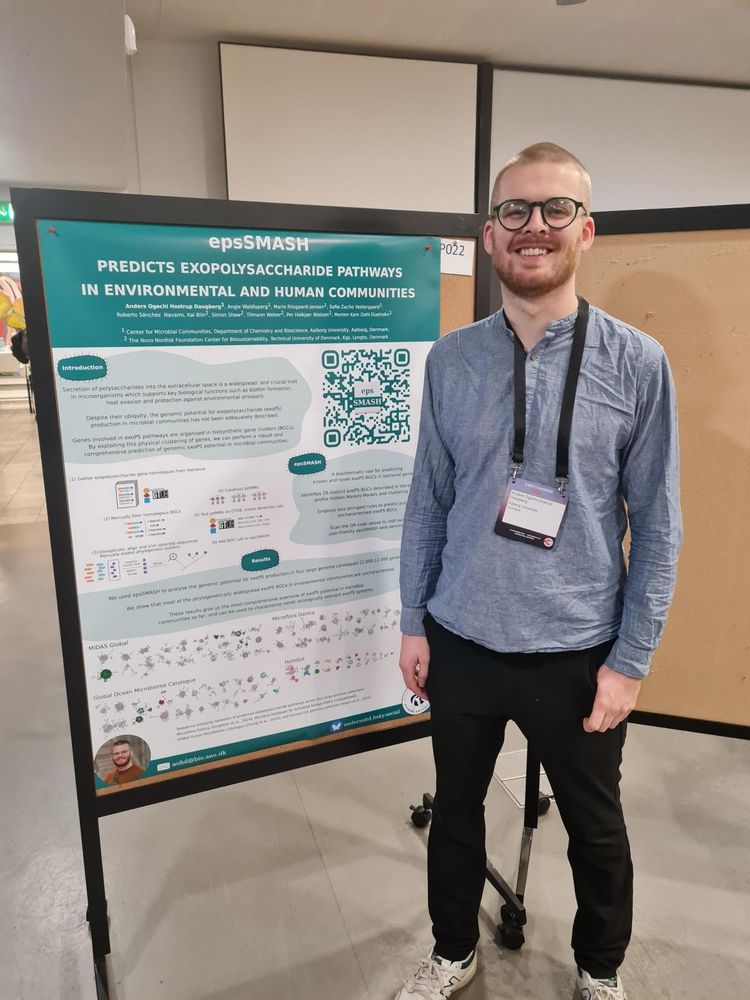
DMS 2025 is a wrap! 🧫
I had a lot of great discussions with people about biofilms and EPS 🦠
Thomas Bjarnsholt's keynote about rediscovering the drivers of chronic infections was a highlight 🧬
A lot of interest in epsSMASH, so now I am even more motivated to get our preprint out ASAP! 🖥
I had a lot of great discussions with people about biofilms and EPS 🦠
Thomas Bjarnsholt's keynote about rediscovering the drivers of chronic infections was a highlight 🧬
A lot of interest in epsSMASH, so now I am even more motivated to get our preprint out ASAP! 🖥
November 11, 2025 at 10:59 PM
DMS 2025 is a wrap! 🧫
I had a lot of great discussions with people about biofilms and EPS 🦠
Thomas Bjarnsholt's keynote about rediscovering the drivers of chronic infections was a highlight 🧬
A lot of interest in epsSMASH, so now I am even more motivated to get our preprint out ASAP! 🖥
I had a lot of great discussions with people about biofilms and EPS 🦠
Thomas Bjarnsholt's keynote about rediscovering the drivers of chronic infections was a highlight 🧬
A lot of interest in epsSMASH, so now I am even more motivated to get our preprint out ASAP! 🖥
Reposted by Anders Ogechi Hostrup Daugberg

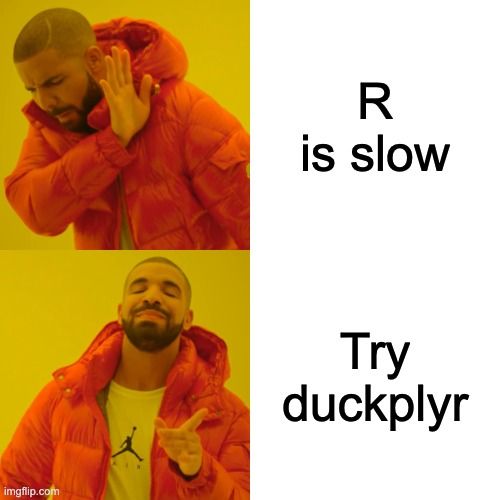
1/ Working with big data in R?
Your wrangling just got a massive upgrade.
duckplyr is now in the tidyverse—and it’s fast. Really fast. 🧵
Your wrangling just got a massive upgrade.
duckplyr is now in the tidyverse—and it’s fast. Really fast. 🧵
November 11, 2025 at 2:45 PM
1/ Working with big data in R?
Your wrangling just got a massive upgrade.
duckplyr is now in the tidyverse—and it’s fast. Really fast. 🧵
Your wrangling just got a massive upgrade.
duckplyr is now in the tidyverse—and it’s fast. Really fast. 🧵
Reposted by Anders Ogechi Hostrup Daugberg

note, gliding is not comparable to sliding
the here described spreading is very similar to sliding (=spreading by growth and facilitating compounds, like polysaccharides), which was known for Salmonella - the authors are not fully correct stating that sliding always depends on surfactant
the here described spreading is very similar to sliding (=spreading by growth and facilitating compounds, like polysaccharides), which was known for Salmonella - the authors are not fully correct stating that sliding always depends on surfactant

November 4, 2025 at 2:42 PM
note, gliding is not comparable to sliding
the here described spreading is very similar to sliding (=spreading by growth and facilitating compounds, like polysaccharides), which was known for Salmonella - the authors are not fully correct stating that sliding always depends on surfactant
the here described spreading is very similar to sliding (=spreading by growth and facilitating compounds, like polysaccharides), which was known for Salmonella - the authors are not fully correct stating that sliding always depends on surfactant
Reposted by Anders Ogechi Hostrup Daugberg
Cellulose biosynthesis and function in Streptomyces
@cp-trendsmicrobiol.bsky.social by Chennan Yang, @xiaobozhong.bsky.social and Dennis Claessen
www.cell.com/trends/micro...
@cp-trendsmicrobiol.bsky.social by Chennan Yang, @xiaobozhong.bsky.social and Dennis Claessen
www.cell.com/trends/micro...

Cellulose biosynthesis and function in Streptomyces
Cellulose, a ubiquitous polysaccharide with critical roles in life, provides structural
integrity to cells in plants and aids biofilm formation in many bacteria. Although
bacterial cellulose biosynthe...
www.cell.com
October 30, 2025 at 12:50 PM
Cellulose biosynthesis and function in Streptomyces
@cp-trendsmicrobiol.bsky.social by Chennan Yang, @xiaobozhong.bsky.social and Dennis Claessen
www.cell.com/trends/micro...
@cp-trendsmicrobiol.bsky.social by Chennan Yang, @xiaobozhong.bsky.social and Dennis Claessen
www.cell.com/trends/micro...
Reposted by Anders Ogechi Hostrup Daugberg

Our @narjournal.bsky.social manuscript is out! It explores the growth of the GTDB (gtdb.ecogenomic.org) since its inception, as well as updates to the website, methodology, policies, and major taxonomic and nomenclatural changes over the past three years.
academic.oup.com/nar/advance-...
academic.oup.com/nar/advance-...

GTDB release 10: a complete and systematic taxonomy for 715 230 bacterial and 17 245 archaeal genomes
Abstract. The Genome Taxonomy Database (GTDB; https://gtdb.ecogenomic.org) provides a phylogenetically consistent and rank normalized genome-based taxonomy
academic.oup.com
October 22, 2025 at 2:20 PM
Our @narjournal.bsky.social manuscript is out! It explores the growth of the GTDB (gtdb.ecogenomic.org) since its inception, as well as updates to the website, methodology, policies, and major taxonomic and nomenclatural changes over the past three years.
academic.oup.com/nar/advance-...
academic.oup.com/nar/advance-...
Reposted by Anders Ogechi Hostrup Daugberg
Ultra-deep long-read metagenomics captures diverse taxonomic and biosynthetic potential of soil microbes. #Long-read #Sequencing #Metagenomics #SoilMicrobiome #Genomics #Bioinformatics @biorxivpreprint.bsky.social 🧪🧬 🖥️
www.biorxiv.org/content/10.1...
www.biorxiv.org/content/10.1...

October 24, 2025 at 9:15 AM
Ultra-deep long-read metagenomics captures diverse taxonomic and biosynthetic potential of soil microbes. #Long-read #Sequencing #Metagenomics #SoilMicrobiome #Genomics #Bioinformatics @biorxivpreprint.bsky.social 🧪🧬 🖥️
www.biorxiv.org/content/10.1...
www.biorxiv.org/content/10.1...
Reposted by Anders Ogechi Hostrup Daugberg

Diverse biofilm-forming Sphingomonadaceae represent twelve novel species isolated from glaciers on the Tibetan Plateau. Published Open Access and fee-free in IJSEM using a Publish and Read agreement: doi.org/10.1099/ijse... #IJSEM #PublishAndRead

October 15, 2025 at 8:01 AM
Diverse biofilm-forming Sphingomonadaceae represent twelve novel species isolated from glaciers on the Tibetan Plateau. Published Open Access and fee-free in IJSEM using a Publish and Read agreement: doi.org/10.1099/ijse... #IJSEM #PublishAndRead
Reposted by Anders Ogechi Hostrup Daugberg

PhD opportunity in my lab: exploring how commensals and pathogens build biofilm communities on endotracheal (ventilator) tubes. Microbial ecology, medical microbiology and fancy imaging! Co-supervised with the fabulous Saskia Bakker and Jeremy Webb warwick.ac.uk/fac/cross_fa... #MicroSky
Dr Freya Harrison
Dr Freya Harrison
warwick.ac.uk
October 15, 2025 at 8:09 PM
PhD opportunity in my lab: exploring how commensals and pathogens build biofilm communities on endotracheal (ventilator) tubes. Microbial ecology, medical microbiology and fancy imaging! Co-supervised with the fabulous Saskia Bakker and Jeremy Webb warwick.ac.uk/fac/cross_fa... #MicroSky
Reposted by Anders Ogechi Hostrup Daugberg
Dynamic visualization of extracellular matrix components in S. aureus colony biofilms reveals functional amyloids leading to the formation of cap-like structures
@biofilmjournal.bsky.social from Agneta Richter-Dahlfors
www.sciencedirect.com/science/arti...
@biofilmjournal.bsky.social from Agneta Richter-Dahlfors
www.sciencedirect.com/science/arti...

Dynamic visualization of extracellular matrix components in S. aureus colony biofilms reveals functional amyloids leading to the formation of cap-like structures
Staphylococcus aureus infections represent a clinical challenge due to their propensity to form biofilms and the increasing prevalence of antibiotic r…
www.sciencedirect.com
September 19, 2025 at 11:23 AM
Dynamic visualization of extracellular matrix components in S. aureus colony biofilms reveals functional amyloids leading to the formation of cap-like structures
@biofilmjournal.bsky.social from Agneta Richter-Dahlfors
www.sciencedirect.com/science/arti...
@biofilmjournal.bsky.social from Agneta Richter-Dahlfors
www.sciencedirect.com/science/arti...
Reposted by Anders Ogechi Hostrup Daugberg
Confused writing is usually a symptom of confused thinking. As we struggle to clarify writing, we clarify our thoughts. AI writing aids rob us of that struggle, leaving clean-looking text and thoughts still confused for lack of inspection. Writing is not just a product; it is a diagnostic tool.
September 5, 2025 at 3:20 PM
Confused writing is usually a symptom of confused thinking. As we struggle to clarify writing, we clarify our thoughts. AI writing aids rob us of that struggle, leaving clean-looking text and thoughts still confused for lack of inspection. Writing is not just a product; it is a diagnostic tool.
Reposted by Anders Ogechi Hostrup Daugberg
I’m excited to share our effort to obtain one of the first estimates of the net rate, in physical time, of lateral gene transfer (LGT) – nature’s own genetic engineering - across a complex, global microbiome:
doi.org/10.1093/isme...
doi.org/10.1093/isme...

September 7, 2025 at 2:41 PM
I’m excited to share our effort to obtain one of the first estimates of the net rate, in physical time, of lateral gene transfer (LGT) – nature’s own genetic engineering - across a complex, global microbiome:
doi.org/10.1093/isme...
doi.org/10.1093/isme...
Reposted by Anders Ogechi Hostrup Daugberg

“Writing an essay is hard because it forces you to use your brain in ways you haven't before…Your job is not to turn in completed assignments; it's to learn how to think. Turning in completed assignments can help you learn how to think, but only if you're the one who completed them.”
As always, Ted Chiang is great in this interview.
cdh.princeton.edu/blog/2025/08...
cdh.princeton.edu/blog/2025/08...

August 14, 2025 at 2:21 PM
“Writing an essay is hard because it forces you to use your brain in ways you haven't before…Your job is not to turn in completed assignments; it's to learn how to think. Turning in completed assignments can help you learn how to think, but only if you're the one who completed them.”
Reposted by Anders Ogechi Hostrup Daugberg


Reposted by Anders Ogechi Hostrup Daugberg

Really liked the explanation about human understanding, and what we miss when we use black box models. This has always been my gripe with prediction models for eg AMR - I want to know why that feature is associated with resistance!

This is an excellent long-read on AI and science with lots of useful further reading www.aisnakeoil.com/p/could-ai-s.... Well worth your time to actually read it.
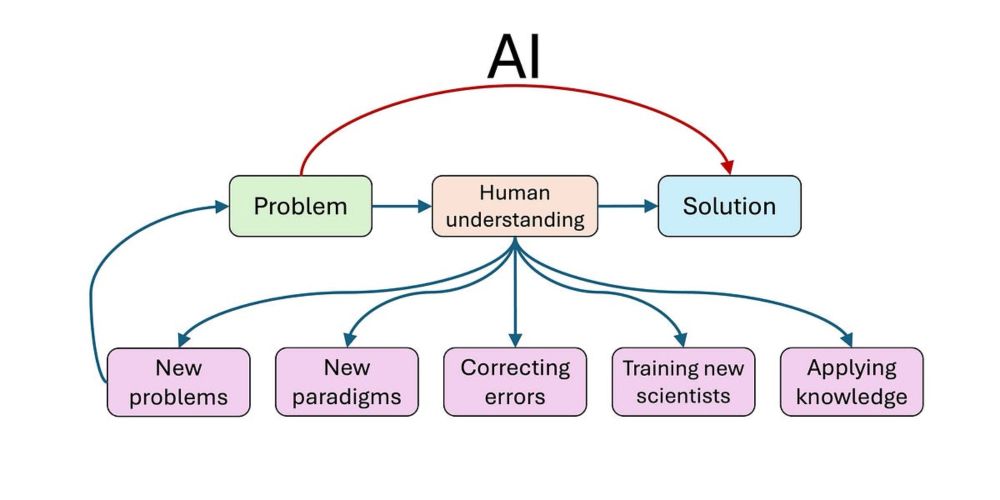
Could AI slow science?
Confronting the production-progress paradox
www.aisnakeoil.com
August 12, 2025 at 4:56 AM
Really liked the explanation about human understanding, and what we miss when we use black box models. This has always been my gripe with prediction models for eg AMR - I want to know why that feature is associated with resistance!
Reposted by Anders Ogechi Hostrup Daugberg

I frequently meet ppl who tell me about medieval German, or fen art, or alchemy, muons, human language processing, or extremely specific sorts of religious scholarship. Occasionally inventors of extraordinary things. I love how all these diverse specialties can be in one place (a university canteen)

a university is not for generating profit, it provides cultural enrichment via weird little gremlin people who love visigoths or haikus, and very occasionally a scientist who figures out faster than light travel
August 12, 2025 at 12:35 PM
I frequently meet ppl who tell me about medieval German, or fen art, or alchemy, muons, human language processing, or extremely specific sorts of religious scholarship. Occasionally inventors of extraordinary things. I love how all these diverse specialties can be in one place (a university canteen)