



Anirudh GJ
@anirudhgj.bsky.social
NeuroAI PhD student @ Mila & Universite de Montreal w/ Prof. Matthew Perich.
Studying continual learning and adaptation in Brain and ANNs.
Studying continual learning and adaptation in Brain and ANNs.
Reposted by Anirudh GJ

Thrilled to see the first preprint of the lab out 🤩 Check it out if you need to compare dynamics in your data and RNN (or any other combinations of dynamical systems)!
Wanna compare dynamics across neural data, RNNs, or dynamical systems? We got a fast and furious method🏎️
The 1st preprint of my PhD 🥳 fast dynamical similarity analysis (fastDSA):
📜: arxiv.org/abs/2511.22828
💻: github.com/CMC-lab/fast...
I’ll be @cosynemeeting.bsky.social - happy to chat 😉
The 1st preprint of my PhD 🥳 fast dynamical similarity analysis (fastDSA):
📜: arxiv.org/abs/2511.22828
💻: github.com/CMC-lab/fast...
I’ll be @cosynemeeting.bsky.social - happy to chat 😉

January 8, 2026 at 4:37 PM
Thrilled to see the first preprint of the lab out 🤩 Check it out if you need to compare dynamics in your data and RNN (or any other combinations of dynamical systems)!
Reposted by Anirudh GJ

When we try to formalize a neuron computationally, we don't translate biology into code—we perform a violent collapse.
www.ocrampal.com/what-a-neuro...
#philosophy #science #psychology #AI #intelligence #physics #biology #philmind #philsci #philsky #philpsy #neurosky #neuroskyence
www.ocrampal.com/what-a-neuro...
#philosophy #science #psychology #AI #intelligence #physics #biology #philmind #philsci #philsky #philpsy #neurosky #neuroskyence

What a Neuron Teaches Us About Computation's Limits
When we try to formalize a neuron computationally, we don't translate biology into code—we perform a violent collapse. We lock causation into fixed arrows when biology lives in causal ambiguity. We sy...
www.ocrampal.com
January 3, 2026 at 4:16 PM
When we try to formalize a neuron computationally, we don't translate biology into code—we perform a violent collapse.
www.ocrampal.com/what-a-neuro...
#philosophy #science #psychology #AI #intelligence #physics #biology #philmind #philsci #philsky #philpsy #neurosky #neuroskyence
www.ocrampal.com/what-a-neuro...
#philosophy #science #psychology #AI #intelligence #physics #biology #philmind #philsci #philsky #philpsy #neurosky #neuroskyence
Reposted by Anirudh GJ
Episode #36 in #TheoreticalNeurosciencePodcast: On low-dimensional manifolds in motor cortex – with Sara Solla @sasolla.bsky.social
theoreticalneuroscience.no/thn36
Manifold analysis has changed our thinking on how cortex works. One of the pioneers of this modelling approach explains.
theoreticalneuroscience.no/thn36
Manifold analysis has changed our thinking on how cortex works. One of the pioneers of this modelling approach explains.

January 3, 2026 at 9:21 AM
Episode #36 in #TheoreticalNeurosciencePodcast: On low-dimensional manifolds in motor cortex – with Sara Solla @sasolla.bsky.social
theoreticalneuroscience.no/thn36
Manifold analysis has changed our thinking on how cortex works. One of the pioneers of this modelling approach explains.
theoreticalneuroscience.no/thn36
Manifold analysis has changed our thinking on how cortex works. One of the pioneers of this modelling approach explains.
Reposted by Anirudh GJ

Goal selection through the lens of subjective functions:
arxiv.org/abs/2512.15948
I welcome any feedback on these preliminary ideas.
arxiv.org/abs/2512.15948
I welcome any feedback on these preliminary ideas.

Subjective functions
Where do objective functions come from? How do we select what goals to pursue? Human intelligence is adept at synthesizing new objective functions on the fly. How does this work, and can we endow arti...
arxiv.org
December 19, 2025 at 3:15 AM
Goal selection through the lens of subjective functions:
arxiv.org/abs/2512.15948
I welcome any feedback on these preliminary ideas.
arxiv.org/abs/2512.15948
I welcome any feedback on these preliminary ideas.
Reposted by Anirudh GJ

We took a stab at how to infer both the dynamics and control parameters of partially-observable systems.
It’s a nasty problem, but @vgeadah.bsky.social made tremendous progress, ending up with some really elegant formalisms.
It’s a nasty problem, but @vgeadah.bsky.social made tremendous progress, ending up with some really elegant formalisms.

In a system subject to unobserved control, can you infer both the underlying dynamics and the control objective? 🤔
A year ago, I was presenting our work at IEEE CDC on solving this problem for stochastic LQR.
arxiv.org/abs/2502.15014
Short 🧵 on the results, and how I think about them a year later.
A year ago, I was presenting our work at IEEE CDC on solving this problem for stochastic LQR.
arxiv.org/abs/2502.15014
Short 🧵 on the results, and how I think about them a year later.

December 18, 2025 at 6:51 PM
We took a stab at how to infer both the dynamics and control parameters of partially-observable systems.
It’s a nasty problem, but @vgeadah.bsky.social made tremendous progress, ending up with some really elegant formalisms.
It’s a nasty problem, but @vgeadah.bsky.social made tremendous progress, ending up with some really elegant formalisms.
Reposted by Anirudh GJ

Do we need to study animals in the wild to fully understand the brain? Maybe. OTOH, I sit in front a computer all day.
bigthink.com/neuropsych/n...
#neuroscience
bigthink.com/neuropsych/n...
#neuroscience

The next revolution in neuroscience is happening outside the lab
By tracking brain activity as primates move freely in the wild, neuroethology could reshape what we think we know about our own minds.
bigthink.com
December 17, 2025 at 7:09 PM
Do we need to study animals in the wild to fully understand the brain? Maybe. OTOH, I sit in front a computer all day.
bigthink.com/neuropsych/n...
#neuroscience
bigthink.com/neuropsych/n...
#neuroscience
Reposted by Anirudh GJ

New paper for #neurips2025!
AI models adjust millions of internal settings to get better at a task. But how are these adjustments determined? For decades, we've mostly figured this out through trial & error.
We took a different approach...🧵 (1/6)
🔗 openreview.net/forum?id=oMi...
AI models adjust millions of internal settings to get better at a task. But how are these adjustments determined? For decades, we've mostly figured this out through trial & error.
We took a different approach...🧵 (1/6)
🔗 openreview.net/forum?id=oMi...

December 16, 2025 at 7:29 PM
New paper for #neurips2025!
AI models adjust millions of internal settings to get better at a task. But how are these adjustments determined? For decades, we've mostly figured this out through trial & error.
We took a different approach...🧵 (1/6)
🔗 openreview.net/forum?id=oMi...
AI models adjust millions of internal settings to get better at a task. But how are these adjustments determined? For decades, we've mostly figured this out through trial & error.
We took a different approach...🧵 (1/6)
🔗 openreview.net/forum?id=oMi...
Reposted by Anirudh GJ

1/X Excited to present this preprint on multi-tasking, with
@david-g-clark.bsky.social and Ashok Litwin-Kumar! Timely too, as “low-D manifold” has been trending again. (If you read thru the end, we escape Flatland and return to the glorious high-D world we deserve.) www.biorxiv.org/content/10.6...
@david-g-clark.bsky.social and Ashok Litwin-Kumar! Timely too, as “low-D manifold” has been trending again. (If you read thru the end, we escape Flatland and return to the glorious high-D world we deserve.) www.biorxiv.org/content/10.6...

A theory of multi-task computation and task selection
Neural activity during the performance of a stereotyped behavioral task is often described as low-dimensional, occupying only a limited region in the space of all firing-rate patterns. This region has...
www.biorxiv.org
December 15, 2025 at 7:41 PM
1/X Excited to present this preprint on multi-tasking, with
@david-g-clark.bsky.social and Ashok Litwin-Kumar! Timely too, as “low-D manifold” has been trending again. (If you read thru the end, we escape Flatland and return to the glorious high-D world we deserve.) www.biorxiv.org/content/10.6...
@david-g-clark.bsky.social and Ashok Litwin-Kumar! Timely too, as “low-D manifold” has been trending again. (If you read thru the end, we escape Flatland and return to the glorious high-D world we deserve.) www.biorxiv.org/content/10.6...
Reposted by Anirudh GJ

1/6 New preprint 🚀 How does the cortex learn to represent things and how they move without reconstructing sensory stimuli? We developed a circuit-centric recurrent predictive learning (RPL) model based on JEPAs.
🔗 doi.org/10.1101/2025...
Led by @atenagm.bsky.social @mshalvagal.bsky.social
🔗 doi.org/10.1101/2025...
Led by @atenagm.bsky.social @mshalvagal.bsky.social

November 27, 2025 at 8:24 AM
1/6 New preprint 🚀 How does the cortex learn to represent things and how they move without reconstructing sensory stimuli? We developed a circuit-centric recurrent predictive learning (RPL) model based on JEPAs.
🔗 doi.org/10.1101/2025...
Led by @atenagm.bsky.social @mshalvagal.bsky.social
🔗 doi.org/10.1101/2025...
Led by @atenagm.bsky.social @mshalvagal.bsky.social
Reposted by Anirudh GJ

📍Excited to share that our paper was selected as a Spotlight at #NeurIPS2025!
arxiv.org/pdf/2410.03972
It started from a question I kept running into:
When do RNNs trained on the same task converge/diverge in their solutions?
🧵⬇️
arxiv.org/pdf/2410.03972
It started from a question I kept running into:
When do RNNs trained on the same task converge/diverge in their solutions?
🧵⬇️

November 24, 2025 at 4:43 PM
📍Excited to share that our paper was selected as a Spotlight at #NeurIPS2025!
arxiv.org/pdf/2410.03972
It started from a question I kept running into:
When do RNNs trained on the same task converge/diverge in their solutions?
🧵⬇️
arxiv.org/pdf/2410.03972
It started from a question I kept running into:
When do RNNs trained on the same task converge/diverge in their solutions?
🧵⬇️
Reposted by Anirudh GJ

Now in PRX: Theory linking connectivity structure to collective activity in nonlinear RNNs!
For neuro fans: conn. structure can be invisible in single neurons but shape pop. activity
For low-rank RNN fans: a theory of rank=O(N)
For physics fans: fluctuations around DMFT saddle⇒dimension of activity
For neuro fans: conn. structure can be invisible in single neurons but shape pop. activity
For low-rank RNN fans: a theory of rank=O(N)
For physics fans: fluctuations around DMFT saddle⇒dimension of activity

Connectivity Structure and Dynamics of Nonlinear Recurrent Neural Networks
The structure of brain connectivity predicts collective neural activity, with a small number of connectivity features determining activity dimensionality, linking circuit architecture to network-level...
journals.aps.org
November 3, 2025 at 9:47 PM
Now in PRX: Theory linking connectivity structure to collective activity in nonlinear RNNs!
For neuro fans: conn. structure can be invisible in single neurons but shape pop. activity
For low-rank RNN fans: a theory of rank=O(N)
For physics fans: fluctuations around DMFT saddle⇒dimension of activity
For neuro fans: conn. structure can be invisible in single neurons but shape pop. activity
For low-rank RNN fans: a theory of rank=O(N)
For physics fans: fluctuations around DMFT saddle⇒dimension of activity
Reposted by Anirudh GJ

What if we did a single run and declared victory

October 23, 2025 at 2:28 AM
What if we did a single run and declared victory
Reposted by Anirudh GJ

Very excited to release a new blog post that formalizes what it means for data to be compositional, and shows how compositionality can exist at multiple scales. Early days, but I think there may be significant implications for AI. Check it out! ericelmoznino.github.io/blog/2025/08...
Defining and quantifying compositional structure
What is compositionality? For those of us working in AI or cognitive neuroscience this question can appear easy at first, but becomes increasingly perplexing the more we think about it. We aren’t shor...
ericelmoznino.github.io
August 18, 2025 at 8:46 PM
Very excited to release a new blog post that formalizes what it means for data to be compositional, and shows how compositionality can exist at multiple scales. Early days, but I think there may be significant implications for AI. Check it out! ericelmoznino.github.io/blog/2025/08...
Reposted by Anirudh GJ

📰 I really enjoyed writing this article with @thetransmitter.bsky.social! In it, I summarize parts of our recent perspective article on neural manifolds (www.nature.com/articles/s41...), with a focus on highlighting just a few cool insights into the brain we've already seen at the population level.

Neural manifold properties can help us understand how animal brains deal with competing and multifaceted information, execute flexible behaviors and reuse common computations, writes @mattperich.bsky.social.
#neuroskyence
www.thetransmitter.org/neural-dynam...
#neuroskyence
www.thetransmitter.org/neural-dynam...
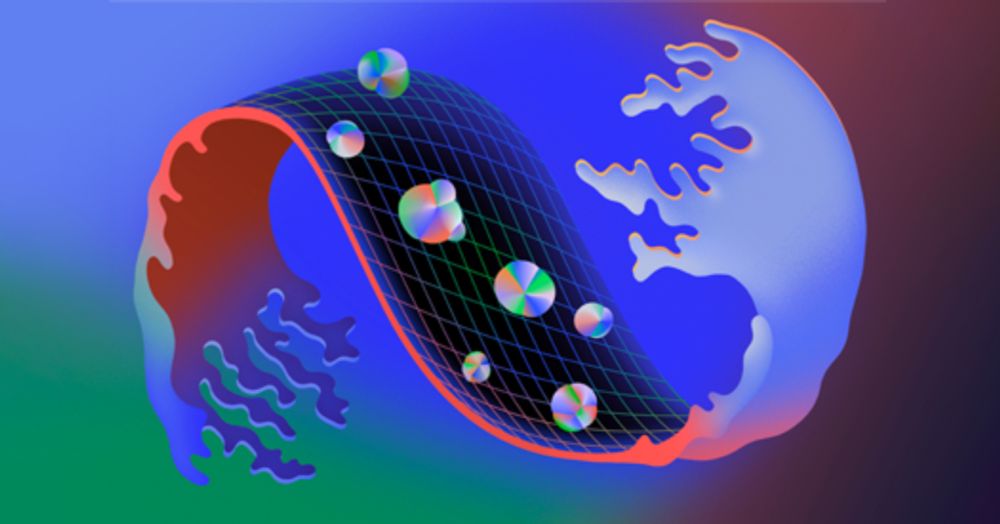
Neural population-based approaches have opened new windows into neural computations and behavior
Neural manifold properties can help us understand how animal brains deal with complex information, execute flexible behaviors and reuse common computations.
www.thetransmitter.org
August 4, 2025 at 6:45 PM
📰 I really enjoyed writing this article with @thetransmitter.bsky.social! In it, I summarize parts of our recent perspective article on neural manifolds (www.nature.com/articles/s41...), with a focus on highlighting just a few cool insights into the brain we've already seen at the population level.
Reposted by Anirudh GJ

Is it possible to go from spikes to rates without averaging?
We show how to exactly map recurrent spiking networks into recurrent rate networks, with the same number of neurons. No temporal or spatial averaging needed!
Presented at Gatsby Neural Dynamics Workshop, London.
We show how to exactly map recurrent spiking networks into recurrent rate networks, with the same number of neurons. No temporal or spatial averaging needed!
Presented at Gatsby Neural Dynamics Workshop, London.

From Spikes To Rates
YouTube video by Gerstner Lab
youtu.be
August 8, 2025 at 3:25 PM
Is it possible to go from spikes to rates without averaging?
We show how to exactly map recurrent spiking networks into recurrent rate networks, with the same number of neurons. No temporal or spatial averaging needed!
Presented at Gatsby Neural Dynamics Workshop, London.
We show how to exactly map recurrent spiking networks into recurrent rate networks, with the same number of neurons. No temporal or spatial averaging needed!
Presented at Gatsby Neural Dynamics Workshop, London.
Reposted by Anirudh GJ
I wonder, where would be a good place to do modeling and chat with many people that study different species or do comparative studies? (asking for a friend)
To identify fundamental neuroscientific principles that generalize across species, systems and circuits, neuroscientists must embrace an evolutionary perspective, argue Karl Farrow and @katjareinhard.bsky.social.
#neuroskyence
www.thetransmitter.org/systems-neur...
#neuroskyence
www.thetransmitter.org/systems-neur...

Systems and circuit neuroscience need an evolutionary perspective
To identify fundamental neuroscientific principles that generalize across species, neuroscientists must frame their research through an evolutionary lens.
www.thetransmitter.org
July 16, 2025 at 10:13 PM
I wonder, where would be a good place to do modeling and chat with many people that study different species or do comparative studies? (asking for a friend)
Reposted by Anirudh GJ
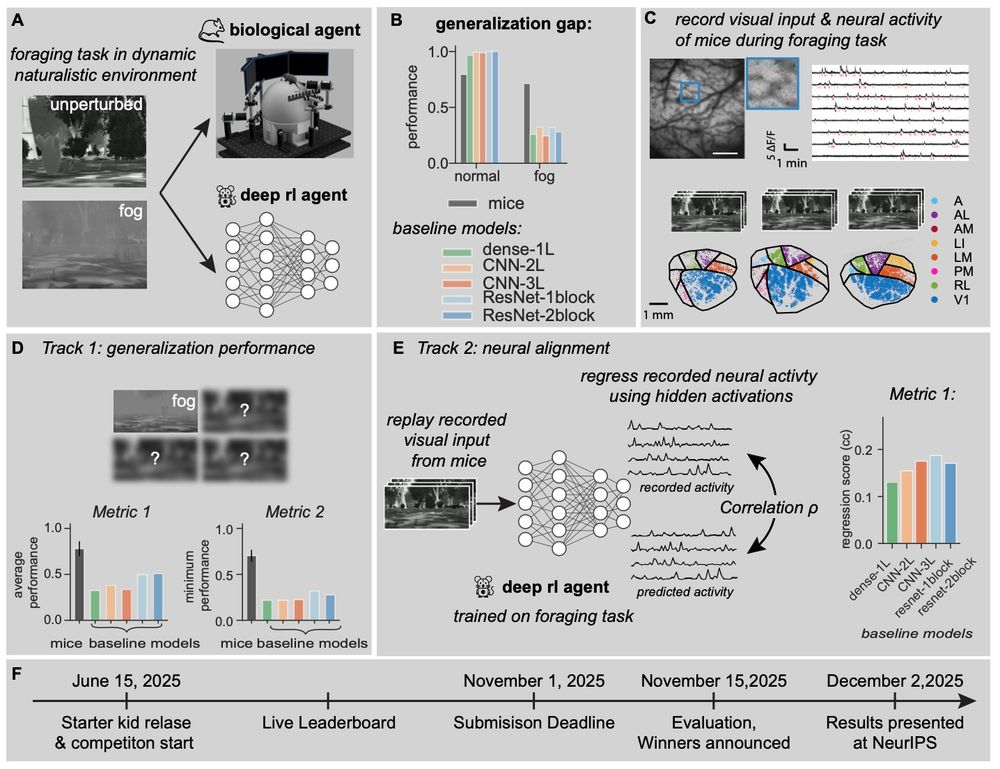
Mice learn these tasks and are robust to perturbations like fog. Now, we invite you all to make AI agents to beat mice.
We present our #NeurIPS competition. You can learn about it here: robustforaging.github.io (7/n)
We present our #NeurIPS competition. You can learn about it here: robustforaging.github.io (7/n)
July 10, 2025 at 12:22 PM
Mice learn these tasks and are robust to perturbations like fog. Now, we invite you all to make AI agents to beat mice.
We present our #NeurIPS competition. You can learn about it here: robustforaging.github.io (7/n)
We present our #NeurIPS competition. You can learn about it here: robustforaging.github.io (7/n)
Reposted by Anirudh GJ

This paper carefully examines how well simple units capture neural data.
To quote someone from my lab (they can take credit if they want):
Def not news to those of us who use [ANN] models, but a good counter argument to the "but neurons are more complicated" crowd.
arxiv.org/abs/2504.08637
🧠📈 🧪
To quote someone from my lab (they can take credit if they want):
Def not news to those of us who use [ANN] models, but a good counter argument to the "but neurons are more complicated" crowd.
arxiv.org/abs/2504.08637
🧠📈 🧪

Simple low-dimensional computations explain variability in neuronal activity
Our understanding of neural computation is founded on the assumption that neurons fire in response to a linear summation of inputs. Yet experiments demonstrate that some neurons are capable of complex...
arxiv.org
June 25, 2025 at 3:49 PM
This paper carefully examines how well simple units capture neural data.
To quote someone from my lab (they can take credit if they want):
Def not news to those of us who use [ANN] models, but a good counter argument to the "but neurons are more complicated" crowd.
arxiv.org/abs/2504.08637
🧠📈 🧪
To quote someone from my lab (they can take credit if they want):
Def not news to those of us who use [ANN] models, but a good counter argument to the "but neurons are more complicated" crowd.
arxiv.org/abs/2504.08637
🧠📈 🧪
Reposted by Anirudh GJ
"These findings validate core predictions of Spatial Computing by showing that oscillatory dynamics not only gate information in time but also shape where in the cortex cognitive content is represented."
More on Spatial Computing:
doi.org/10.1038/s414...
More on Spatial Computing:
doi.org/10.1038/s414...

Working memory control dynamics follow principles of spatial computing - Nature Communications
It is unclear how cognitive computations are performed on sensory information. Here, neural evidence from working memory tasks suggests that the physical dimensions of cortical networks are used to up...
doi.org
June 25, 2025 at 5:40 PM
"These findings validate core predictions of Spatial Computing by showing that oscillatory dynamics not only gate information in time but also shape where in the cortex cognitive content is represented."
More on Spatial Computing:
doi.org/10.1038/s414...
More on Spatial Computing:
doi.org/10.1038/s414...
Reposted by Anirudh GJ
(1/23) In addition to the new Lady Gaga album "Mayhem," my paper with Manuel Beiran, "Structure of activity in multiregion recurrent neural networks," has been published today.
PNAS link: www.pnas.org/doi/10.1073/...
(see dclark.io for PDF)
An explainer thread...
PNAS link: www.pnas.org/doi/10.1073/...
(see dclark.io for PDF)
An explainer thread...
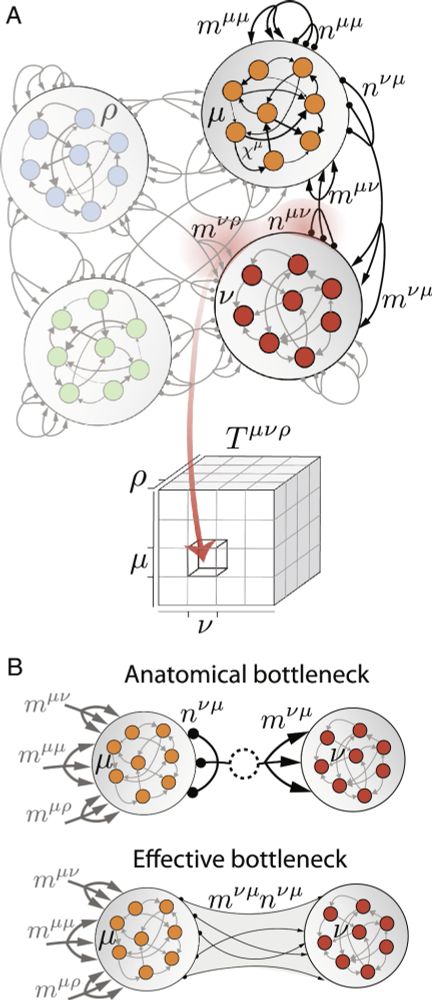
Structure of activity in multiregion recurrent neural networks | PNAS
Neural circuits comprise multiple interconnected regions, each with complex dynamics.
The interplay between local and global activity is thought to...
www.pnas.org
March 7, 2025 at 7:39 PM
(1/23) In addition to the new Lady Gaga album "Mayhem," my paper with Manuel Beiran, "Structure of activity in multiregion recurrent neural networks," has been published today.
PNAS link: www.pnas.org/doi/10.1073/...
(see dclark.io for PDF)
An explainer thread...
PNAS link: www.pnas.org/doi/10.1073/...
(see dclark.io for PDF)
An explainer thread...
Reposted by Anirudh GJ
Music is universal. It varies more within than between societies and can be described by a few key dimensions. That’s because brains operate by using the raw materials of music: oscillations (brainwaves).
www.science.org/doi/10.1126/...
#neuroscience
www.science.org/doi/10.1126/...
#neuroscience
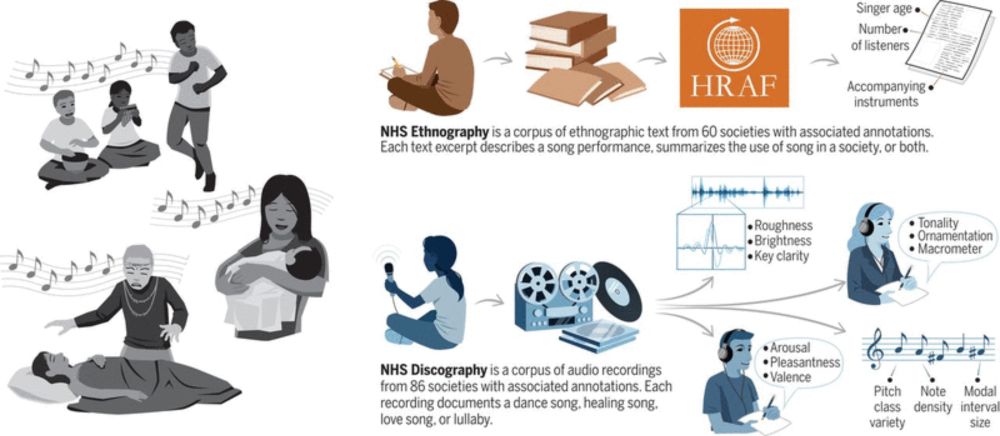
Universality and diversity in human song
Songs exhibit universal patterns across cultures.
www.science.org
June 23, 2025 at 11:38 AM
Music is universal. It varies more within than between societies and can be described by a few key dimensions. That’s because brains operate by using the raw materials of music: oscillations (brainwaves).
www.science.org/doi/10.1126/...
#neuroscience
www.science.org/doi/10.1126/...
#neuroscience
Reposted by Anirudh GJ

1/N
How do neural dynamics in motor cortex interact with those in subcortical networks to flexibly control movement? I’m beyond thrilled to share our work on this problem, led by Eric Kirk @eric-kirk.bsky.social with help from Kangjia Cai!
www.biorxiv.org/content/10.1...
How do neural dynamics in motor cortex interact with those in subcortical networks to flexibly control movement? I’m beyond thrilled to share our work on this problem, led by Eric Kirk @eric-kirk.bsky.social with help from Kangjia Cai!
www.biorxiv.org/content/10.1...
June 23, 2025 at 12:28 PM
1/N
How do neural dynamics in motor cortex interact with those in subcortical networks to flexibly control movement? I’m beyond thrilled to share our work on this problem, led by Eric Kirk @eric-kirk.bsky.social with help from Kangjia Cai!
www.biorxiv.org/content/10.1...
How do neural dynamics in motor cortex interact with those in subcortical networks to flexibly control movement? I’m beyond thrilled to share our work on this problem, led by Eric Kirk @eric-kirk.bsky.social with help from Kangjia Cai!
www.biorxiv.org/content/10.1...
Reposted by Anirudh GJ

Thrilled to announce I'll be starting my own neuro-theory lab, as an Assistant Professor at @yaleneuro.bsky.social @wutsaiyale.bsky.social this Fall!
My group will study offline learning in the sleeping brain: how neural activity self-organizes during sleep and the computations it performs. 🧵
My group will study offline learning in the sleeping brain: how neural activity self-organizes during sleep and the computations it performs. 🧵
June 23, 2025 at 3:55 PM
Thrilled to announce I'll be starting my own neuro-theory lab, as an Assistant Professor at @yaleneuro.bsky.social @wutsaiyale.bsky.social this Fall!
My group will study offline learning in the sleeping brain: how neural activity self-organizes during sleep and the computations it performs. 🧵
My group will study offline learning in the sleeping brain: how neural activity self-organizes during sleep and the computations it performs. 🧵
Reposted by Anirudh GJ

aside from this being a v cool paper I also want to congratulate the authors on the incredible SNR achieved in the title via a complete absence of filler words
Neuromorphic hierarchical modular reservoirs
www.biorxiv.org/content/10.1...
Neuromorphic hierarchical modular reservoirs
www.biorxiv.org/content/10.1...

June 22, 2025 at 5:13 PM
aside from this being a v cool paper I also want to congratulate the authors on the incredible SNR achieved in the title via a complete absence of filler words
Neuromorphic hierarchical modular reservoirs
www.biorxiv.org/content/10.1...
Neuromorphic hierarchical modular reservoirs
www.biorxiv.org/content/10.1...
Reposted by Anirudh GJ

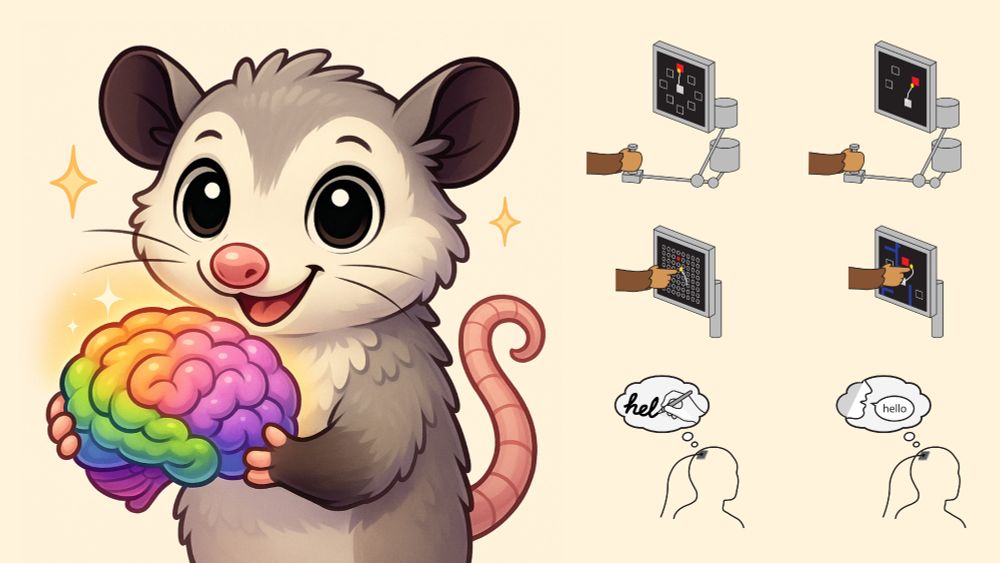
New preprint! 🧠🤖
How do we build neural decoders that are:
⚡️ fast enough for real-time use
🎯 accurate across diverse tasks
🌍 generalizable to new sessions, subjects, and even species?
We present POSSM, a hybrid SSM architecture that optimizes for all three of these axes!
🧵1/7
How do we build neural decoders that are:
⚡️ fast enough for real-time use
🎯 accurate across diverse tasks
🌍 generalizable to new sessions, subjects, and even species?
We present POSSM, a hybrid SSM architecture that optimizes for all three of these axes!
🧵1/7
June 6, 2025 at 5:40 PM
New preprint! 🧠🤖
How do we build neural decoders that are:
⚡️ fast enough for real-time use
🎯 accurate across diverse tasks
🌍 generalizable to new sessions, subjects, and even species?
We present POSSM, a hybrid SSM architecture that optimizes for all three of these axes!
🧵1/7
How do we build neural decoders that are:
⚡️ fast enough for real-time use
🎯 accurate across diverse tasks
🌍 generalizable to new sessions, subjects, and even species?
We present POSSM, a hybrid SSM architecture that optimizes for all three of these axes!
🧵1/7