




Elna Mortensen
@elnamortensen1.bsky.social
Freelancer//Literature & culture & digital curiousity & education
Reposted by Elna Mortensen

Why is criticism a time-honored side gig for artists? “Art and criticism are not quite as spiritually opposed as some artists in particular like to imagine: they are at base attempts to pin down something ineffable.”

Why Has Criticism Always Been Such a Good Side Gig for Artists?
There might not be a more natural, if also more fraught, complementary profession to artistry than criticism. Who, after all, would have a better perspective on the necessary background and unique …
buff.ly
December 22, 2025 at 9:30 PM
Why is criticism a time-honored side gig for artists? “Art and criticism are not quite as spiritually opposed as some artists in particular like to imagine: they are at base attempts to pin down something ineffable.”
Reposted by Elna Mortensen

"Metabolic images are visual material made by consuming billions of other images to be broken down and absorbed by #AI models via a gargantuan infrastructure that absorbs energy and water, and excretes media, atmospheric carbon, and other pollutants." — @katecrawford.bsky.social

Intensification - Kate Crawford - Eating the Future: The Metabolic Logic of AI Slop
AI slop isn’t invested in the order of events or even looking like reality. The slop is not the territory: it just smothers it in synthetic goop. It’s flooding the zone with AI shit.
www.e-flux.com
September 15, 2025 at 2:00 AM
"Metabolic images are visual material made by consuming billions of other images to be broken down and absorbed by #AI models via a gargantuan infrastructure that absorbs energy and water, and excretes media, atmospheric carbon, and other pollutants." — @katecrawford.bsky.social
Reposted by Elna Mortensen

In her Long Now Talk, @katecrawford.bsky.social argues that AI has created a metabolic rift: massive data collection that acts like poor nutrition at planetary scale. However, this is something we’ve seen before, dating back to the 1500s.
Watch the full talk here: www.youtube.com/watch?v=lsBn...
Watch the full talk here: www.youtube.com/watch?v=lsBn...

Kate Crawford | Mapping Empires
YouTube video by The Long Now Foundation
www.youtube.com
December 11, 2025 at 8:10 PM
In her Long Now Talk, @katecrawford.bsky.social argues that AI has created a metabolic rift: massive data collection that acts like poor nutrition at planetary scale. However, this is something we’ve seen before, dating back to the 1500s.
Watch the full talk here: www.youtube.com/watch?v=lsBn...
Watch the full talk here: www.youtube.com/watch?v=lsBn...
Reposted by Elna Mortensen

I gave a new talk on AI, cultural hegemony and the importance of the digital survival of "small" languages online this past Tuesday at University of Copenhagen. Notes and partial slides now online: ethanzuckerman.com/2025/12/05/g...

Gramsci's Nightmare: AI, Platform Power and the Automation of Cultural Hegemony - Ethan Zuckerman
Large language models lock values into place, making it hard to challenge the cultural hegemony of a particular form of western culture
ethanzuckerman.com
December 5, 2025 at 11:51 PM
I gave a new talk on AI, cultural hegemony and the importance of the digital survival of "small" languages online this past Tuesday at University of Copenhagen. Notes and partial slides now online: ethanzuckerman.com/2025/12/05/g...
Reposted by Elna Mortensen

Fünfzehn Jahre hat der dänische Autor und Karikaturist Jakob Martin Strid an seinem »Fantastischen Bus« geschraubt. Nun liegt dieses überdimensionale Wunderwerk des Erzählens vor. Eine Kritik unserer Zeit und eine hoffnungsvolle Hommage an eine tierisch sympathische Schicksalsgemeinschaft.

Fabel-hafter Roadtrip
Fünfzehn Jahre hat der dänische Autor und Karikaturist Jakob Martin Strid an seinem »Fantastischen Bus« geschraubt. Nun liegt dieses überdimensionale Wunderwerk des Erzählens vor. Eine Kritik unserer Zeit und eine hoffnungsvolle Hommage an eine tierisch sympathische Schicksalsgemeinschaft.
www.intellectures.de
November 28, 2025 at 7:40 AM
Fünfzehn Jahre hat der dänische Autor und Karikaturist Jakob Martin Strid an seinem »Fantastischen Bus« geschraubt. Nun liegt dieses überdimensionale Wunderwerk des Erzählens vor. Eine Kritik unserer Zeit und eine hoffnungsvolle Hommage an eine tierisch sympathische Schicksalsgemeinschaft.
Reposted by Elna Mortensen

Was Lesen mit Denken zu tun hat und warum uns die Maschine genau das nicht abnehmen, sondern nur abgewöhnen kann, darüber habe ich für @54books.bsky.social nachgedacht. Es geht um KI-Hype, den Zustand der Kulturindustrie und die faschistische Tendenz der Affirmation.

Das Ende des Denkens - Über das Lesen und KI - 54books
von Alex Struwe „Deutschland liebt das Lesen“, verkündete die Presseabteilung der Leipziger Buchmesse Ende März 2025. 296.000 Interessierte waren dieses Mal zum jährlichen…
54books.de
December 11, 2025 at 3:16 PM
Was Lesen mit Denken zu tun hat und warum uns die Maschine genau das nicht abnehmen, sondern nur abgewöhnen kann, darüber habe ich für @54books.bsky.social nachgedacht. Es geht um KI-Hype, den Zustand der Kulturindustrie und die faschistische Tendenz der Affirmation.
Reposted by Elna Mortensen

MUST READ
“The repetitive reproduction of the past brings about the slow cancellation of future.”
Pause & reflection have become revolutionary acts in an AI driven culture that valorizes “the eternalisation of present” via suspension of temporality.
www.thephilosophicalsalon.com/the-aestheti...
“The repetitive reproduction of the past brings about the slow cancellation of future.”
Pause & reflection have become revolutionary acts in an AI driven culture that valorizes “the eternalisation of present” via suspension of temporality.
www.thephilosophicalsalon.com/the-aestheti...

May 25, 2025 at 11:41 AM
MUST READ
“The repetitive reproduction of the past brings about the slow cancellation of future.”
Pause & reflection have become revolutionary acts in an AI driven culture that valorizes “the eternalisation of present” via suspension of temporality.
www.thephilosophicalsalon.com/the-aestheti...
“The repetitive reproduction of the past brings about the slow cancellation of future.”
Pause & reflection have become revolutionary acts in an AI driven culture that valorizes “the eternalisation of present” via suspension of temporality.
www.thephilosophicalsalon.com/the-aestheti...
Reposted by Elna Mortensen

As the shine started to come off generative AI, 2025 has been a year of reckoning. @willdouglasheaven.bsky.social offers four ways to think about the state of AI as this year comes to a close, framing it as “the start of a much-needed hype correction.” www.technologyreview.com/2025/12/15/1...

The great AI hype correction of 2025
Four ways to think about this year's reckoning
www.technologyreview.com
December 17, 2025 at 4:06 PM
As the shine started to come off generative AI, 2025 has been a year of reckoning. @willdouglasheaven.bsky.social offers four ways to think about the state of AI as this year comes to a close, framing it as “the start of a much-needed hype correction.” www.technologyreview.com/2025/12/15/1...
"If we can shift the spotlight from the hype around generative technologies to the predictive advances already transforming daily life, we can build AI that is genuinely useful, equitable, and sustainable."
www.technologyreview.com/2025/12/15/1...
www.technologyreview.com/2025/12/15/1...

Generative AI hype distracts us from AI’s more important breakthroughs
It's a seductive distraction from the advances in AI that are most likely to improve or even save your life
www.technologyreview.com
December 17, 2025 at 8:00 PM
"If we can shift the spotlight from the hype around generative technologies to the predictive advances already transforming daily life, we can build AI that is genuinely useful, equitable, and sustainable."
www.technologyreview.com/2025/12/15/1...
www.technologyreview.com/2025/12/15/1...
Reposted by Elna Mortensen

Think you know Hans Christian Andersen? Four experts pick his weirdest fairy tales to read this Christmas
By Ane Grum-Schwensen, Holger Berg, Jacob Bøggild and Sarah Bienko Eriksen
theconversation.com/think-you-kn...
Andersen at PG:
www.gutenberg.org/ebooks/autho...
#books #literature
By Ane Grum-Schwensen, Holger Berg, Jacob Bøggild and Sarah Bienko Eriksen
theconversation.com/think-you-kn...
Andersen at PG:
www.gutenberg.org/ebooks/autho...
#books #literature

December 17, 2025 at 6:10 PM
Think you know Hans Christian Andersen? Four experts pick his weirdest fairy tales to read this Christmas
By Ane Grum-Schwensen, Holger Berg, Jacob Bøggild and Sarah Bienko Eriksen
theconversation.com/think-you-kn...
Andersen at PG:
www.gutenberg.org/ebooks/autho...
#books #literature
By Ane Grum-Schwensen, Holger Berg, Jacob Bøggild and Sarah Bienko Eriksen
theconversation.com/think-you-kn...
Andersen at PG:
www.gutenberg.org/ebooks/autho...
#books #literature
Reposted by Elna Mortensen

Ich weiß, dass es euch genauso brennend interessiert wie mich, dass Islands Schwimmbadkultur jetzt immaterielles UNESCO-Weltkulturerbe ist!
December 12, 2025 at 6:09 PM
Ich weiß, dass es euch genauso brennend interessiert wie mich, dass Islands Schwimmbadkultur jetzt immaterielles UNESCO-Weltkulturerbe ist!
Reposted by Elna Mortensen

NOW ONLINE: The lastest special issue of Photography & Culture on «AI and Photography», guest-edited by Briankle Chang and Sarah M. Miller and featuring among others my essay «Images from Images: Generative AI and the Reconfiguration of the ‹Photographic›»
#OpenAccess
#OpenAccess

Photography and Culture
AI and Photography. Volume 18, Issue 3-4 of Photography and Culture
www.tandfonline.com
December 12, 2025 at 10:44 AM
NOW ONLINE: The lastest special issue of Photography & Culture on «AI and Photography», guest-edited by Briankle Chang and Sarah M. Miller and featuring among others my essay «Images from Images: Generative AI and the Reconfiguration of the ‹Photographic›»
#OpenAccess
#OpenAccess
"Pasquinelli points out that Vedic fire rituals (with precisely arranged bricks) is an example of early societies using counting, geometry, and organised spaces to encode knowledge and social order."

AI has a 3,000-year history: https://thoughtshrapnel.com/2025/11/26/ai-has-a-year-history.html

December 11, 2025 at 8:04 PM
"Pasquinelli points out that Vedic fire rituals (with precisely arranged bricks) is an example of early societies using counting, geometry, and organised spaces to encode knowledge and social order."
Reposted by Elna Mortensen

This article about the style of AI-generated writing is really good. Lots of specific examples and many of the things we've been discussing in #AIstories. www.nytimes.com/2025/12/03/m...

Why Does A.I. Write Like … That?
www.nytimes.com
December 3, 2025 at 11:29 PM
This article about the style of AI-generated writing is really good. Lots of specific examples and many of the things we've been discussing in #AIstories. www.nytimes.com/2025/12/03/m...
Reposted by Elna Mortensen

“If we misunderstand what science is, mistaking automation of method for the human project of collectively constructing, debating & refining the symbolic representations through which we make sense of reality, AI may foretell the death of science.”
— @saraimari.bsky.social
#science #ai
— @saraimari.bsky.social
#science #ai

The Death Of The Scientist | NOEMA
Will AI kill science, or will it foster a scientific revolution? The answer depends on something no one knows: What is science?
www.noemamag.com
December 11, 2025 at 6:03 PM
“If we misunderstand what science is, mistaking automation of method for the human project of collectively constructing, debating & refining the symbolic representations through which we make sense of reality, AI may foretell the death of science.”
— @saraimari.bsky.social
#science #ai
— @saraimari.bsky.social
#science #ai
Reposted by Elna Mortensen

The Earliest Known Customer Complaint Was Made 3,800 Years Ago: Read the Rant on an Ancient Babylonian Tablet

The Earliest Known Customer Complaint Was Made 3,800 Years Ago: Read the Rant on an Ancient Babylonian Tablet
Image via Wikimedia Commons
The site Fast Company published an article that describes the “Complaint Restraint project,” an initiative that aims to create a “positive life by eliminating negative stat...
www.openculture.com
December 11, 2025 at 6:09 PM
The Earliest Known Customer Complaint Was Made 3,800 Years Ago: Read the Rant on an Ancient Babylonian Tablet
Reposted by Elna Mortensen

George Orwell said that the process of learning bad writing habits is reversible. In this article on @openculture.bsky.social, he outlines six rules he follows. Such as, “never use a long word where a short one will do.” Read the rest here: www.openculture.com/2025/12/geor...

George Orwell’s Six Rules for Writing Clear and Tight Prose
Image via Wikimedia Commons
Most everyone who knows the work of George Orwell knows his 1946 essay “Politics and the English Language” (published here), in which he rails against careless, confusing, ...
www.openculture.com
December 11, 2025 at 3:02 PM
George Orwell said that the process of learning bad writing habits is reversible. In this article on @openculture.bsky.social, he outlines six rules he follows. Such as, “never use a long word where a short one will do.” Read the rest here: www.openculture.com/2025/12/geor...
Reposted by Elna Mortensen
“Antiquity was not in good repute everywhere.” How monks preserved classical culture and paved the way for the Renaissance.
lithub.com/how-medieval...
lithub.com/how-medieval...

How Medieval Monks and Scribes Helped Preserve Classical Culture
The Christianization of Europe was mostly a “top-down” affair. A chieftain or a prince was baptized, and his people followed suit. For example, three thousand people are said to have followed Clovi…
lithub.com
June 16, 2025 at 7:30 PM
“Antiquity was not in good repute everywhere.” How monks preserved classical culture and paved the way for the Renaissance.
lithub.com/how-medieval...
lithub.com/how-medieval...
Reposted by Elna Mortensen
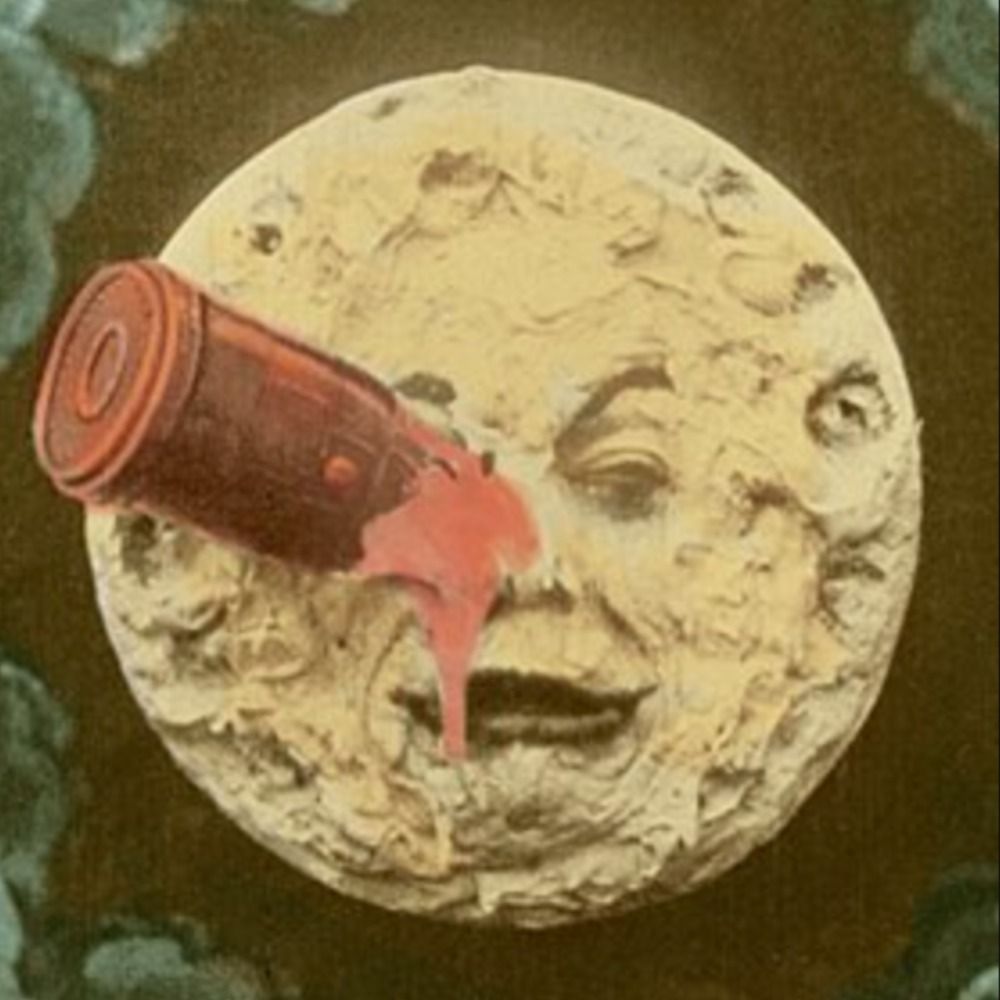
In her essay “Reading Like a Roman”, Alex Tadel explores Graeco-Roman reading culture through one of its best-preserved and most lavishly-illustrated artefacts: https://publicdomainreview.org/essay/reading-like-a-roman

June 7, 2025 at 7:46 PM
In her essay “Reading Like a Roman”, Alex Tadel explores Graeco-Roman reading culture through one of its best-preserved and most lavishly-illustrated artefacts: https://publicdomainreview.org/essay/reading-like-a-roman
Reposted by Elna Mortensen

The recent history of AI in 32 otters, by @emollick.bsky.social www.oneusefulthing.org/p/the-recent... Three years of (accelerated) #AI evolution #MediaEvolution


June 2, 2025 at 6:34 AM
The recent history of AI in 32 otters, by @emollick.bsky.social www.oneusefulthing.org/p/the-recent... Three years of (accelerated) #AI evolution #MediaEvolution
Reposted by Elna Mortensen
Like I said: AI is *directly* damaging actual democratic educational infrastructure

AI bot scrapers are hitting every site on the web in search of training data. This report is the first good attempt to evaluate the impact of these AI scrapers, especially on smaller institutions that are trying to make their collections open to the public www.404media.co/ai-scraping-...

AI Scraping Bots Are Breaking Open Libraries, Archives, and Museums
"This is a moment where that community feels collectively under threat and isn't sure what the process is for solving the problem.”
www.404media.co
June 17, 2025 at 6:43 PM
Like I said: AI is *directly* damaging actual democratic educational infrastructure
Reposted by Elna Mortensen
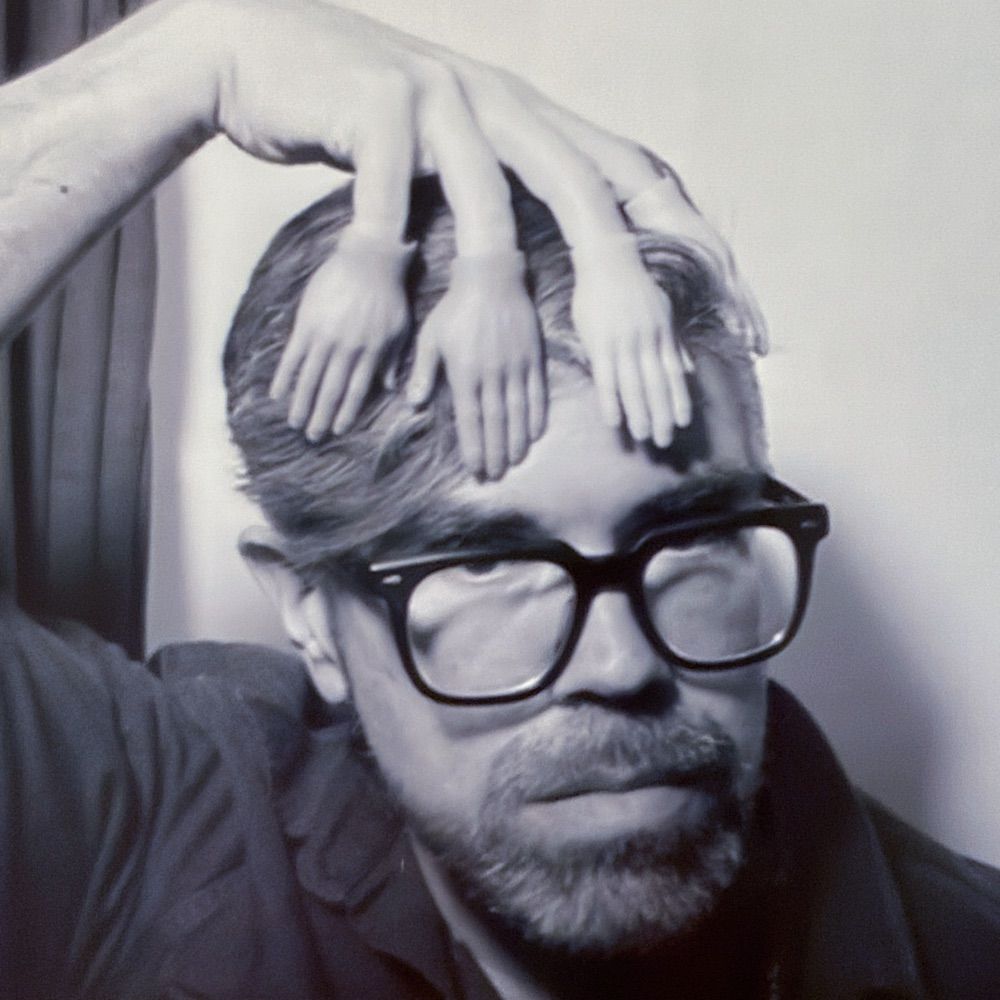
When LLM's commit "crimes," there's never a motive. Yet the press & industry assert the "black box" frame at the wrong level of AI: suggesting moral decision-making, rather than the hidden logic of flipping neurons. My latest in @techpolicypress.bsky.social: www.techpolicy.press/the-black-bo...

The Black Box Myth: What the Industry Pretends Not to Know About AI | TechPolicy.Press
Tech Policy Press fellow Eryk Salvaggio says it's a problem is that those of us outside of the AI industry don’t know what rules they are following.
www.techpolicy.press
June 17, 2025 at 1:16 PM
When LLM's commit "crimes," there's never a motive. Yet the press & industry assert the "black box" frame at the wrong level of AI: suggesting moral decision-making, rather than the hidden logic of flipping neurons. My latest in @techpolicypress.bsky.social: www.techpolicy.press/the-black-bo...
Reposted by Elna Mortensen
My latest piece, on the absurd notion of extending human rights to AI: “A model train works like a train because it is a model of a train; a toy railroad does not, therefore, merit funding as a transportation network.” #ai #mlsky
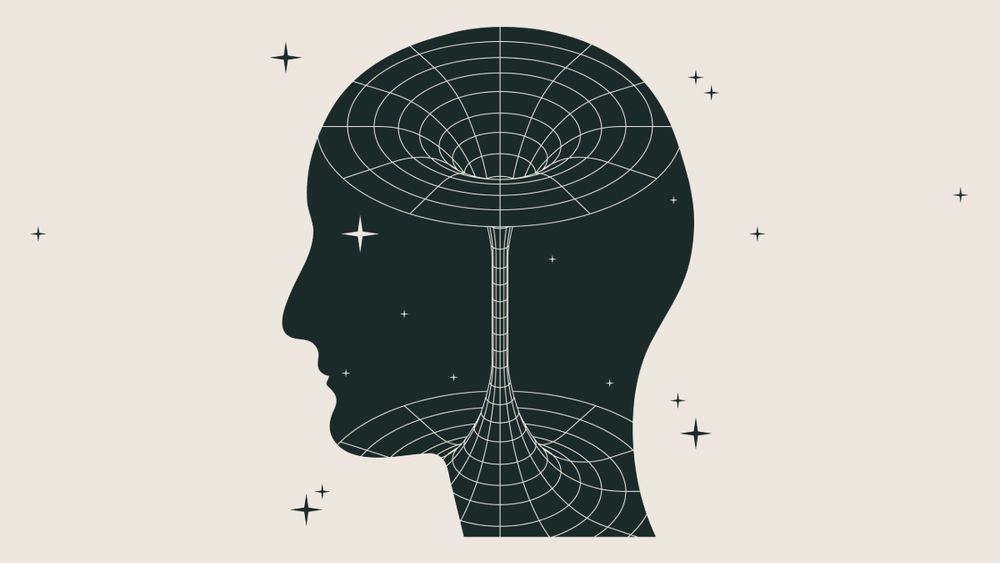
Machines Cannot Feel or Think, but Humans Can, and Ought To | TechPolicy.Press
By attributing experiences and emotions to software systems, we pave the way for them to be perceived as having rights, writes Eryk Salvaggio.
www.techpolicy.press
May 6, 2025 at 7:31 AM
Reposted by Elna Mortensen

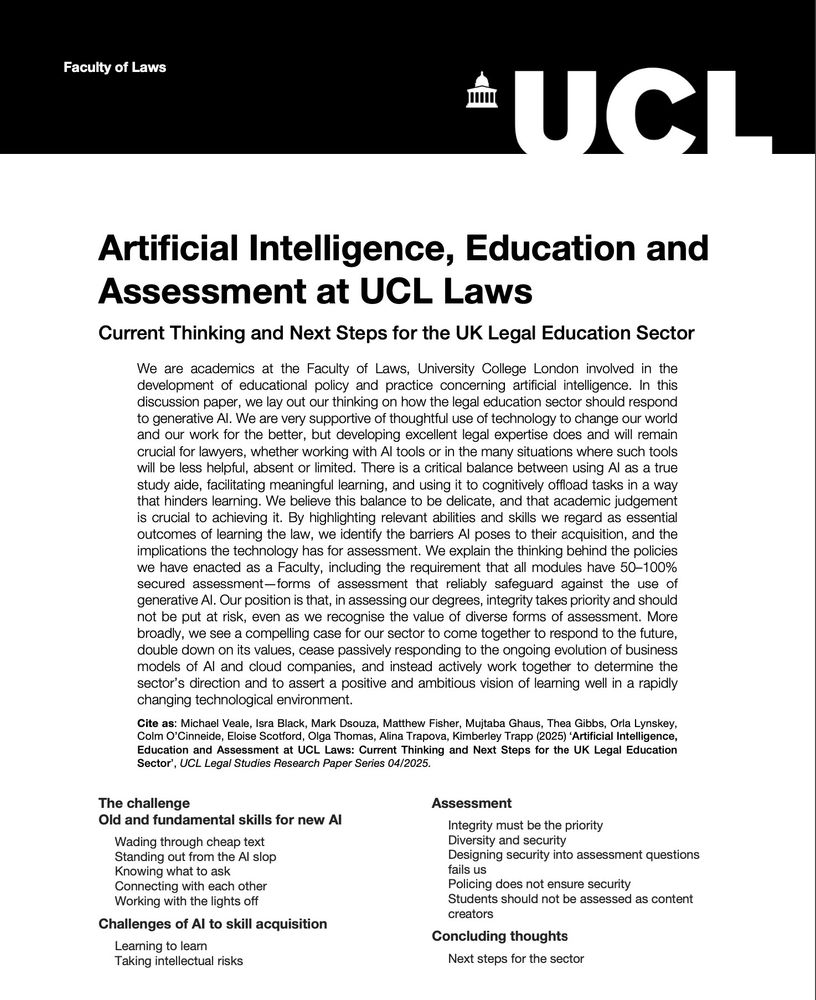
Superb thread reasserting the importance of higher education in the context of AI - much here is transferable outside of legal education

How should legal education respond to AI? Together with 11 UCL Laws colleagues, this paper is our vision for the sector. It's rooted in academic integrity, fundamental competences, and concerns around impacts on learning to learn and intellectual risk taking. (🧵)
discovery.ucl.ac.uk/id/eprint/10...
discovery.ucl.ac.uk/id/eprint/10...
May 6, 2025 at 1:00 PM
Superb thread reasserting the importance of higher education in the context of AI - much here is transferable outside of legal education
Reposted by Elna Mortensen

A short interview in which
@mkirschenbaum.bsky.social explains genAI's impact on written language. And sometimes, spoken language.
To that latter point, consider how "AI" exists as all of incantation, deity, and bogeyman. It can do anything because we haven't pinned it down to a _something_ .
@mkirschenbaum.bsky.social explains genAI's impact on written language. And sometimes, spoken language.
To that latter point, consider how "AI" exists as all of incantation, deity, and bogeyman. It can do anything because we haven't pinned it down to a _something_ .

May 6, 2025 at 1:09 PM
A short interview in which
@mkirschenbaum.bsky.social explains genAI's impact on written language. And sometimes, spoken language.
To that latter point, consider how "AI" exists as all of incantation, deity, and bogeyman. It can do anything because we haven't pinned it down to a _something_ .
@mkirschenbaum.bsky.social explains genAI's impact on written language. And sometimes, spoken language.
To that latter point, consider how "AI" exists as all of incantation, deity, and bogeyman. It can do anything because we haven't pinned it down to a _something_ .