



Meisam Zaferani
@meisamzaferani.bsky.social
Biophysicist | Immigrant | First Gen | Husband
Princeton, NJ
Princeton, NJ
Reposted by Meisam Zaferani

Lund et al. @ucph.bsky.social reveal that coupling of neuropeptide-containing dense core vesicles undergoing axonal transport to #kinesin-1 & #dynein is mediated by an adaptor complex composed of Syd/dJIP3/4 and RUFY, controlled by Rab2, Arl8, & the Arl8 activator BORC. rupress.org/jcb/article/...
January 7, 2026 at 3:31 PM
Lund et al. @ucph.bsky.social reveal that coupling of neuropeptide-containing dense core vesicles undergoing axonal transport to #kinesin-1 & #dynein is mediated by an adaptor complex composed of Syd/dJIP3/4 and RUFY, controlled by Rab2, Arl8, & the Arl8 activator BORC. rupress.org/jcb/article/...
Reposted by Meisam Zaferani

Happy to be joining the Department of Applied Mathematics and Theoretical Physics at the University of Cambridge @cam.ac.uk as an associate professor. I’ll continue my work at the Institute of Physics in Amsterdam and am much looking forward to new collaborations and scientific exchange!

January 2, 2026 at 11:22 AM
Happy to be joining the Department of Applied Mathematics and Theoretical Physics at the University of Cambridge @cam.ac.uk as an associate professor. I’ll continue my work at the Institute of Physics in Amsterdam and am much looking forward to new collaborations and scientific exchange!
Reposted by Meisam Zaferani
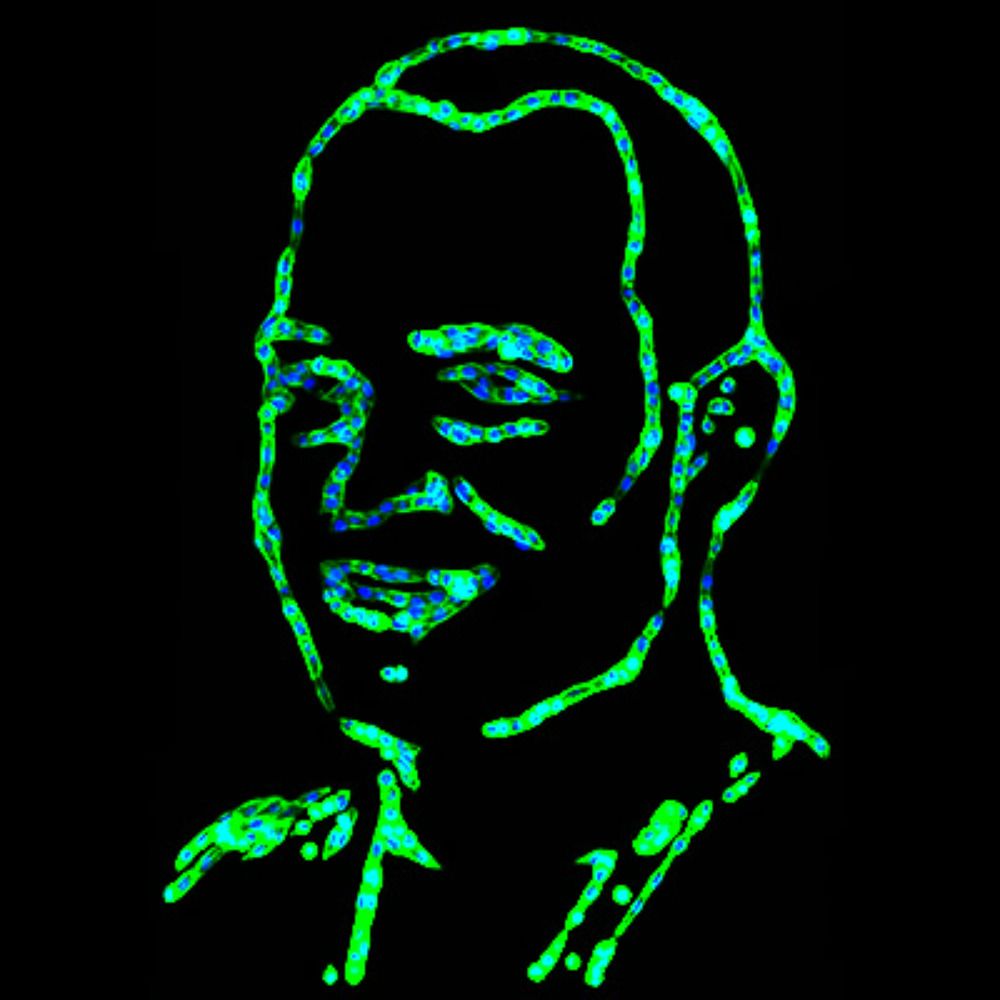
#LivingArchitectures
We put cells and cytoskeleton filaments on the architecture of the musée d'Orsay.
www.musee-orsay.fr/fr/agenda/ev...
Scientists of the #CytoMorphoLab adapted their protocols to illustrate the questions that keep them awake at night.
-> Two shows on the 24th and 25th of January.
We put cells and cytoskeleton filaments on the architecture of the musée d'Orsay.
www.musee-orsay.fr/fr/agenda/ev...
Scientists of the #CytoMorphoLab adapted their protocols to illustrate the questions that keep them awake at night.
-> Two shows on the 24th and 25th of January.


December 5, 2025 at 4:11 PM
#LivingArchitectures
We put cells and cytoskeleton filaments on the architecture of the musée d'Orsay.
www.musee-orsay.fr/fr/agenda/ev...
Scientists of the #CytoMorphoLab adapted their protocols to illustrate the questions that keep them awake at night.
-> Two shows on the 24th and 25th of January.
We put cells and cytoskeleton filaments on the architecture of the musée d'Orsay.
www.musee-orsay.fr/fr/agenda/ev...
Scientists of the #CytoMorphoLab adapted their protocols to illustrate the questions that keep them awake at night.
-> Two shows on the 24th and 25th of January.
Reposted by Meisam Zaferani
Mathematicians are studying elliptic curve patterns that resemble murmurations of starlings. Nina Zubrilina, a doctoral student at Princeton, was the first to prove a formula that explains reasons for the patterns. www.quantamagazine.org/elliptic-cur...

November 30, 2025 at 4:46 PM
Mathematicians are studying elliptic curve patterns that resemble murmurations of starlings. Nina Zubrilina, a doctoral student at Princeton, was the first to prove a formula that explains reasons for the patterns. www.quantamagazine.org/elliptic-cur...
Reposted by Meisam Zaferani

Allele-frequency time series as a window into gene flow and transmission in COVID / influenza is now out in PNAS
www.pnas.org/doi/10.1073/...
Huge thanks to three reviewers altruistically improving our paper!
Below is the thread from the preprint.
www.pnas.org/doi/10.1073/...
Huge thanks to three reviewers altruistically improving our paper!
Below is the thread from the preprint.
November 26, 2025 at 7:18 PM
Allele-frequency time series as a window into gene flow and transmission in COVID / influenza is now out in PNAS
www.pnas.org/doi/10.1073/...
Huge thanks to three reviewers altruistically improving our paper!
Below is the thread from the preprint.
www.pnas.org/doi/10.1073/...
Huge thanks to three reviewers altruistically improving our paper!
Below is the thread from the preprint.
Fabulous!
Cellular structure self-organizes through an interplay between internal mechanisms and external cues. The single-celled suctorian P. collini builds a trap structure to capture large prey using microtubule feeding tentacles, creating feedback between cell morphology and prey availability.
November 18, 2025 at 10:31 PM
Fabulous!
Reposted by Meisam Zaferani

Mechanosensation and fast reorientation of ciliary structures: Marvin's work on the surprising locomotion capabilities of Trichoplax, an animal without neurons!
www.biorxiv.org/content/10.1...
www.biorxiv.org/content/10.1...
August 27, 2025 at 10:50 AM
Mechanosensation and fast reorientation of ciliary structures: Marvin's work on the surprising locomotion capabilities of Trichoplax, an animal without neurons!
www.biorxiv.org/content/10.1...
www.biorxiv.org/content/10.1...
Reposted by Meisam Zaferani
What a pleasure to collaborate with Laura #Schaedel and her team at @uni-saarland.de to study #microtubule damage and repair under mechanical load.

September 14, 2025 at 9:48 AM
What a pleasure to collaborate with Laura #Schaedel and her team at @uni-saarland.de to study #microtubule damage and repair under mechanical load.
Reposted by Meisam Zaferani
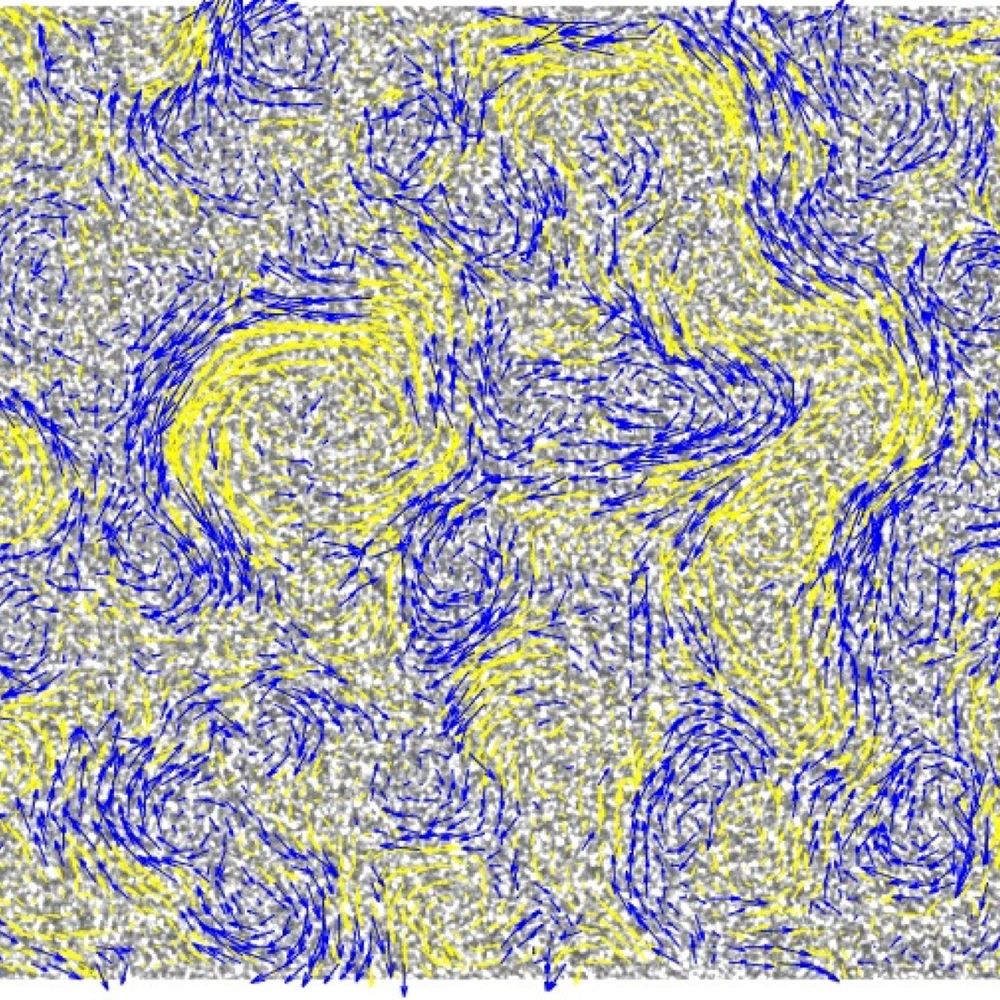
How do microtubules explore and adapt to space?
New study by Zaferani et al. in
@natchemeng.nature.com
shows that branched MTs read boundaries — a leap from biology to engineering: nature.com/articles/s44...
My News & Views: rdcu.be/eEiaX
Congrats
@meisamzaferani.bsky.social
& team 👏
New study by Zaferani et al. in
@natchemeng.nature.com
shows that branched MTs read boundaries — a leap from biology to engineering: nature.com/articles/s44...
My News & Views: rdcu.be/eEiaX
Congrats
@meisamzaferani.bsky.social
& team 👏

Boundary-sensing mechanism in branched microtubule networks - Nature Chemical Engineering
Uncovering the rules of microtubule network self-organization under confinement is key to understanding how cells build structure in complex environments. This study reveals a tunable boundary-sensing...
nature.com
September 10, 2025 at 1:28 PM
How do microtubules explore and adapt to space?
New study by Zaferani et al. in
@natchemeng.nature.com
shows that branched MTs read boundaries — a leap from biology to engineering: nature.com/articles/s44...
My News & Views: rdcu.be/eEiaX
Congrats
@meisamzaferani.bsky.social
& team 👏
New study by Zaferani et al. in
@natchemeng.nature.com
shows that branched MTs read boundaries — a leap from biology to engineering: nature.com/articles/s44...
My News & Views: rdcu.be/eEiaX
Congrats
@meisamzaferani.bsky.social
& team 👏
Reposted by Meisam Zaferani
The multinucleate, multibudding yeast, A. pullulans delivers nuclei into each daughter bud during #mitosis. Petrucco, @gladfelterlab.bsky.social, Lew et al image #microtubules during mitosis, revealing mechanisms ensuring that most daughters inherit one & only one nucleus rupress.org/jcb/article/...
August 29, 2025 at 4:00 PM
The multinucleate, multibudding yeast, A. pullulans delivers nuclei into each daughter bud during #mitosis. Petrucco, @gladfelterlab.bsky.social, Lew et al image #microtubules during mitosis, revealing mechanisms ensuring that most daughters inherit one & only one nucleus rupress.org/jcb/article/...
💥 💥 Our paper on the boundary-sensing mechanism in branched microtubule networks is now published in Nature Chemical Engineering! I sincerely thank all the contributing authors, reviewers, and editors who made this work possible.
www.nature.com/articles/s44...
www.nature.com/articles/s44...

August 20, 2025 at 2:18 PM
💥 💥 Our paper on the boundary-sensing mechanism in branched microtubule networks is now published in Nature Chemical Engineering! I sincerely thank all the contributing authors, reviewers, and editors who made this work possible.
www.nature.com/articles/s44...
www.nature.com/articles/s44...
Fascinating!
Geng, @kjverhey1.bsky.social et al find that KIF1C forms condensates where the exposed #kinesin motor domains entangle nearby #microtubules, causing them to bend & break in a process dependent on motor processivity, cluster properties, cytoplasmic viscosity, & MT anchors rupress.org/jcb/article/...
August 11, 2025 at 11:18 PM
Fascinating!
Reposted by Meisam Zaferani
Thrilled to see our study on how kinesin-2 motors are switched on and off published in @natsmb.nature.com ⚛️
➡️ www.nature.com/articles/s41...
Congrats to all authors from me and Anthony 🎉 @dunnschool.bsky.social Check out this animation made by talented PhD student @matthew-batisio.bsky.social 😆
➡️ www.nature.com/articles/s41...
Congrats to all authors from me and Anthony 🎉 @dunnschool.bsky.social Check out this animation made by talented PhD student @matthew-batisio.bsky.social 😆
July 29, 2025 at 9:04 AM
Thrilled to see our study on how kinesin-2 motors are switched on and off published in @natsmb.nature.com ⚛️
➡️ www.nature.com/articles/s41...
Congrats to all authors from me and Anthony 🎉 @dunnschool.bsky.social Check out this animation made by talented PhD student @matthew-batisio.bsky.social 😆
➡️ www.nature.com/articles/s41...
Congrats to all authors from me and Anthony 🎉 @dunnschool.bsky.social Check out this animation made by talented PhD student @matthew-batisio.bsky.social 😆
Reposted by Meisam Zaferani

Nature research paper: Spatiotemporal orchestration of mitosis by cyclin-dependent kinase
https://go.nature.com/444lRhe
https://go.nature.com/444lRhe

Spatiotemporal orchestration of mitosis by cyclin-dependent kinase - Nature
Experiments in fission yeast show that cyclin-dependent kinase is first activated in the nucleus, from which the mitotic signal is propagated from CDK at the centrosome to the cytoplasm.
go.nature.com
June 25, 2025 at 5:50 PM
Nature research paper: Spatiotemporal orchestration of mitosis by cyclin-dependent kinase
https://go.nature.com/444lRhe
https://go.nature.com/444lRhe
Reposted by Meisam Zaferani

Researchers used #optogenetics to stimulate epidermal cells in #drosophila larvae, triggering escape behaviours even without injury.
This shows that mechanosensory signals can drive nociceptive responses, linking touch detection to pain responses.
buff.ly/XX2vmuw
This shows that mechanosensory signals can drive nociceptive responses, linking touch detection to pain responses.
buff.ly/XX2vmuw
June 5, 2025 at 8:02 PM
Researchers used #optogenetics to stimulate epidermal cells in #drosophila larvae, triggering escape behaviours even without injury.
This shows that mechanosensory signals can drive nociceptive responses, linking touch detection to pain responses.
buff.ly/XX2vmuw
This shows that mechanosensory signals can drive nociceptive responses, linking touch detection to pain responses.
buff.ly/XX2vmuw
Reposted by Meisam Zaferani

Happy to contribute to this fantastic work by @maksimkalutskii.bsky.social and @maxotubule.bsky.social!
www.pnas.org/doi/abs/10.1...
www.pnas.org/doi/abs/10.1...
June 3, 2025 at 11:14 AM
Happy to contribute to this fantastic work by @maksimkalutskii.bsky.social and @maxotubule.bsky.social!
www.pnas.org/doi/abs/10.1...
www.pnas.org/doi/abs/10.1...
Reposted by Meisam Zaferani
Pretty much everything is fucked, but here is some beautiful and exciting science from @archaeon-alex.bsky.social and colleagues.
www.science.org/doi/10.1126/...
www.science.org/doi/10.1126/...
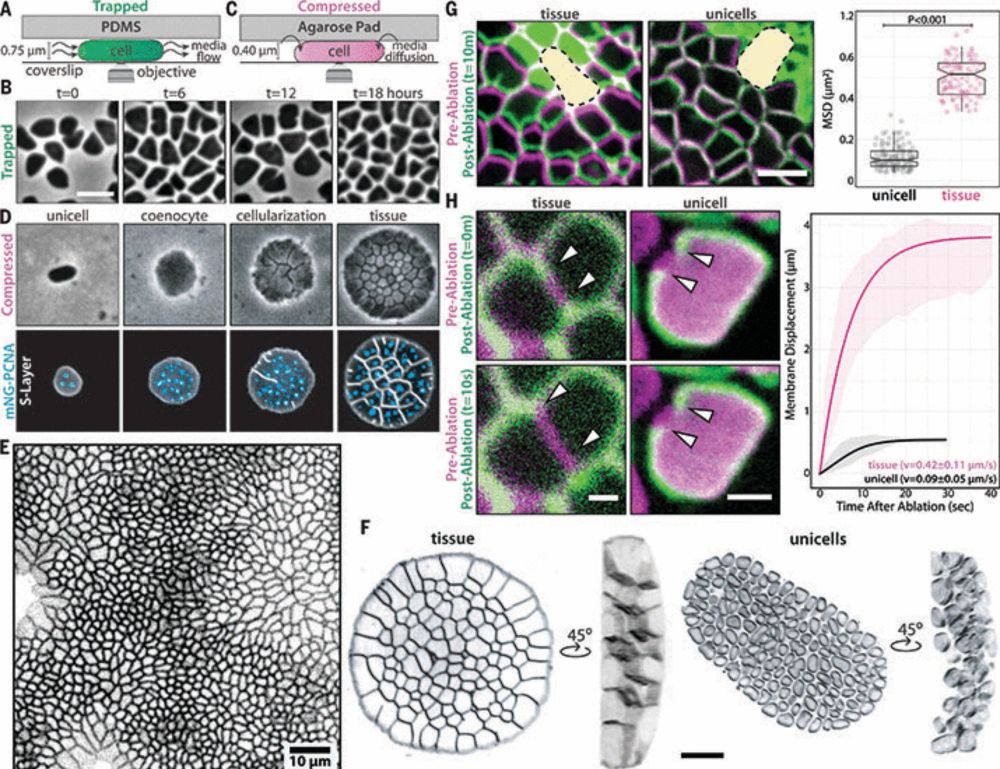
Tissue-like multicellular development triggered by mechanical compression in archaea
The advent of clonal multicellularity is a critical evolutionary milestone, seen often in eukaryotes, rarely in bacteria, and only once in archaea. We show that uniaxial compression induces clonal mul...
www.science.org
April 4, 2025 at 3:40 AM
Pretty much everything is fucked, but here is some beautiful and exciting science from @archaeon-alex.bsky.social and colleagues.
www.science.org/doi/10.1126/...
www.science.org/doi/10.1126/...
Reposted by Meisam Zaferani

Excited to release our latest work:
doi.org/10.1101/2025...
Here, we describe how confined bacterial suspensions self-organize into structured domains of different motilities, in response to oxygen limitations🦠🍥
Bluetorial follows! [1/8]
doi.org/10.1101/2025...
Here, we describe how confined bacterial suspensions self-organize into structured domains of different motilities, in response to oxygen limitations🦠🍥
Bluetorial follows! [1/8]
February 27, 2025 at 5:28 PM
Excited to release our latest work:
doi.org/10.1101/2025...
Here, we describe how confined bacterial suspensions self-organize into structured domains of different motilities, in response to oxygen limitations🦠🍥
Bluetorial follows! [1/8]
doi.org/10.1101/2025...
Here, we describe how confined bacterial suspensions self-organize into structured domains of different motilities, in response to oxygen limitations🦠🍥
Bluetorial follows! [1/8]
Reposted by Meisam Zaferani

📢Excited to share our new paper in Nature Physics
@naturephysics.bsky.social: Cooperative hydrodynamics accompany multicellular-like colonial organization in the unicellular Stentor!
How do single-celled organisms benefit from teamwork? Let’s dive in! #Multicellularity nature.com/articles/s41...?
@naturephysics.bsky.social: Cooperative hydrodynamics accompany multicellular-like colonial organization in the unicellular Stentor!
How do single-celled organisms benefit from teamwork? Let’s dive in! #Multicellularity nature.com/articles/s41...?
April 2, 2025 at 12:14 PM
📢Excited to share our new paper in Nature Physics
@naturephysics.bsky.social: Cooperative hydrodynamics accompany multicellular-like colonial organization in the unicellular Stentor!
How do single-celled organisms benefit from teamwork? Let’s dive in! #Multicellularity nature.com/articles/s41...?
@naturephysics.bsky.social: Cooperative hydrodynamics accompany multicellular-like colonial organization in the unicellular Stentor!
How do single-celled organisms benefit from teamwork? Let’s dive in! #Multicellularity nature.com/articles/s41...?
Reposted by Meisam Zaferani
Live imaging of mouse egg cells reveals how they control the timing of essential embryo development processes.

Unlocking the embryo
Live imaging of mouse egg cells reveals how they control the timing of essential embryo development processes.
buff.ly
March 30, 2025 at 1:59 PM
Live imaging of mouse egg cells reveals how they control the timing of essential embryo development processes.
Reposted by Meisam Zaferani
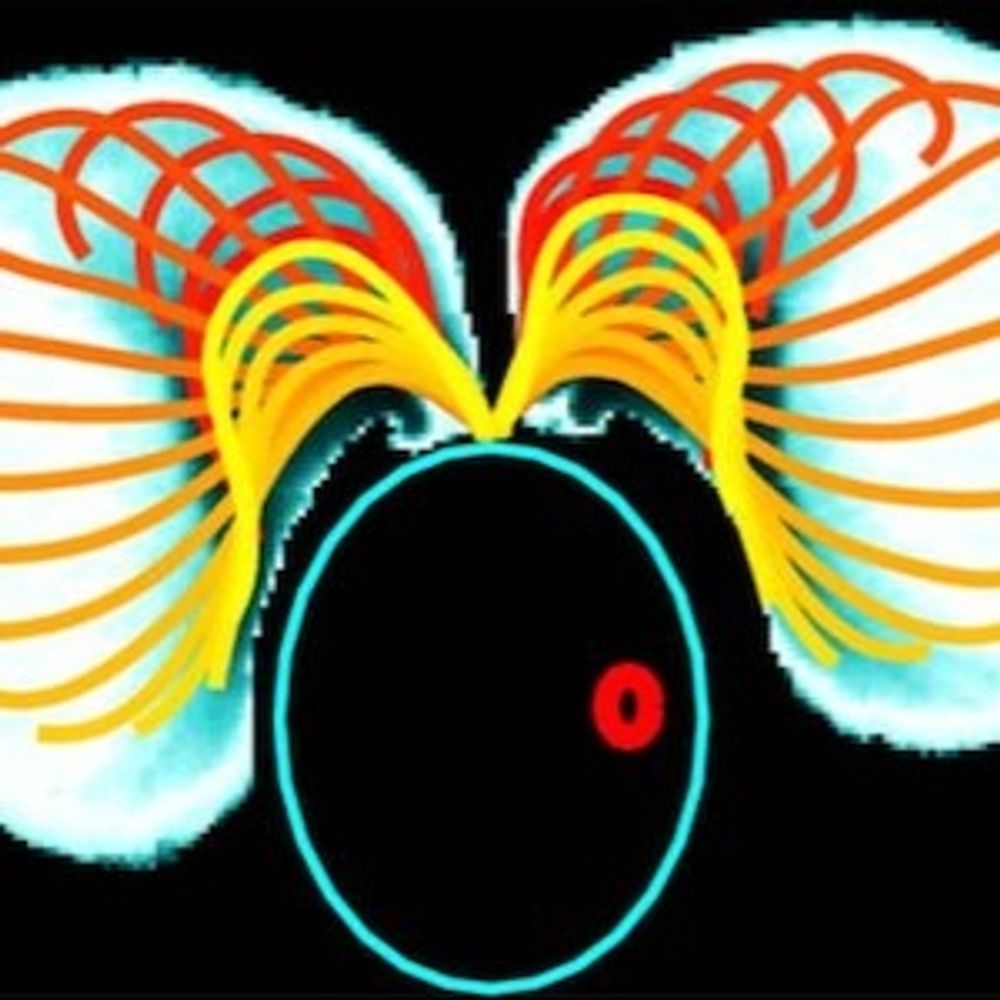
Delighted to see our work on #diatom motility published in @pnas.org !🎉
doi.org/10.1073/pnas...
These abundant single-celled algae are responsible for a significant portion of the air we breathe yet often overlooked. Here we show how how diatom (raphe) shape impacts their gliding function... 1/3
doi.org/10.1073/pnas...
These abundant single-celled algae are responsible for a significant portion of the air we breathe yet often overlooked. Here we show how how diatom (raphe) shape impacts their gliding function... 1/3
March 19, 2025 at 10:21 AM
Delighted to see our work on #diatom motility published in @pnas.org !🎉
doi.org/10.1073/pnas...
These abundant single-celled algae are responsible for a significant portion of the air we breathe yet often overlooked. Here we show how how diatom (raphe) shape impacts their gliding function... 1/3
doi.org/10.1073/pnas...
These abundant single-celled algae are responsible for a significant portion of the air we breathe yet often overlooked. Here we show how how diatom (raphe) shape impacts their gliding function... 1/3
Reposted by Meisam Zaferani
A new paper on single molecule analysis of electron transfer to Shewanella from quantum dots that we helped out on is up on PNAS today:
www.pnas.org/doi/10.1073/...
www.pnas.org/doi/10.1073/...
PNAS
Proceedings of the National Academy of Sciences (PNAS), a peer reviewed journal of the National Academy of Sciences (NAS) - an authoritative source of high-impact, original research that broadly spans...
www.pnas.org
March 18, 2025 at 7:15 PM
A new paper on single molecule analysis of electron transfer to Shewanella from quantum dots that we helped out on is up on PNAS today:
www.pnas.org/doi/10.1073/...
www.pnas.org/doi/10.1073/...
Reposted by Meisam Zaferani
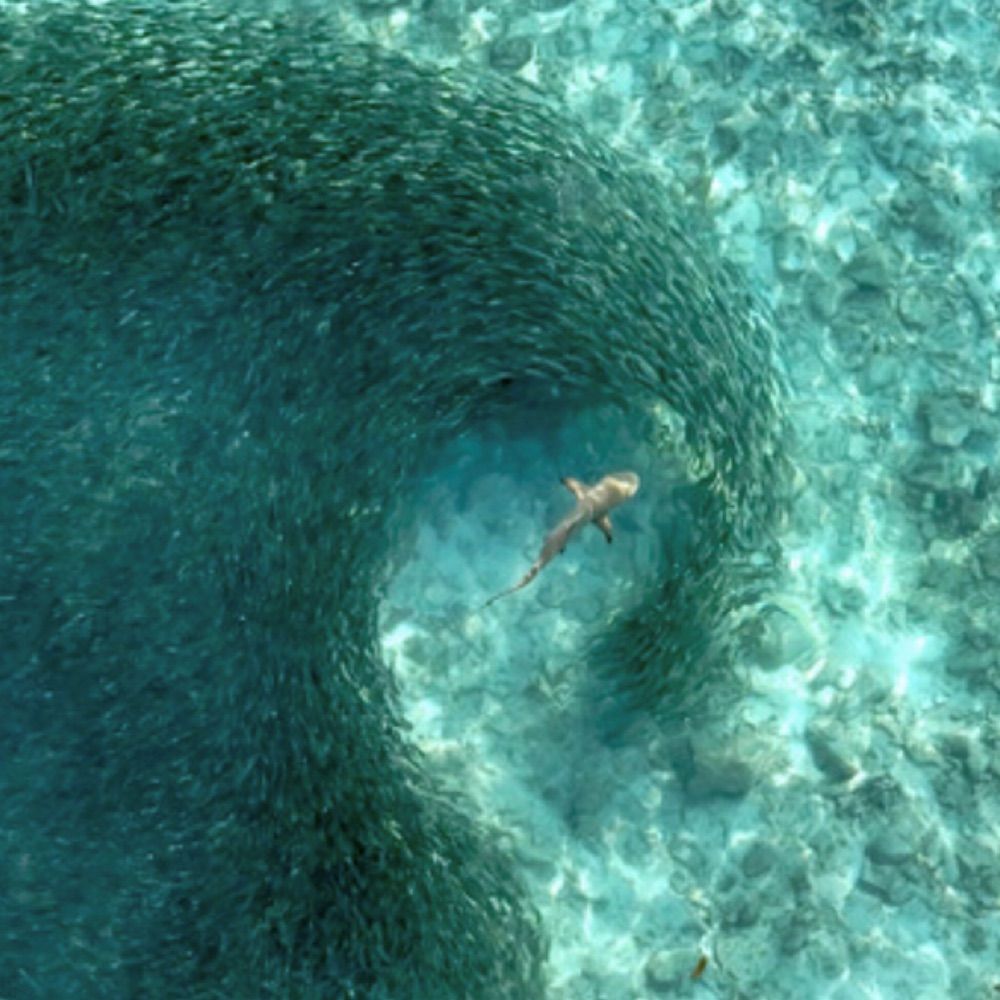
Virtual reality rewrites the rules of the swarm. www.science.org/doi/10.1126/...
We find that classical models of collective behavior fail to account for collective motion.
www.science.org/doi/10.1126/...
We find that classical models of collective behavior fail to account for collective motion.
www.science.org/doi/10.1126/...
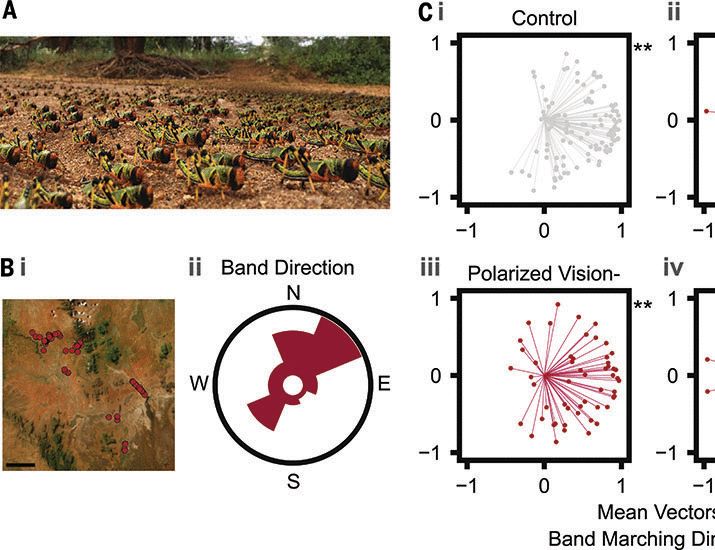
The behavioral mechanisms governing collective motion in swarming locusts
Collective motion, which is ubiquitous in nature, has traditionally been explained by “self-propelled particle” models from theoretical physics. Here we show, through field, lab, and virtual reality e...
www.science.org
February 27, 2025 at 9:34 PM
Virtual reality rewrites the rules of the swarm. www.science.org/doi/10.1126/...
We find that classical models of collective behavior fail to account for collective motion.
www.science.org/doi/10.1126/...
We find that classical models of collective behavior fail to account for collective motion.
www.science.org/doi/10.1126/...
Reposted by Meisam Zaferani
Research on the development, physiology, and pathophysiology of reproduction is of great importance for understanding fertility and health.
Explore the latest in our new #ReproductiveHealth Special Issue.
Explore the latest in our new #ReproductiveHealth Special Issue.

Special Issue: Reproductive Health
Our latest Special Issue showcases research in reproductive biology and medicine.
buff.ly
February 24, 2025 at 2:47 PM
Research on the development, physiology, and pathophysiology of reproduction is of great importance for understanding fertility and health.
Explore the latest in our new #ReproductiveHealth Special Issue.
Explore the latest in our new #ReproductiveHealth Special Issue.
Reposted by Meisam Zaferani
Published #OpenAccess today:
The core of cilia and flagella twist to create the beating motion that enables motion of some types of single cell.
www.nature.com/articles/s41...
The core of cilia and flagella twist to create the beating motion that enables motion of some types of single cell.
www.nature.com/articles/s41...

Twist–torsion coupling in beating axonemes - Nature Physics
Many single cells rely on beating cilia and flagella to move. Now it is shown that the core of these appendages twists to generate the torsion waves responsible for three-dimensional motion.
www.nature.com
February 24, 2025 at 2:23 PM
Published #OpenAccess today:
The core of cilia and flagella twist to create the beating motion that enables motion of some types of single cell.
www.nature.com/articles/s41...
The core of cilia and flagella twist to create the beating motion that enables motion of some types of single cell.
www.nature.com/articles/s41...