



Théophile Niault
@tniault.bsky.social
Post doc at Swarts lab, wageningen university, netherlands.
Argonaute systems, anti plasmid systems 🧬
Argonaute systems, anti plasmid systems 🧬
Reposted by Théophile Niault

🧬🛡️How are new immune mechanisms created?
We show how Lamassu antiphage system, originated from a DNA-repair complex and evolved into a compact and modular immune machine, wt Dinshaw Patel lab in @pnas.org.
👏 @matthieu-haudiquet.bsky.social, Arpita Chakravarti & all authors!
doi.org/10.1073/pnas...
We show how Lamassu antiphage system, originated from a DNA-repair complex and evolved into a compact and modular immune machine, wt Dinshaw Patel lab in @pnas.org.
👏 @matthieu-haudiquet.bsky.social, Arpita Chakravarti & all authors!
doi.org/10.1073/pnas...


November 27, 2025 at 9:35 AM
🧬🛡️How are new immune mechanisms created?
We show how Lamassu antiphage system, originated from a DNA-repair complex and evolved into a compact and modular immune machine, wt Dinshaw Patel lab in @pnas.org.
👏 @matthieu-haudiquet.bsky.social, Arpita Chakravarti & all authors!
doi.org/10.1073/pnas...
We show how Lamassu antiphage system, originated from a DNA-repair complex and evolved into a compact and modular immune machine, wt Dinshaw Patel lab in @pnas.org.
👏 @matthieu-haudiquet.bsky.social, Arpita Chakravarti & all authors!
doi.org/10.1073/pnas...
Reposted by Théophile Niault
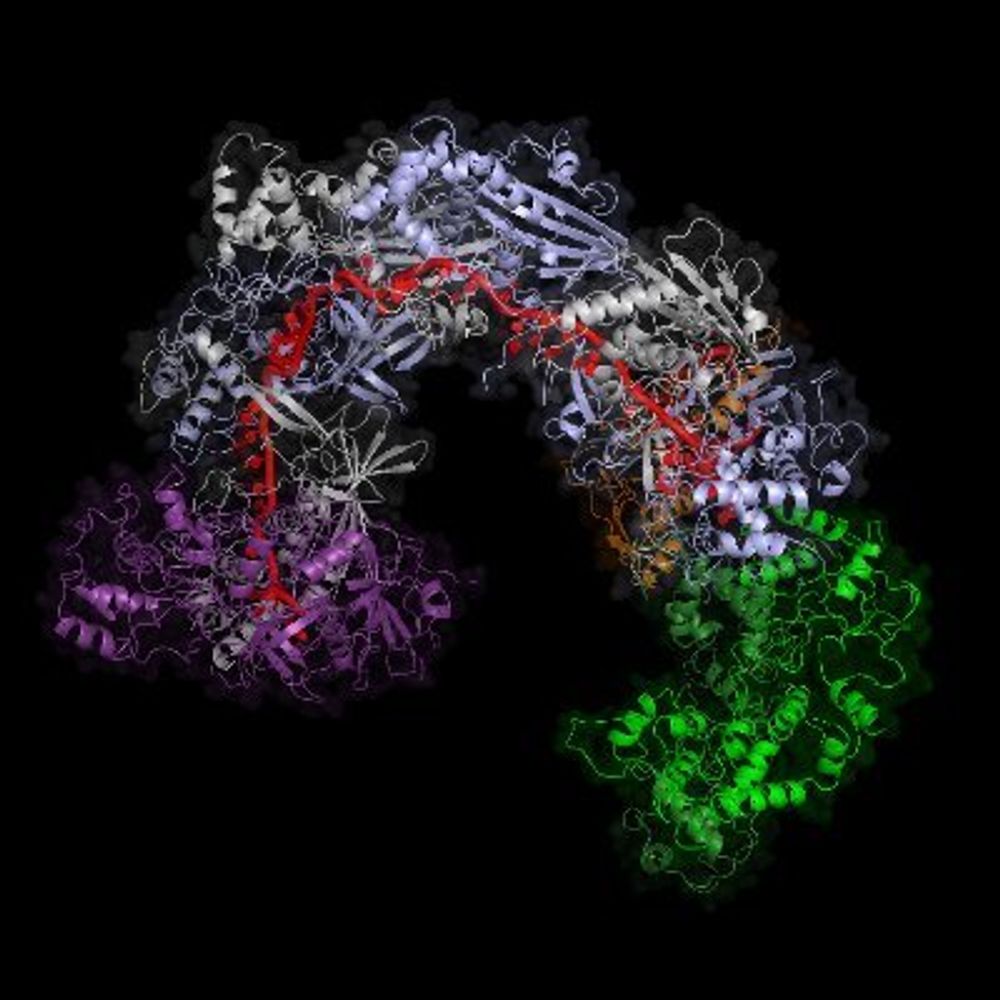
1/9 Metagenomics lets us read microbiomes in nature without cultivation, but writing (editing) them in their native context is still a major challenge.
Meet MetaEdit: a platform for pathway-scale metagenomic editing inside the gut microbiome. science.org/doi/10.1126/...
Meet MetaEdit: a platform for pathway-scale metagenomic editing inside the gut microbiome. science.org/doi/10.1126/...

Metagenomic editing of commensal bacteria in vivo using CRISPR-associated transposases
Although metagenomic sequencing has revealed a rich microbial biodiversity in the mammalian gut, methods to genetically alter specific species in the microbiome are highly limited. Here, we introduce ...
science.org
November 14, 2025 at 2:25 PM
1/9 Metagenomics lets us read microbiomes in nature without cultivation, but writing (editing) them in their native context is still a major challenge.
Meet MetaEdit: a platform for pathway-scale metagenomic editing inside the gut microbiome. science.org/doi/10.1126/...
Meet MetaEdit: a platform for pathway-scale metagenomic editing inside the gut microbiome. science.org/doi/10.1126/...
Reposted by Théophile Niault

Gluing a bulky host protein onto an immune surveillance complex is a wild mechanism of viral immune evasion!
@natmicrobiol.nature.com
#phagesky #phage #microsky
www.nature.com/articles/s41...
@natmicrobiol.nature.com
#phagesky #phage #microsky
www.nature.com/articles/s41...

November 12, 2025 at 5:47 PM
Gluing a bulky host protein onto an immune surveillance complex is a wild mechanism of viral immune evasion!
@natmicrobiol.nature.com
#phagesky #phage #microsky
www.nature.com/articles/s41...
@natmicrobiol.nature.com
#phagesky #phage #microsky
www.nature.com/articles/s41...
Reposted by Théophile Niault
Bacteria can sense when a virus starts shredding their genome — by detecting methylated mononucleotides.
Here’s the story of how we discovered the Metis defense system 👇
www.biorxiv.org/content/10.1...
Here’s the story of how we discovered the Metis defense system 👇
www.biorxiv.org/content/10.1...

November 6, 2025 at 5:00 AM
Bacteria can sense when a virus starts shredding their genome — by detecting methylated mononucleotides.
Here’s the story of how we discovered the Metis defense system 👇
www.biorxiv.org/content/10.1...
Here’s the story of how we discovered the Metis defense system 👇
www.biorxiv.org/content/10.1...
Reposted by Théophile Niault
Perfect timing in the field for a beautiful review on NAD+ in bacterial immunity by @hugovaysset.bsky.social and @audeber.bsky.social @cp-molcell.bsky.social
#MicroSky
www.cell.com/molecular-ce...
#MicroSky
www.cell.com/molecular-ce...

October 16, 2025 at 2:58 PM
Perfect timing in the field for a beautiful review on NAD+ in bacterial immunity by @hugovaysset.bsky.social and @audeber.bsky.social @cp-molcell.bsky.social
#MicroSky
www.cell.com/molecular-ce...
#MicroSky
www.cell.com/molecular-ce...
Reposted by Théophile Niault

Delighted to see our paper studying the evolution of plasmids over the last 100 years, now out! Years of work by Adrian Cazares, also Nick Thomson @sangerinstitute.bsky.social - this version much improved over the preprint. Final version should be open access, apols.
Thread 1/n
Thread 1/n

September 25, 2025 at 9:29 PM
Delighted to see our paper studying the evolution of plasmids over the last 100 years, now out! Years of work by Adrian Cazares, also Nick Thomson @sangerinstitute.bsky.social - this version much improved over the preprint. Final version should be open access, apols.
Thread 1/n
Thread 1/n
Reposted by Théophile Niault
You’ve heard of ubiquitination, meet deazaguanylation: Doug Wassarman in our lab discovered phage defense pathways have co-opted Q nucleobase biosynthetic enzymes to catalyze a new form of protein conjugation chemistry @science.org
www.science.org/doi/10.1126/...
www.science.org/doi/10.1126/...

September 25, 2025 at 7:16 PM
You’ve heard of ubiquitination, meet deazaguanylation: Doug Wassarman in our lab discovered phage defense pathways have co-opted Q nucleobase biosynthetic enzymes to catalyze a new form of protein conjugation chemistry @science.org
www.science.org/doi/10.1126/...
www.science.org/doi/10.1126/...
Reposted by Théophile Niault

Dual transposon sequencing profiles the genetic interaction landscape in bacteria | Science www.science.org/doi/10.1126/...

Dual transposon sequencing profiles the genetic interaction landscape in bacteria
Gene redundancy complicates systematic characterization of gene function as single-gene deletions may not produce discernible phenotypes. We report dual transposon sequencing (dual Tn-seq), a platform...
www.science.org
September 25, 2025 at 11:19 PM
Dual transposon sequencing profiles the genetic interaction landscape in bacteria | Science www.science.org/doi/10.1126/...
Reposted by Théophile Niault

Preprint: De-novo design of proteins that inhibit bacterial defenses
Our approach allows silencing defense systems of choice. We show how this approach enables programming of “untransformable” bacteria, and how it can enhance phage therapy applications
Congrats Jeremy Garb!
tinyurl.com/Syttt
🧵
Our approach allows silencing defense systems of choice. We show how this approach enables programming of “untransformable” bacteria, and how it can enhance phage therapy applications
Congrats Jeremy Garb!
tinyurl.com/Syttt
🧵

Synthetically designed anti-defense proteins overcome barriers to bacterial transformation and phage infection
Bacterial defense systems present considerable barriers to both phage infection and plasmid transformation. These systems target mobile genetic elements, limiting the efficacy of bacteriophage-based t...
www.biorxiv.org
September 2, 2025 at 10:48 AM
Preprint: De-novo design of proteins that inhibit bacterial defenses
Our approach allows silencing defense systems of choice. We show how this approach enables programming of “untransformable” bacteria, and how it can enhance phage therapy applications
Congrats Jeremy Garb!
tinyurl.com/Syttt
🧵
Our approach allows silencing defense systems of choice. We show how this approach enables programming of “untransformable” bacteria, and how it can enhance phage therapy applications
Congrats Jeremy Garb!
tinyurl.com/Syttt
🧵
Reposted by Théophile Niault

Very interesting work from Ibarlosa and colleagues regarding functional amyloid forming proteins in prokaryotic immunity.
www.nature.com/articles/s41...
Check out our News & Views summary of the work as well!
rdcu.be/eBHxh
www.nature.com/articles/s41...
Check out our News & Views summary of the work as well!
rdcu.be/eBHxh

Amyloids in bacterial antiphage defence
Nature Microbiology - Bacterial prions form amyloids in response to phage infection and induce cell death to prevent viral replication, similar to the processes in fungi and across the tree of life.
rdcu.be
August 21, 2025 at 2:06 PM
Very interesting work from Ibarlosa and colleagues regarding functional amyloid forming proteins in prokaryotic immunity.
www.nature.com/articles/s41...
Check out our News & Views summary of the work as well!
rdcu.be/eBHxh
www.nature.com/articles/s41...
Check out our News & Views summary of the work as well!
rdcu.be/eBHxh
Reposted by Théophile Niault

Reposted by Théophile Niault


Reposted by Théophile Niault
🦠🧍♀️From bacterial to human immunity.
We report in @science.org the discovery of a human homolog of SIR2 antiphage proteins that participates in the TLR pathway of animal innate immunity.
Co-led wt @enzopoirier.bsky.social by D. Bonhomme and @hugovaysset.bsky.social
www.science.org/doi/10.1126/...
We report in @science.org the discovery of a human homolog of SIR2 antiphage proteins that participates in the TLR pathway of animal innate immunity.
Co-led wt @enzopoirier.bsky.social by D. Bonhomme and @hugovaysset.bsky.social
www.science.org/doi/10.1126/...
www.science.org
July 24, 2025 at 6:23 PM
🦠🧍♀️From bacterial to human immunity.
We report in @science.org the discovery of a human homolog of SIR2 antiphage proteins that participates in the TLR pathway of animal innate immunity.
Co-led wt @enzopoirier.bsky.social by D. Bonhomme and @hugovaysset.bsky.social
www.science.org/doi/10.1126/...
We report in @science.org the discovery of a human homolog of SIR2 antiphage proteins that participates in the TLR pathway of animal innate immunity.
Co-led wt @enzopoirier.bsky.social by D. Bonhomme and @hugovaysset.bsky.social
www.science.org/doi/10.1126/...
Reposted by Théophile Niault
Words cannot describe how excited I am to share the findings from the second half of my postdoc in @aaronwhiteley.bsky.social's lab where we discover that bacteria use functional amyloids to defend themselves from predatory bacteria. rdcu.be/euu5Y. See thread for details on this epic adventure 1/.
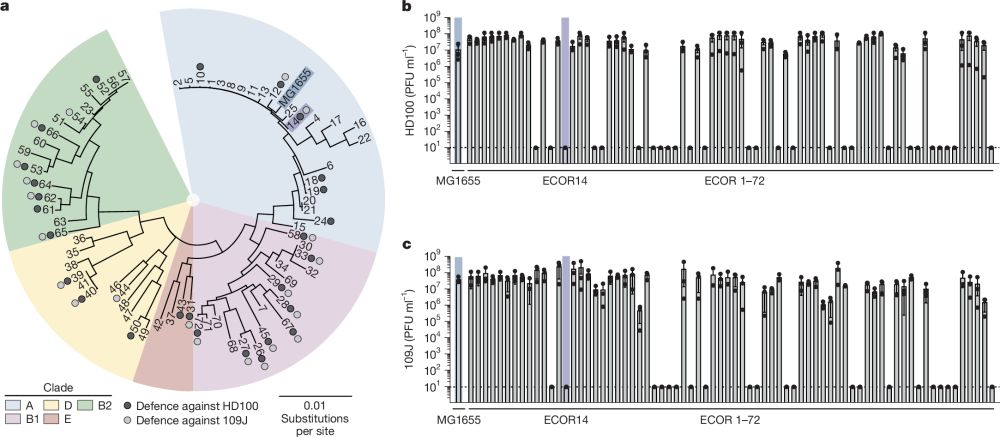
Functional amyloid proteins confer defence against predatory bacteria
Nature - Escherichia coli uses curli fibres, oligomers of the functional amyloid CsgA, as a barrier to protect against the predatory bacteria Bdellovibrio bacteriovorus and Myxococcus xanthus in a...
rdcu.be
July 2, 2025 at 8:10 PM
Words cannot describe how excited I am to share the findings from the second half of my postdoc in @aaronwhiteley.bsky.social's lab where we discover that bacteria use functional amyloids to defend themselves from predatory bacteria. rdcu.be/euu5Y. See thread for details on this epic adventure 1/.
Reposted by Théophile Niault

Reposted by Théophile Niault

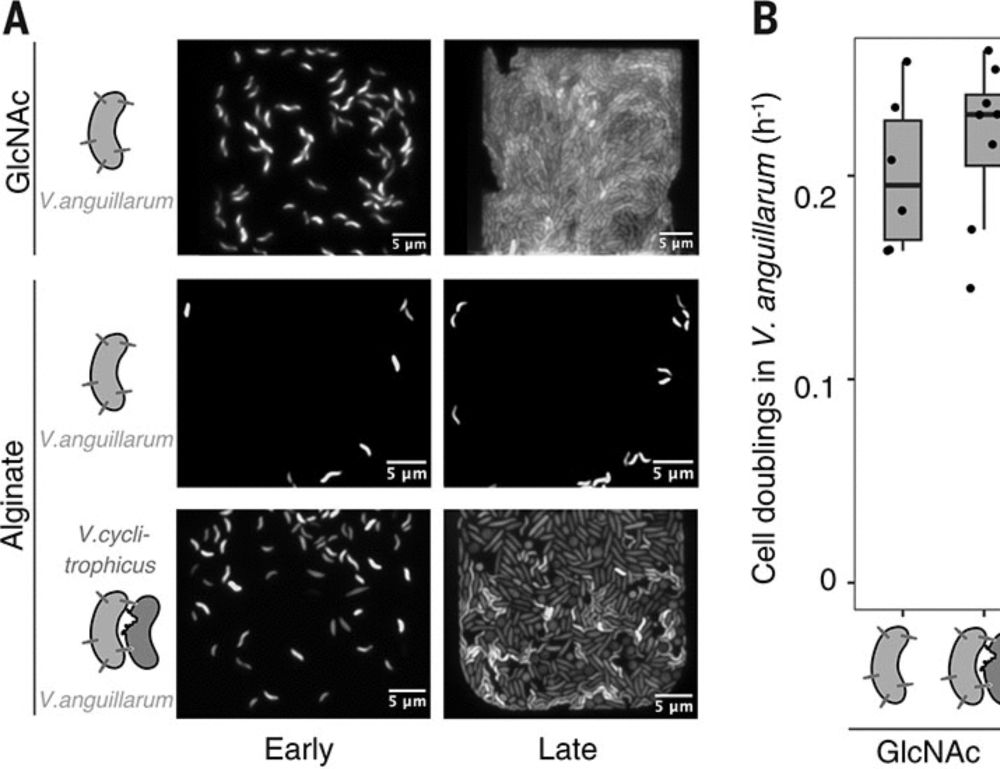
Thrilled to share our new paper in @science.org describing our discovery that bacteria can switch from competitors to bonafide predators when resources run dry—arming nanoscale “spears” (T6SS) to stab & consume neighbours.
www.science.org/doi/10.1126/...
#MicroSKy #Microbiology
www.science.org/doi/10.1126/...
#MicroSKy #Microbiology
Antagonism as a foraging strategy in microbial communities
In natural habitats, nutrient availability limits bacterial growth. We discovered that bacteria can overcome this limitation by acquiring nutrients by lysing neighboring cells through contact-dependen...
www.science.org
June 13, 2025 at 5:39 AM
Thrilled to share our new paper in @science.org describing our discovery that bacteria can switch from competitors to bonafide predators when resources run dry—arming nanoscale “spears” (T6SS) to stab & consume neighbours.
www.science.org/doi/10.1126/...
#MicroSKy #Microbiology
www.science.org/doi/10.1126/...
#MicroSKy #Microbiology
Reposted by Théophile Niault

Thrilled to share my first PhD paper, out of the Mazel lab! @amazeld.bsky.social
We discovered that accessory peptide deformylases (PDFs) are widespread in bacteria and may provide resistance to natural inhibitors, posing a challenge to future antibiotic strategies
doi.org/10.1101/2025...
We discovered that accessory peptide deformylases (PDFs) are widespread in bacteria and may provide resistance to natural inhibitors, posing a challenge to future antibiotic strategies
doi.org/10.1101/2025...

Unraveling the prevalence and multifaceted roles of accessory peptide deformylases in bacterial adaptation and resistance
Peptide deformylases (PDFs) are enzymes that are essential for bacterial viability and attractive targets for antibiotic development. Yet, despite their conserved function, many bacteria encode multip...
doi.org
June 7, 2025 at 10:09 AM
Thrilled to share my first PhD paper, out of the Mazel lab! @amazeld.bsky.social
We discovered that accessory peptide deformylases (PDFs) are widespread in bacteria and may provide resistance to natural inhibitors, posing a challenge to future antibiotic strategies
doi.org/10.1101/2025...
We discovered that accessory peptide deformylases (PDFs) are widespread in bacteria and may provide resistance to natural inhibitors, posing a challenge to future antibiotic strategies
doi.org/10.1101/2025...
Reposted by Théophile Niault

🧪
Finally out after peer review, our work showing that "Mobile #Integrons carry Phage Defense Systems" is now published in Science 🎉
Short 🧵
www.science.org/doi/10.1126/...
Finally out after peer review, our work showing that "Mobile #Integrons carry Phage Defense Systems" is now published in Science 🎉
Short 🧵
www.science.org/doi/10.1126/...

Mobile integrons encode phage defense systems
Integrons are bacterial genetic elements that capture, stockpile, and modulate the expression of genes encoded in integron cassettes. Mobile integrons (MIs) are borne on plasmids, acting as a vehicle ...
www.science.org
May 8, 2025 at 8:27 PM
🧪
Finally out after peer review, our work showing that "Mobile #Integrons carry Phage Defense Systems" is now published in Science 🎉
Short 🧵
www.science.org/doi/10.1126/...
Finally out after peer review, our work showing that "Mobile #Integrons carry Phage Defense Systems" is now published in Science 🎉
Short 🧵
www.science.org/doi/10.1126/...
Reposted by Théophile Niault

Our paper on how integrons are biobanks of novel minimal defense systems is now out www.science.org/doi/10.1126/... Two main conclusions on this excellent work led by @eloilittner.bsky.social @baptistedarracq.bsky.social 1/n
May 9, 2025 at 1:07 PM
Our paper on how integrons are biobanks of novel minimal defense systems is now out www.science.org/doi/10.1126/... Two main conclusions on this excellent work led by @eloilittner.bsky.social @baptistedarracq.bsky.social 1/n
Reposted by Théophile Niault

Exciting news!! Our latest paper is out in Nat. Microbiol. @natmicrobiol.nature.com
We show that a sub-lineage of 7th pandemic V. cholerae has acquired mobile genetic elements packed with phage defense systems—rendering it multi-phage resistant 😳 ..... 1/3
www.nature.com/articles/s41...
We show that a sub-lineage of 7th pandemic V. cholerae has acquired mobile genetic elements packed with phage defense systems—rendering it multi-phage resistant 😳 ..... 1/3
www.nature.com/articles/s41...
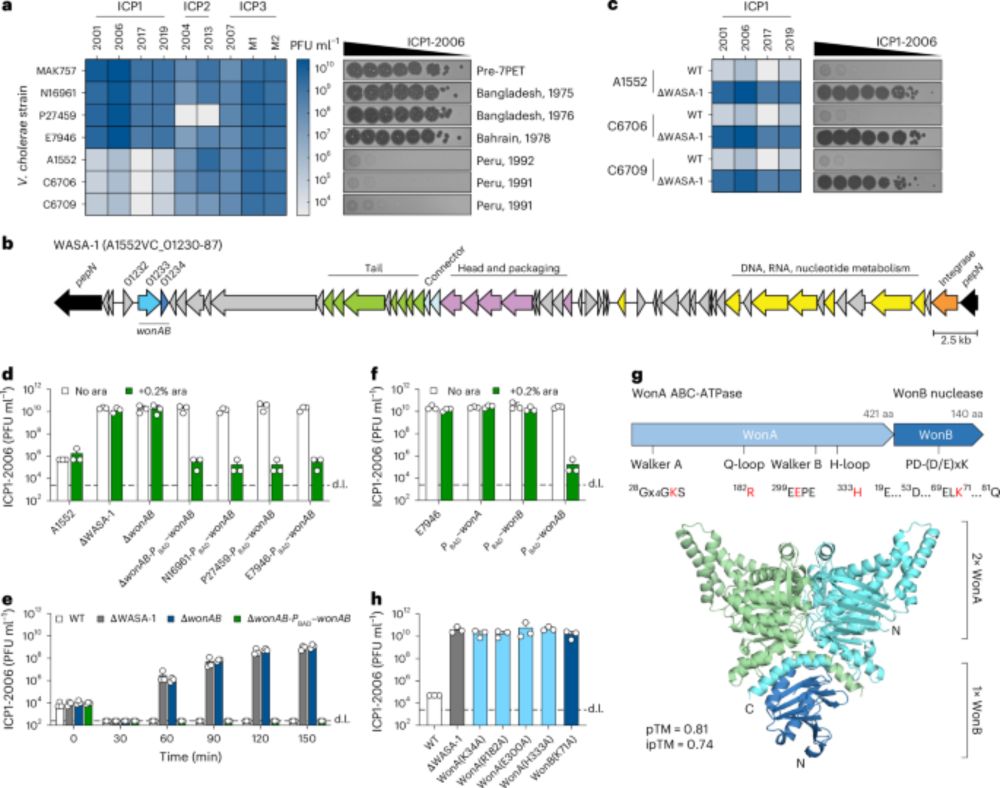
West African–South American pandemic Vibrio cholerae encodes multiple distinct phage defence systems - Nature Microbiology
The West African–South American lineage of Vibrio cholerae contains multiple distinct anti-phage defence systems that provide resistance to various phage families, including vibriophage ICP1, a key pr...
www.nature.com
May 22, 2025 at 6:14 PM
Exciting news!! Our latest paper is out in Nat. Microbiol. @natmicrobiol.nature.com
We show that a sub-lineage of 7th pandemic V. cholerae has acquired mobile genetic elements packed with phage defense systems—rendering it multi-phage resistant 😳 ..... 1/3
www.nature.com/articles/s41...
We show that a sub-lineage of 7th pandemic V. cholerae has acquired mobile genetic elements packed with phage defense systems—rendering it multi-phage resistant 😳 ..... 1/3
www.nature.com/articles/s41...
Reposted by Théophile Niault

The Viral AlphaFold Database of monomers and homodimers reveals conserved protein folds in viruses of bacteria, archaea, and eukaryotes https://www.biorxiv.org/content/10.1101/2025.05.14.653371v1
May 17, 2025 at 4:17 AM
The Viral AlphaFold Database of monomers and homodimers reveals conserved protein folds in viruses of bacteria, archaea, and eukaryotes https://www.biorxiv.org/content/10.1101/2025.05.14.653371v1
Reposted by Théophile Niault

New publication from our Lesterlin lab in collab with lab of @knutdrescher.bsky.social
We determined the spatiotemporal dissemination of conjugative plasmids within biofilms and found that they spread only in specific structural regions.
www.pnas.org/doi/10.1073/...
We determined the spatiotemporal dissemination of conjugative plasmids within biofilms and found that they spread only in specific structural regions.
www.pnas.org/doi/10.1073/...
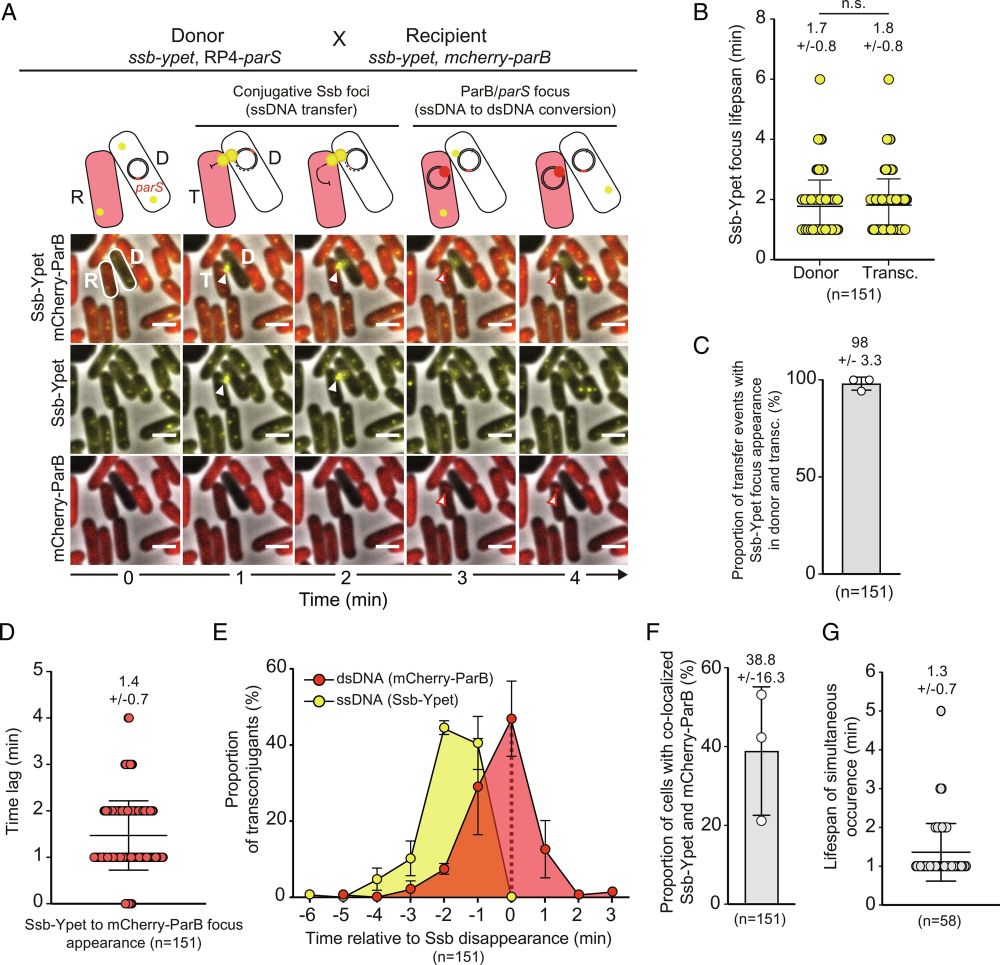
Biofilm architecture determines the dissemination of conjugative plasmids | PNAS
Plasmid conjugation is a contact-dependent horizontal gene transfer mechanism that
significantly contributes to the dissemination of antibiotic res...
www.pnas.org
April 28, 2025 at 11:22 AM
New publication from our Lesterlin lab in collab with lab of @knutdrescher.bsky.social
We determined the spatiotemporal dissemination of conjugative plasmids within biofilms and found that they spread only in specific structural regions.
www.pnas.org/doi/10.1073/...
We determined the spatiotemporal dissemination of conjugative plasmids within biofilms and found that they spread only in specific structural regions.
www.pnas.org/doi/10.1073/...
Reposted by Théophile Niault

Cyanobacterial Argonautes and Cas4 family nucleases cooperate to interfere with invading DNA: Molecular Cell https://www.cell.com/molecular-cell/fulltext/S1097-2765(25)00302-8?rss=yes

Cyanobacterial Argonautes and Cas4 family nucleases cooperate to interfere with invading DNA
Bobadilla Ugarte et al. have functionally, structurally, and biochemically characterized cyanobacterial APACE1 immune systems. In APACE1 systems, a pAgo protein mediates small DNA-guided DNA interference, whereas ACE1 contributes to guide DNA processing. This study broadens our mechanistic understanding of how diversified pAgo systems protect their bacterial hosts against invading DNA.
www.cell.com
April 26, 2025 at 9:23 AM
Cyanobacterial Argonautes and Cas4 family nucleases cooperate to interfere with invading DNA: Molecular Cell https://www.cell.com/molecular-cell/fulltext/S1097-2765(25)00302-8?rss=yes
Reposted by Théophile Niault
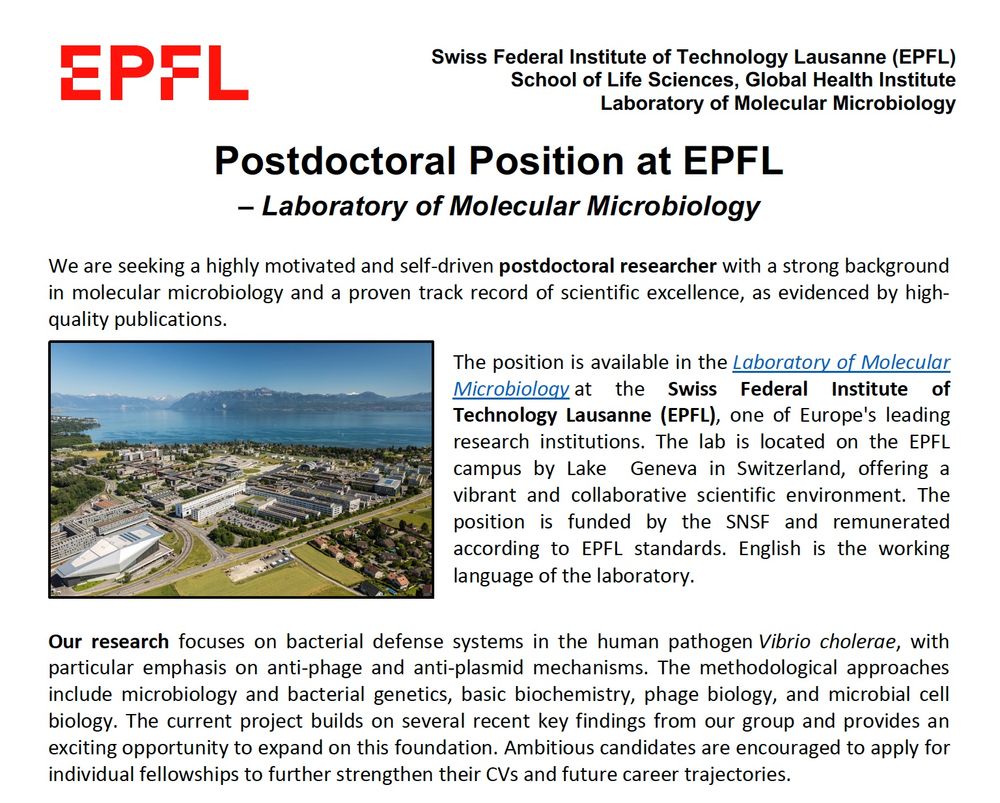
Join the Blokesch lab (@EPFL) as a postdoc in Molecular Microbiology 🤩
Study Vibrio cholerae defense systems (phage/plasmid) in a dynamic, collaborative environment in Lausanne close to Lake Geneva in 🇨🇭!
Please visit my lab's webpage for details about the position and how to formally apply.
Study Vibrio cholerae defense systems (phage/plasmid) in a dynamic, collaborative environment in Lausanne close to Lake Geneva in 🇨🇭!
Please visit my lab's webpage for details about the position and how to formally apply.
April 25, 2025 at 4:15 PM
Join the Blokesch lab (@EPFL) as a postdoc in Molecular Microbiology 🤩
Study Vibrio cholerae defense systems (phage/plasmid) in a dynamic, collaborative environment in Lausanne close to Lake Geneva in 🇨🇭!
Please visit my lab's webpage for details about the position and how to formally apply.
Study Vibrio cholerae defense systems (phage/plasmid) in a dynamic, collaborative environment in Lausanne close to Lake Geneva in 🇨🇭!
Please visit my lab's webpage for details about the position and how to formally apply.
Reposted by Théophile Niault

And its out! Last work of the lab: "Evolutionary Constraints on RNA Polymerase Gene Positioning in the Genome of
Fast-Growing Bacteria."
We show how the genomic location of RNA polymerase impacts cell physiology. www.biorxiv.org/cgi/content/...
Fast-Growing Bacteria."
We show how the genomic location of RNA polymerase impacts cell physiology. www.biorxiv.org/cgi/content/...

Evolutionary Constraints on RNA Polymerase Gene Positioning in the Genome of Fast-Growing Bacteria..
The influence of gene order within the chromosome on cellular homeostasis and genome evolution remains unclear. Bacterial chromosomes are structured along the replication origin ( oriC )-terminus ( te...
www.biorxiv.org
April 15, 2025 at 4:50 AM
And its out! Last work of the lab: "Evolutionary Constraints on RNA Polymerase Gene Positioning in the Genome of
Fast-Growing Bacteria."
We show how the genomic location of RNA polymerase impacts cell physiology. www.biorxiv.org/cgi/content/...
Fast-Growing Bacteria."
We show how the genomic location of RNA polymerase impacts cell physiology. www.biorxiv.org/cgi/content/...