



하이퍼 판타지아 분이랑 얘기할 기회가 있었는데 (전 하이포에 가까운 것 같습니다) 진짜 머릿속에 구체적으로 집을 건축하고, 방 하나하나에 자기가 봤던 물건을 보관하고 있고, 가끔씩 방에 들어가서 그걸 꺼내보고 그런다는 것에 정말 놀랐음...
aphantasia.com/study/vviq 이런 테스트들 해보시면 됨.
x.com/GosariDraw/s... 여기서 업어옴.
aphantasia.com/study/vviq 이런 테스트들 해보시면 됨.
x.com/GosariDraw/s... 여기서 업어옴.

November 13, 2025 at 2:53 AM
하이퍼 판타지아 분이랑 얘기할 기회가 있었는데 (전 하이포에 가까운 것 같습니다) 진짜 머릿속에 구체적으로 집을 건축하고, 방 하나하나에 자기가 봤던 물건을 보관하고 있고, 가끔씩 방에 들어가서 그걸 꺼내보고 그런다는 것에 정말 놀랐음...
aphantasia.com/study/vviq 이런 테스트들 해보시면 됨.
x.com/GosariDraw/s... 여기서 업어옴.
aphantasia.com/study/vviq 이런 테스트들 해보시면 됨.
x.com/GosariDraw/s... 여기서 업어옴.

2. The idea that most kids have hyperphantasia but it's not usually carried forward into adulthood. When kids go through adolescence and focus less on fantasy, their mental imagery is reduced - a.k.a., "use it or lose it". Those who keep their hyperphantasia never abandoned their fantasies. 3/4

October 29, 2025 at 12:47 PM
2. The idea that most kids have hyperphantasia but it's not usually carried forward into adulthood. When kids go through adolescence and focus less on fantasy, their mental imagery is reduced - a.k.a., "use it or lose it". Those who keep their hyperphantasia never abandoned their fantasies. 3/4

So many corny prophantasia jokes I want to make right now...😅
September 17, 2025 at 3:45 AM
So many corny prophantasia jokes I want to make right now...😅

Excellent 🥰
My brain's trying to figure out if I have prophantasia or not 😅
My brain's trying to figure out if I have prophantasia or not 😅
September 17, 2025 at 3:21 AM
Excellent 🥰
My brain's trying to figure out if I have prophantasia or not 😅
My brain's trying to figure out if I have prophantasia or not 😅
You already know how much I relate to this 🫂 Today I’m thinking about prophantasia & Roman dodecahedrons if you want some rabbit holes 💛
September 16, 2025 at 8:30 PM
You already know how much I relate to this 🫂 Today I’m thinking about prophantasia & Roman dodecahedrons if you want some rabbit holes 💛

Did you decide against prophantasia in favor of imagery augmented reality then?
August 26, 2025 at 3:16 PM
Did you decide against prophantasia in favor of imagery augmented reality then?
I think for people to see images floating before their eyes they need something like ganzflicker, in which case they are actually perceiving something unreal on the computer screen... but it's not the same as prophantasia, either!
August 12, 2025 at 10:58 PM
I think for people to see images floating before their eyes they need something like ganzflicker, in which case they are actually perceiving something unreal on the computer screen... but it's not the same as prophantasia, either!

They defined prophantasia as the "ability" to project mental images into your visual field - but it seems like most people who have that ability don't typically experience this unless through some deliberate effort (although some people apparently do experience projected images w/o effort).
August 12, 2025 at 10:22 PM
They defined prophantasia as the "ability" to project mental images into your visual field - but it seems like most people who have that ability don't typically experience this unless through some deliberate effort (although some people apparently do experience projected images w/o effort).
Agreed although I'm talking about the projector vs associator distinction in mental imagery, not synaesthesia (but they could be related): 🙂https://doi.org/10.1016/j.cortex.2023.09.013
That said, our recent data on this suggests that prophantasia is better term (cc @kerblooee.bsky.social )
That said, our recent data on this suggests that prophantasia is better term (cc @kerblooee.bsky.social )
Redirecting
doi.org
August 12, 2025 at 10:20 PM
Agreed although I'm talking about the projector vs associator distinction in mental imagery, not synaesthesia (but they could be related): 🙂https://doi.org/10.1016/j.cortex.2023.09.013
That said, our recent data on this suggests that prophantasia is better term (cc @kerblooee.bsky.social )
That said, our recent data on this suggests that prophantasia is better term (cc @kerblooee.bsky.social )
The way I conceived it, projector/associator/prophantasia axis is the same as sensory qualia. At least I described the projector experience as being in the visual field & Figueroa defined it similarly I believe. For me at least the "behind the head" feeling just distinguishes it from "real seeing"
June 3, 2025 at 12:36 AM
The way I conceived it, projector/associator/prophantasia axis is the same as sensory qualia. At least I described the projector experience as being in the visual field & Figueroa defined it similarly I believe. For me at least the "behind the head" feeling just distinguishes it from "real seeing"
But even the subjective Perky designs don't work for me at all. I thought I imagined real gratings in the noise a few times & got really excited - only to realise I was looking at catch trials 😉
If we're right about this prophantasia/projector business, then that's because I just don't project.
If we're right about this prophantasia/projector business, then that's because I just don't project.
May 27, 2025 at 12:33 AM
But even the subjective Perky designs don't work for me at all. I thought I imagined real gratings in the noise a few times & got really excited - only to realise I was looking at catch trials 😉
If we're right about this prophantasia/projector business, then that's because I just don't project.
If we're right about this prophantasia/projector business, then that's because I just don't project.
There's so much great work on imagining and its varieties at the moment.
E.g. @eazanon.bsky.social, @kerblooee.bsky.social and others' introduction of #prophantasia: the ability to project mental images into the external world osf.io/preprints/os...
E.g. @eazanon.bsky.social, @kerblooee.bsky.social and others' introduction of #prophantasia: the ability to project mental images into the external world osf.io/preprints/os...
OSF
osf.io
May 18, 2025 at 11:57 AM
There's so much great work on imagining and its varieties at the moment.
E.g. @eazanon.bsky.social, @kerblooee.bsky.social and others' introduction of #prophantasia: the ability to project mental images into the external world osf.io/preprints/os...
E.g. @eazanon.bsky.social, @kerblooee.bsky.social and others' introduction of #prophantasia: the ability to project mental images into the external world osf.io/preprints/os...
And in fact even minimum VVIQ scores can still have quasi visual prophantasia experiences it would seem. It really all comes back to the Plato's Cave problem of vividness. You can only rate this relative to what you know. Since I don't project, it would've never occurred to me to interpret 5 as that
May 13, 2025 at 10:57 PM
And in fact even minimum VVIQ scores can still have quasi visual prophantasia experiences it would seem. It really all comes back to the Plato's Cave problem of vividness. You can only rate this relative to what you know. Since I don't project, it would've never occurred to me to interpret 5 as that
As it happens, in Marks' original version you're supposed to do the 16 item version twice once with open and once with closed eyes. I'm pretty sure nobody ever does that... (but our survey suggests it matters, certainly for the prophantasia aspect)
May 13, 2025 at 10:38 PM
As it happens, in Marks' original version you're supposed to do the 16 item version twice once with open and once with closed eyes. I'm pretty sure nobody ever does that... (but our survey suggests it matters, certainly for the prophantasia aspect)
If that prophantasia factor also manifests in something that can be tested experimentally that would be really important. Obviously this has long been my hypothesis of course - the notion that my mental image should somehow be confused for something on screen is just bizarre to me.
May 11, 2025 at 11:58 PM
If that prophantasia factor also manifests in something that can be tested experimentally that would be really important. Obviously this has long been my hypothesis of course - the notion that my mental image should somehow be confused for something on screen is just bizarre to me.

Hi Reshanne, thanks for explaining. That is interesting. Do I understand correctly that your definition of prophantasia is about how similar imagery is to 'physically' seeing a star? But isn't that how vividness was defined in the VVIQ originally? Apologies if I am missing something obvious here!
May 9, 2025 at 7:46 AM
Hi Reshanne, thanks for explaining. That is interesting. Do I understand correctly that your definition of prophantasia is about how similar imagery is to 'physically' seeing a star? But isn't that how vividness was defined in the VVIQ originally? Apologies if I am missing something obvious here!
The way you test prophantasia in the paper - where participants need to indicate which image is more like their imagery experience - seems different to Sam's associator/projector distinction, which I thought was more about the location of imagery (e.g. on screen or in your mind). What do you think?
May 8, 2025 at 1:16 PM
The way you test prophantasia in the paper - where participants need to indicate which image is more like their imagery experience - seems different to Sam's associator/projector distinction, which I thought was more about the location of imagery (e.g. on screen or in your mind). What do you think?
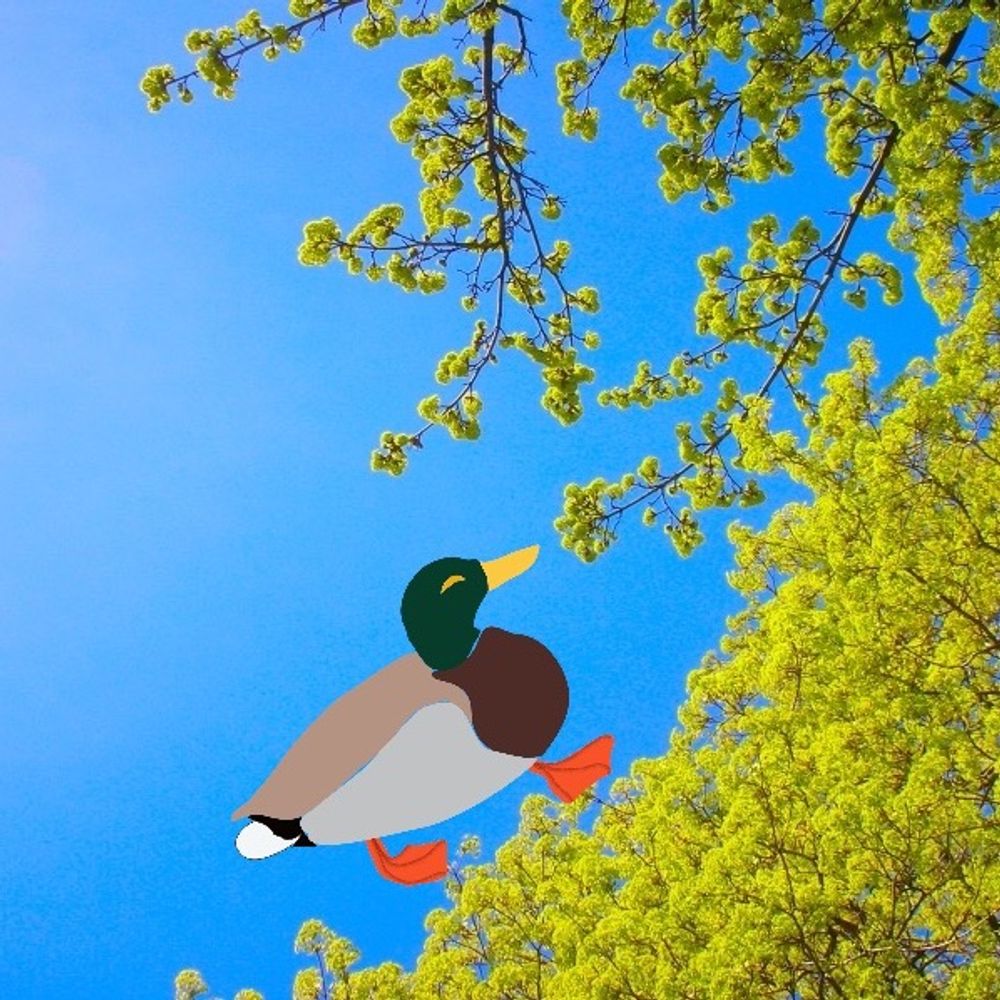
I know what aphantasia and hyperphantasia are but have not heard of prophantasia before. 🤨
May 8, 2025 at 11:51 AM
I know what aphantasia and hyperphantasia are but have not heard of prophantasia before. 🤨
Reposting this - still looking for more participants! Especially if you (think you) have #aphantasia or #hyperphantasia, we are very interested in hearing from you... Also if you have experience of #prophantasia (cc @kerblooee.bsky.social)
#mentalimagery #visionscience #psychscisky
#mentalimagery #visionscience #psychscisky
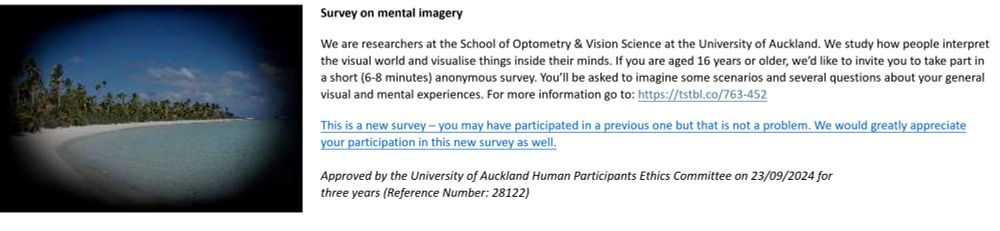
Here is a new, shorter version of our mental imagery survey. Please if you can spare a few minutes we would appreciate if you could take this & pass it along to others who might be interested. Thanks! tstbl.co/763-452
#neuroskyence #visionscience #psychscisky #aphantasia #mentalimagery
#neuroskyence #visionscience #psychscisky #aphantasia #mentalimagery
May 8, 2025 at 2:25 AM
Reposting this - still looking for more participants! Especially if you (think you) have #aphantasia or #hyperphantasia, we are very interested in hearing from you... Also if you have experience of #prophantasia (cc @kerblooee.bsky.social)
#mentalimagery #visionscience #psychscisky
#mentalimagery #visionscience #psychscisky
Philosophers (Bence Nanay, Cavedon-Taylor) and Galton (1880) have talked about mental projection, but it is rarely investigated as a dimension of imagery in experiments. Adding a #prophantasia test (see picture) to your study could reveal new insights!
6/8
6/8

May 6, 2025 at 8:24 AM
Philosophers (Bence Nanay, Cavedon-Taylor) and Galton (1880) have talked about mental projection, but it is rarely investigated as a dimension of imagery in experiments. Adding a #prophantasia test (see picture) to your study could reveal new insights!
6/8
6/8
#prophantasia ability predicts perception/ imagery interference. Not vividness. So when researchers ask people to imagine a stimulus on their screen - are they measuring prophantasia ability rather than imagery vividness? The same question asked by @sampendu.bsky.social:
doi.org/10.1016/j.co...
5/8
doi.org/10.1016/j.co...
5/8

What is the true range of mental imagery?
www.sciencedirect.com
May 6, 2025 at 8:24 AM
#prophantasia ability predicts perception/ imagery interference. Not vividness. So when researchers ask people to imagine a stimulus on their screen - are they measuring prophantasia ability rather than imagery vividness? The same question asked by @sampendu.bsky.social:
doi.org/10.1016/j.co...
5/8
doi.org/10.1016/j.co...
5/8
We didn't just ask people to rate their imagery vividness, but also their 'augmented imagery' - #prophantasia is the ability to project mental images into the external world, like imagery-augmented reality. To what extent does this dimension of imagery influence perception? We got a surprise!
4/8
4/8
May 6, 2025 at 8:24 AM
We didn't just ask people to rate their imagery vividness, but also their 'augmented imagery' - #prophantasia is the ability to project mental images into the external world, like imagery-augmented reality. To what extent does this dimension of imagery influence perception? We got a surprise!
4/8
4/8
"individuals with the ability to project their mental images into the external environment (i.e., prophantasia) may exhibit stronger congruency effects."
May 6, 2025 at 6:51 AM
"individuals with the ability to project their mental images into the external environment (i.e., prophantasia) may exhibit stronger congruency effects."

Especially given what I've read about aphantasia and prophantasia/hyperphantasia... Anyone with a vivid sense of perception was set up for pathology by the scientific establishment since the European Enlightenment. Which was so steeped in bias we've not even really begun to weed out in earnestness.
April 26, 2025 at 5:23 PM
Especially given what I've read about aphantasia and prophantasia/hyperphantasia... Anyone with a vivid sense of perception was set up for pathology by the scientific establishment since the European Enlightenment. Which was so steeped in bias we've not even really begun to weed out in earnestness.
Partially inspired by @kerblooee.bsky.social's work with prophantasia
January 18, 2025 at 11:47 PM
Partially inspired by @kerblooee.bsky.social's work with prophantasia