
Kevin Kenny
banner
kevinkenny.bsky.social
Kevin Kenny
@kevinkenny.bsky.social

Historian of US immigration | 19th-century | race | labor | slavery | global migration | diaspora

Political science 28%
Sociology 16%
Pinned
🗃️ The US attracted more foreign-born people from more places than any other nation in history. We need language to acknowledge that central fact of American history. But we also need language that goes beyond the idea that the United States is, or ever was, simply a “nation of immigrants.” 🧵1/10

Reposted by Kevin Kenny

Sorry to miss #AHA26 #AHA2026 this year, but delighted to see that "Threat of Dissent" was able to make it to the conference.

Thank you to @harvardpress.bsky.social for displaying "Threat of Dissent" at the book exhibit & to my terrific editor @birdmaddgirl.bsky.social for sending me this photo. 🗃️

Thank you, Charlotte

Thank you. Both of the first two maps are problematic

Yes, indeed. A much better map. Thank you!
Actually, looking at the map the other user posted... isn't great either.

This map is significantly better. Click on the traditional territories option.
www.whose.land/en/
Map Loading
www.whose.land

Reposted by Kevin Kenny

Actually, looking at the map the other user posted... isn't great either.

This map is significantly better. Click on the traditional territories option.
www.whose.land/en/
Map Loading
www.whose.land

Reposted by Kevin Kenny

Trained as a Calif archeologist in the 70s. Astonishing how much more we have learned abt human movement on the land since then. The DNA & technological evidence is amazing. Even these maps are only a snapshot in time.

Reposted by Kevin Kenny

The original also has a slur on it. Arctic people are Inuit, not... what the map says.

Locke's theory of private property conjured up by the application of an individual's labor to the earth turned land into property--whose original occupants could then be dispossessed.
So many good points!

I would also emphasize that the US and its founding mythos were not only built upon dispossession, but that this dispossession was precipitated by the invention and imposition of the Lockean concept of possession—one that warrants critical examination

Yes, citizenship excludes as well as includes. By definition, US birthright citizenship excludes most people in the world. Yet the 14th amendment mentions naturalization as the second criterion--& there is no test for citizenship in the US, by race, ethnicity, culture, religion, or parental status.

Yes, citizenship excludes as well as includes. By definition, US birthright citizenship excludes most people in the world. Yet the 14th amendment mentions naturalization as the second criterion--& there is no test for citizenship in the US, by race, ethnicity, culture, religion, or parental status.
However, I do think the 14th Amendment regime also needs to be scrutinized for imposing citizenship, contributing to citizenship becoming an apartheid-like system (what Hannah Arendt referred to as ‘the right to have rights’), and turning the United States into a gatekeeping nation…

Yes, citizenship excludes as well as includes. By definition, US birthright citizenship excludes most people in the world. Yet the 14th amendment mentions naturalization as the second criterion--& there is no test for citizenship in the US, by race, ethnicity, culture, religion, or parental status.

Reposted by Kevin Kenny

However, I do think the 14th Amendment regime also needs to be scrutinized for imposing citizenship, contributing to citizenship becoming an apartheid-like system (what Hannah Arendt referred to as ‘the right to have rights’), and turning the United States into a gatekeeping nation…

Reposted by Kevin Kenny

So many good points!

I would also emphasize that the US and its founding mythos were not only built upon dispossession, but that this dispossession was precipitated by the invention and imposition of the Lockean concept of possession—one that warrants critical examination

Reposted by Kevin Kenny

Skyline Sunset - New York City #FridayPhoto 🗃️📷📸

Reposted by Kevin Kenny

These are also times that try men’s souls. Which means it’s a damn good time to commemorate the 250th anniversary of Thomas Paine’s Common Sense, with the help of my new @satevepost.bsky.social Considering History column. 🗃️

www.saturdayeveningpost.com/2026/01/cons...
Considering History: Common Sense, Loyalists, and the Fight for American Ideals | The Saturday Evening Post
Thomas Paine’s pamphlet can offer a perspective on the overlooked Revolutionary community known as the Loyalists, who demonstrated that the Revolution was fought not by or for a particular culture or ...
www.saturdayeveningpost.com

Thank you. I worried about the original

Reposted by Kevin Kenny

Here is a much more accurate map

Reposted by Anna O. Law

Eagerly awaited...and coming very soon from @academic.oup.com
The final set of corrections to the galleys just went in. I guess whether I (or you) like it or not, the book is coming on March 10, 2026.

Pre-order info here: global.oup.com/academic/pro...

Thank you!

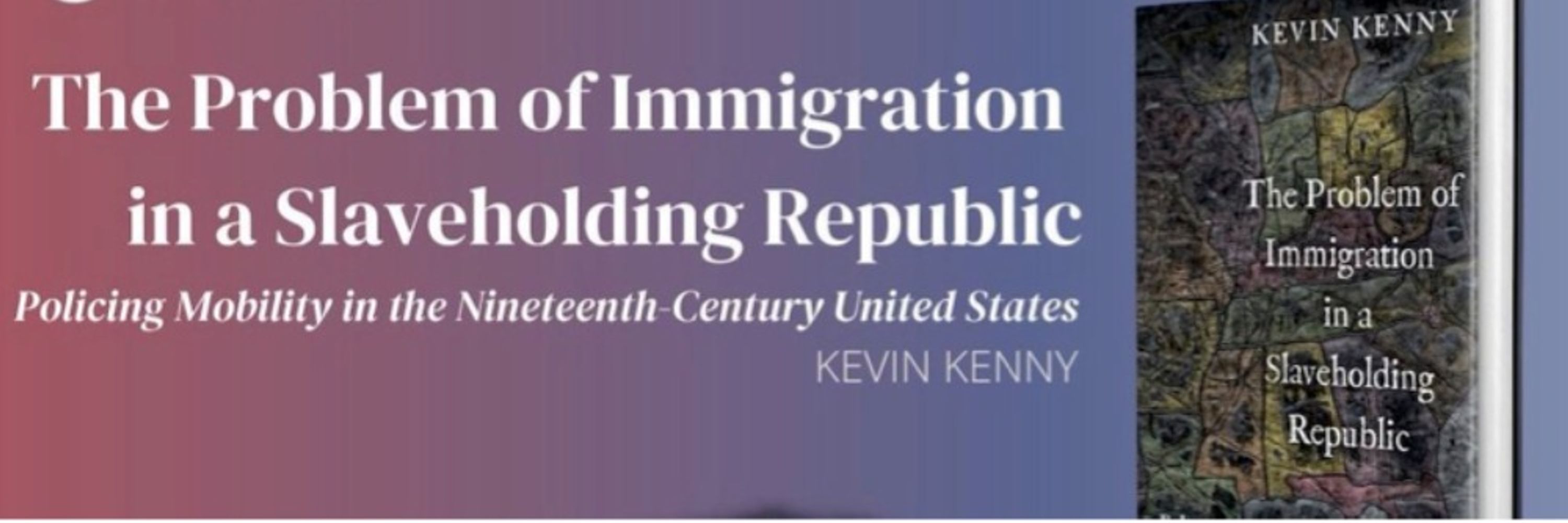
🗃️ An important theme in my “The Problem of Immigration in a Slaveholding Republic” @academic.oup.com, the intersection of Native & immigration history is central to @unlawfulentries.bsky.social forthcoming big book “Migration & the Origins of American Citizenship” global.oup.com/academic/pro... 🧵7/7

🗃️ The myth of a “nation of immigrants,” @maggieblackhawk.bsky.social explains, “conceals the countless foreign nations, lands, and peoples over which the US asserted its power to govern & dispossess, without consent or negotiation & often by force.” Harvard Law Review 137 (Nov. 2023), 17–18. 🧵6/7

🗃️ NYU Law professor @maggieblackhawk.bsky.social, Fond du Lac Band of Lake Superior Ojibwe, notes: “Our founding myth is that we are a ‘nation of immigrants,’ a myth that erases the original, Indigenous inhabitants of North America and those communities brought to these lands in chains.” 🧵🧵5/7

🗃️ “The United States,” @mjwitgen.bsky.social explains, “was founded as, & continues to be, a nation of settler immigrants locked into a struggle over the meaning of place and belonging with the Native nations of North America.” See Witgen, “A Nation of Settlers," WMQ 76 (July 2019), 3rd series. 🧵4/7

🗃️ “To imagine the United States as a nation of immigrants, devoid of an Indigenous population, is not only a form of erasure; it is also historically inaccurate,” writes Columbia University historian @mjwitgen.bsky.social, a citizen of the Red Cliff Band of Lake Superior Ojibwe. 🧵3/7

🗃️ Immigration history did not unfold in an already emptied space. Many immigrants took over Native land and all of them settled on territory—both urban and rural—once possessed by Native people. That fact in itself lays to rest the notion that the US was, simply “a nation of immigrants.” 🧵2/7
🗃️ Time to rewrite immigration history with Native history in mind. The US was founded on the conquest, dispossession, removal, exploitation, or genocide of Native people. Denial of that fact generated counter-myths: empty land, waste land, Manifest Destiny—and the slogan “nation of immigrants.” 🧵1/7
The final set of corrections to the galleys just went in. I guess whether I (or you) like it or not, the book is coming on March 10, 2026.

Pre-order info here: global.oup.com/academic/pro...

Yes, Australia and Canada are the two other countries that sometimes use "Nation of Immigrants." See Donna Gabaccia, “Nation of Immigrants. Do Words Matter?” The Pluralist 5 (Fall 2010): 5–31.

Yes, Australia and Canada are the two other countries that sometimes use "Nation of Immigrants." See Donna Gabaccia, “Nation of Immigrants. Do Words Matter?” The Pluralist 5 (Fall 2010): 5–31.
We use the ‘nation of immigrants’ line in Oz, too.

Reposted by Kevin Kenny

We use the ‘nation of immigrants’ line in Oz, too.