
Nicolas Gross
banner
nicolas-p-gross.bsky.social
Nicolas Gross
@nicolas-p-gross.bsky.social

Community ecologist interested in the biodiversity-ecosystem functioning relationship

Environmental science 46%
Agriculture 25%
Pinned
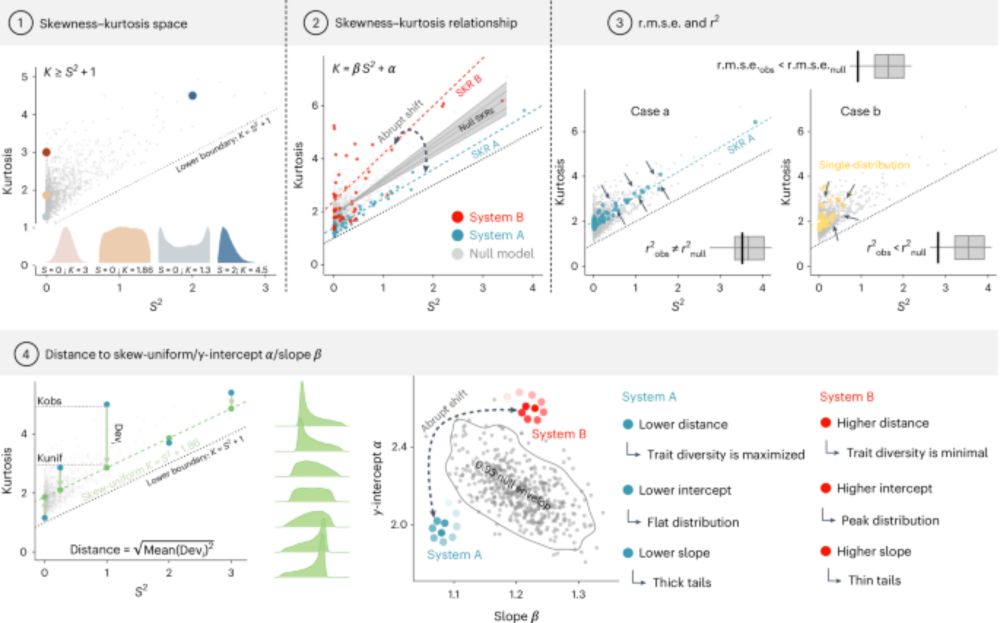
Our new paper is out to day in Nature Ecology and Evolution!

It is called: Thresholds of functional trait diversity driven by land use intensification

⬇️
www.nature.com/articles/s41...
#FunctionalTraits 🌐 ➕📏

@inrae-france.bsky.social @urep.bsky.social @cnrsecologie.bsky.social @bexplo.bsky.social
Thresholds of functional trait diversity driven by land use intensification - Nature Ecology & Evolution
Land use intensification is a major driver of biodiversity change and ecosystem functioning. Here the authors identify thresholds of grassland plant community structure and stability in response to la...
www.nature.com

it is on my reading list!
“Bektaş et al. (2026) offer a valuable template for future studies embracing the complexity of whole-plant strategies, inviting the scientific community to go beyond the traditionally used traits (Matthus et al., 2025).”
Thank you @karlandraczek.bsky.social & @newphyt.bsky.social 🙏🏽

De rien 😉!

The link is to the paper is here ⬇️

besjournals.onlinelibrary.wiley.com/doi/full/10....
besjournals.onlinelibrary.wiley.com

Another great outcome from the #BIODESERT dryland survey publishedin @journalofecology.bsky.social !

Congrats to Kaarina for leading this one!

@ftmaestre.bsky.social @inrae-france.bsky.social @urep.bsky.social

In herbaceous plants, phenols are driven by grazing pressure and foliar nitrogen, while woody plants respond mainly to climate (precipitation & temperature).

Livestock and climate change thus reshape plant secondary metabolites, with consequences for ecosystem functioning and forage quality 🌍🌱

Reposted by Brian J. Enquist

Plant phenolics play a key roles in plant strategies.

Here we explore the drivers of phenolic content in plants over 1800 species across global drylands 🧪🌐

➡️https://besjournals.onlinelibrary.wiley.com/doi/full/10.1111/1365-2745.70222

Reposted by Nicolas Gross

Just published in @natecoevo.nature.com: using data from the @erc.europa.eu funded BIODESERT dryland survey, we show that plant diversity strongly enhances ecosystem resistance to increasing grazing pressure. Conserving biodiversity is key to sustaining dryland rangelands worldwide rdcu.be/eXY6D

Another outcomes of #biodesert survey and the #DRY plant trait database!

This work has been led by @LucioBiancari at the @ftmaestre.bsky.social lab!

Congrats to all coauthors

@inrae-france.bsky.social @urep.bsky.social

Grazing is a major land use in drylands with major impact on ecosystems

In a new paper, we found that plant diversity is key to increase ecosystem resistance to increasing grazing pressure. This effect is driven by complementarity in plant traits

🧪🌐

Find more here⬇️

www.nature.com/articles/s41...
Plant diversity enhances ecosystem resistance to increasing grazing pressure in global drylands - Nature Ecology & Evolution
Grazing affects plant diversity, but plant diversity in turn may modulate the effect of grazing on the plant community. This global analysis explores the association between plant species richness and...
www.nature.com

Led by Inke Smit this paper has been accepted without revision! Sometimes yes it happens! Hope you enjoy reading it!

Congrats Imke and all coauthors !

New paper out today from our global #Biodesert survey!

onlinelibrary.wiley.com/doi/10.1111/...

We found a global a conservative-acquisitive functional trait match between dominant and target plants that promoted facilitation worldwide 🌐🧪🌎🌾

@inrae-france.bsky.social @urep.bsky.social
Plant Trait Matching Occurs in Facilitative Interactions Across Global Drylands
Aim Plant functional traits can influence interaction outcomes between nurse and target plants through a “functional trait match”, which occurs when the traits of nurse plants ameliorate their envir.....
onlinelibrary.wiley.com
Restoration ultimately aims to recover complex ecological systems with many interdependent species at large scale

To understand the driving processes, we combined experiments & modelling

Finding a trade-off between species recovery and food-web complexity
onlinelibrary.wiley.com/doi/10.1111/...

Je pense que tout le monde devrait écouter cette prise de parole et mesurer ce qui vient de se produire avec cette tentative d'annulation, validée en haut lieu, d'un colloque scientifique au Collège de France
[ #VeilleESR #CancelCulture ] Suite à des pressions politiques, dont un message du Ministre sur X (le réseau de désinformation du suprémaciste Elon Musk), le Collège de France a été contraint d'annuler un colloque sur la Palestine.
Le Collège de France annule un colloque sur la Palestine « en réaction à la polémique entourant » l’événement
Le Collège de France « ne prône, ni n’encourage, ni ne soutient aucune forme de militantisme », a affirmé l’établissement qui assure de sa « stricte neutralité (…) au regard des questions de nature po...
www.lemonde.fr

Reposted by Nicolas Gross

Un document concis et clair du @hc-climat.bsky.social
Rapid attribution study by @climameter.bsky.social @davifaranda.bsky.social of hurricane #melissa

More at climameter.org
Happy to announce a short perspective piece as part of a SynCom @helmholtz.de working group. Discussing the breadth of biodiversity indicators, we encourage to differentiate better between multidimensional diagnosis, leading steering & actionable management indicators
dx.doi.org/10.1002/2688... 🧪
Operational perspectives for biodiversity indicators
To understand, measure and mitigate biodiversity change, science and policy need to differentiate between diagnostic indicators that capture as many different biodiversity facets as needed, outcome-o...
dx.doi.org
The latest DroughtNet paper is out in Science today! Using coordinated experiments across six continents and 74 sites, the International Drought Experiment found differences between the effects of extreme droughts and more typical droughts... (1/3) www.science.org/doi/10.1126/...
Drought intensity and duration interact to magnify losses in primary productivity
As droughts become longer and more intense, impacts on terrestrial primary productivity are expected to increase progressively. Yet, some ecosystems appear to acclimate to multiyear drought, with cons...
www.science.org

Reposted by Nicolas Gross

Ces écosystèmes accueillent une riche biodiversité, piègent du carbone, filtrent l’eau, permettent de nourrir des animaux d’élevage… mais ils sont menacés par une utilisation de plus en plus intensive.

Aujourd’hui, nous allons parler des prairies !
We need much more semi-natural habitat (6-37%, depending on species group) in agricultural landscapes to effectively conserve pollinators. Large collaborative synthesis study looking at 59 studies in 1250 landscapes from 19 countries now published in Science www.science.org/doi/10.1126/...

Reposted by Nicolas Gross

L’agroécologie : une alliée pour la nature, le climat et l’agriculture en Europe

Une méta-analyse de 170 études, dans 21 pays, montre que les systèmes agroécologiques favorisent la biodiversité & le stockage du C dans les sols 👉 www.inrae.fr/actualites/l...

@agroscope.bsky.social @urep.bsky.social
Highly interesting research by Tamsin Lockwood and colleagues now published in a paper titled

"Semi-natural grasslands as a nature-based solution for climate change mitigation: An assessment of carbon and plant communities across age gradients"

www.sciencedirect.com/science/arti...

Reposted by Nicolas Gross

Read the story behind this paper in the @springernature.com Earth & Environment community:

communities.springernature.com/posts/decada...
Decadal warming depletes topsoil nitrogen stocks in a Tibetan permafrost ecosystem
communities.springernature.com

Reposted by Nicolas Gross

📰Published📰Phosphorus recycling: how plants on nutrient poor soils make ends meet🌱

buff.ly/lja9aBp

🧪🌍
Phosphorus recycling: how plants on nutrient poor soils make ends meet
Sushmita Dhakal, Kazi R Mehnaz, Erin I E Rogers, Ian J Wright, David S Ellsworth This is a plain language summary of a Functional Ecology research article which can be found here. Phosphorus is an …
buff.ly

Congrats! can you send the paper it is a paywall, merci!

Reposted by Nicolas Gross

New publication in Proceedings B: urlr.me/qZ39CJ. We show that the use of insecticides reduces rapeseed yields beyond a threshold of 36g/ha. The reason is that insecticides reduce natural regulation, leading to an increase in insect pests and weeds!
Crop yield loss under high insecticide regime driven by reduction in natural pest control | Proceedings of the Royal Society B: Biological Sciences
Current agricultural pest management mainly relies on the use of synthetic insecticides with strong adverse impacts on the environment or humans. Decreasing crop productivity in the case of pesticide-...
urlr.me