



Björn Lindström
@bjornlindstrom.bsky.social
Researching (social) learning and cultural evolution at Karolinska Institute, Sweden
Pinned

Through experiments and simulations, this study shows how individuals learn to learn from others, dynamically shaping the processes involved in cultural evolution. @davidschultner.bsky.social @bjornlindstrom.bsky.social
@lucasmolleman.bsky.social
www.nature.com/articles/s41...
@lucasmolleman.bsky.social
www.nature.com/articles/s41...
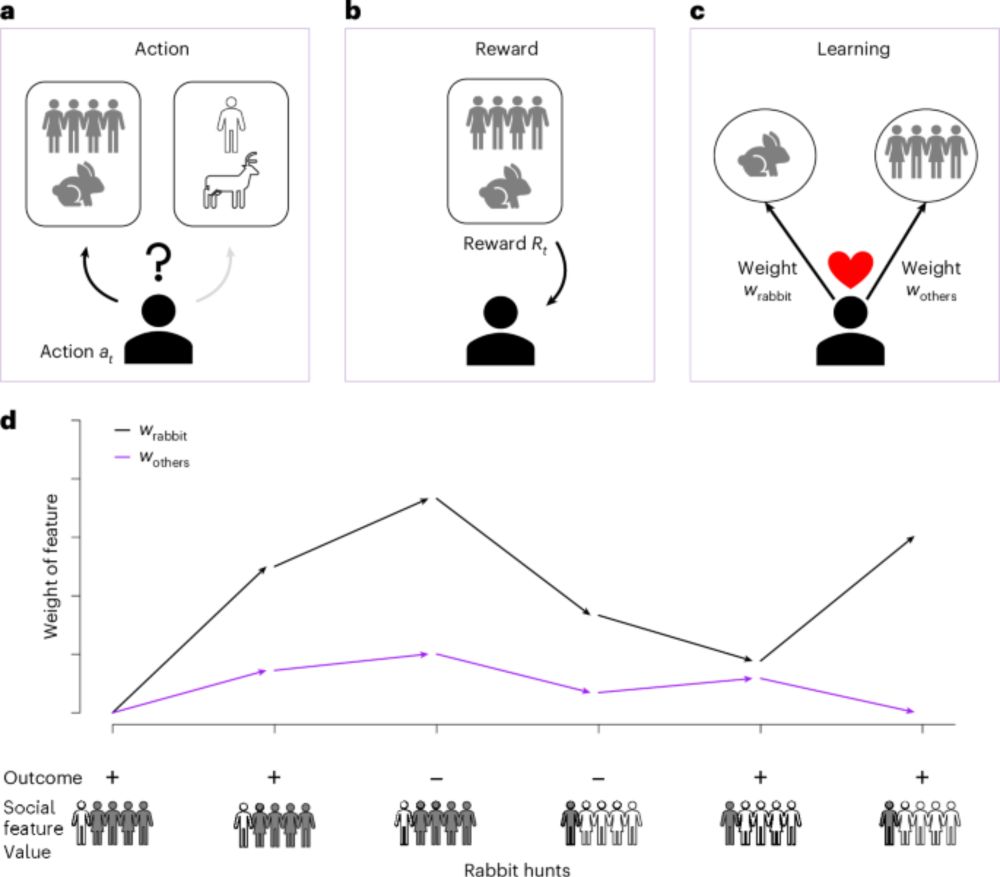
Feature-based reward learning shapes human social learning strategies - Nature Human Behaviour
This research advances a mechanistic reward learning account of social learning strategies. Through experiments and simulations, it shows how individuals learn to learn from others, dynamically shapin...
www.nature.com
Thrilled that our paper on the mechanisms underlying social learning strategies is out! First big paper from my @erc.europa.eu & @kawresearch.bsky.social funded group. More to come! I'm currently looking to recruit two post docs, get in touch if you find this line of research interesting.
Reposted by Björn Lindström
In today's modeling class I had a lot of fun trying to reconduce a bunch of different models to the update rule from rescorla wagner :-)
it turns out that - at least for RL, bayesian update, kalman filters and hierarchically gaussian filters - it's "all" in the learning rate definition.
it turns out that - at least for RL, bayesian update, kalman filters and hierarchically gaussian filters - it's "all" in the learning rate definition.

February 12, 2026 at 1:07 PM
In today's modeling class I had a lot of fun trying to reconduce a bunch of different models to the update rule from rescorla wagner :-)
it turns out that - at least for RL, bayesian update, kalman filters and hierarchically gaussian filters - it's "all" in the learning rate definition.
it turns out that - at least for RL, bayesian update, kalman filters and hierarchically gaussian filters - it's "all" in the learning rate definition.
Reposted by Björn Lindström
Here’s Duke behavioral economist Dan Ariely asking Jeffrey Epstein for “the name and email of the redhead that was here with you.” This is four years after Epstein’s 2008 conviction for procuring a child for prostitution.

January 31, 2026 at 1:15 AM
Here’s Duke behavioral economist Dan Ariely asking Jeffrey Epstein for “the name and email of the redhead that was here with you.” This is four years after Epstein’s 2008 conviction for procuring a child for prostitution.
Reposted by Björn Lindström

Very happy to see our ice-fishing paper on the cover of @science.org this week! 🎣🎉
We tracked large groups of Finnish competitive ice-fishers to study how social foragers use social information when searching for resources. 🐟
Link: www.science.org/doi/10.1126/... (contact me for open access)
We tracked large groups of Finnish competitive ice-fishers to study how social foragers use social information when searching for resources. 🐟
Link: www.science.org/doi/10.1126/... (contact me for open access)
www.science.org
January 30, 2026 at 12:36 PM
Very happy to see our ice-fishing paper on the cover of @science.org this week! 🎣🎉
We tracked large groups of Finnish competitive ice-fishers to study how social foragers use social information when searching for resources. 🐟
Link: www.science.org/doi/10.1126/... (contact me for open access)
We tracked large groups of Finnish competitive ice-fishers to study how social foragers use social information when searching for resources. 🐟
Link: www.science.org/doi/10.1126/... (contact me for open access)
Reposted by Björn Lindström

"Social media is like a Skinner box" is a phrase I've heard repeated a lot, but never meaningfully engaged with. We try and do so in this preprint.
Behaviorist principles are very useful to understanding digital behavior, but work in this area tends not to be aware of them. So, we provide a primer.
Behaviorist principles are very useful to understanding digital behavior, but work in this area tends not to be aware of them. So, we provide a primer.

Our preprint has evolved!
v2 of “Digital Behaviourism” is out now with a new title, new co-authors, and a deeper dive into the behavioural concepts that shape our online lives.
It’s time to move beyond “screen time” and focus on function of online behaviours.
osf.io/preprints/ps...
v2 of “Digital Behaviourism” is out now with a new title, new co-authors, and a deeper dive into the behavioural concepts that shape our online lives.
It’s time to move beyond “screen time” and focus on function of online behaviours.
osf.io/preprints/ps...

January 26, 2026 at 10:08 AM
"Social media is like a Skinner box" is a phrase I've heard repeated a lot, but never meaningfully engaged with. We try and do so in this preprint.
Behaviorist principles are very useful to understanding digital behavior, but work in this area tends not to be aware of them. So, we provide a primer.
Behaviorist principles are very useful to understanding digital behavior, but work in this area tends not to be aware of them. So, we provide a primer.
Reposted by Björn Lindström
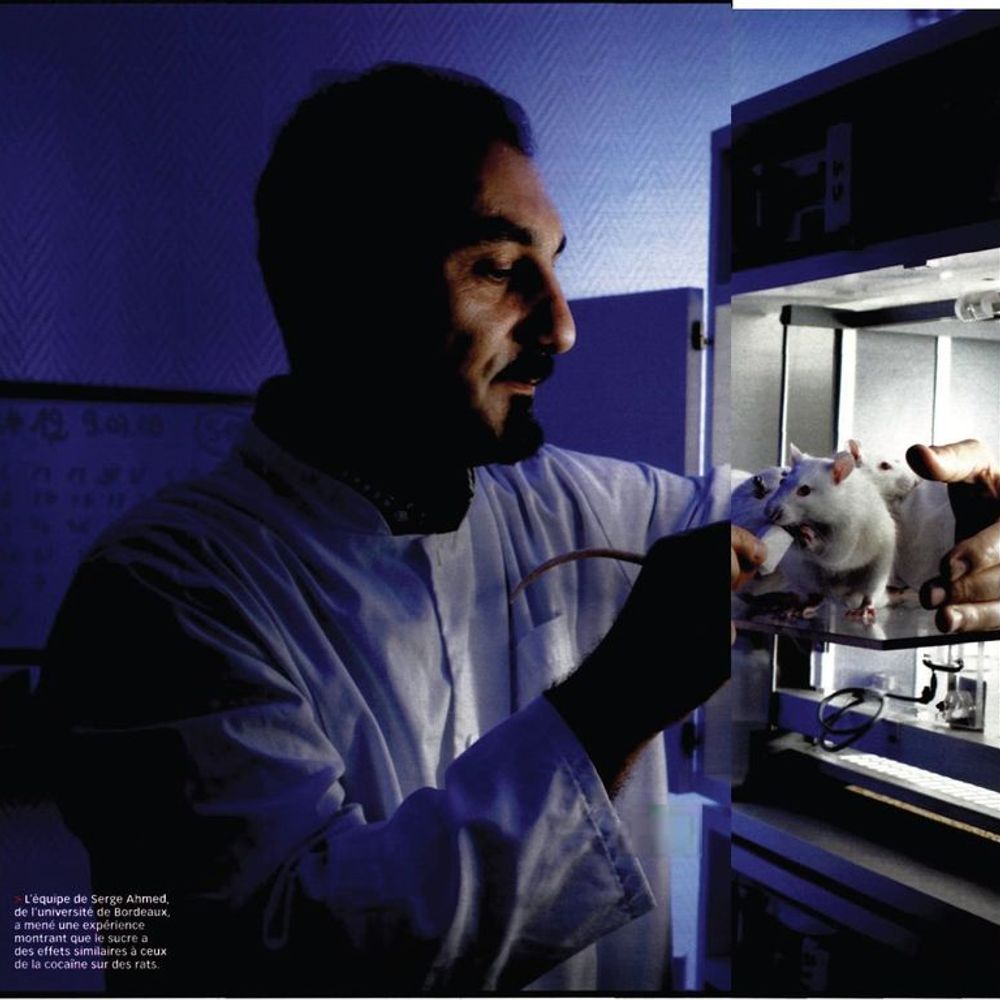
Reward as drive reduction, the return!
This opinion piece on the explanatory and unifying power of the homeostatic reinforcement learning framework is amazingly accessible, despite its technical nature, and extremely insightful 👏
www.sciencedirect.com/science/arti...
1/2
This opinion piece on the explanatory and unifying power of the homeostatic reinforcement learning framework is amazingly accessible, despite its technical nature, and extremely insightful 👏
www.sciencedirect.com/science/arti...
1/2

January 27, 2026 at 9:22 AM
Reward as drive reduction, the return!
This opinion piece on the explanatory and unifying power of the homeostatic reinforcement learning framework is amazingly accessible, despite its technical nature, and extremely insightful 👏
www.sciencedirect.com/science/arti...
1/2
This opinion piece on the explanatory and unifying power of the homeostatic reinforcement learning framework is amazingly accessible, despite its technical nature, and extremely insightful 👏
www.sciencedirect.com/science/arti...
1/2
Reposted by Björn Lindström

Our experiences have countless details, and it can be hard to know which matter.
How can we behave effectively in the future when, right now, we don't know what we'll need?
Out today in @nathumbehav.nature.com , @marcelomattar.bsky.social and I find that people solve this by using episodic memory.
How can we behave effectively in the future when, right now, we don't know what we'll need?
Out today in @nathumbehav.nature.com , @marcelomattar.bsky.social and I find that people solve this by using episodic memory.

Episodic memory facilitates flexible decision-making via access to detailed events - Nature Human Behaviour
Nicholas and Mattar found that people use episodic memory to make decisions when it is unclear what will be needed in the future. These findings reveal how the rich representational capacity of episod...
www.nature.com
January 23, 2026 at 1:18 PM
Our experiences have countless details, and it can be hard to know which matter.
How can we behave effectively in the future when, right now, we don't know what we'll need?
Out today in @nathumbehav.nature.com , @marcelomattar.bsky.social and I find that people solve this by using episodic memory.
How can we behave effectively in the future when, right now, we don't know what we'll need?
Out today in @nathumbehav.nature.com , @marcelomattar.bsky.social and I find that people solve this by using episodic memory.
Reposted by Björn Lindström

"The relationship between childhood exploration and population-level innovation in cultural evolution" with @ndersen.bsky.social @sheinalew.bsky.social @felixthehauskat.bsky.social out in Proc B
royalsocietypublishing.org/rspb/article...
royalsocietypublishing.org/rspb/article...

The relationship between childhood exploration and population-level innovation in cultural evolution
Abstract. The societal effects of children’s learning in cultural evolution have been underexplored. Here, we investigate using agent-based models how a pr
royalsocietypublishing.org
January 22, 2026 at 1:01 PM
"The relationship between childhood exploration and population-level innovation in cultural evolution" with @ndersen.bsky.social @sheinalew.bsky.social @felixthehauskat.bsky.social out in Proc B
royalsocietypublishing.org/rspb/article...
royalsocietypublishing.org/rspb/article...
Reposted by Björn Lindström

New in Nature Neuroscience: We developed a flexible model that reveals how animals learn tasks—uncovering stages, sudden insights, and gradual improvements unique to each animal.
Learning isn't monotonic, and our model captures that complexity 🐭📊
www.nature.com/articles/s41...
Learning isn't monotonic, and our model captures that complexity 🐭📊
www.nature.com/articles/s41...

Infinite hidden Markov models can dissect the complexities of learning - Nature Neuroscience
Bruijns et al. present a modeling tool that enables the tracking of learning dynamics across subjects to reveal how behaviors emerge and adapt. Applying the tool to a decision-making task in mice unco...
www.nature.com
January 20, 2026 at 2:35 PM
New in Nature Neuroscience: We developed a flexible model that reveals how animals learn tasks—uncovering stages, sudden insights, and gradual improvements unique to each animal.
Learning isn't monotonic, and our model captures that complexity 🐭📊
www.nature.com/articles/s41...
Learning isn't monotonic, and our model captures that complexity 🐭📊
www.nature.com/articles/s41...
Reposted by Björn Lindström

📖Published!
STbayes: An R package for creating, fitting and understanding Bayesian models of social transmission
This framework can be used to infer complex transmission rules🖥️ 🧪
Read more:
STbayes: An R package for creating, fitting and understanding Bayesian models of social transmission
This framework can be used to infer complex transmission rules🖥️ 🧪
Read more:
buff.ly
January 15, 2026 at 8:15 AM
📖Published!
STbayes: An R package for creating, fitting and understanding Bayesian models of social transmission
This framework can be used to infer complex transmission rules🖥️ 🧪
Read more:
STbayes: An R package for creating, fitting and understanding Bayesian models of social transmission
This framework can be used to infer complex transmission rules🖥️ 🧪
Read more:
Reposted by Björn Lindström

🎉 📣Join today at 1pm GMT to learn about ESLR and get involved!
📣 Join us Wednesday 14 Jan at 1pm GMT 💻🌍 Early career researcher interested in culture, behaviour, and learning? Get involved, learn about ESLR, and meet others in the field. We'll cover 2026 activities including skill-sharing sessions. 🛠️💡 Join: meet.google.com/sun-ddcz-gky

Meet
Real-time meetings by Google. Using your browser, share your video, desktop, and presentations with teammates and customers.
meet.google.com
January 14, 2026 at 10:12 AM
🎉 📣Join today at 1pm GMT to learn about ESLR and get involved!
Reposted by Björn Lindström

Proc B with @sampassmore.bsky.social! We used simulations to explore the innovation strategies of speed climbers 🧗♀️ Innovation is higher among slower athletes and lower when the population size is larger, and the overall balance of innovation and copying appears to be suboptimal 🔗 bit.ly/499QjZM

Simulation-based inference with deep learning suggests speed climbers combine innovation and copying to improve performance
Abstract. In the Olympic sport of speed climbing, athletes compete to reach the top of a 15 m wall as quickly as possible. Since the standardization of the
bit.ly
January 8, 2026 at 2:00 PM
Proc B with @sampassmore.bsky.social! We used simulations to explore the innovation strategies of speed climbers 🧗♀️ Innovation is higher among slower athletes and lower when the population size is larger, and the overall balance of innovation and copying appears to be suboptimal 🔗 bit.ly/499QjZM
Reposted by Björn Lindström
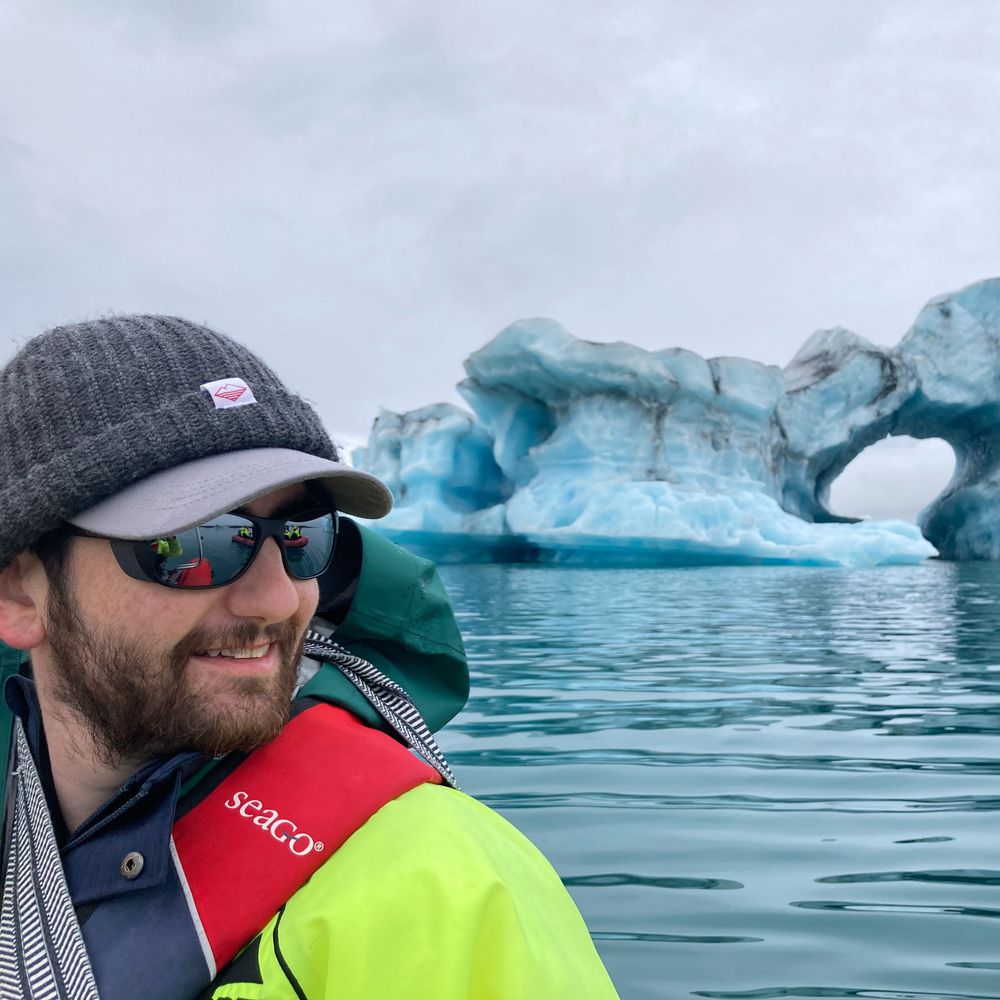
Can humans & animals really use internal maps to take shortcuts?
Tolman famously said yes - based largely on his Sunburst maze.
Our new review & meta-analysis suggests evidence is far weaker than you might think.
🧵👇 doi.org/10.1111/ejn....
@uofgpsychneuro.bsky.social @ejneuroscience.bsky.social
Tolman famously said yes - based largely on his Sunburst maze.
Our new review & meta-analysis suggests evidence is far weaker than you might think.
🧵👇 doi.org/10.1111/ejn....
@uofgpsychneuro.bsky.social @ejneuroscience.bsky.social

Tolman's Sunburst Maze 80 Years on: A Meta‐Analysis Reveals Poor Replicability and Little Evidence for Shortcutting
In 1946, Tolman et al. reported that rats could take a novel shortcut to a goal after training on an indirect route, supporting the Cognitive Map theory. However, a review of subsequent Sunburst maze...
doi.org
January 5, 2026 at 7:52 PM
Can humans & animals really use internal maps to take shortcuts?
Tolman famously said yes - based largely on his Sunburst maze.
Our new review & meta-analysis suggests evidence is far weaker than you might think.
🧵👇 doi.org/10.1111/ejn....
@uofgpsychneuro.bsky.social @ejneuroscience.bsky.social
Tolman famously said yes - based largely on his Sunburst maze.
Our new review & meta-analysis suggests evidence is far weaker than you might think.
🧵👇 doi.org/10.1111/ejn....
@uofgpsychneuro.bsky.social @ejneuroscience.bsky.social
Reposted by Björn Lindström

On a more positive note, this NN is worth a read. It takes a similar approach to Ashwood, Calhoun etc to explore diff behavioral states using HMM, but here using a hierarchical Dirichlet process to infer number of states www.nature.com/articles/s41...

Infinite hidden Markov models can dissect the complexities of learning - Nature Neuroscience
Bruijns et al. present a modeling tool that enables the tracking of learning dynamics across subjects to reveal how behaviors emerge and adapt. Applying the tool to a decision-making task in mice unco...
www.nature.com
January 5, 2026 at 3:42 PM
On a more positive note, this NN is worth a read. It takes a similar approach to Ashwood, Calhoun etc to explore diff behavioral states using HMM, but here using a hierarchical Dirichlet process to infer number of states www.nature.com/articles/s41...
Reposted by Björn Lindström
My co-authors and I are happy to present our framework "Collective Intelligence as Collective Information Processing (CIP)."
Here we propose decomposing different information processing mechanisms to unify disparate phenomena traditionally classified as "collective intelligence."
Here we propose decomposing different information processing mechanisms to unify disparate phenomena traditionally classified as "collective intelligence."


December 30, 2025 at 6:35 PM
My co-authors and I are happy to present our framework "Collective Intelligence as Collective Information Processing (CIP)."
Here we propose decomposing different information processing mechanisms to unify disparate phenomena traditionally classified as "collective intelligence."
Here we propose decomposing different information processing mechanisms to unify disparate phenomena traditionally classified as "collective intelligence."
Reposted by Björn Lindström

🚨 New Paper Alert 🚨 "Understanding & Predicting Cultural Change" is accepted at Advances in Experimental Social Psychology!
Varnum & I argue that Psychology cannot afford to be blind to time. We need to move from cross-sectional snapshots to dynamic time-series movies. 🧵👇
Varnum & I argue that Psychology cannot afford to be blind to time. We need to move from cross-sectional snapshots to dynamic time-series movies. 🧵👇

December 29, 2025 at 4:21 PM
🚨 New Paper Alert 🚨 "Understanding & Predicting Cultural Change" is accepted at Advances in Experimental Social Psychology!
Varnum & I argue that Psychology cannot afford to be blind to time. We need to move from cross-sectional snapshots to dynamic time-series movies. 🧵👇
Varnum & I argue that Psychology cannot afford to be blind to time. We need to move from cross-sectional snapshots to dynamic time-series movies. 🧵👇

Reposted by Björn Lindström

All I want for Christmas is for Sweden to revive its spooky Christmas goat tradition.


December 24, 2025 at 9:17 AM
All I want for Christmas is for Sweden to revive its spooky Christmas goat tradition.
Reposted by Björn Lindström

December 17, 2025 at 7:57 AM
Reposted by Björn Lindström
"misinformation is widespread in biological systems spanning levels of organization, and [...] is probably an inevitable property that inherits from fundamental constraints on biological communication systems, rather than a pathology"
royalsocietypublishing.org/rsif/article...
royalsocietypublishing.org/rsif/article...

A brief natural history of misinformation
Abstract. The idea that organisms benefit by acquiring information through social connections is a cornerstone of our understanding of social evolution and
royalsocietypublishing.org
December 14, 2025 at 6:36 AM
"misinformation is widespread in biological systems spanning levels of organization, and [...] is probably an inevitable property that inherits from fundamental constraints on biological communication systems, rather than a pathology"
royalsocietypublishing.org/rsif/article...
royalsocietypublishing.org/rsif/article...
Reposted by Björn Lindström

New paper out in Phil Trans with Angel Jimenez, Keith Jensen and Lei Chang
From information free-riding to information sharing: how have humans solved the cooperative dilemma at the heart of cumulative cultural evolution?
royalsocietypublishing.org/rstb/article...
From information free-riding to information sharing: how have humans solved the cooperative dilemma at the heart of cumulative cultural evolution?
royalsocietypublishing.org/rstb/article...

From information free-riding to information sharing: how have humans solved the cooperative dilemma at the heart of cumulative cultural evolution?
Abstract. Cumulative cultural evolution, where populations accumulate ever-improving knowledge, technologies and social customs, is arguably a unique featu
royalsocietypublishing.org
December 4, 2025 at 10:23 AM
New paper out in Phil Trans with Angel Jimenez, Keith Jensen and Lei Chang
From information free-riding to information sharing: how have humans solved the cooperative dilemma at the heart of cumulative cultural evolution?
royalsocietypublishing.org/rstb/article...
From information free-riding to information sharing: how have humans solved the cooperative dilemma at the heart of cumulative cultural evolution?
royalsocietypublishing.org/rstb/article...
Reposted by Björn Lindström

Very grateful that our paper was awarded ISCON’s Best 2024 Paper in Social Cognition!! Huge thanks to the fantastic team: Ben Stillerman, @bjornlindstrom.bsky.social , @leorhackel.bsky.social , Damaris Hagen, Nils Jostmann, and @davidamodio.bsky.social 🎊💐

ISCON is pleased to announce the winner of best 2024 paper in social cognition award, which is:
www.pnas.org/doi/10.1073/...
Paper was led by @davidschultner.bsky.social, w Ben Stillerman, Bjorn Lindstrom, @leorhackel.bsky.social, Damaris Hagen, Nils Jostmann, and @davidamodio.bsky.social
1/4
www.pnas.org/doi/10.1073/...
Paper was led by @davidschultner.bsky.social, w Ben Stillerman, Bjorn Lindstrom, @leorhackel.bsky.social, Damaris Hagen, Nils Jostmann, and @davidamodio.bsky.social
1/4
PNAS
Proceedings of the National Academy of Sciences (PNAS), a peer reviewed journal of the National Academy of Sciences (NAS) - an authoritative source of high-impact, original research that broadly spans...
www.pnas.org
December 2, 2025 at 10:20 PM
Very grateful that our paper was awarded ISCON’s Best 2024 Paper in Social Cognition!! Huge thanks to the fantastic team: Ben Stillerman, @bjornlindstrom.bsky.social , @leorhackel.bsky.social , Damaris Hagen, Nils Jostmann, and @davidamodio.bsky.social 🎊💐
Reposted by Björn Lindström

🚨Two postdoc positions @tse-fr.eu @iast.fr 🚨
We are recruiting two postdocs as part of the ANR-funded project ENFORCE.
Join me, @giuliandr.bsky.social, & @zhgarfield.com, to study punitive systems across societies.
Full time, 2 years, no teaching.
Deadline: Jan 23
www.tse-fr.eu/groups/depar...
We are recruiting two postdocs as part of the ANR-funded project ENFORCE.
Join me, @giuliandr.bsky.social, & @zhgarfield.com, to study punitive systems across societies.
Full time, 2 years, no teaching.
Deadline: Jan 23
www.tse-fr.eu/groups/depar...

Department of Social and Behavioral Sciences
www.tse-fr.eu
December 1, 2025 at 12:37 PM
🚨Two postdoc positions @tse-fr.eu @iast.fr 🚨
We are recruiting two postdocs as part of the ANR-funded project ENFORCE.
Join me, @giuliandr.bsky.social, & @zhgarfield.com, to study punitive systems across societies.
Full time, 2 years, no teaching.
Deadline: Jan 23
www.tse-fr.eu/groups/depar...
We are recruiting two postdocs as part of the ANR-funded project ENFORCE.
Join me, @giuliandr.bsky.social, & @zhgarfield.com, to study punitive systems across societies.
Full time, 2 years, no teaching.
Deadline: Jan 23
www.tse-fr.eu/groups/depar...
Reposted by Björn Lindström

📣 Very happy to announce a new BBS target article with Nick Chater in which we propose a new theory of cultural evolution, highlighting the importance of bottom-up social interaction in explaining the emergence of cultural complexity
🧵 1/8
www.cambridge.org/core/journal...
🧵 1/8
www.cambridge.org/core/journal...
Social Tinkering: The Social Foundations of Cultural Complexity | Behavioral and Brain Sciences | Cambridge Core
Social Tinkering: The Social Foundations of Cultural Complexity
www.cambridge.org
November 28, 2025 at 3:36 PM
📣 Very happy to announce a new BBS target article with Nick Chater in which we propose a new theory of cultural evolution, highlighting the importance of bottom-up social interaction in explaining the emergence of cultural complexity
🧵 1/8
www.cambridge.org/core/journal...
🧵 1/8
www.cambridge.org/core/journal...
Reposted by Björn Lindström
My paper is out!
Computational modeling of error patterns during reward-based learning show evidence that habit learning (value free!) supplements working memory in 7 human data sets.
rdcu.be/eQjLN
Computational modeling of error patterns during reward-based learning show evidence that habit learning (value free!) supplements working memory in 7 human data sets.
rdcu.be/eQjLN

A habit and working memory model as an alternative account of human reward-based learning
Nature Human Behaviour - In this study, Collins proposes an alternative dual-process (working memory and habit) model of reinforcement learning in humans.
rdcu.be
November 17, 2025 at 5:18 PM
My paper is out!
Computational modeling of error patterns during reward-based learning show evidence that habit learning (value free!) supplements working memory in 7 human data sets.
rdcu.be/eQjLN
Computational modeling of error patterns during reward-based learning show evidence that habit learning (value free!) supplements working memory in 7 human data sets.
rdcu.be/eQjLN
Reposted by Björn Lindström
Come and do a PhD at Exeter with me and Chico Camargo (Computer Science) on human-genAI coevolution
"Leveraging Natural Language Processing for Data-Driven Agent-Based Modelling of Online Cultural Dynamics"
www.exeter.ac.uk/v8media/recr...
More details here:
www.exeter.ac.uk/study/fundin...
"Leveraging Natural Language Processing for Data-Driven Agent-Based Modelling of Online Cultural Dynamics"
www.exeter.ac.uk/v8media/recr...
More details here:
www.exeter.ac.uk/study/fundin...
www.exeter.ac.uk
November 14, 2025 at 3:14 PM
Come and do a PhD at Exeter with me and Chico Camargo (Computer Science) on human-genAI coevolution
"Leveraging Natural Language Processing for Data-Driven Agent-Based Modelling of Online Cultural Dynamics"
www.exeter.ac.uk/v8media/recr...
More details here:
www.exeter.ac.uk/study/fundin...
"Leveraging Natural Language Processing for Data-Driven Agent-Based Modelling of Online Cultural Dynamics"
www.exeter.ac.uk/v8media/recr...
More details here:
www.exeter.ac.uk/study/fundin...