Dr. Joan Dudney
banner
dudney-joan.bsky.social
Dr. Joan Dudney
@dudney-joan.bsky.social

Assistant Professor @ucsantabarbara Global Change Forest Ecologist @switzernetwork @SmithFellows @PeaceCorps #BLM

Environmental science 80%
Geography 20%
Pinned
Disturbance interactions have profound consequences for forest health, yet remain poorly understood.

Here we use DAGs to differentiate #Synergisms, #CompoundDisturbances & #NetworkEffects and review the impacts of climate change.

Final version out now! 🧪🌐🍁🌱
www.annualreviews.org/content/jour...
Sorry @nytimes.com , for those of us in the sciences, this is not a "quiet policy change". 🧪🦠💊🌍 It is however a disaster for society.
The U.S. Is Funding Fewer Grants in Every Area of Science and Medicine www.nytimes.com/interactive/...
The U.S. Is Funding Fewer Grants in Every Area of Science and Medicine
A quiet policy change means the government is making fewer bets on long-term science.
www.nytimes.com

Reposted by Joan Dudney

Why is Southwest Virginia a hotspot for tick-borne diseases? And what are people doing about it? My latest in the @pulitzercenter.org -funded climate/health series for @wvtf.bsky.social in partnership with @climatecentral.org.
www.wvtf.org/news/2025-12...
🧪🌎 #publichealth #climatechange
Nice preprint for eco evo folk to check out from @sfwalmsley.bsky.social and colleagues - Towards a causal understanding of bidirectional effects in ecology and evolution - ecoevorxiv.org/repository/v... #causalinference 🌍
Towards a causal understanding of bidirectional effects in ecology and evolution
ecoevorxiv.org

Reposted by Joan Dudney

Watched S5 E1 ("The Crawl") of #StrangerThings last night & was thrilled to see gorgeous examples of drill holes made by a yellow-bellied sapsucker (Sphyrapicus varius) in the trunk of what's likely a loblolly pine (Pinus taeda); Will Byers (Noah Schnapps) for scale. 🧪🌲🪵🐦🕳️

Reposted by Joan Dudney

Good morning everyone. Today in “One day, one paper”, mixed forests in China’s Loess Plateau show deeper water uptake and stricter stomatal regulation, enhancing resilience under drought and offering key insights for sustainable afforestation 🌎
A comparison of water use strategies between pure and mixed forests on the Chinese Loess Plateau
Read the free Plain Language Summary for this article on the Journal blog.
besjournals.onlinelibrary.wiley.com
Divergent Trends in Insect Disturbance Across Europe's Temperate and Boreal Forests

🔗 buff.ly/APK3ybC

Reposted by Joan Dudney

Check out our latest publication from the #FREE group at #CESAB taking a functional and trait perspective on classic metapopulation ecology led by @nmouquet.bsky.social 🧪🌐
Spatial Insurance of Distinct Ecological Functions

Communities can act as functional sources and sustain rare ecological roles across space. We reveal patterns of functional vulnerability for plants and birds

Check out our Perspective in Ecol Lett

👉 onlinelibrary.wiley.com/doi/10.1111/...

🌐🌍🦤🪴🍁🧪

This paper was made possible thanks to the many insights and deep conversations with my brilliant co-authors
@julieedtree.bsky.social @rupertseidl.bsky.social
@brian-j-harvey.bsky.social
Study area shape matters when tracking species range shifts & we may underestimate longitudinal range shifts to the benefit of latitudinal range shifts, potentially undermining drivers other than T°C 🌡

🌐🌏🌎🌍🧪🐠🐍🦋🦉🦇🌳🌲

shorturl.at/prp63
Global bias towards recording latitudinal range shifts - Nature Climate Change
The authors consider studies reporting species range shifts and demonstrate a geometric bias in sampling along latitudinal, rather than longitudinal, gradients. This bias may favour the corroboration ...
shorturl.at

Reposted by Joan Dudney

Our new study—part of the forthcoming book Andean #Herpetofauna—explores how #amphibian diversity and threats shift across the elevational zones of the #Colombian #Andes 🧪🦤🐸🌐🌎

link.springer.com/chapter/10.1...
Diversity and Extinction Risk of Colombian Andean Amphibians Across Life Regions
The Andean region in Colombia is heavily populated and has suffered significant habitat conversion and loss, which leads to declining amphibian species richness and abundance. The Colombian Andes enco...
link.springer.com
The Amazon Rainforest was shaped by people. Analysis of 262 trees species across 1,521 forest plots reveals that both pre-Columbian Indigenous peoples and European colonists enduringly influenced the forest’s relative abundance of trees. In PNAS: https://ow.ly/VAqY50XuP38
A paper in Scientific Data presents a novel global natural forest map for 2020 at 10 m resolution. This map can support forest monitoring or conservation efforts that require a comprehensive baseline for monitoring deforestation and degradation. go.nature.com/4remVIQ ⚒️ 🧪
📢 Upcoming online seminar:

Next week (26th November) at 11am CET, Alice Penanhoat @alice4science.bsky.social from Swedish University of Agricultural Sciences will talk about her interdisciplinary research on forest structure 🌲🌳🔍

Register here to join the zoom seminar:
lnkd.in/gcgh5qFE

Reposted by Joan Dudney

Central Europe’s forests face steep biomass losses and beetle outbreaks above 1.5 °C warming; staying below 2 °C keeps timber, carbon and diversity services safer, underscoring the urgency of meeting Paris Agreement targets.
#biomass
@forestecosyst.bsky.social
www.sciencedirect.com/science/arti...
Hi people. Today in "one day, one paper", thermal tolerance breadth in plants exceeds local climate ranges, shaped mainly by heat, cold, and aridity. Desert species show extreme resilience, revealing partial support for climate variability hypothesis and highlighting microclimate-driven plasticity🌎🍁
Drivers of thermal tolerance breadth of plants across contrasting biomes
The results provide partial support for the climate variability hypothesis in plants: photosystem thermal tolerance breadth was greatest in more thermally variable biomes. This relationship was large....
besjournals.onlinelibrary.wiley.com

Incredible figure! Congratulations on this insightful work!

Reposted by Joan Dudney

Unlocking Populus’ genetic blueprint! 🧬
From 707 resequenced trees, researchers built a high-density map pinpointing 89 QTLs for growth, wood, and disease traits, boosting genomic selection accuracy by up to 21%.
🔗 link.springer.com/article/10.1...

#JFR #ForestryGenomics #Populus 🍁🌺🌱🌿
Insights Into Water Vapor Uptake by Dry Soils Using a Global Eddy Covariance Observation Network

🔗 buff.ly/O9bovwm

Reposted by Joan Dudney

Hello everyone. Today in "One day, one paper", contrasting phenological responses among understorey herb species to warming, light, nitrogen, and land-use legacy reveal shifts in plant competition, with key implications for biodiversity and adaptive forest management 🍁🌎
Intra‐annual growth dynamics of forest understorey herbaceous plant species in response to global change
This study provides new insights into the growth dynamics of forest understorey species and their responses to global change drivers. The findings suggest that global changes, such as climate warming...
besjournals.onlinelibrary.wiley.com
Our new paper in Ecology Letters, led by Jan Divíšek, shows that non-invasive alien plant species that successfully establish within local plant communities tend to resemble the resident native species. In contrast, invasive alien species usually differ from native plants.
doi.org/10.1111/ele....
🌳 Our research in Nature Communications!
Converting coniferous to broad-leaved forests in Europe could cut summer hot extremes by up to 1 °C — boosting climate effectiveness.
Read more 👇
🔗https://www.nature.com/articles/s41467-025-64580-y
#ForestNavigator #ClimateScience #Forestry #NatureComms

Conversion from coniferous to broadleaved trees can make European forests more climate-effective - Nature Communications
This study investigates the effects of forestation on temperature in Europe using climate model experiments. The findings indicate that conversion from coniferous to broadleaved trees in currently for...
nature.com
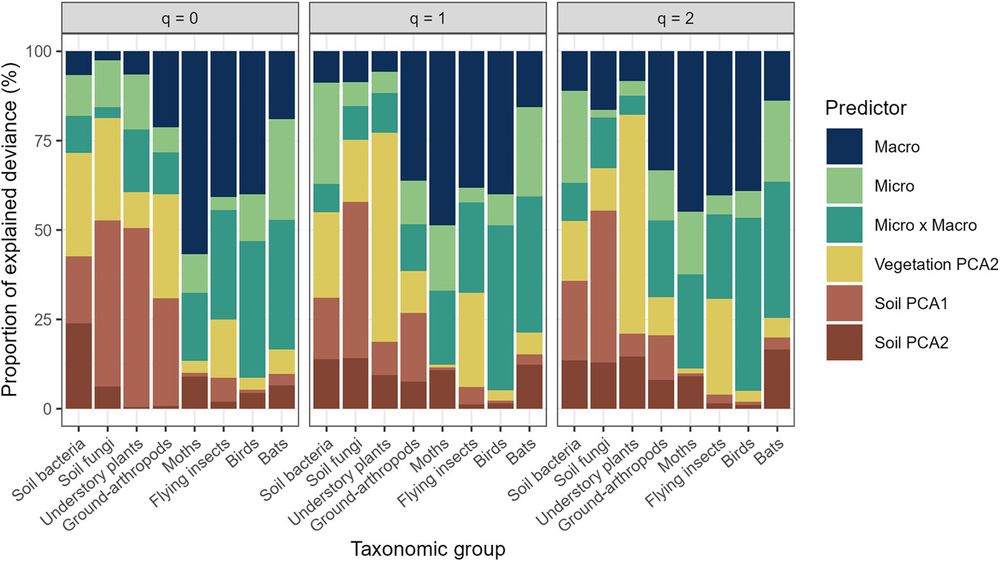
Great to see the results of our massive biodiversity assessment at Berchtesgaden Natl. Park pour in! Cool insights on patterns & drivers of multidiversity!

#1 Macro- and microclimate interactively shape species diversity of multiple taxa in mountain landscapes by L. Geres. doi.org/10.1002/ecog...
Globalization has accelerated the spread of mosquito species that transmit human diseases. An analysis in Nature Communications shows that 45 disease-vector mosquito species have been introduced to non-native regions worldwide. go.nature.com/4hn6ogW 🧪
Mortality from fire & wind is increasing in Europe's forests, but what about biotic disturbances? A new, massive dataset compiled by @thlasny.bsky.social and many local experts shows a mixed picture: While wood borers increase strongly, defoliator activity generally decreases doi.org/10.1111/gcb....
Great new paper led by @knowlton.bsky.social with @ttkeller.bsky.social and @rupertseidl.bsky.social (and me!) Still so much to learn from #Yellowstone about #fire, #forests & #climatechange. #NSFfunded #JFSPfunded
🆕 in Ecosphere's "Vegetation Ecology" track: A hot & dry future may shake up Yellowstone forests—think fewer spruce, more fire-tolerant neighbors

📄Simulated postfire tree regeneration suggests reorganization of Greater Yellowstone forests during the 21st century
doi.org/10.1002/ecs2...

Congratulations @julieedtree.bsky.social on this cutting-edge research, out today #AGUpubs!

High-resolution tree-ring data are dramatically improving our ability to estimate past climate. We’re now much closer to accurately tracking temperature changes—both today and across history!
Dr. Julie Edwards (@julieedtree.bsky.social) leads a new paper showing that high-resolution cellular-scale measurements (Quantitative Wood Anatomy) yield better temperature signals in Alaskan tree rings than even conventional MXD across all frequencies agupubs.onlinelibrary.wiley.com/doi/10.1029/...
Resolution and Frequency‐Dependent Climate Signals in an Arctic Tree‐Ring Temperature Reconstruction of the Last Millennium
Tree-ring density measurement resolution affects low-frequency trends in temperature reconstructions High-resolution anatomical maximum latewood density has stronger correlations with instrumenta...
agupubs.onlinelibrary.wiley.com
📣So happy to share the PhorEau model, combining models of forest dynamics, plant water relations, and process-based SDM = linking ecophysiology, ecology & biogeography 🌳📈💻
gmd.copernicus.org/articles/18/...
➡️ from Tanguy Postic's PhD, with many perspectives to simulate forests under CC
PHOREAU v1.0: a new process-based model to predict forest functioning, from tree ecophysiology to forest dynamics and biogeography
Abstract. Climate change impacts forest functioning and dynamics, but large uncertainties remain regarding the interactions between species composition, demographic processes and environmental drivers...
gmd.copernicus.org
Please pass along, I’m recruiting PhD students to join our Macroecology Lab @uofa-eeb.bsky.social We study phys ecology, macroecology, biodiversity - spanning scaling, trait-based ecology, theory, comparative biology & ecoinformatics. Several avenues for funding. Please reach out if interested🧪🌐🌾