



James Briscoe
@jamesbriscoe.bsky.social
Developmental Biologist working at the Francis Crick Institute. Neural tube, morphogens, and gene regulatory networks. Editor-in-chief, Development.
London · briscoelab.org
London · briscoelab.org
Pinned
James Briscoe
@jamesbriscoe.bsky.social
· Oct 27
Our latest: *Hierarchical lineage architecture of human and avian spinal cord revealed by single-cell genomic barcoding*
For a summary & the digested highlights see thread🧵 from @giulia-boezio.bsky.social
www.biorxiv.org/content/10.1...
For a summary & the digested highlights see thread🧵 from @giulia-boezio.bsky.social
www.biorxiv.org/content/10.1...
Reposted by James Briscoe
Our new paper: Entropy Sorting Feature Selection (ESFS)
A computational framework for gene selection from single cell data that extracts biological signals in noisy data while avoiding artefacts from conventional dimensionality reduction
A thread
www.biorxiv.org/content/10.6...
A computational framework for gene selection from single cell data that extracts biological signals in noisy data while avoiding artefacts from conventional dimensionality reduction
A thread
www.biorxiv.org/content/10.6...
www.biorxiv.org
February 3, 2026 at 6:44 PM
Our new paper: Entropy Sorting Feature Selection (ESFS)
A computational framework for gene selection from single cell data that extracts biological signals in noisy data while avoiding artefacts from conventional dimensionality reduction
A thread
www.biorxiv.org/content/10.6...
A computational framework for gene selection from single cell data that extracts biological signals in noisy data while avoiding artefacts from conventional dimensionality reduction
A thread
www.biorxiv.org/content/10.6...
Reposted by James Briscoe
After 15 years as Editor-in-chief (EiC), Michael Way @drmichaelway.bsky.social will be stepping down at the end of 2026 & we are seeking feedback from the cell biology community as part of the consultation process for appointing a new EiC.
We'd love to hear from you: www.surveymonkey.com/r/GZCC9F9
We'd love to hear from you: www.surveymonkey.com/r/GZCC9F9

February 3, 2026 at 1:36 PM
After 15 years as Editor-in-chief (EiC), Michael Way @drmichaelway.bsky.social will be stepping down at the end of 2026 & we are seeking feedback from the cell biology community as part of the consultation process for appointing a new EiC.
We'd love to hear from you: www.surveymonkey.com/r/GZCC9F9
We'd love to hear from you: www.surveymonkey.com/r/GZCC9F9
Our new paper: Entropy Sorting Feature Selection (ESFS)
A computational framework for gene selection from single cell data that extracts biological signals in noisy data while avoiding artefacts from conventional dimensionality reduction
A thread
www.biorxiv.org/content/10.6...
A computational framework for gene selection from single cell data that extracts biological signals in noisy data while avoiding artefacts from conventional dimensionality reduction
A thread
www.biorxiv.org/content/10.6...
www.biorxiv.org
February 3, 2026 at 6:44 PM
Our new paper: Entropy Sorting Feature Selection (ESFS)
A computational framework for gene selection from single cell data that extracts biological signals in noisy data while avoiding artefacts from conventional dimensionality reduction
A thread
www.biorxiv.org/content/10.6...
A computational framework for gene selection from single cell data that extracts biological signals in noisy data while avoiding artefacts from conventional dimensionality reduction
A thread
www.biorxiv.org/content/10.6...
Reposted by James Briscoe
I watched much of Ian Chapman's (Head of @ukri.org) appearance this morning at @ukparliament.parliament.uk Science, Innovation and Technology Committee..
A few points and new information that bioscientists may find interesting...
A 🧵
A few points and new information that bioscientists may find interesting...
A 🧵
February 3, 2026 at 1:57 PM
I watched much of Ian Chapman's (Head of @ukri.org) appearance this morning at @ukparliament.parliament.uk Science, Innovation and Technology Committee..
A few points and new information that bioscientists may find interesting...
A 🧵
A few points and new information that bioscientists may find interesting...
A 🧵
Reposted by James Briscoe
We're hiring! JCS is looking for a Reviews Editor to join the team. This is a fantastic opportunity for someone who loves cell biology and wants to stay connected with the field (and be part of an organisation that believes in supporting the community).
www.biologists.com/about-us/wor...
www.biologists.com/about-us/wor...

Work for us
Working for us We’re always looking for talented and motivated people to work as part of our close-knit team. Roles range from editorial to production, marketing to event co-ordination, HR to accounts...
www.biologists.com
January 28, 2026 at 5:08 PM
We're hiring! JCS is looking for a Reviews Editor to join the team. This is a fantastic opportunity for someone who loves cell biology and wants to stay connected with the field (and be part of an organisation that believes in supporting the community).
www.biologists.com/about-us/wor...
www.biologists.com/about-us/wor...
Our latest: A gene selection method for single-cell RNA-seq that identifies developmental & spatial patterns missed by other analysis pipelines
ESFS: A Noise-Resilient Framework for Feature Selection and Marker Gene Discovery in Single-Cell Transcriptomics | bioRxiv www.biorxiv.org/content/10.6...
ESFS: A Noise-Resilient Framework for Feature Selection and Marker Gene Discovery in Single-Cell Transcriptomics | bioRxiv www.biorxiv.org/content/10.6...
ESFS: A Noise-Resilient Framework for Feature Selection and Marker Gene Discovery in Single-Cell Transcriptomics
Single-cell RNA sequencing (scRNA-seq) has transformed our ability to resolve cellular heterogeneity, but extracting meaningful signals remains challenging due to technical noise, batch effects, and the limitations of current feature selection methods. We present Entropy Sorting Feature Selection (ESFS), a modular, user-friendly framework that captures multivariate gene expression relationships without imputation or denoising via latent spaces. Across diverse datasets, ESFS improves interpretability and reveals biology missed by standard workflows: identifying coherent developmental programs in eight independent human embryo datasets without batch integration; resolving spatial gene expression in mouse colon obscured by conventional analyses; distinguishing shared and tumour-specific microenvironments in glioblastoma; and disambiguating spatial, temporal, and neurogenic programs in the developing mouse neural tube. By operating in gene expression space, ESFS produces interpretable, biologically meaningful outputs while reducing artefacts introduced by feature extraction. These results position ESFS as a powerful means to uncover relevant molecular signatures in noisy, high-dimensional transcriptomics data. ### Competing Interest Statement The authors have declared no competing interest. Cancer Research UK, CC001051 Medical Research Council, https://ror.org/03x94j517, CC001051 Wellcome Trust, CC001051 Wellcome Trust, 220379/D/20/Z European Molecular Biology Organization, 792-2021 UK Research and Innovation, EP/X031225/1
www.biorxiv.org
January 28, 2026 at 5:59 AM
Our latest: A gene selection method for single-cell RNA-seq that identifies developmental & spatial patterns missed by other analysis pipelines
ESFS: A Noise-Resilient Framework for Feature Selection and Marker Gene Discovery in Single-Cell Transcriptomics | bioRxiv www.biorxiv.org/content/10.6...
ESFS: A Noise-Resilient Framework for Feature Selection and Marker Gene Discovery in Single-Cell Transcriptomics | bioRxiv www.biorxiv.org/content/10.6...
Looking forward to
the St. Anna CCRI Symposium on Cell Fate in Cancer and Development tomorrow
ccri.at/st-anna-ccri...
the St. Anna CCRI Symposium on Cell Fate in Cancer and Development tomorrow
ccri.at/st-anna-ccri...
January 22, 2026 at 4:36 PM
Looking forward to
the St. Anna CCRI Symposium on Cell Fate in Cancer and Development tomorrow
ccri.at/st-anna-ccri...
the St. Anna CCRI Symposium on Cell Fate in Cancer and Development tomorrow
ccri.at/st-anna-ccri...
Reposted by James Briscoe

Thrilled to share that I’ve been awarded a FIS-3 Advanced Grant (ERC-inspired) to study the evolution of neurogenic GRNs.
Recruiting soon: 4 postdocs + 3 PhDs
Press release in Italian — to decolonise scientific language 😄
magazine.unibo.it/it/articoli/...
Email me if interested in joining the lab
Recruiting soon: 4 postdocs + 3 PhDs
Press release in Italian — to decolonise scientific language 😄
magazine.unibo.it/it/articoli/...
Email me if interested in joining the lab

Un viaggio all’origine dei sistemi nervosi
Il nuovo progetto GRNevo, finanziato con un grant FIS-3 Advanced da 1,9 milioni di euro, studierà come si formano i neuroni durante lo sviluppo in specie animali molto distanti tra loro: dal moscerino...
magazine.unibo.it
January 13, 2026 at 11:14 AM
Thrilled to share that I’ve been awarded a FIS-3 Advanced Grant (ERC-inspired) to study the evolution of neurogenic GRNs.
Recruiting soon: 4 postdocs + 3 PhDs
Press release in Italian — to decolonise scientific language 😄
magazine.unibo.it/it/articoli/...
Email me if interested in joining the lab
Recruiting soon: 4 postdocs + 3 PhDs
Press release in Italian — to decolonise scientific language 😄
magazine.unibo.it/it/articoli/...
Email me if interested in joining the lab
Reposted by James Briscoe
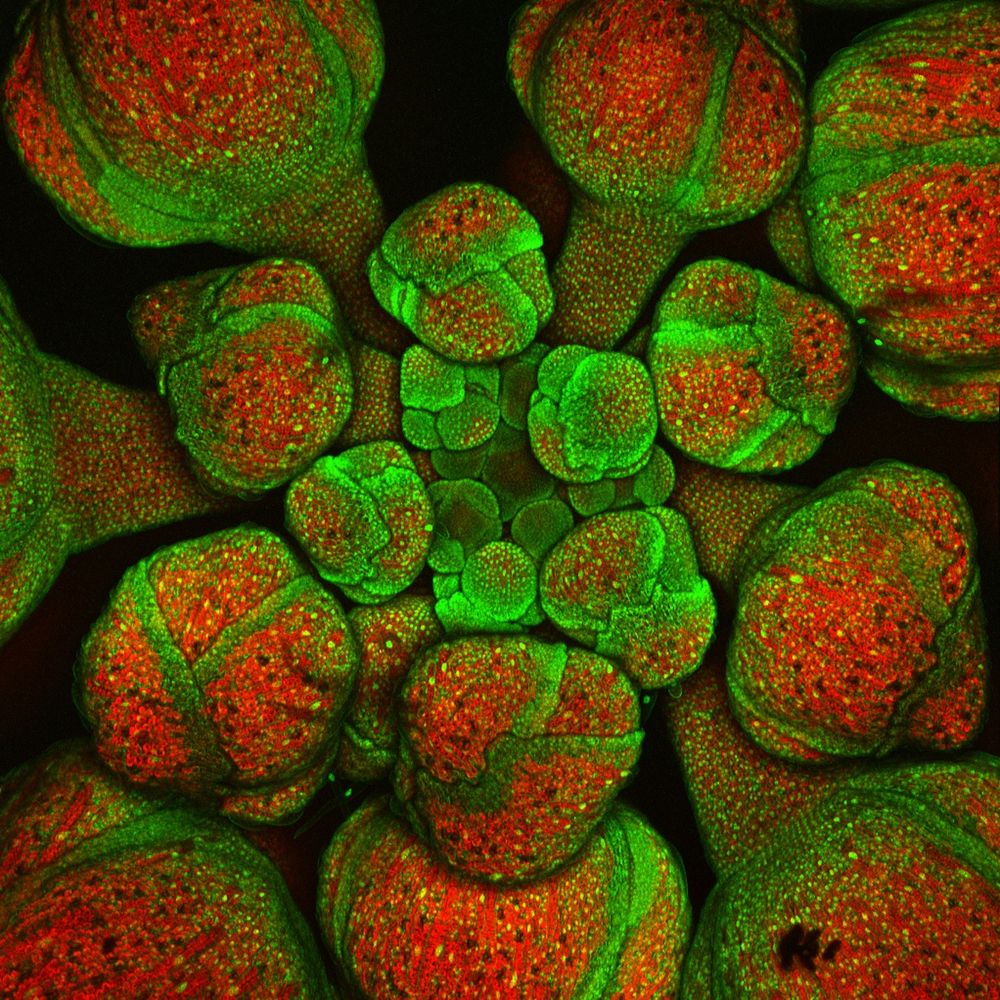
Feb 1 deadline approaching for our @kitp-ucsb.bsky.social QBio summer course on Physical Principles of Morphogenesis in Plants and Animals. @streichan.bsky.social
@maurazimmermann.bsky.social @maizel-lab.org @yusuke-mori.bsky.social @akankshi.bsky.social @nicolettapetridou.bsky.social
@maurazimmermann.bsky.social @maizel-lab.org @yusuke-mori.bsky.social @akankshi.bsky.social @nicolettapetridou.bsky.social

January 13, 2026 at 11:36 PM
Feb 1 deadline approaching for our @kitp-ucsb.bsky.social QBio summer course on Physical Principles of Morphogenesis in Plants and Animals. @streichan.bsky.social
@maurazimmermann.bsky.social @maizel-lab.org @yusuke-mori.bsky.social @akankshi.bsky.social @nicolettapetridou.bsky.social
@maurazimmermann.bsky.social @maizel-lab.org @yusuke-mori.bsky.social @akankshi.bsky.social @nicolettapetridou.bsky.social
There's still time to apply to be a 2026 @dev-journal.bsky.social Pathway to Independence fellow
For those about to apply for their first independent academic position, the programme offers
- mentoring
- leadership training
- profile rising
- networking
journals.biologists.com/dev/pages/pi...
For those about to apply for their first independent academic position, the programme offers
- mentoring
- leadership training
- profile rising
- networking
journals.biologists.com/dev/pages/pi...
Pathway to Independence programme | Development | The Company of Biologists
Pathway to Independence programme | Development | The Company of Biologists
Development's Pathway to Independence programme
Launched in 2022, Development’s Pathway Independence programm...
journals.biologists.com
January 13, 2026 at 5:29 PM
There's still time to apply to be a 2026 @dev-journal.bsky.social Pathway to Independence fellow
For those about to apply for their first independent academic position, the programme offers
- mentoring
- leadership training
- profile rising
- networking
journals.biologists.com/dev/pages/pi...
For those about to apply for their first independent academic position, the programme offers
- mentoring
- leadership training
- profile rising
- networking
journals.biologists.com/dev/pages/pi...
Reposted by James Briscoe

We're happy to highlight two very exciting preprints from @idoiaeu.bsky.social and @matosches.bsky.social about the evolution of Cajal-Retzius cells. Find our perspective in @dev-journal.bsky.social here:
doi.org/10.1242/dev....
doi.org/10.1242/dev....

In preprints: the deep evolutionary roots of Cajal-Retzius cells
Vertebrates show a striking diversity of brain size and morphology. Mammals, in particular, have an especially large cerebral cortex, presenting with a characteristic six-layered structure that is bel...
doi.org
January 9, 2026 at 2:24 PM
We're happy to highlight two very exciting preprints from @idoiaeu.bsky.social and @matosches.bsky.social about the evolution of Cajal-Retzius cells. Find our perspective in @dev-journal.bsky.social here:
doi.org/10.1242/dev....
doi.org/10.1242/dev....
Reposted by James Briscoe
The hard truth about how hard it is to publish in Development
Editor-in-Chief @jamesbriscoe.bsky.social leads our team of Academic Editors in addressing the perception that Development is ‘too hard to publish in’ by discussing the journal's review process.
doi.org/10.1242/dev....
Editor-in-Chief @jamesbriscoe.bsky.social leads our team of Academic Editors in addressing the perception that Development is ‘too hard to publish in’ by discussing the journal's review process.
doi.org/10.1242/dev....

January 12, 2026 at 10:36 AM
The hard truth about how hard it is to publish in Development
Editor-in-Chief @jamesbriscoe.bsky.social leads our team of Academic Editors in addressing the perception that Development is ‘too hard to publish in’ by discussing the journal's review process.
doi.org/10.1242/dev....
Editor-in-Chief @jamesbriscoe.bsky.social leads our team of Academic Editors in addressing the perception that Development is ‘too hard to publish in’ by discussing the journal's review process.
doi.org/10.1242/dev....
Reposted by James Briscoe

We had a great experience publishing in Development (doi.org/10.1242/dev....). High-quality reviews, quick turnaround, and our editor (Jim Wells) was very helpful and provided feedback about the reviewers comments.
January 7, 2026 at 4:42 AM
We had a great experience publishing in Development (doi.org/10.1242/dev....). High-quality reviews, quick turnaround, and our editor (Jim Wells) was very helpful and provided feedback about the reviewers comments.
Reposted by James Briscoe

We believe that, as our future leaders in biology, it is vital to provide #ECRs with the right support during the early stages of your academic career. We offer a number of practical ways to help you meet the unique needs and challenges you may encounter: www.biologists.com/about-us/ear...

Supporting early-career researchers
On these pages we highlight the range of resources that we offer to early-career researchers.
www.biologists.com
December 19, 2025 at 4:59 PM
We believe that, as our future leaders in biology, it is vital to provide #ECRs with the right support during the early stages of your academic career. We offer a number of practical ways to help you meet the unique needs and challenges you may encounter: www.biologists.com/about-us/ear...
Reposted by James Briscoe

What's it like being Editor-in-chief of @jcellsci.bsky.social? doi.org/10.1242/jcs....

At the helm of JCS – Editors-in-Chief past, present… and future
The Editor-in-Chief (EIC) of Journal of Cell Science plays a key role in defining the overall vision of the journal, helping to decide on journal strategy, policy and priorities, and overseeing all co...
doi.org
December 22, 2025 at 10:33 AM
What's it like being Editor-in-chief of @jcellsci.bsky.social? doi.org/10.1242/jcs....
Delighted & honoured to have given the Jean Brachet Memorial Lecture for the International Society for Differentiation
Thanks to the Indian SDB for hosting and to Sally Dunwoodie for the generous introduction.
Thanks to the Indian SDB for hosting and to Sally Dunwoodie for the generous introduction.

December 18, 2025 at 2:14 PM
Delighted & honoured to have given the Jean Brachet Memorial Lecture for the International Society for Differentiation
Thanks to the Indian SDB for hosting and to Sally Dunwoodie for the generous introduction.
Thanks to the Indian SDB for hosting and to Sally Dunwoodie for the generous introduction.
Reposted by James Briscoe

And here is the PDF of the 4th course @college-de-france.fr. You will find the justification and presentation of geometric representation of cell decisions, a parsimonious mathematical model for signalling and cell state transitions
tinyurl.com/yc7u296j
tinyurl.com/yc7u296j


December 16, 2025 at 9:57 AM
And here is the PDF of the 4th course @college-de-france.fr. You will find the justification and presentation of geometric representation of cell decisions, a parsimonious mathematical model for signalling and cell state transitions
tinyurl.com/yc7u296j
tinyurl.com/yc7u296j
Good to see the peer reviewed version of this published
A chemo-optogenetic system for spatiotemporal control of gene expression
We use it to:
- Reconstruct SHH mediated neural tube patterning in vitro
- Measure extracellular half-life of Shh
www.cell.com/developmenta...
A chemo-optogenetic system for spatiotemporal control of gene expression
We use it to:
- Reconstruct SHH mediated neural tube patterning in vitro
- Measure extracellular half-life of Shh
www.cell.com/developmenta...

Investigating morphogen and patterning dynamics with optogenetic control of morphogen production
Benzinger et al. develop a chemo-optogenetic system for precise spatiotemporal control
of morphogen production in vitro. Using light-controlled Sonic hedgehog expression,
they recapitulate neural tube...
www.cell.com
December 16, 2025 at 1:45 AM
Good to see the peer reviewed version of this published
A chemo-optogenetic system for spatiotemporal control of gene expression
We use it to:
- Reconstruct SHH mediated neural tube patterning in vitro
- Measure extracellular half-life of Shh
www.cell.com/developmenta...
A chemo-optogenetic system for spatiotemporal control of gene expression
We use it to:
- Reconstruct SHH mediated neural tube patterning in vitro
- Measure extracellular half-life of Shh
www.cell.com/developmenta...
Looking forward to a few days at the InSDB-ISD meeting @insdb.bsky.social. Always happy to discuss @dev-journal.bsky.social
Development's Editor-in-Chief @jamesbriscoe.bsky.social will be attending the upcoming InSDB-ISD Joint Meeting from 14-17 December 2025 at IISER Berhampur, India. @insdb.bsky.social
Speak to James about your next Development paper.
Speak to James about your next Development paper.

December 14, 2025 at 9:54 AM
Looking forward to a few days at the InSDB-ISD meeting @insdb.bsky.social. Always happy to discuss @dev-journal.bsky.social
Learn more about @dev-journal.bsky.social Pathway to Independence Programme - supporting the transition of postdocs to group leaders
Catch up on where the 2022 PI fellows are now
Apply to become a 2026 PI fellow
journals.biologists.com/dev/article/...
Catch up on where the 2022 PI fellows are now
Apply to become a 2026 PI fellow
journals.biologists.com/dev/article/...

A path to success: Development's Pathway to Independence programme
ABSTRACT. For post-docs pursuing an academic career, the transition to a group leader position can be a notoriously difficult one, not least because the availability of necessary support and training ...
journals.biologists.com
December 8, 2025 at 9:58 AM
Learn more about @dev-journal.bsky.social Pathway to Independence Programme - supporting the transition of postdocs to group leaders
Catch up on where the 2022 PI fellows are now
Apply to become a 2026 PI fellow
journals.biologists.com/dev/article/...
Catch up on where the 2022 PI fellows are now
Apply to become a 2026 PI fellow
journals.biologists.com/dev/article/...
BBC News - Top UK scientist says research visa restrictions endanger economy
www.bbc.com/news/article...
www.bbc.com/news/article...

Top UK scientist says research visa restrictions endanger economy
Prof Sir Paul Nurse says the UK is "shooting itself in the foot" with its visa system for researchers.
www.bbc.com
December 5, 2025 at 6:35 AM
BBC News - Top UK scientist says research visa restrictions endanger economy
www.bbc.com/news/article...
www.bbc.com/news/article...
Great to see this published: Fitting dynamical landscape models to single-cell data, creating interpretable maps of cell decision making & developmental logic
Applied to neural tube patterning, we show how morphogen signals reshape landscapes and drive fate decisions
www.pnas.org/doi/10.1073/...
Applied to neural tube patterning, we show how morphogen signals reshape landscapes and drive fate decisions
www.pnas.org/doi/10.1073/...

Reconstructing Waddington’s landscape from data | PNAS
The development of a zygote into a functional organism requires that this single progenitor
cell gives rise to numerous distinct cell types. Attemp...
www.pnas.org
December 4, 2025 at 6:29 AM
Great to see this published: Fitting dynamical landscape models to single-cell data, creating interpretable maps of cell decision making & developmental logic
Applied to neural tube patterning, we show how morphogen signals reshape landscapes and drive fate decisions
www.pnas.org/doi/10.1073/...
Applied to neural tube patterning, we show how morphogen signals reshape landscapes and drive fate decisions
www.pnas.org/doi/10.1073/...
Reposted by James Briscoe
Primate amnion development
In this Review, Nikola Sekulovski, Amber E. Carleton, Chien-Wei Lin and Kenichiro Taniguchi (@taniguchi-lab.bsky.social) discuss recent advances in primate amnion development
doi.org/10.1242/dev....
In this Review, Nikola Sekulovski, Amber E. Carleton, Chien-Wei Lin and Kenichiro Taniguchi (@taniguchi-lab.bsky.social) discuss recent advances in primate amnion development
doi.org/10.1242/dev....

December 3, 2025 at 4:42 PM
Primate amnion development
In this Review, Nikola Sekulovski, Amber E. Carleton, Chien-Wei Lin and Kenichiro Taniguchi (@taniguchi-lab.bsky.social) discuss recent advances in primate amnion development
doi.org/10.1242/dev....
In this Review, Nikola Sekulovski, Amber E. Carleton, Chien-Wei Lin and Kenichiro Taniguchi (@taniguchi-lab.bsky.social) discuss recent advances in primate amnion development
doi.org/10.1242/dev....
Reposted by James Briscoe
Applications are open for @dev-journal.bsky.social 2026 Pathway to Independence (PI) programme, supporting postdocs applying for group leader positions:
Mentoring
Profile raising
Leadership training
Network building
Spread the word...
www.biologists.com/grants/devel...
Mentoring
Profile raising
Leadership training
Network building
Spread the word...
www.biologists.com/grants/devel...

Development's Pathway to Independence Programme
Our grants support and encourage the sharing of knowledge throughout the community by facilitating international collaboration, event attendance and the organisation of scientific meetings, conference...
www.biologists.com
December 3, 2025 at 6:56 AM
Applications are open for @dev-journal.bsky.social 2026 Pathway to Independence (PI) programme, supporting postdocs applying for group leader positions:
Mentoring
Profile raising
Leadership training
Network building
Spread the word...
www.biologists.com/grants/devel...
Mentoring
Profile raising
Leadership training
Network building
Spread the word...
www.biologists.com/grants/devel...
Applications are open for @dev-journal.bsky.social 2026 Pathway to Independence (PI) programme, supporting postdocs applying for group leader positions:
Mentoring
Profile raising
Leadership training
Network building
Spread the word...
www.biologists.com/grants/devel...
Mentoring
Profile raising
Leadership training
Network building
Spread the word...
www.biologists.com/grants/devel...
Development's Pathway to Independence Programme
Our grants support and encourage the sharing of knowledge throughout the community by facilitating international collaboration, event attendance and the organisation of scientific meetings, conference...
www.biologists.com
December 3, 2025 at 6:56 AM
Applications are open for @dev-journal.bsky.social 2026 Pathway to Independence (PI) programme, supporting postdocs applying for group leader positions:
Mentoring
Profile raising
Leadership training
Network building
Spread the word...
www.biologists.com/grants/devel...
Mentoring
Profile raising
Leadership training
Network building
Spread the word...
www.biologists.com/grants/devel...