John Pinnegar
banner
johnkpinnegar.bsky.social
John Pinnegar
@johnkpinnegar.bsky.social

Director of the Collaborative Centre for Sustainable Use of the Seas (CCSUS) at Cefas and UEA and of the International Marine Climate Change Centre (iMC3).

Environmental science 68%
Geography 18%

Reposted by John K. Pinnegar

Fantastic visit to Cefas this week, chatting with herring experts and channeling our inner ‘Raiders of the Lost Archives’ 📖🐟

@cefasgovuk.bsky.social @johnkpinnegar.bsky.social @georginahunt.bsky.social @emilyphilly.bsky.social

Reposted by John K. Pinnegar

See our latest @newcastleuni.bsky.social and Cefas paper by @georginahunt.bsky.social investigating long-term changes in the feeding of fish species in the North Sea. Plaice, dab and haddock exhibited marked dietary shifts throughout the early 20th century onlinelibrary.wiley.com/doi/10.1111/...
Century‐Scale Changes in the Feeding Patterns of Demersal Fish Species in the Western North Sea
Understanding the extent and magnitude of change in marine food webs requires historical data that predates modern monitoring efforts. Such information can provide invaluable insights into the longer...
onlinelibrary.wiley.com

Reposted by John K. Pinnegar

Reposted by John K. Pinnegar

Reposted by John K. Pinnegar
Reposted by John K. Pinnegar

Reposted by John K. Pinnegar

Reposted by John K. Pinnegar

Reposted by John K. Pinnegar

Reposted by John K. Pinnegar

Reposted by John K. Pinnegar

Reposted by John K. Pinnegar

Reposted by John K. Pinnegar

Reposted by John K. Pinnegar

Reposted by John K. Pinnegar

In 2025, an explosion of common octopus appeared across the southwest coast of England

Dr. Keith Hiscock, MBA, explains what led to this “octopus bloom”, how it connects to long-term changes in our seas, and what it could mean for the future of UK marine life.

www.youtube.com/watch?v=nR2l...
Southwest Octopus Bloom: Behind the Surge with Keith Hiscock, MBE
YouTube video by The Marine Biological Association
www.youtube.com

Reposted by John K. Pinnegar

Did someone say it's take an octopus to work day?

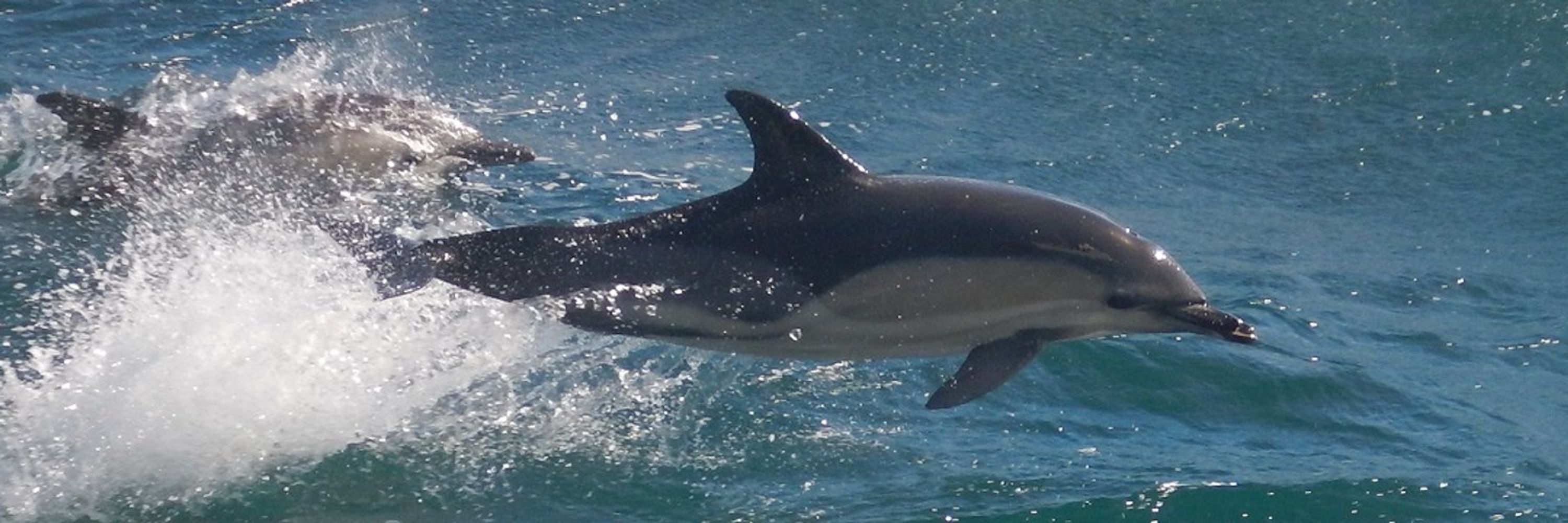
Brilliant photos from @akwildlifefalmouth showing the extent of the octopus surge in the southwest. This Risso's dolphin seemed to be having fun 🐙
I get that the news cycle is packed right now, but I just heard from a colleague at the Smithsonian that this is fully a GIANT SQUID BEING EATEN BY A SPERM WHALE and it’s possibly the first ever confirmed video according to a friend at NOAA

10 YEAR OLD ME IS LOSING HER MIND (a thread 🧵)
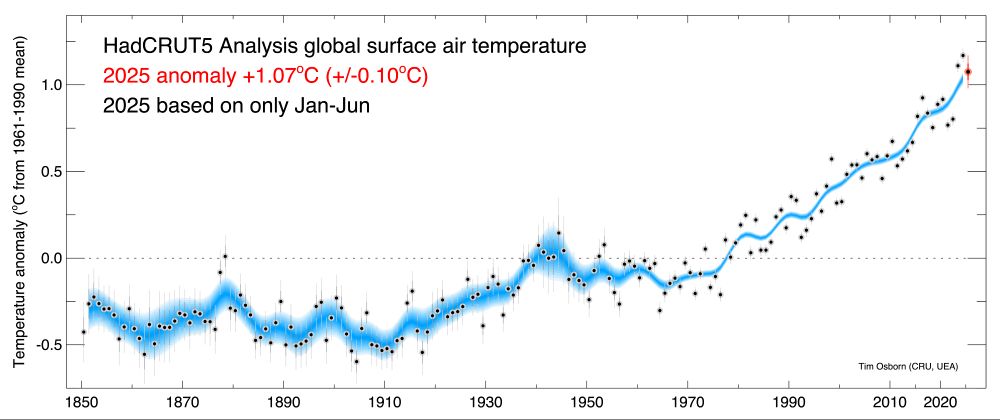
After a brief (ahem) hiatus, the HadCRUT5 global temperature dataset has now been updated to June 2025 by @metoffice.gov.uk @climateuea.bsky.social and @ncas-uk.bsky.social

Reposted by John K. Pinnegar
Great talk on using historical sources to map herring spawning grounds by @georginahunt.bsky.social for @projectfishistory.bsky.social.

Reposted by John K. Pinnegar

🌍🚢🚲 The journey is part of the story!
We’re curious: how did you get to #ICESASC25?

We’re looking for the most sustainable (& maybe surprising!) journey to Klaipeda. Share your travel story & let’s celebrate the many ways our community is reducing its footprint while coming together for science.🌱💙
a large body of water with a sail in the foreground and clouds in the background
ALT: a large body of water with a sail in the foreground and clouds in the background
media.tenor.com

Reposted by John K. Pinnegar

Join us today & Wedn in #ICESASC25 session R, where you can experience the breadth of @icesmarine.bsky.social science: from marine biodiversity & benthic ecology to fish biology & stock assessment to human dimensions - we have it all covered!
@johnkpinnegar.bsky.social @laurauusitalo.bsky.social

Looking forward to seeing you (as one of the co-conveners). I hope you’ve brought an umbrella!

Reposted by John K. Pinnegar

🌀📣 “the scientific case for climate liability is closed “ says lead author of NEW Nature study: may be a game changer tracing and attributing climate damages such as from heat waves 🥵 back to emissions from individual fossil fuel companies #ClimateAction #CarbonMajors

www.nature.com/articles/s41...
Systematic attribution of heatwaves to the emissions of carbon majors - Nature
Climate change made 213 historical heatwaves reported over 2000–2023 more likely and more intense, to which each of the 180 carbon majors (fossil fuel and cement producers) substantially contributed.
www.nature.com

Reposted by John K. Pinnegar

OneBenthic unites seabed data from research, government & industry — incl. offshore wind & marine aggregates.

This collaboration underpins the new BGS Predictive Seabed Sediments (UK) dataset (www.bgs.ac.uk/datasets/bgs...), openly available for science & marine management.

#OneBenthic #OpenData

Reposted by John K. Pinnegar

An unprecedented marine heatwave in 2023 resulted in the global ocean absorbing significantly less CO₂ than anticipated, according to new research involving our School of Environmental Sciences. 🌊🌡️

Read more 👉: bit.ly/41E7BtQ

#CarbonDioxide #OceanSink #ClimateChange

@ueaenv.bsky.social @ethz.ch

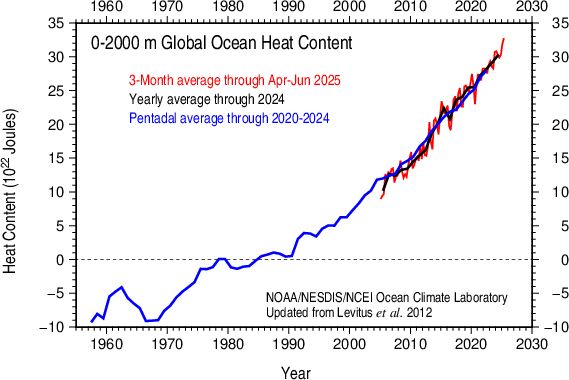
Meanwhile, back in reality, global ocean heat content just updated through June 2025 and set a new record high. Time to wake up!

Data (anomalies) & methods from www.ncei.noaa.gov/access/globa...
🌍 Climate change is already reshaping Mediterranean fisheries.

📊 With indicators like MTC and MTR, we can anticipate risks and opportunities.

💡 Time to act: science, management, and adaptation.

#FutureOfFisheries #BlueTransformation