




CamilleCornet
@camillecornet.bsky.social
PhD student passionate about evolutionary biology 🧬🦋🌿🐝 and adventures in the mountains 🏔️⛺🧗♂️🪂
Reposted by CamilleCornet

An interesting result is that the rate of species description has accelerated, with the largest numbers of new species per year in the past ~20 years. We're currently experiencing an age of discovery for Earth's biodiversity & the role of natural history museum collections couldn't be more important

December 9, 2025 at 12:09 AM
An interesting result is that the rate of species description has accelerated, with the largest numbers of new species per year in the past ~20 years. We're currently experiencing an age of discovery for Earth's biodiversity & the role of natural history museum collections couldn't be more important
Reposted by CamilleCornet

Are you excited about pangenomics? If so, join us in Edinburgh on 8-9th June to discuss the latest methods & insights from using these approaches across biodiversity! More details here:
royalsociety.org/science-even...
Organised together with @henrylnorth.bsky.social & @joanameier.bsky.social!
royalsociety.org/science-even...
Organised together with @henrylnorth.bsky.social & @joanameier.bsky.social!

Pangenomics transforms evolutionary biology | Royal Society
This Theo Murphy meeting organised by Dr Joana Meier, Dr Henry North and Dr Charlotte Wright, will showcase cutting-edge pangenome tools, applied uses of pangenomes which are transforming health and a...
royalsociety.org
December 10, 2025 at 9:15 PM
Are you excited about pangenomics? If so, join us in Edinburgh on 8-9th June to discuss the latest methods & insights from using these approaches across biodiversity! More details here:
royalsociety.org/science-even...
Organised together with @henrylnorth.bsky.social & @joanameier.bsky.social!
royalsociety.org/science-even...
Organised together with @henrylnorth.bsky.social & @joanameier.bsky.social!
The first of many exciting Erebia genomes associated with ERGA-CH 🦋🧬 Stay tuned !! @ergabiodiv.bsky.social

Congratulations Camille @camillecornet.bsky.social for your chromosome level genome of Erebia cassioides - the genome note is out at @riojournal.com riojournal.com/article/174988 being the first genome note of ERGA Switzerland @ergabiodiv.bsky.social

The genome sequence of the Common Brassy Ringlet, Erebia cassioides (Reiner & Hohenwarth, 1792) (Lepidoptera, Nymphalidae)
We present a chromosome-level genome assembly from a female specimen of the Common Brassy Ringlet Erebia cassioides (Arthropoda, Insecta, Lepidoptera, Nymphalidae). The genome consists of a primary as...
riojournal.com
December 8, 2025 at 3:43 PM
The first of many exciting Erebia genomes associated with ERGA-CH 🦋🧬 Stay tuned !! @ergabiodiv.bsky.social
Reposted by CamilleCornet
Are you interested in biodiversity genomics? Fantastic opportunity to join us as a Group Leader at the Tree of Life Programme, @sangerinstitute.bsky.social.
👇
sanger.wd103.myworkdayjobs.com/en-GB/Wellco...
👇
sanger.wd103.myworkdayjobs.com/en-GB/Wellco...
Group Leader - Biodiversity Genomics
Do you want to help us improve human health and understand life on Earth? Make your mark by shaping the future to enable or deliver life-changing science to solve some of humanity’s greatest challenge...
sanger.wd103.myworkdayjobs.com
December 4, 2025 at 12:09 PM
Are you interested in biodiversity genomics? Fantastic opportunity to join us as a Group Leader at the Tree of Life Programme, @sangerinstitute.bsky.social.
👇
sanger.wd103.myworkdayjobs.com/en-GB/Wellco...
👇
sanger.wd103.myworkdayjobs.com/en-GB/Wellco...
Reposted by CamilleCornet

Does obligate asexuality necessarily lead to genomic decay? We found that ancient asexual lineages of oribatid mites have static genomes, frozen in time, whereas genomes of sexual lineages seem to be expanding.

Genomes of ancient asexual mites appear streamlined in their architecture https://www.biorxiv.org/content/10.64898/2025.12.01.691511v1
December 4, 2025 at 9:25 AM
Does obligate asexuality necessarily lead to genomic decay? We found that ancient asexual lineages of oribatid mites have static genomes, frozen in time, whereas genomes of sexual lineages seem to be expanding.
Reposted by CamilleCornet

please share this postdoc job alert! come join the budding Biodiversity Cell Atlas initiative as a postdoc or senior postdoc at @sangerinstitute.bsky.social working closely with @arnausebe.bsky.social and me to make progress on what we cover in this paper www.nature.com/articles/s41...

The Biodiversity Cell Atlas: mapping the tree of life at cellular resolution - Nature
The Biodiversity Cell Atlas aims to create comprehensive single-cell molecular atlases across the eukaryotic tree of life, which will be phylogenetically informed, rely on high-quality genomes and use...
www.nature.com
December 3, 2025 at 1:29 PM
please share this postdoc job alert! come join the budding Biodiversity Cell Atlas initiative as a postdoc or senior postdoc at @sangerinstitute.bsky.social working closely with @arnausebe.bsky.social and me to make progress on what we cover in this paper www.nature.com/articles/s41...
Reposted by CamilleCornet

Biology26, Switzerland’s largest conference on organismal biology—held on Darwin’s birthday to celebrate the past, present, and future of biological research! biology26.ch
Deadline for registration and abstract submission - Dec. 5th
Deadline for registration and abstract submission - Dec. 5th

Join us in Neuchâtel for Biology26, Switzerland’s largest conference on organismal biology—held on Darwin’s birthday to celebrate the past, present, and future of biological research!
biology26.ch
November 30, 2025 at 11:25 AM
Biology26, Switzerland’s largest conference on organismal biology—held on Darwin’s birthday to celebrate the past, present, and future of biological research! biology26.ch
Deadline for registration and abstract submission - Dec. 5th
Deadline for registration and abstract submission - Dec. 5th
Reposted by CamilleCornet
Species sequenced by Project Psyche also contribute to the aims of other projects including ERGA and EBP www.cell.com/trends/ecolo...

Project Psyche: reference genomes for all Lepidoptera in Europe
Project Psyche is a transnational initiative to generate and study chromosome-level
reference genomes of all ~11 000 species of Lepidoptera (butterflies and moths) found
in Europe. Here, we describe t...
www.cell.com
November 29, 2025 at 12:28 PM
Species sequenced by Project Psyche also contribute to the aims of other projects including ERGA and EBP www.cell.com/trends/ecolo...
Reposted by CamilleCornet

(1/5)Thrilled to announce our paper on #ProjectPsyche is out! 🦋We describe how we’ve generated 1000+ high-quality genomes for European Lepidoptera, providing an unprecedented resource for biodiversity, conservation, and evolutionary research.
#Genomics #Biodiversity
www.cell.com/trends/ecolo...
#Genomics #Biodiversity
www.cell.com/trends/ecolo...

Project Psyche: reference genomes for all Lepidoptera in Europe
Project Psyche is a transnational initiative to generate and study chromosome-level
reference genomes of all ~11 000 species of Lepidoptera (butterflies and moths) found
in Europe. Here, we describe t...
www.cell.com
November 27, 2025 at 1:22 PM
(1/5)Thrilled to announce our paper on #ProjectPsyche is out! 🦋We describe how we’ve generated 1000+ high-quality genomes for European Lepidoptera, providing an unprecedented resource for biodiversity, conservation, and evolutionary research.
#Genomics #Biodiversity
www.cell.com/trends/ecolo...
#Genomics #Biodiversity
www.cell.com/trends/ecolo...
I feel so grateful to be involved in such an amazing, collaborative and ground breaking project! Really looking forward to what Project Psyche @projectpsyche.bsky.social will continue to achieve in the future 🦋🧬

One of the most exciting projects I have ever been involved in: Project Psyche! Read all about our ambitions and aims. It's ground breaking stuff, just mind blowing and even surreal (27 years ago we did single genes for lep phylogenetics)! @projectpsyche.bsky.social
www.cell.com/trends/ecolo...
www.cell.com/trends/ecolo...

Project Psyche: reference genomes for all Lepidoptera in Europe
Project Psyche is a transnational initiative to generate and study chromosome-level
reference genomes of all ~11 000 species of Lepidoptera (butterflies and moths) found
in Europe. Here, we describe t...
www.cell.com
November 27, 2025 at 9:09 AM
I feel so grateful to be involved in such an amazing, collaborative and ground breaking project! Really looking forward to what Project Psyche @projectpsyche.bsky.social will continue to achieve in the future 🦋🧬
Reposted by CamilleCornet

We're hiring!
A Post-doctoral fellow in Eco-evolutionary shifts in bumblebee communities. You will be working within @beccsweden.bsky.social w/ Professor Bengt Hansson at The Department of Biology.
👉https://lu.varbi.com/en/what:job/jobID:867222/
Please apply no later than 19 December!
A Post-doctoral fellow in Eco-evolutionary shifts in bumblebee communities. You will be working within @beccsweden.bsky.social w/ Professor Bengt Hansson at The Department of Biology.
👉https://lu.varbi.com/en/what:job/jobID:867222/
Please apply no later than 19 December!

November 26, 2025 at 1:34 PM
We're hiring!
A Post-doctoral fellow in Eco-evolutionary shifts in bumblebee communities. You will be working within @beccsweden.bsky.social w/ Professor Bengt Hansson at The Department of Biology.
👉https://lu.varbi.com/en/what:job/jobID:867222/
Please apply no later than 19 December!
A Post-doctoral fellow in Eco-evolutionary shifts in bumblebee communities. You will be working within @beccsweden.bsky.social w/ Professor Bengt Hansson at The Department of Biology.
👉https://lu.varbi.com/en/what:job/jobID:867222/
Please apply no later than 19 December!
Reposted by CamilleCornet
Do you use genomic data to study Lepidoptera in Europe? Do you want to visit a lab to learn a new skill or build a new collaboration? If so, you should apply for a short term scientific mission! These are small grants to fund research exchanges as part of our Lep10K COST action. All info below!

(1/4) 📣 Exciting news! 📣
The #10KLepGenomes COST Action has opened the second call for Short Term Scientific Missions #STSMs
Keep reading for all the details 👇
The #10KLepGenomes COST Action has opened the second call for Short Term Scientific Missions #STSMs
Keep reading for all the details 👇

November 17, 2025 at 5:18 PM
Do you use genomic data to study Lepidoptera in Europe? Do you want to visit a lab to learn a new skill or build a new collaboration? If so, you should apply for a short term scientific mission! These are small grants to fund research exchanges as part of our Lep10K COST action. All info below!
Reposted by CamilleCornet
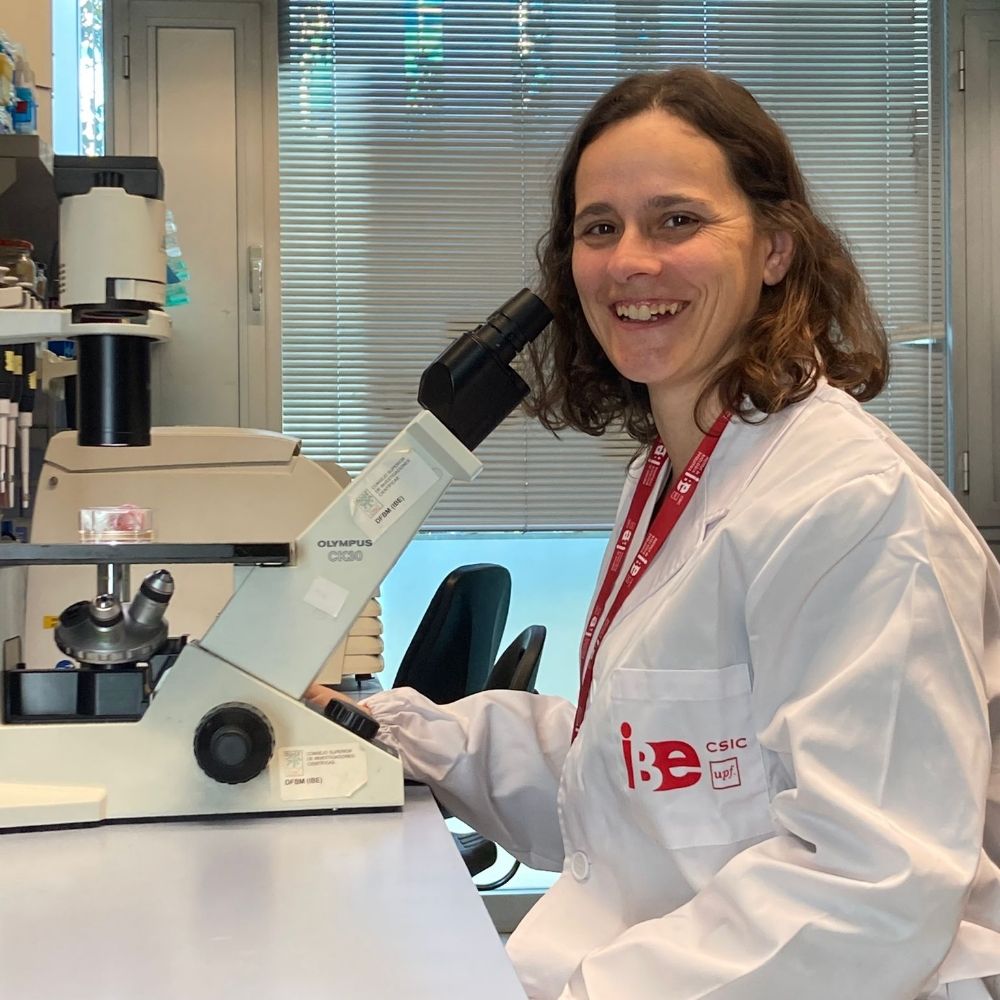
Happy to share Jialin's first publication. She did a great job exploring the transition to land in animals. Co-supervised by the great Jordi Paps and me and in collaboration with Davide Pisani and @phil-donoghue.bsky.social

Nature research paper: Convergent genome evolution shaped the emergence of terrestrial animals
go.nature.com/4i0i61w
go.nature.com/4i0i61w

Convergent genome evolution shaped the emergence of terrestrial animals - Nature
Comparisons of 154 genomes from 21 animal phyla and outgroups have been used to reconstruct ancestral adaptation to life on land across 11 distinct terrestrialization events, revealing strong evidence for convergent genomic evolution across the animal kingdom and recurring periods of terrestrial colonization.
go.nature.com
November 13, 2025 at 3:18 PM
Happy to share Jialin's first publication. She did a great job exploring the transition to land in animals. Co-supervised by the great Jordi Paps and me and in collaboration with Davide Pisani and @phil-donoghue.bsky.social
Reposted by CamilleCornet

Brasó-Vives et al. publish a new Perspective in GBE, highlighting underexplored dimensions of genomic variation that contribute to phenotypic diversity beyond the DNA sequence, contributing to our understanding of genome evolution.
🔗 doi.org/10.1093/gbe/evaf204
#genome #evolution
🔗 doi.org/10.1093/gbe/evaf204
#genome #evolution

November 14, 2025 at 12:17 PM
Brasó-Vives et al. publish a new Perspective in GBE, highlighting underexplored dimensions of genomic variation that contribute to phenotypic diversity beyond the DNA sequence, contributing to our understanding of genome evolution.
🔗 doi.org/10.1093/gbe/evaf204
#genome #evolution
🔗 doi.org/10.1093/gbe/evaf204
#genome #evolution
Reposted by CamilleCornet

1/ Ever needed to annotate TEs in a fungal genome, but didn't know where to start?
We have released #MycoMobilome, a community-focused non-redundant database of transposable element consensus sequences for the fungal kingdom, constructed from >4,000 fungal genomes!
www.biorxiv.org/content/10.1...
We have released #MycoMobilome, a community-focused non-redundant database of transposable element consensus sequences for the fungal kingdom, constructed from >4,000 fungal genomes!
www.biorxiv.org/content/10.1...

October 29, 2025 at 9:02 AM
1/ Ever needed to annotate TEs in a fungal genome, but didn't know where to start?
We have released #MycoMobilome, a community-focused non-redundant database of transposable element consensus sequences for the fungal kingdom, constructed from >4,000 fungal genomes!
www.biorxiv.org/content/10.1...
We have released #MycoMobilome, a community-focused non-redundant database of transposable element consensus sequences for the fungal kingdom, constructed from >4,000 fungal genomes!
www.biorxiv.org/content/10.1...
Reposted by CamilleCornet

I am very excited to present you our work, which will also be very soon on biorxiv!! ✨️

👀Next Wednesday, Oct 22nd, at #FragileNucleosome seminar, we are excited to host @alicelaigle.bsky.social and @seungsookim.bsky.social to tell us about amazing work they are doing!
🗓️Register here for upcoming session and the entire series:
us06web.zoom.us/webinar/regi...
🗓️Register here for upcoming session and the entire series:
us06web.zoom.us/webinar/regi...

October 14, 2025 at 9:11 PM
I am very excited to present you our work, which will also be very soon on biorxiv!! ✨️
Reposted by CamilleCornet
Hospodářská, @petrnguyen.bsky.social et al. investigated genome size and karyotype in Polyommatus and Lysandra butterflies, rejecting polyploidy to confirm karyotypic diversification via chromosome fragmentation in Polyommatinae butterflies.
🔗 doi.org/10.1093/gbe/evaf157
#genome #evolution
🔗 doi.org/10.1093/gbe/evaf157
#genome #evolution

September 22, 2025 at 10:01 AM
Hospodářská, @petrnguyen.bsky.social et al. investigated genome size and karyotype in Polyommatus and Lysandra butterflies, rejecting polyploidy to confirm karyotypic diversification via chromosome fragmentation in Polyommatinae butterflies.
🔗 doi.org/10.1093/gbe/evaf157
#genome #evolution
🔗 doi.org/10.1093/gbe/evaf157
#genome #evolution
Reposted by CamilleCornet

Preprint Alert! 🦥
We produced complete genomes for 2 Xenarthra and placed them in a mammalian comparative framework. We found that Xenarthra harbour the largest number of retrocopies in mammals! www.biorxiv.org/content/10.1...
We produced complete genomes for 2 Xenarthra and placed them in a mammalian comparative framework. We found that Xenarthra harbour the largest number of retrocopies in mammals! www.biorxiv.org/content/10.1...

Retrocopy formation and domestication shape genome evolution in sloths and other xenarthrans
Xenarthrans, comprising sloths, anteaters, and armadillos, represent one of the most morphologically and physiologically specialised mammalian clades, yet the genomic basis of their adaptations remain...
www.biorxiv.org
October 2, 2025 at 9:16 PM
Preprint Alert! 🦥
We produced complete genomes for 2 Xenarthra and placed them in a mammalian comparative framework. We found that Xenarthra harbour the largest number of retrocopies in mammals! www.biorxiv.org/content/10.1...
We produced complete genomes for 2 Xenarthra and placed them in a mammalian comparative framework. We found that Xenarthra harbour the largest number of retrocopies in mammals! www.biorxiv.org/content/10.1...
Reposted by CamilleCornet
To celebrate the genomes for 1,000 (!) species of Lepidoptera in Europe, Project Psyche has released a preprint outlining our ambitions to jointly sequence & leverage genomes of all 11,000 species in Europe to propel science, conservation & society.
This was a joy to write together as a community!
This was a joy to write together as a community!
(6/6)📄 In our new whitepaper (EcoEvoRxiv) we discuss our aims to coordinate this collaborative analysis of Lepidoptera genomes, turning data into impact for science, conservation and society.
Now available at 👉 ecoevorxiv.org/repository/v...
#ProjectPsyche #Genomics
Now available at 👉 ecoevorxiv.org/repository/v...
#ProjectPsyche #Genomics
Project Psyche: Generating and utilising reference genomes for all Lepidoptera in Europe
ecoevorxiv.org
September 18, 2025 at 9:55 AM
To celebrate the genomes for 1,000 (!) species of Lepidoptera in Europe, Project Psyche has released a preprint outlining our ambitions to jointly sequence & leverage genomes of all 11,000 species in Europe to propel science, conservation & society.
This was a joy to write together as a community!
This was a joy to write together as a community!
Reposted by CamilleCornet
PhD opportunity in Bodø! You’ll sequence genomes from invasive and non-invasive slug (A. vulgaris) populations to uncover the molecular basis of invasion dynamics. Supervised by Prof. Les Noble & co-supervisor by me. Fully funded, cutting-edge science, great team. Apply by Sept 21: shorturl.at/zJT06
shorturl.at
September 8, 2025 at 9:12 AM
PhD opportunity in Bodø! You’ll sequence genomes from invasive and non-invasive slug (A. vulgaris) populations to uncover the molecular basis of invasion dynamics. Supervised by Prof. Les Noble & co-supervisor by me. Fully funded, cutting-edge science, great team. Apply by Sept 21: shorturl.at/zJT06
Reposted by CamilleCornet

Hybridization and introgression are major evolutionary processes. Since the 1940s, the prevailing view has been that they shape plants far more than animals. In our new study (www.science.org/doi/10.1126/...
), we find the opposite: animals exchange genes more, and for longer, than plants
), we find the opposite: animals exchange genes more, and for longer, than plants

September 12, 2025 at 7:55 AM
Hybridization and introgression are major evolutionary processes. Since the 1940s, the prevailing view has been that they shape plants far more than animals. In our new study (www.science.org/doi/10.1126/...
), we find the opposite: animals exchange genes more, and for longer, than plants
), we find the opposite: animals exchange genes more, and for longer, than plants
Reposted by CamilleCornet
(1/6) 🦋 We are thrilled to announce the release of the 1,000th reference genome of Lepidoptera species found in Europe!
This goal was reached with the release of Stenoptilia islandicus, also known as the mountain plume moth.
Read the story below!👇🏽
This goal was reached with the release of Stenoptilia islandicus, also known as the mountain plume moth.
Read the story below!👇🏽

September 13, 2025 at 5:35 PM
(1/6) 🦋 We are thrilled to announce the release of the 1,000th reference genome of Lepidoptera species found in Europe!
This goal was reached with the release of Stenoptilia islandicus, also known as the mountain plume moth.
Read the story below!👇🏽
This goal was reached with the release of Stenoptilia islandicus, also known as the mountain plume moth.
Read the story below!👇🏽
Reposted by CamilleCornet
How many chromosomes can an animal have?
In our paper out now in @currentbiology.bsky.social we show that the Atlas blue butterfly has 229 chromosome pairs- the highest in diploid Metazoa! These arose by rapid autosome fragmentation while sex chromosomes stayed intact.
www.cell.com/current-biol...
In our paper out now in @currentbiology.bsky.social we show that the Atlas blue butterfly has 229 chromosome pairs- the highest in diploid Metazoa! These arose by rapid autosome fragmentation while sex chromosomes stayed intact.
www.cell.com/current-biol...
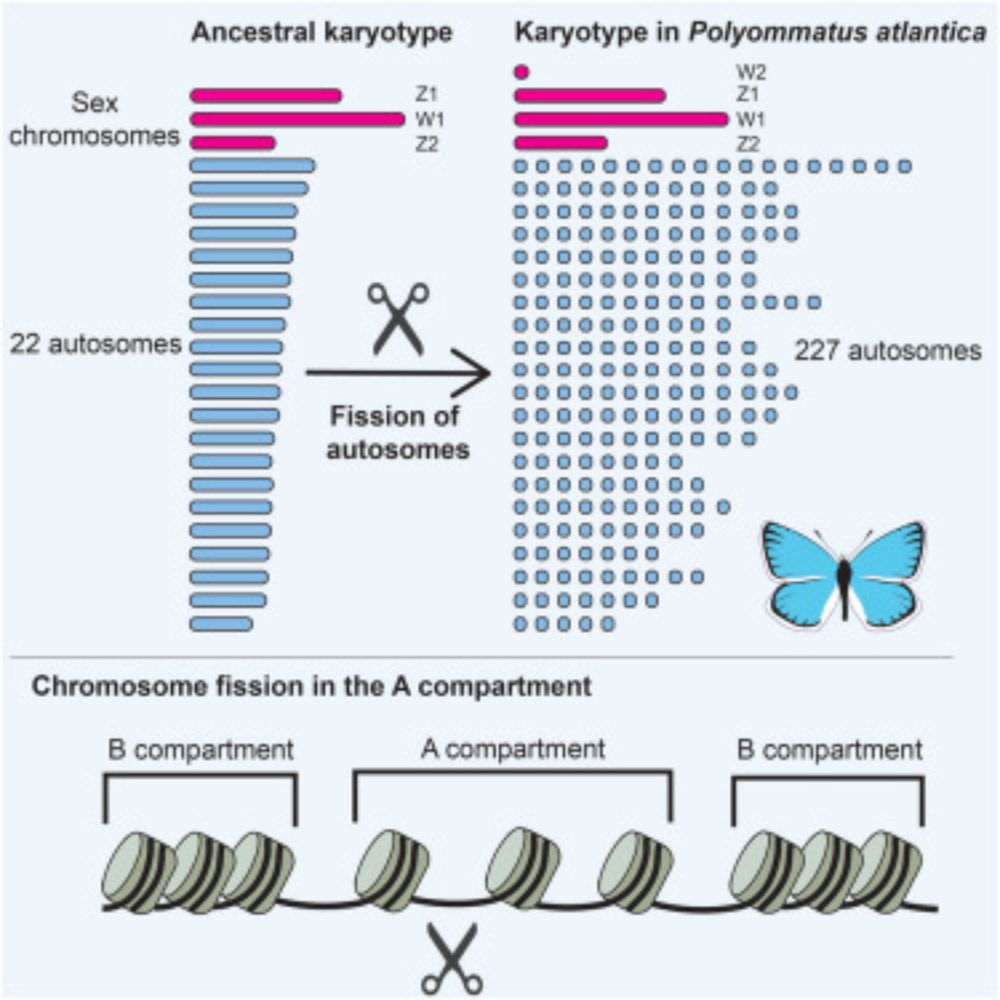
Constraints on chromosome evolution revealed by the 229 chromosome pairs of the Atlas blue butterfly
The genome of the Atlas blue butterfly contains ten times more chromosomes than most
butterflies, and more than any other known diploid animal. Wright et al. show that
this extraordinary karyotype is ...
tinyurl.com
September 11, 2025 at 3:22 PM
How many chromosomes can an animal have?
In our paper out now in @currentbiology.bsky.social we show that the Atlas blue butterfly has 229 chromosome pairs- the highest in diploid Metazoa! These arose by rapid autosome fragmentation while sex chromosomes stayed intact.
www.cell.com/current-biol...
In our paper out now in @currentbiology.bsky.social we show that the Atlas blue butterfly has 229 chromosome pairs- the highest in diploid Metazoa! These arose by rapid autosome fragmentation while sex chromosomes stayed intact.
www.cell.com/current-biol...
Reposted by CamilleCornet

🌍 As climate change reshapes ecosystems, #genomics helps science understand how species might adapt. Hear how @biogeneurope.bsky.social projects are tackling these biodiversity challenges at the Genomics for Biodiversity Conference (online | free) 👇
www.erga-biodiversity.eu/post/genomic...
www.erga-biodiversity.eu/post/genomic...

Genomics for Biodiversity Conference - from genomes to impact
29–31 October 2025Summary🗓️ Dates: 29 - 31 October 2025 (click to add to your agenda!)🔗 Online venue: ERGA YouTube Channel📢 Open call for abstracts: Deadline September 15th (more information below)...
www.erga-biodiversity.eu
September 9, 2025 at 10:31 AM
🌍 As climate change reshapes ecosystems, #genomics helps science understand how species might adapt. Hear how @biogeneurope.bsky.social projects are tackling these biodiversity challenges at the Genomics for Biodiversity Conference (online | free) 👇
www.erga-biodiversity.eu/post/genomic...
www.erga-biodiversity.eu/post/genomic...
Reposted by CamilleCornet

Learnt loads working on this review together with incredible 🌿 biologists! We discuss the role of chromosomal rearrangements in population div. & speciation & attempt to bridge the gap between macro- and microevolutionary processes. www.frontiersin.org/journals/pla...

Frontiers | Bridging micro and macroevolution: insights from chromosomal dynamics in plants
Understanding the relationship between macro- and microevolutionary processes and their delimitation remains a challenge. This review focuses on the role of ...
www.frontiersin.org
August 28, 2025 at 10:07 AM
Learnt loads working on this review together with incredible 🌿 biologists! We discuss the role of chromosomal rearrangements in population div. & speciation & attempt to bridge the gap between macro- and microevolutionary processes. www.frontiersin.org/journals/pla...