



Ng Ting Hui
@siputairtawar.bsky.social
Senior lecturer @ Uni Malaysia Sabah 🇲🇾
Biodiversity, ecology, freshwater molluscs & other inverts, invasive species, natural history collections, Southeast Asia
she/her
https://orcid.org/0000-0002-5123-0039
Biodiversity, ecology, freshwater molluscs & other inverts, invasive species, natural history collections, Southeast Asia
she/her
https://orcid.org/0000-0002-5123-0039
Pinned
Ng Ting Hui
@siputairtawar.bsky.social
· Nov 12
I study the biodiversity and ecology of #freshwater #Mollusca and other #inverts, and #InvasiveSpecies in #SoutheastAsia. Since 2022, I've been a senior lecturer at #UniversitiMalaysiaSabah in 🇲🇾 #Borneo. My research and teaching heavily involves #NaturalHistoryCollections. 🌏🧪 [1/5]
Reposted by Ng Ting Hui

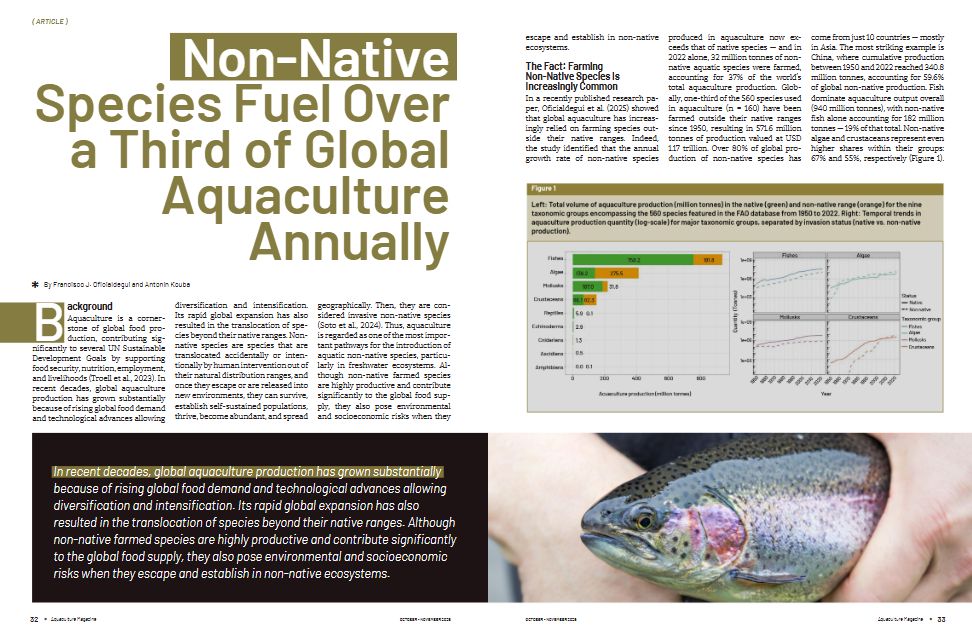
🔵 Aquaculture is one of the most important pathways for the introduction of non-native species.
Since 1950, one third of species used in aquaculture have been farmed outside of their native ranges.
📄 doi.org/10.1111/raq....
🔗 issuu.com/aquaculturem...
Since 1950, one third of species used in aquaculture have been farmed outside of their native ranges.
📄 doi.org/10.1111/raq....
🔗 issuu.com/aquaculturem...
December 9, 2025 at 1:08 PM
🔵 Aquaculture is one of the most important pathways for the introduction of non-native species.
Since 1950, one third of species used in aquaculture have been farmed outside of their native ranges.
📄 doi.org/10.1111/raq....
🔗 issuu.com/aquaculturem...
Since 1950, one third of species used in aquaculture have been farmed outside of their native ranges.
📄 doi.org/10.1111/raq....
🔗 issuu.com/aquaculturem...
Reposted by Ng Ting Hui
Delighted to publish Forum Article by @nicolasgaltier.bsky.social et al:
"Journals run by learned societies or universities have more ethical policies while being cheaper and similarly cited"
doi.org/10.1093/jeb/...
Thank you for choosing JEB - we encourage the support of #societyjournals
"Journals run by learned societies or universities have more ethical policies while being cheaper and similarly cited"
doi.org/10.1093/jeb/...
Thank you for choosing JEB - we encourage the support of #societyjournals

Time to publish responsibly: DAFNEE, a database of academia-friendly journals in ecology and evolutionary biology
Abstract. The current economics of scientific publishing reveal a profound imbalance: academia pays prices far exceeding the actual costs of publication. R
doi.org
December 9, 2025 at 10:16 AM
Delighted to publish Forum Article by @nicolasgaltier.bsky.social et al:
"Journals run by learned societies or universities have more ethical policies while being cheaper and similarly cited"
doi.org/10.1093/jeb/...
Thank you for choosing JEB - we encourage the support of #societyjournals
"Journals run by learned societies or universities have more ethical policies while being cheaper and similarly cited"
doi.org/10.1093/jeb/...
Thank you for choosing JEB - we encourage the support of #societyjournals
Reposted by Ng Ting Hui
Methods tip: Transects are cheaper and more precise at high densities; camera traps cost more but detect rare/low-abundance species and run 24/7.
This study was part of my PhD work advised by Haw Chuan Lim & collab with NParks.
www.sciencedirect.com/science/arti...
This study was part of my PhD work advised by Haw Chuan Lim & collab with NParks.
www.sciencedirect.com/science/arti...

Rapid population growth of greater mouse-deer after active forest restoration and African Swine Fever outbreak
Even as a highly urbanized city-state, Singapore has seen the recolonization of extirpated wildlife amidst habitat restoration efforts and ecological …
www.sciencedirect.com
November 28, 2025 at 7:27 PM
Methods tip: Transects are cheaper and more precise at high densities; camera traps cost more but detect rare/low-abundance species and run 24/7.
This study was part of my PhD work advised by Haw Chuan Lim & collab with NParks.
www.sciencedirect.com/science/arti...
This study was part of my PhD work advised by Haw Chuan Lim & collab with NParks.
www.sciencedirect.com/science/arti...
Reposted by Ng Ting Hui
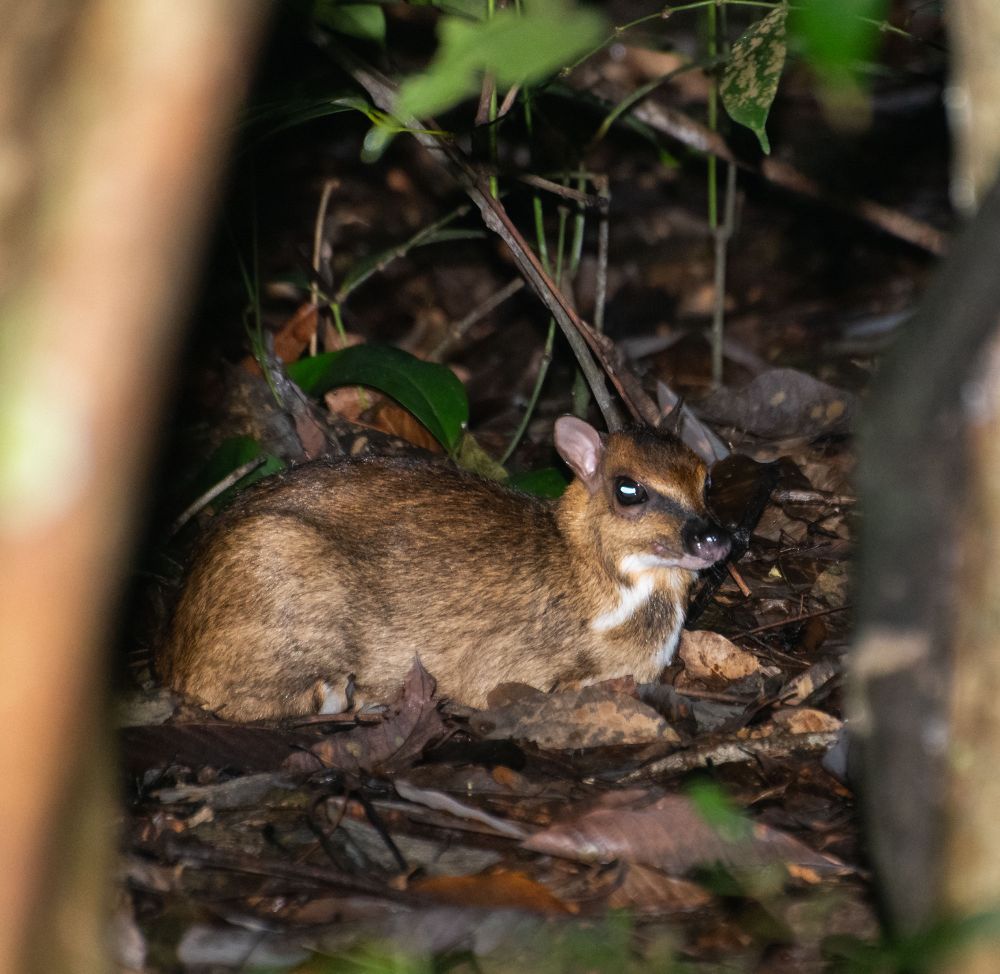
[New paper] After the 2023 African Swine Fever outbreak, greater mouse-deer density on Pulau Ubin, Singapore surged to 293/km2—the highest known for the species.
Likely drivers: >98% wild pig mortality, active reforestation and low predation pressure.
doi.org/10.1016/j.bi...
Likely drivers: >98% wild pig mortality, active reforestation and low predation pressure.
doi.org/10.1016/j.bi...

November 28, 2025 at 7:27 PM
[New paper] After the 2023 African Swine Fever outbreak, greater mouse-deer density on Pulau Ubin, Singapore surged to 293/km2—the highest known for the species.
Likely drivers: >98% wild pig mortality, active reforestation and low predation pressure.
doi.org/10.1016/j.bi...
Likely drivers: >98% wild pig mortality, active reforestation and low predation pressure.
doi.org/10.1016/j.bi...
Reposted by Ng Ting Hui
Thanks Ang Qing for writing this news story on our research findings of mouse-deer population boom on Pulau Ubin after African Swine Fever all but wiped out wild pigs there.
And kudos for getting Bill Laurance & Matt Luskin to comment on the findings.
www.straitstimes.com/singapore/en...
And kudos for getting Bill Laurance & Matt Luskin to comment on the findings.
www.straitstimes.com/singapore/en...

How a fatal virus sparked Pulau Ubin’s mouse-deer boom
The island is now the easiest place in the world to encounter the greater mouse-deer. Read more at straitstimes.com. Read more at straitstimes.com.
www.straitstimes.com
December 8, 2025 at 8:18 PM
Thanks Ang Qing for writing this news story on our research findings of mouse-deer population boom on Pulau Ubin after African Swine Fever all but wiped out wild pigs there.
And kudos for getting Bill Laurance & Matt Luskin to comment on the findings.
www.straitstimes.com/singapore/en...
And kudos for getting Bill Laurance & Matt Luskin to comment on the findings.
www.straitstimes.com/singapore/en...
Reposted by Ng Ting Hui

📣 Our friends at the #ScholCommLab have published a preprint, "The Drain of #ScientificPublishing", and are calling for #research communities, funders, governments, and #universities to "re-communalise publishing to serve #science not the market"
doi.org/10.48550/arX...
#ScholComm #AcademicSky
doi.org/10.48550/arX...
#ScholComm #AcademicSky

December 8, 2025 at 8:53 PM
📣 Our friends at the #ScholCommLab have published a preprint, "The Drain of #ScientificPublishing", and are calling for #research communities, funders, governments, and #universities to "re-communalise publishing to serve #science not the market"
doi.org/10.48550/arX...
#ScholComm #AcademicSky
doi.org/10.48550/arX...
#ScholComm #AcademicSky
Thor-Seng Liew, Jessey Yee Wei Chai, @ladyfern1991.bsky.social, Martinah Lakim (2025) #Phylogeny and #biogeography of the mountain semi-slugs genus Microparmarion ( #Gastropoda: Ariophantidae) in northern Borneo 🇲🇾
doi.org/10.1093/moll... via J. Molluscan Studies @malacsoc.bsky.social 🧪🌏
doi.org/10.1093/moll... via J. Molluscan Studies @malacsoc.bsky.social 🧪🌏
doi.org
December 8, 2025 at 4:25 AM
Thor-Seng Liew, Jessey Yee Wei Chai, @ladyfern1991.bsky.social, Martinah Lakim (2025) #Phylogeny and #biogeography of the mountain semi-slugs genus Microparmarion ( #Gastropoda: Ariophantidae) in northern Borneo 🇲🇾
doi.org/10.1093/moll... via J. Molluscan Studies @malacsoc.bsky.social 🧪🌏
doi.org/10.1093/moll... via J. Molluscan Studies @malacsoc.bsky.social 🧪🌏
Reposted by Ng Ting Hui
Open access via SharedIt rdcu.be/eThTl & Table 1 Suggestions to fostering a lower stress academic workplace for individuals, groups, and institutions >> osf.io/p6yut/files/...
December 5, 2025 at 12:06 PM
Open access via SharedIt rdcu.be/eThTl & Table 1 Suggestions to fostering a lower stress academic workplace for individuals, groups, and institutions >> osf.io/p6yut/files/...
Reposted by Ng Ting Hui
💼 💔 Academia’s toxic love language is playing “hard to get”
🧪 💓 Science is the beautiful pursuit of building knowledge
I wrote an essay for Nature Human Behaviour on treating academia as “just a job” www.nature.com/articles/s41...
What ideas would you add? 💡
#HigherEd #PhDLife #DiversityInSTEM
🧪 💓 Science is the beautiful pursuit of building knowledge
I wrote an essay for Nature Human Behaviour on treating academia as “just a job” www.nature.com/articles/s41...
What ideas would you add? 💡
#HigherEd #PhDLife #DiversityInSTEM
www.nature.com
December 5, 2025 at 10:24 AM
💼 💔 Academia’s toxic love language is playing “hard to get”
🧪 💓 Science is the beautiful pursuit of building knowledge
I wrote an essay for Nature Human Behaviour on treating academia as “just a job” www.nature.com/articles/s41...
What ideas would you add? 💡
#HigherEd #PhDLife #DiversityInSTEM
🧪 💓 Science is the beautiful pursuit of building knowledge
I wrote an essay for Nature Human Behaviour on treating academia as “just a job” www.nature.com/articles/s41...
What ideas would you add? 💡
#HigherEd #PhDLife #DiversityInSTEM
Reposted by Ng Ting Hui

An eel donated to a natural history museum in 1873 had two ticks embedded in its skin, making it the first known instance of ticks parasitizing a fish. But it was only first documented this year, when a tick specialist identified the ticks and reported the case in the Journal of Medical Entomology.

Ticks on an Eel: Museum Specimen is a First of its Kind
Two ticks found on an 1873 electric eel specimen mark the first recorded case of ticks parasitizing a fish—but only documented just this year.
entomologytoday.org
December 3, 2025 at 4:42 PM
An eel donated to a natural history museum in 1873 had two ticks embedded in its skin, making it the first known instance of ticks parasitizing a fish. But it was only first documented this year, when a tick specialist identified the ticks and reported the case in the Journal of Medical Entomology.
Bethânia Oliveira Resende et al. (2025) Collaborative research networks as a strategy to synthesize knowledge of Amazonian #biodiversity. Proc Biol Sci @royalsocietypublishing.org
🔓 doi.org/10.1098/rspb... 🧪🌎🌱
🔓 doi.org/10.1098/rspb... 🧪🌎🌱
doi.org
December 2, 2025 at 1:54 AM
Bethânia Oliveira Resende et al. (2025) Collaborative research networks as a strategy to synthesize knowledge of Amazonian #biodiversity. Proc Biol Sci @royalsocietypublishing.org
🔓 doi.org/10.1098/rspb... 🧪🌎🌱
🔓 doi.org/10.1098/rspb... 🧪🌎🌱
Reposted by Ng Ting Hui

My special issue on gardens and plants as laboratories of premodern science is out on @royalsocietypublishing.org #notesandrecords #nrrs #histplants #histsci #vegscilif #envhist with articles by me, Luzzini on minerals, @johedesan.bsky.social on Guy de La Brosse, Jalobeanu on Bacon, and Benharrech🌱

November 17, 2025 at 11:07 AM
My special issue on gardens and plants as laboratories of premodern science is out on @royalsocietypublishing.org #notesandrecords #nrrs #histplants #histsci #vegscilif #envhist with articles by me, Luzzini on minerals, @johedesan.bsky.social on Guy de La Brosse, Jalobeanu on Bacon, and Benharrech🌱
Reposted by Ng Ting Hui
The Rediscovery of a Challenger Expedition Specimen in William Herdman’s Zoology Museum Collection at the University of Liverpool (and how digitisation is transformative).
Written by Leonie Sedman, Curator of Heritage & Collections Care, University of Liverpool. Along with many other NatSCA…
Written by Leonie Sedman, Curator of Heritage & Collections Care, University of Liverpool. Along with many other NatSCA…

The Rediscovery of a Challenger Expedition Specimen in William Herdman’s Zoology Museum Collection at the University of Liverpool (and how digitisation is transformative).
Written by Leonie Sedman, Curator of Heritage & Collections Care, University of Liverpool. Along with many other NatSCA members, I care for a mixed collection, meaning that one inevitably becomes something of a 'Jack of all trades’ missing out on the academic satisfaction created by specialisation. As a curator who finds collections research to be the most satisfying part of my job, it can be frustrating when that research is often only possible on a ‘need-to-know’ basis - usually when a new display or exhibition is being planned, or when the specimens are to be used in teaching.
natsca.blog
November 20, 2025 at 11:01 AM
The Rediscovery of a Challenger Expedition Specimen in William Herdman’s Zoology Museum Collection at the University of Liverpool (and how digitisation is transformative).
Written by Leonie Sedman, Curator of Heritage & Collections Care, University of Liverpool. Along with many other NatSCA…
Written by Leonie Sedman, Curator of Heritage & Collections Care, University of Liverpool. Along with many other NatSCA…
Reposted by Ng Ting Hui

We wrote the Strain on scientific publishing to highlight the problems of time & trust. With a fantastic group of co-authors, we present The Drain of Scientific Publishing:
a 🧵 1/n
Drain: arxiv.org/abs/2511.04820
Strain: direct.mit.edu/qss/article/...
Oligopoly: direct.mit.edu/qss/article/...
a 🧵 1/n
Drain: arxiv.org/abs/2511.04820
Strain: direct.mit.edu/qss/article/...
Oligopoly: direct.mit.edu/qss/article/...


November 11, 2025 at 11:52 AM
We wrote the Strain on scientific publishing to highlight the problems of time & trust. With a fantastic group of co-authors, we present The Drain of Scientific Publishing:
a 🧵 1/n
Drain: arxiv.org/abs/2511.04820
Strain: direct.mit.edu/qss/article/...
Oligopoly: direct.mit.edu/qss/article/...
a 🧵 1/n
Drain: arxiv.org/abs/2511.04820
Strain: direct.mit.edu/qss/article/...
Oligopoly: direct.mit.edu/qss/article/...
Guide to the #Ferns of Mount Alab 🇲🇾 by @ladyfern1991.bsky.social, Luiza Majuakim & Geofarry Gunsalam. 🌏🧪📚


November 13, 2025 at 9:37 AM
Guide to the #Ferns of Mount Alab 🇲🇾 by @ladyfern1991.bsky.social, Luiza Majuakim & Geofarry Gunsalam. 🌏🧪📚
Reposted by Ng Ting Hui

To read about the history of the Paleontological Research Institution's 1/2 million specimen modern mollusk collections, including many endangered or recently extinct species;
check out page 141 on of the Nautilus issue on the history of malacology collections 🦑🦪🐌
shellmuseum.org/wp-content/u...
check out page 141 on of the Nautilus issue on the history of malacology collections 🦑🦪🐌
shellmuseum.org/wp-content/u...

November 11, 2025 at 12:50 AM
To read about the history of the Paleontological Research Institution's 1/2 million specimen modern mollusk collections, including many endangered or recently extinct species;
check out page 141 on of the Nautilus issue on the history of malacology collections 🦑🦪🐌
shellmuseum.org/wp-content/u...
check out page 141 on of the Nautilus issue on the history of malacology collections 🦑🦪🐌
shellmuseum.org/wp-content/u...
#Histories of #Malacological #Collections special issue in The Nautilus shellmuseum.org/shells-and-s... 🌏🧪🐚🐌🐙🦑🦪🏛️

Publications - Bailey-Matthews National Shell Museum & Aquariums
The Nautilus The Nautilus is a peer-reviewed scientific journal that publishes articles on the biology, ecology, and systematics of mollusks.
shellmuseum.org
November 10, 2025 at 1:17 AM
#Histories of #Malacological #Collections special issue in The Nautilus shellmuseum.org/shells-and-s... 🌏🧪🐚🐌🐙🦑🦪🏛️
Marinoni et al. (2025) Network of biological collections in Paraná State, Brazil—Taxonline: a success story
@biojlinnsoc.bsky.social
doi.org/10.1093/biol...
#biodiversity #collections #openScience 🐚🌿🪲🍄🏛️🌏
@biojlinnsoc.bsky.social
doi.org/10.1093/biol...
#biodiversity #collections #openScience 🐚🌿🪲🍄🏛️🌏

Network of biological collections in Paraná State, Brazil—Taxonline: a success story
Abstract. Scientific biological collections play a vital role in preserving biodiversity knowledge, particularly in regions experiencing rapid environmenta
doi.org
November 4, 2025 at 12:27 AM
Marinoni et al. (2025) Network of biological collections in Paraná State, Brazil—Taxonline: a success story
@biojlinnsoc.bsky.social
doi.org/10.1093/biol...
#biodiversity #collections #openScience 🐚🌿🪲🍄🏛️🌏
@biojlinnsoc.bsky.social
doi.org/10.1093/biol...
#biodiversity #collections #openScience 🐚🌿🪲🍄🏛️🌏
Reposted by Ng Ting Hui

Shell-o...is it a Linnean Lens you're looking for?
Tomorrow, Jon Ablett will share some species from our collection – from sex changing seashells, to killer cone shells. We'll hear how molluscs have been used for dyes, clothing, and even musical instruments.
Join online, 2pm, 4 Nov
Tomorrow, Jon Ablett will share some species from our collection – from sex changing seashells, to killer cone shells. We'll hear how molluscs have been used for dyes, clothing, and even musical instruments.
Join online, 2pm, 4 Nov

Linnean Lens | Treasures of the Linnean Shells collection
A shell show-and-tell, with Jon Ablett, Senior Curator of Mollusca at the Natural History Museum, sharing the Linnean shell collection.
buff.ly
November 3, 2025 at 8:30 AM
Shell-o...is it a Linnean Lens you're looking for?
Tomorrow, Jon Ablett will share some species from our collection – from sex changing seashells, to killer cone shells. We'll hear how molluscs have been used for dyes, clothing, and even musical instruments.
Join online, 2pm, 4 Nov
Tomorrow, Jon Ablett will share some species from our collection – from sex changing seashells, to killer cone shells. We'll hear how molluscs have been used for dyes, clothing, and even musical instruments.
Join online, 2pm, 4 Nov
Reposted by Ng Ting Hui

Finally, our paper on climate is published! Those who are interested can read it via this link - doi.org/10.1016/j.ec...
Redirecting
doi.org
November 2, 2025 at 6:53 AM
Finally, our paper on climate is published! Those who are interested can read it via this link - doi.org/10.1016/j.ec...
Dr @ladyfern1991.bsky.social, Luiza Majuakim, Monica Suleiman, Kanehiro Kitayama, Thor-Seng Liew. Comparison of ambient temperature variations at 2 elevations of ⛰️ #Kinabalu, Sabah, 🇲🇾 #Borneo, 2016–2017 in relation to the El Niño event.
🔓via Climate Change Ecology doi.org/10.1016/j.ec... 🧪🌏
🔓via Climate Change Ecology doi.org/10.1016/j.ec... 🧪🌏
Redirecting
doi.org
November 2, 2025 at 6:46 AM
Dr @ladyfern1991.bsky.social, Luiza Majuakim, Monica Suleiman, Kanehiro Kitayama, Thor-Seng Liew. Comparison of ambient temperature variations at 2 elevations of ⛰️ #Kinabalu, Sabah, 🇲🇾 #Borneo, 2016–2017 in relation to the El Niño event.
🔓via Climate Change Ecology doi.org/10.1016/j.ec... 🧪🌏
🔓via Climate Change Ecology doi.org/10.1016/j.ec... 🧪🌏
Reposted by Ng Ting Hui

Very excited to announce that our collaborative manifesto for 🌱 #PlantScience #Education has now been published! Educators from >10 countries and 30 institutions have contributed to it and we are incredibly proud of the final output. Here is a short thread 🧵1/4 doi.org/10.1002/ppp3...

A manifesto for plant science education
Plants provide oxygen, food, shelter, medicines and environmental services, without which human society could not exist. Tackling pressing and global challenges requires well-trained plant scientists....
doi.org
October 29, 2025 at 9:09 AM
Very excited to announce that our collaborative manifesto for 🌱 #PlantScience #Education has now been published! Educators from >10 countries and 30 institutions have contributed to it and we are incredibly proud of the final output. Here is a short thread 🧵1/4 doi.org/10.1002/ppp3...
Reposted by Ng Ting Hui
Shipworms are actually a common food clam, particularly in Asia! Some cultures throw logs or stumps in the water to farm them! Researchers suggest they could someday make for a sustainable market in the West, as they can be cooked similarly to calamari (312) nautil.us/naked-clams-...

October 30, 2025 at 12:36 AM
Shipworms are actually a common food clam, particularly in Asia! Some cultures throw logs or stumps in the water to farm them! Researchers suggest they could someday make for a sustainable market in the West, as they can be cooked similarly to calamari (312) nautil.us/naked-clams-...
Reposted by Ng Ting Hui
One like, one clam fact
One like, one opinion about how to solve climate change.

1 like, 1 housing opinion
July 22, 2025 at 3:18 AM
One like, one clam fact
Reposted by Ng Ting Hui

Century-old papers saved from the bin reveal changes in Europe’s plant life

Century-old papers saved from the bin reveal changes in Europe’s plant life
Plant inventories dating back to 1884 and nearly thrown away enable unique time-lapse study of biodiversity in Swiss meadows
www.theguardian.com
October 9, 2025 at 4:35 AM
Century-old papers saved from the bin reveal changes in Europe’s plant life