


Tomas Hessler
@tomas-hessler.bsky.social
Postdoc at UC Berkeley Metagenomics | Microbial ecology | Phage | Bioprocess engineering 🇿🇦 views are my own
Reposted by Tomas Hessler

Born #OnThisDay in 1922, Esther Lederberg was the first to isolate the lambda phage in 1951. She characterised the lysogenic phase, whereby the phage are able to integrate into the bacterial genome, staying dormant. This discovery made them a model tool of study, leading to many more breakthroughs.

December 18, 2025 at 10:21 AM
Born #OnThisDay in 1922, Esther Lederberg was the first to isolate the lambda phage in 1951. She characterised the lysogenic phase, whereby the phage are able to integrate into the bacterial genome, staying dormant. This discovery made them a model tool of study, leading to many more breakthroughs.
Reposted by Tomas Hessler

Do you think transporters in E. coli contribute to metabolite release? No? Explore the effect of 66 different transporter knockout mutations on the exometabolome dynamics of ~300 metabolites yourself: keio.unil.ch
Teaser: Increased proline in ΔputP
#microsky #MEvoSky
Teaser: Increased proline in ΔputP
#microsky #MEvoSky

December 3, 2025 at 11:11 AM
Do you think transporters in E. coli contribute to metabolite release? No? Explore the effect of 66 different transporter knockout mutations on the exometabolome dynamics of ~300 metabolites yourself: keio.unil.ch
Teaser: Increased proline in ΔputP
#microsky #MEvoSky
Teaser: Increased proline in ΔputP
#microsky #MEvoSky
Reposted by Tomas Hessler
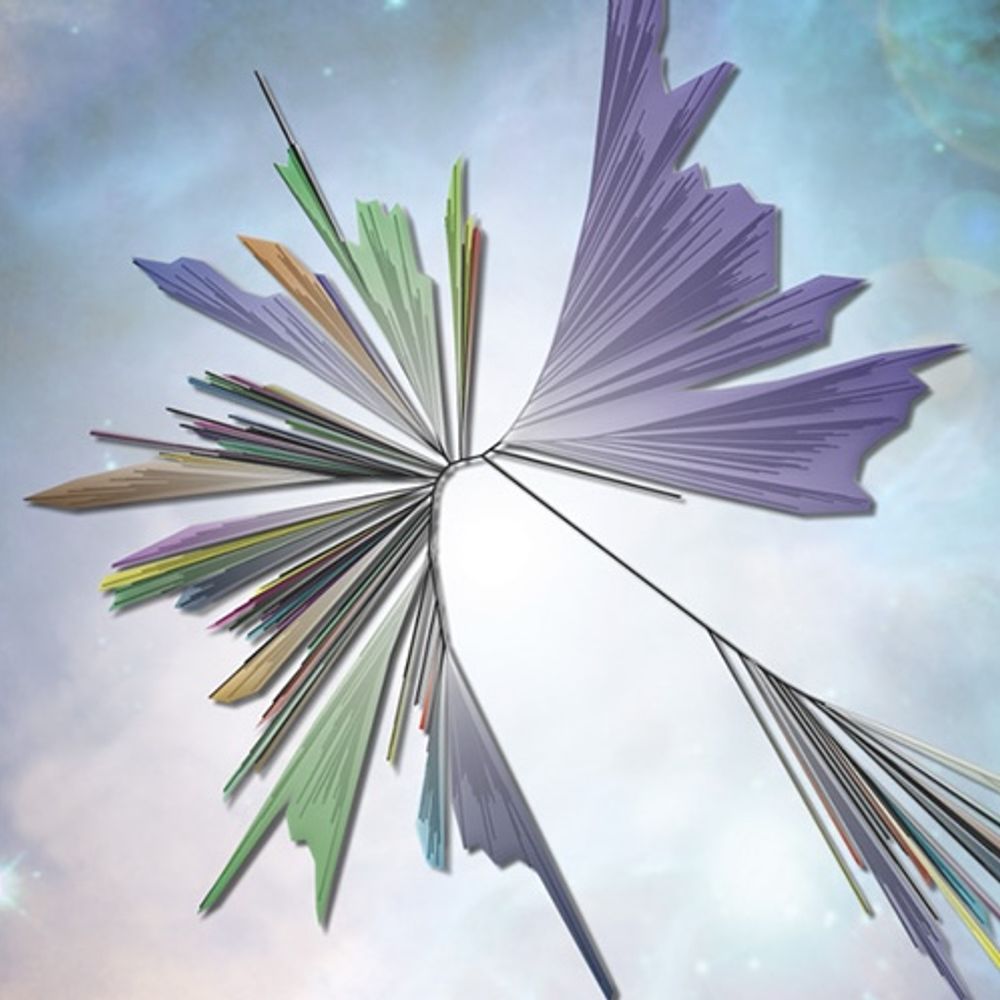
Out now in Nature Communications: Convergent evolution of viral-like Borg archaeal extrachromosomal elements and giant eukaryotic viruses
www.nature.com/articles/s41...
@luisvalentin.bsky.social @lingdong-shi.bsky.social @martianmicrobe.bsky.social @mschoelmerich.bsky.social
www.nature.com/articles/s41...
@luisvalentin.bsky.social @lingdong-shi.bsky.social @martianmicrobe.bsky.social @mschoelmerich.bsky.social

Convergent evolution of viral-like Borg archaeal extrachromosomal elements and giant eukaryotic viruses - Nature Communications
Borgs are large extrachromosomal elements of anaerobic methane-oxidizing archaea. Here, via in silico protein structure prediction of ~10,000 Borg proteins, the authors reveal that Borgs share numerou...
www.nature.com
November 28, 2025 at 9:01 PM
Out now in Nature Communications: Convergent evolution of viral-like Borg archaeal extrachromosomal elements and giant eukaryotic viruses
www.nature.com/articles/s41...
@luisvalentin.bsky.social @lingdong-shi.bsky.social @martianmicrobe.bsky.social @mschoelmerich.bsky.social
www.nature.com/articles/s41...
@luisvalentin.bsky.social @lingdong-shi.bsky.social @martianmicrobe.bsky.social @mschoelmerich.bsky.social
Reposted by Tomas Hessler
#microsky #phagesky
Transposon mutagenesis of jumbo #phage using an anti-CRISPR factor as selectable marker
www.biorxiv.org/content/10.1...
Transposon mutagenesis of jumbo #phage using an anti-CRISPR factor as selectable marker
www.biorxiv.org/content/10.1...

Bacteriophage genome-wide transposon mutagenesis
Bacteriophages have genomes that span a wide size range, are densely packed with coding sequences, and frequently encode genes of unknown function. Classical forward genetics has defined essential gen...
www.biorxiv.org
November 25, 2025 at 8:07 AM
#microsky #phagesky
Transposon mutagenesis of jumbo #phage using an anti-CRISPR factor as selectable marker
www.biorxiv.org/content/10.1...
Transposon mutagenesis of jumbo #phage using an anti-CRISPR factor as selectable marker
www.biorxiv.org/content/10.1...
Reposted by Tomas Hessler
New paper out: An archaeal genetic code with all TAG codons as pyrrolysine: www.science.org/doi/10.1126/...

An archaeal genetic code with all TAG codons as pyrrolysine
Multiple genetic codes developed during the evolution of eukaryotes and bacteria, yet no alternative genetic code is known for archaea. We used proteomics to confirm our prediction that certain archae...
www.science.org
November 23, 2025 at 7:22 PM
New paper out: An archaeal genetic code with all TAG codons as pyrrolysine: www.science.org/doi/10.1126/...
Reposted by Tomas Hessler

We are thrilled to announce our latest publication in the Microbiome journal in collaboration with
@thehesslab.bsky.social
Supplementation with red seaweed in cows reduces methane and induces previously uncharacterized hydrogenotropic bacteria.
microbiomejournal.biomedcentral.com/articles/10....
@thehesslab.bsky.social
Supplementation with red seaweed in cows reduces methane and induces previously uncharacterized hydrogenotropic bacteria.
microbiomejournal.biomedcentral.com/articles/10....

Red seaweed supplementation suppresses methanogenesis in the rumen, revealing potentially advantageous traits among hydrogenotrophic bacteria - Microbiome
Background Macroalgae belonging to the genus Asparagopsis have shown to reduce methane (CH4) production during rumen fermentation, while increasing feed efficiency when added to the feed of cattle. Ho...
microbiomejournal.biomedcentral.com
November 19, 2025 at 12:09 AM
We are thrilled to announce our latest publication in the Microbiome journal in collaboration with
@thehesslab.bsky.social
Supplementation with red seaweed in cows reduces methane and induces previously uncharacterized hydrogenotropic bacteria.
microbiomejournal.biomedcentral.com/articles/10....
@thehesslab.bsky.social
Supplementation with red seaweed in cows reduces methane and induces previously uncharacterized hydrogenotropic bacteria.
microbiomejournal.biomedcentral.com/articles/10....
Reposted by Tomas Hessler
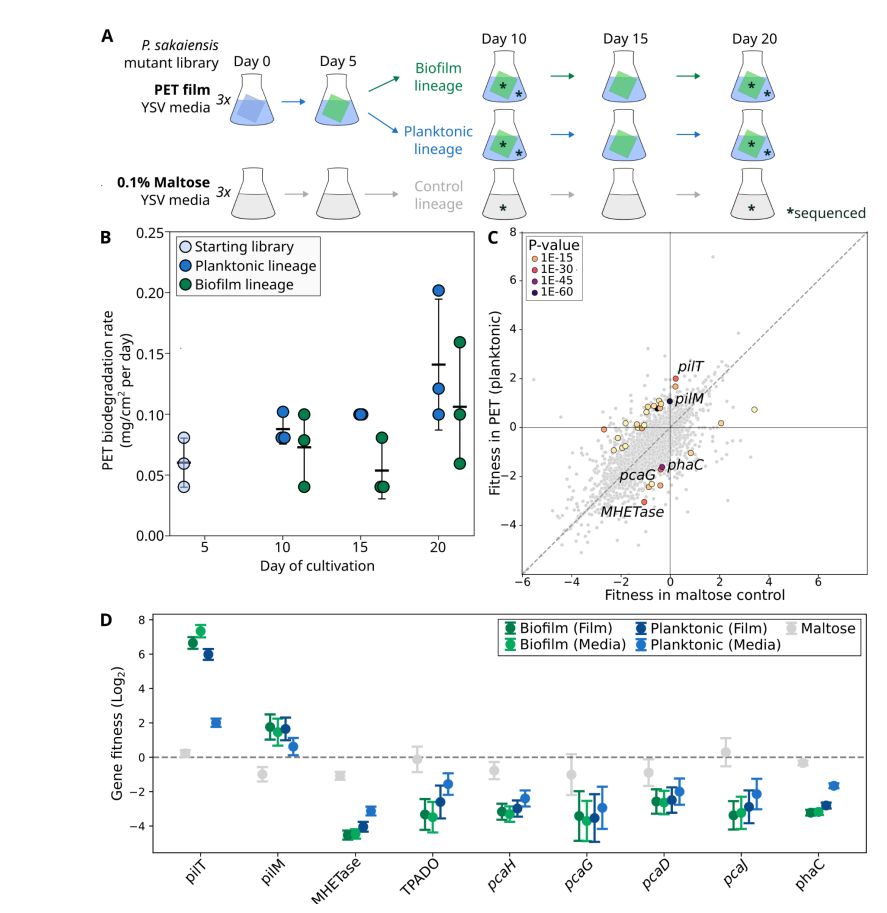
Very happy to share our recent work @cultivarium.bsky.social on genetic tools for Ideonella sakaiensis, a (Betaproteo-)bacterium that degrades PET plastic.
We identified a plasmid vector for the strain and generated a large RB-TnSeq library, screening for genes impacting plastic degradation.
We identified a plasmid vector for the strain and generated a large RB-TnSeq library, screening for genes impacting plastic degradation.
November 12, 2025 at 7:05 PM
Very happy to share our recent work @cultivarium.bsky.social on genetic tools for Ideonella sakaiensis, a (Betaproteo-)bacterium that degrades PET plastic.
We identified a plasmid vector for the strain and generated a large RB-TnSeq library, screening for genes impacting plastic degradation.
We identified a plasmid vector for the strain and generated a large RB-TnSeq library, screening for genes impacting plastic degradation.
Reposted by Tomas Hessler

We selected the laziest mouse at each round to inoculate the next batch of germfree mice: over rounds of selection and passaging, behavior shifted without changes to the mouse genome: rdcu.be/eM3rO
🦠🧫
🦠🧫

Selection and transmission of the gut microbiome alone can shift mammalian behavior
Nature Communications - Here, the authors present evidence that the gut microbiome alone, without changes in the host genome, can shape how animals respond to selection, identifying a bacterium and...
rdcu.be
October 28, 2025 at 7:51 AM
We selected the laziest mouse at each round to inoculate the next batch of germfree mice: over rounds of selection and passaging, behavior shifted without changes to the mouse genome: rdcu.be/eM3rO
🦠🧫
🦠🧫
Reposted by Tomas Hessler

Our new paper maps the tRNA modification landscape in Vibrio cholerae! 💫
We describe differences from E. coli and discuss links to decoding of stress-related codons 🦠
Huge thanks to amazing co-authors and collaborators!
@plos.org #rnasky #microsky #tRNAmodifications
We describe differences from E. coli and discuss links to decoding of stress-related codons 🦠
Huge thanks to amazing co-authors and collaborators!
@plos.org #rnasky #microsky #tRNAmodifications

The tRNA epitranscriptomic landscape and RNA modification enzymes in Vibrio cholerae
Author summary This study charts the first genome-wide map of transfer RNA (tRNA) modifications in the cholera pathogen, Vibrio cholerae, revealing how chemical marks on tRNAs shape translation and st...
journals.plos.org
November 3, 2025 at 11:58 PM
Our new paper maps the tRNA modification landscape in Vibrio cholerae! 💫
We describe differences from E. coli and discuss links to decoding of stress-related codons 🦠
Huge thanks to amazing co-authors and collaborators!
@plos.org #rnasky #microsky #tRNAmodifications
We describe differences from E. coli and discuss links to decoding of stress-related codons 🦠
Huge thanks to amazing co-authors and collaborators!
@plos.org #rnasky #microsky #tRNAmodifications
Reposted by Tomas Hessler

How do spontaneous mutations arise?
In this latest #GENETICS review, Susan Lovett and @thalia.bsky.social provide a detailed overview of bacterial genetics experiments instrumental in understanding how genomes change. buff.ly/CXJnTqn
In this latest #GENETICS review, Susan Lovett and @thalia.bsky.social provide a detailed overview of bacterial genetics experiments instrumental in understanding how genomes change. buff.ly/CXJnTqn

October 7, 2025 at 6:02 PM
How do spontaneous mutations arise?
In this latest #GENETICS review, Susan Lovett and @thalia.bsky.social provide a detailed overview of bacterial genetics experiments instrumental in understanding how genomes change. buff.ly/CXJnTqn
In this latest #GENETICS review, Susan Lovett and @thalia.bsky.social provide a detailed overview of bacterial genetics experiments instrumental in understanding how genomes change. buff.ly/CXJnTqn
Reposted by Tomas Hessler

VACANCY - Independent research fellowships leading to tenured positions
We’re inviting applications from outstanding researchers who either hold, or wish to apply for, Independent Research Fellowships.
APPLICATION DEADLINE: 10 November 2025
Click here to apply: jic.link/Fellows
We’re inviting applications from outstanding researchers who either hold, or wish to apply for, Independent Research Fellowships.
APPLICATION DEADLINE: 10 November 2025
Click here to apply: jic.link/Fellows

October 3, 2025 at 3:11 PM
VACANCY - Independent research fellowships leading to tenured positions
We’re inviting applications from outstanding researchers who either hold, or wish to apply for, Independent Research Fellowships.
APPLICATION DEADLINE: 10 November 2025
Click here to apply: jic.link/Fellows
We’re inviting applications from outstanding researchers who either hold, or wish to apply for, Independent Research Fellowships.
APPLICATION DEADLINE: 10 November 2025
Click here to apply: jic.link/Fellows
Reposted by Tomas Hessler
Now online at @nature.com we show how the Panoptes defense system protects against viruses that attempt immune evasion - and expands our understanding of the role of oligonucleotides in immunity.
Check out this work co-led with @benadler.bsky.social here:
www.nature.com/articles/s41...
Check out this work co-led with @benadler.bsky.social here:
www.nature.com/articles/s41...

A miniature CRISPR–Cas10 enzyme confers immunity by inhibitory signalling - Nature
Panoptes, an anti-phage defence system against virus-mediated immune suppression, is revealed.
www.nature.com
October 2, 2025 at 3:01 AM
Now online at @nature.com we show how the Panoptes defense system protects against viruses that attempt immune evasion - and expands our understanding of the role of oligonucleotides in immunity.
Check out this work co-led with @benadler.bsky.social here:
www.nature.com/articles/s41...
Check out this work co-led with @benadler.bsky.social here:
www.nature.com/articles/s41...
Reposted by Tomas Hessler
Most plasmids described in E. coli are small compared to the megaplasmids we identified here! Check out the preprint if you want to learn about these mysterious large elements and their potential functions 🧬. I’m very grateful to have had the opportunity to work on this in @banfieldlab.bsky.social

Megaplasmids associate with Escherichia coli and other Enterobacteriaceae https://www.biorxiv.org/content/10.1101/2025.09.30.679422v1
October 1, 2025 at 5:10 AM
Most plasmids described in E. coli are small compared to the megaplasmids we identified here! Check out the preprint if you want to learn about these mysterious large elements and their potential functions 🧬. I’m very grateful to have had the opportunity to work on this in @banfieldlab.bsky.social
Reposted by Tomas Hessler
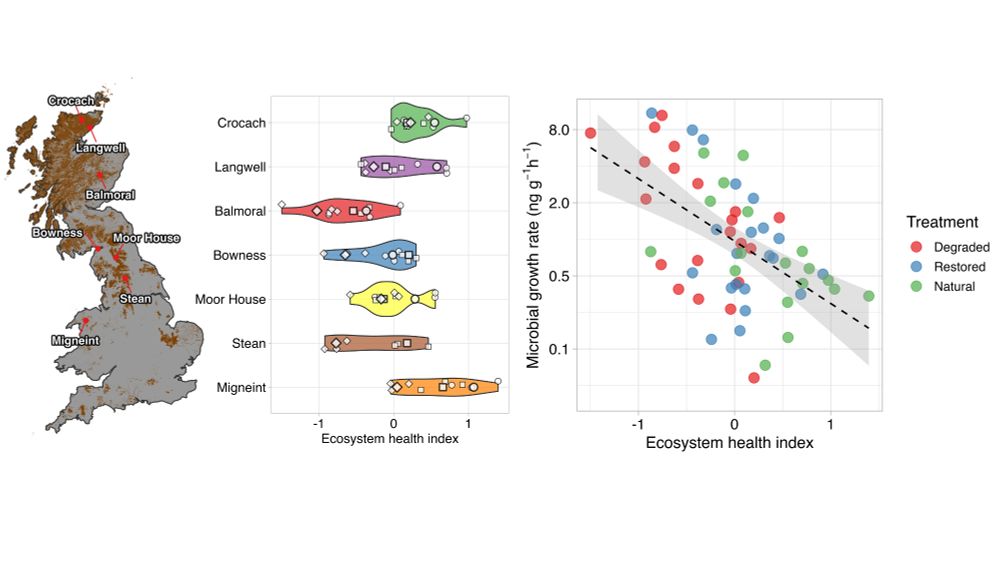
📢 New preprint on work by my first PhD student William Pallier.
Recovery of microbial ecophysiology and carbon accrual functions in peatlands under restoration.
We demonstrate that microbial ecophysiology predictably changes with peatland ecosystem health.
www.biorxiv.org/content/10.1...
Recovery of microbial ecophysiology and carbon accrual functions in peatlands under restoration.
We demonstrate that microbial ecophysiology predictably changes with peatland ecosystem health.
www.biorxiv.org/content/10.1...
August 4, 2025 at 4:31 PM
📢 New preprint on work by my first PhD student William Pallier.
Recovery of microbial ecophysiology and carbon accrual functions in peatlands under restoration.
We demonstrate that microbial ecophysiology predictably changes with peatland ecosystem health.
www.biorxiv.org/content/10.1...
Recovery of microbial ecophysiology and carbon accrual functions in peatlands under restoration.
We demonstrate that microbial ecophysiology predictably changes with peatland ecosystem health.
www.biorxiv.org/content/10.1...
Reposted by Tomas Hessler
How much of selection in human microbiomes is driven by phage?
Excited to share our latest, led by A. Delphine Tripp, showing a case where phage is just not that important:
Phage-mediated lysis does not determine Cutibacterium acnes colonization on human skin
www.biorxiv.org/content/10.1...
🧵
Excited to share our latest, led by A. Delphine Tripp, showing a case where phage is just not that important:
Phage-mediated lysis does not determine Cutibacterium acnes colonization on human skin
www.biorxiv.org/content/10.1...
🧵

Phage-mediated lysis does not determine Cutibacterium acnes colonization on human skin
Despite Cutibacterium acnes being the most abundant and prevalent bacteria on human skin, only a single type of phage has been identified that infects this host. Here, we leverage this one-to-one syst...
www.biorxiv.org
September 22, 2025 at 5:57 PM
How much of selection in human microbiomes is driven by phage?
Excited to share our latest, led by A. Delphine Tripp, showing a case where phage is just not that important:
Phage-mediated lysis does not determine Cutibacterium acnes colonization on human skin
www.biorxiv.org/content/10.1...
🧵
Excited to share our latest, led by A. Delphine Tripp, showing a case where phage is just not that important:
Phage-mediated lysis does not determine Cutibacterium acnes colonization on human skin
www.biorxiv.org/content/10.1...
🧵
Reposted by Tomas Hessler

You like phages ? In this publication, we use metaHiC and our new version of the MetaTOR pipeline to challenge the traditional view of phages with a narrow host range.
@rkoszul.bsky.social @natmicrobiol.nature.com @cnrs.fr @institutpasteur.bsky.social
www.nature.com/articles/s41...
@rkoszul.bsky.social @natmicrobiol.nature.com @cnrs.fr @institutpasteur.bsky.social
www.nature.com/articles/s41...

Phages with a broad host range are common across ecosystems - Nature Microbiology
Proximity-ligation-based sequencing from 111 samples and 5 environments reveals that a substantial proportion of phages infect multiple species.
www.nature.com
September 19, 2025 at 9:32 AM
You like phages ? In this publication, we use metaHiC and our new version of the MetaTOR pipeline to challenge the traditional view of phages with a narrow host range.
@rkoszul.bsky.social @natmicrobiol.nature.com @cnrs.fr @institutpasteur.bsky.social
www.nature.com/articles/s41...
@rkoszul.bsky.social @natmicrobiol.nature.com @cnrs.fr @institutpasteur.bsky.social
www.nature.com/articles/s41...
Reposted by Tomas Hessler
The Department of Biology at Colorado State University is hiring an Assistant Professor in the area of plant-microbe interactions! Please spread the word!
jobs.colostate.edu/postings/165...
jobs.colostate.edu/postings/165...

Assistant Professor Plant-Microbe Interactions
We seek a creative, collaborative, and visionary plant biologist to establish an internationally recognized research program at the forefront of plant-microbe interactions aimed at understanding how t...
jobs.colostate.edu
September 8, 2025 at 3:45 PM
The Department of Biology at Colorado State University is hiring an Assistant Professor in the area of plant-microbe interactions! Please spread the word!
jobs.colostate.edu/postings/165...
jobs.colostate.edu/postings/165...
Reposted by Tomas Hessler

GPU-accelerated MMseqs2 offers tremendous speedup for homology retrieval, protein structure prediction with ColabFold, and protein structure search with Foldseek. @martinsteinegger.bsky.social @milot.bsky.social @machine.learning.bio
www.nature.com/articles/s41...
www.nature.com/articles/s41...
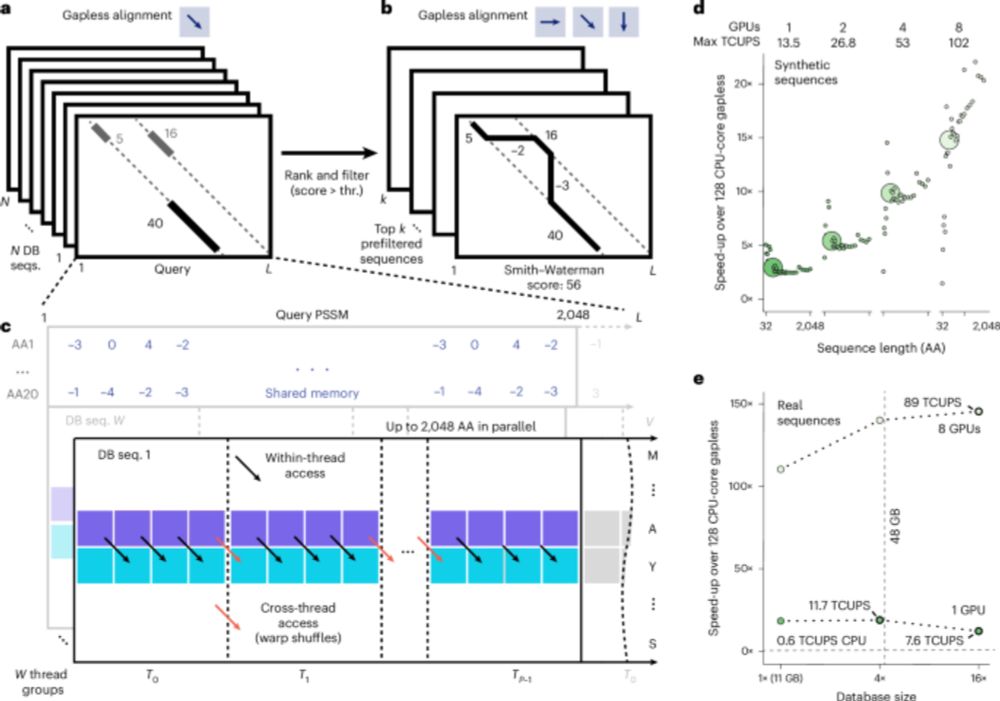
GPU-accelerated homology search with MMseqs2 - Nature Methods
Graphics processing unit-accelerated MMseqs2 offers tremendous speedups for homology retrieval from metagenomic databases, query-centered multiple sequence alignment generation for structure predictio...
www.nature.com
September 18, 2025 at 8:09 PM
GPU-accelerated MMseqs2 offers tremendous speedup for homology retrieval, protein structure prediction with ColabFold, and protein structure search with Foldseek. @martinsteinegger.bsky.social @milot.bsky.social @machine.learning.bio
www.nature.com/articles/s41...
www.nature.com/articles/s41...
Reposted by Tomas Hessler

Hexokinase 2 (HK2) is known for its metabolic role in #glycolysis. This study shows that it also functions as an #RNAbindingProtein that regulates mRNA translation, particularly of SOX10, promoting #melanoma cell proliferation independently of glycolysis @plosbiology.org 🧪 plos.io/3ViI1qL

September 17, 2025 at 4:44 PM
Hexokinase 2 (HK2) is known for its metabolic role in #glycolysis. This study shows that it also functions as an #RNAbindingProtein that regulates mRNA translation, particularly of SOX10, promoting #melanoma cell proliferation independently of glycolysis @plosbiology.org 🧪 plos.io/3ViI1qL
Reposted by Tomas Hessler

Naiavirus: an enveloped giant virus with a pleomorphic, flexible tail
nature.com/articles/s41467-025-63463-6
nature.com/articles/s41467-025-63463-6

Naiavirus: an enveloped giant virus with a pleomorphic, flexible tail - Nature Communications
Rodrigues and Queiroz et al. report the discovery of Naiavirus, the largest enveloped virus, isolated from a Brazil biome. With an oval capsid and flexible tail, its giant genome holds many novel gene...
nature.com
September 17, 2025 at 3:36 PM
Naiavirus: an enveloped giant virus with a pleomorphic, flexible tail
nature.com/articles/s41467-025-63463-6
nature.com/articles/s41467-025-63463-6
Reposted by Tomas Hessler

Nature research paper: Programmable antisense oligomers for phage functional genomics
go.nature.com/46b1XAQ
go.nature.com/46b1XAQ

Programmable antisense oligomers for phage functional genomics - Nature
Establishing antisense oligomers as versatile, non-genetic tools to silence phage mRNAs opens applications in basic research and biotechnology, as shown by identifying essential factors for propagation of the nucleus-forming jumbo phage ΦKZ such as the RNase H-like protein ΦKZ155.
go.nature.com
September 12, 2025 at 8:14 AM
Nature research paper: Programmable antisense oligomers for phage functional genomics
go.nature.com/46b1XAQ
go.nature.com/46b1XAQ
Reposted by Tomas Hessler
Quantifying phage infectivity from characteristics of bacterial population dynamics www.pnas.org/doi/abs/10.1... #jcampubs

Quantifying phage infectivity from characteristics of bacterial population dynamics | PNAS
A frequent goal of phage biology is to quantify how well a phage kills a population
of host bacteria. Unfortunately, traditional methods to quantif...
www.pnas.org
September 9, 2025 at 2:33 PM
Quantifying phage infectivity from characteristics of bacterial population dynamics www.pnas.org/doi/abs/10.1... #jcampubs
Reposted by Tomas Hessler
Our paper on model cyanobacterial communities by @andrejakust.bsky.social is finally typeset and looks beautiful, check it out:
academic.oup.com/ismej/articl...
academic.oup.com/ismej/articl...
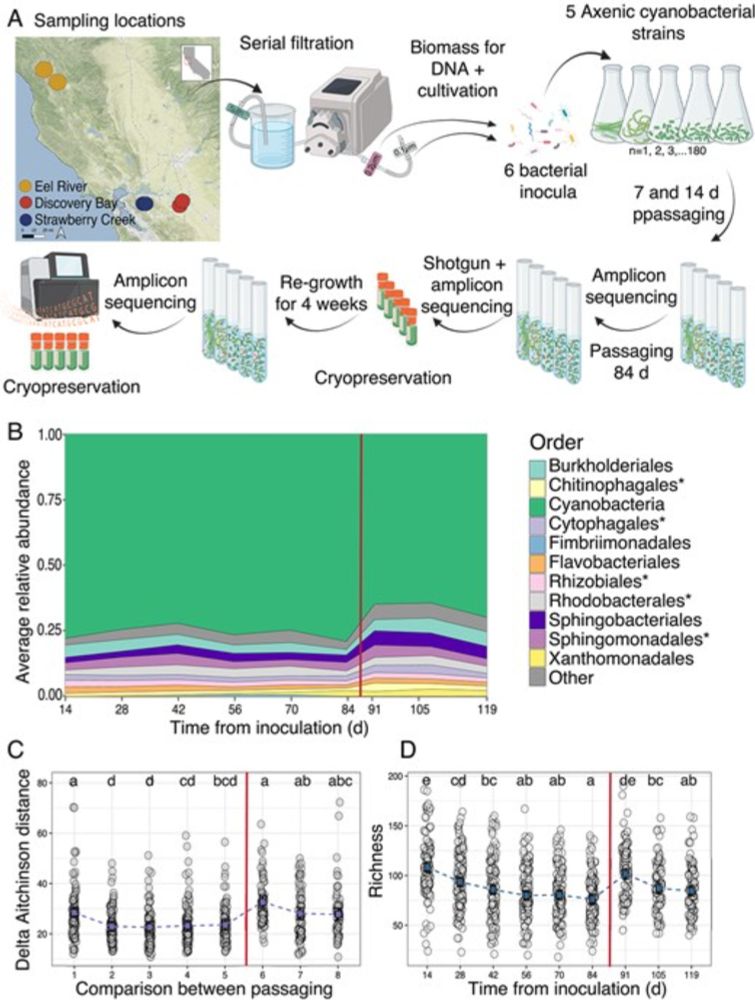
Model cyanobacterial consortia reveal a consistent core microbiome independent of inoculation source or cyanobacterial host species
Abstract. Cyanobacteria are integral to biogeochemical cycles, influence climate processes, and hold promise for commercial applications. In natural habita
academic.oup.com
September 2, 2025 at 4:21 PM
Our paper on model cyanobacterial communities by @andrejakust.bsky.social is finally typeset and looks beautiful, check it out:
academic.oup.com/ismej/articl...
academic.oup.com/ismej/articl...
Reposted by Tomas Hessler

I was shocked when I first saw these results from standard climate models used in IPCC reports: for high emissions, the Atlantic overturning circulation #AMOC shuts down in all 9 models that ran past 2100, and is well on the way to shutdown by 2100.
Our paper on that is out today.🧵
Our paper on that is out today.🧵

August 28, 2025 at 3:55 PM
I was shocked when I first saw these results from standard climate models used in IPCC reports: for high emissions, the Atlantic overturning circulation #AMOC shuts down in all 9 models that ran past 2100, and is well on the way to shutdown by 2100.
Our paper on that is out today.🧵
Our paper on that is out today.🧵
Reposted by Tomas Hessler
Widespread purine bias in bacterial genes driven by runaway transcription www.biorxiv.org/content/10.1... #jcampubs
August 26, 2025 at 1:12 PM
Widespread purine bias in bacterial genes driven by runaway transcription www.biorxiv.org/content/10.1... #jcampubs