



If anyone has any ideas that they would like to work on in choanoflagellates or Nematostella (or both) then please reach out!

Attention scientists from all over the world🙃
The Call for Letters of Intent for #HFSPResearchGrants 2027 is now open! 🧪
Get your international & interdisciplinary team. It's time to put your bold research idea into practice!
🔗https://bit.ly/48VsGCG
📅 15 Dec 2025–26 Mar 2026
#sts #LifeSciences
The Call for Letters of Intent for #HFSPResearchGrants 2027 is now open! 🧪
Get your international & interdisciplinary team. It's time to put your bold research idea into practice!
🔗https://bit.ly/48VsGCG
📅 15 Dec 2025–26 Mar 2026
#sts #LifeSciences

December 16, 2025 at 10:13 AM
If anyone has any ideas that they would like to work on in choanoflagellates or Nematostella (or both) then please reach out!
He also has a poster on Monday
[P0971] Cellular Transformers: Surface Glycans Mediate Robust Assembly of Silica Cages in Loricate Choanoflagellates [Board No. 405]
[P0971] Cellular Transformers: Surface Glycans Mediate Robust Assembly of Silica Cages in Loricate Choanoflagellates [Board No. 405]
December 6, 2025 at 6:40 PM
He also has a poster on Monday
[P0971] Cellular Transformers: Surface Glycans Mediate Robust Assembly of Silica Cages in Loricate Choanoflagellates [Board No. 405]
[P0971] Cellular Transformers: Surface Glycans Mediate Robust Assembly of Silica Cages in Loricate Choanoflagellates [Board No. 405]
#aECM at #CellBio2025 Deepak Krishnamurthygave a fascinating talk about how choanoflagellates use glycans to help build 3D basket structures or « lorica » around themselves
December 6, 2025 at 6:27 PM
#aECM at #CellBio2025 Deepak Krishnamurthygave a fascinating talk about how choanoflagellates use glycans to help build 3D basket structures or « lorica » around themselves

Super excited to be speaking at ASCB tomorrow at the "Cell Biology at the Extremes" session on our work on loricate choanoflagellates. In this talk I will explore "How can a single cell build complex extracellular structures in a noisy environment?" Saturday, December 6 from 11 AM Room 120.
December 6, 2025 at 3:43 AM
Super excited to be speaking at ASCB tomorrow at the "Cell Biology at the Extremes" session on our work on loricate choanoflagellates. In this talk I will explore "How can a single cell build complex extracellular structures in a noisy environment?" Saturday, December 6 from 11 AM Room 120.
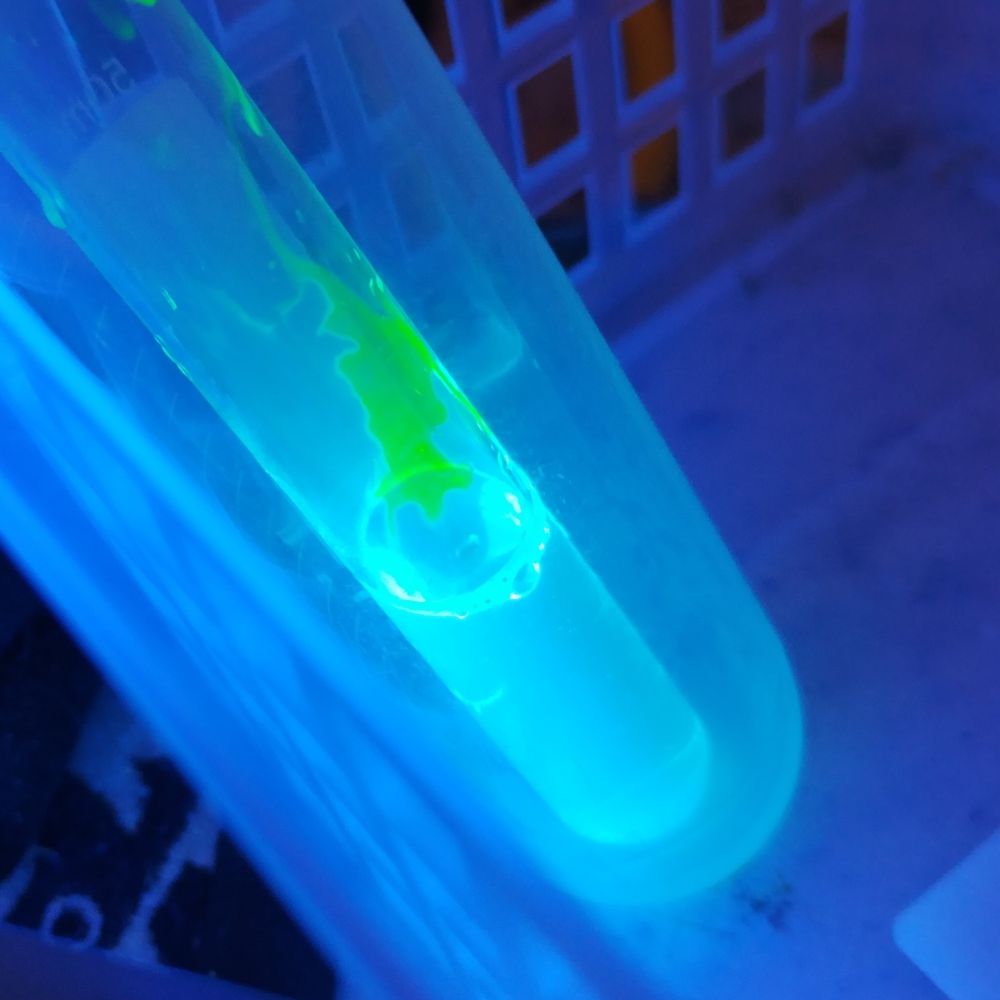
Opisthokonts generally often generate chitin, for example hydrozoans have chitinous tunics, choanoflagellates secrete chitin alongside cellulose, etc.
It's more like we are talking about sister clades having similar structural polymers.
pmc.ncbi.nlm.nih.gov/articles/PMC...
It's more like we are talking about sister clades having similar structural polymers.
pmc.ncbi.nlm.nih.gov/articles/PMC...

Early Divergence, Broad Distribution, and High Diversity of Animal Chitin Synthases
Even though chitin is one of the most abundant biopolymers in nature, current knowledge on chitin formation is largely based only on data from fungi and insects. This study reveals unanticipated broad taxonomic distribution and extensive ...
pmc.ncbi.nlm.nih.gov
November 28, 2025 at 8:08 AM
Opisthokonts generally often generate chitin, for example hydrozoans have chitinous tunics, choanoflagellates secrete chitin alongside cellulose, etc.
It's more like we are talking about sister clades having similar structural polymers.
pmc.ncbi.nlm.nih.gov/articles/PMC...
It's more like we are talking about sister clades having similar structural polymers.
pmc.ncbi.nlm.nih.gov/articles/PMC...

In this week's DB unit seminar @embl.org, Eva Pillai @evapillai.bsky.social , a postdoc in the Arendt, Diz-Muñoz @diz-lab.bsky.social and Brunet groups @thibautbrunet.bsky.social , shared insights on the role of cell surface mechanics in multicellularity, using choanoflagellates as a model organism

November 20, 2025 at 7:52 AM
In this week's DB unit seminar @embl.org, Eva Pillai @evapillai.bsky.social , a postdoc in the Arendt, Diz-Muñoz @diz-lab.bsky.social and Brunet groups @thibautbrunet.bsky.social , shared insights on the role of cell surface mechanics in multicellularity, using choanoflagellates as a model organism

Some synteny exists with choanoflagellates, but few orthologous genes remain, given the long evolutionary distance. This probably increases the likelihood of homoplasy. Genome structure may thus be more informative for testing nested relationships than for determining the root of the tree.
November 17, 2025 at 9:22 AM
Some synteny exists with choanoflagellates, but few orthologous genes remain, given the long evolutionary distance. This probably increases the likelihood of homoplasy. Genome structure may thus be more informative for testing nested relationships than for determining the root of the tree.

How a microscopic, single-celled organism can help us to understand how animals first evolved: Prof @maxjtelford.bsky.social @ucllifesciences.bsky.social writes about choanoflagellates, the closest living relative to animals, in @uk.theconversation.com theconversation.com/how-the-firs...

How the first animals evolved – a new clue from a tiny relative
Meet the choanoflagellates - the microscopic cousins of animals.
theconversation.com
October 30, 2025 at 5:42 PM
How a microscopic, single-celled organism can help us to understand how animals first evolved: Prof @maxjtelford.bsky.social @ucllifesciences.bsky.social writes about choanoflagellates, the closest living relative to animals, in @uk.theconversation.com theconversation.com/how-the-firs...

Meet the choanoflagellates - the microscopic cousins of animals.

How the first animals evolved – a new clue from a tiny relative
Meet the choanoflagellates - the microscopic cousins of animals.
tcnv.link
October 29, 2025 at 5:21 PM
Meet the choanoflagellates - the microscopic cousins of animals.

Congratulations (and thank you) to Prof. Nicole King (@berkeleymcb.bsky.social) for her fascinating Alma Howard Lecture @biomcgill.bsky.social 🎉🤩👩🔬
She shared new data on the secret (sex) lives of choanoflagellates and their implications for the evolution of mating and multicellularity in animals 🦠
She shared new data on the secret (sex) lives of choanoflagellates and their implications for the evolution of mating and multicellularity in animals 🦠

September 25, 2025 at 4:45 PM
Congratulations (and thank you) to Prof. Nicole King (@berkeleymcb.bsky.social) for her fascinating Alma Howard Lecture @biomcgill.bsky.social 🎉🤩👩🔬
She shared new data on the secret (sex) lives of choanoflagellates and their implications for the evolution of mating and multicellularity in animals 🦠
She shared new data on the secret (sex) lives of choanoflagellates and their implications for the evolution of mating and multicellularity in animals 🦠

Thrilled to see choanoflagellates can glide! I think this provide further support to the stunning complexity of the unicellular ancestor of animals, as we have been proposing. Congrats @thibautbrunet.bsky.social ! very nice work. #AnimalOrigins #choanos #multicellularity #protistsOnSky
New short paper from our lab @currentbiology.bsky.social, in which we discover of a new mode of cell motility for choanoflagellates: flagellar gliding. www.cell.com/current-biol... - A 🧵

Flagellar gliding in choanoflagellates
Freire-Delgado and Brunet discover a new mode of cell motility in choanoflagellates,
the closest relatives of animals. Under mild confinement, choanoflagellate move over
surfaces without cell deformat...
www.cell.com
September 12, 2025 at 10:52 AM
Thrilled to see choanoflagellates can glide! I think this provide further support to the stunning complexity of the unicellular ancestor of animals, as we have been proposing. Congrats @thibautbrunet.bsky.social ! very nice work. #AnimalOrigins #choanos #multicellularity #protistsOnSky
New short paper from our lab @currentbiology.bsky.social, in which we discover of a new mode of cell motility for choanoflagellates: flagellar gliding. www.cell.com/current-biol... - A 🧵
Flagellar gliding in choanoflagellates
Freire-Delgado and Brunet discover a new mode of cell motility in choanoflagellates,
the closest relatives of animals. Under mild confinement, choanoflagellate move over
surfaces without cell deformat...
www.cell.com
September 9, 2025 at 6:12 PM
New short paper from our lab @currentbiology.bsky.social, in which we discover of a new mode of cell motility for choanoflagellates: flagellar gliding. www.cell.com/current-biol... - A 🧵
'How bacterial immune components were first acquired & adapted within eukaryotic cells remains poorly understood. Here we identify a complete cGLR-STING signaling axis in choanoflagellates, the closest living relatives of animals, that exhibits a mosaic of features from bacterial & animal immunity'

A choanoflagellate cGLR-STING pathway reveals evolutionary links between bacterial and animal immunity
Animal innate immunity evolved from ancient pathways in bacterial anti-phage defense. How bacterial immune components were first acquired and adapted within eukaryotic cells remains poorly understood....
www.biorxiv.org
September 7, 2025 at 12:05 AM
'How bacterial immune components were first acquired & adapted within eukaryotic cells remains poorly understood. Here we identify a complete cGLR-STING signaling axis in choanoflagellates, the closest living relatives of animals, that exhibits a mosaic of features from bacterial & animal immunity'
Yao reasoned single cell eukaryotes may be a model to explain the earliest stages of innate immunity. She discovered in choanoflagellates, the closest living relatives of animals, cGLR (cGAS-like receptor) and STING proteins that are mosaics of features from both bacterial and animal immunity

September 5, 2025 at 10:13 AM
Yao reasoned single cell eukaryotes may be a model to explain the earliest stages of innate immunity. She discovered in choanoflagellates, the closest living relatives of animals, cGLR (cGAS-like receptor) and STING proteins that are mosaics of features from both bacterial and animal immunity

#Blender52, attempt 3 to make this post without it turning into a black rectangle, the theme is microscopic so I got inspiration from a biologist friend who sent me pictures of choanoflagellates and stantons.
#Blender #3D #Art
#Blender #3D #Art

August 5, 2025 at 5:13 PM
#Blender52, attempt 3 to make this post without it turning into a black rectangle, the theme is microscopic so I got inspiration from a biologist friend who sent me pictures of choanoflagellates and stantons.
#Blender #3D #Art
#Blender #3D #Art

Looks can be deceiving: discordances in phylogeny and morphology within loricate choanoflagellates bioRxivpreprint
Looks can be deceiving: discordances in phylogeny and morphology within loricate choanoflagellates
Choanoflagellates are heterotrophic holozoans that are classified into two groups based on their morphology: loricates, which possess a silica-based extracellular structure, and craspedids, which do not. Although the craspedid versus loricate morphological separation is currently supported by their phylogenetic relationship, recent evidence has suggested inconsistencies between morphology and phylogeny within each group. Loricate choanoflagellate taxonomy has historically been based on selected aspects of their lorica morphology, and on their mode of cell division, in which tectiform daughter cells emerge into a lorica synthesized by their mother cell following division, and nudiform daughter cells do not. Here, we characterize two new loricate strains that display unexpected morphological features when compared to their nearest genetic relatives. The strain BEAP0094 very closely matched the 18S ribosomal gene of the tectiform Pseudostephanoeca paucicostata, but its morphology clearly differed, due to the absence of the characteristic anterior ring found in all Stephanoeca species. Instead, its features resembled more closely those of the Acanthocorbis genus, raising the possibility of the existence of either multiple lorica morphologies within the same or very closely related species, or multiple morphological species sharing the same 18S ribosomal gene. The second strain we investigated, BEAP0360, presented a morphological match to Stephanoeca cauliculata, but its 18S ribosomal sequence did not, suggesting that different species could share the same lorica architecture. BEAP0360, here described as Cepoeca plumata (n. gen. n. sp.), possesses a key phylogenetic placement, potentially as the earliest branching member within nudiform loricates, which would be informative for investigating the evolution of the nudiform lifestyle. Our findings are inconsistent with a strict classification based on currently defined aspects of lorica morphology and support the usage of genetic data as primary criterion for genus-level taxonomic assignment.
dlvr.it
July 24, 2025 at 9:39 PM
Looks can be deceiving: discordances in phylogeny and morphology within loricate choanoflagellates bioRxivpreprint
Looks can be deceiving: discordances in phylogeny and morphology within loricate choanoflagellates https://www.biorxiv.org/content/10.1101/2025.07.22.666139v1
July 24, 2025 at 2:01 AM
Looks can be deceiving: discordances in phylogeny and morphology within loricate choanoflagellates https://www.biorxiv.org/content/10.1101/2025.07.22.666139v1

Choanoflagellates, tiny marine creatures, can transform into multicellular forms when exposed to certain environmental signals. New findings reveal that a sugar from red algae triggers this change, even without bacterial influence. This discovery hints that algae play a crucial role in shaping th...
A red algal polysaccharide influences the multicellular development of the choanoflagellate Salpingoeca rosetta.
Published in Current biology : CB
doi.org
July 23, 2025 at 7:00 PM
Choanoflagellates, tiny marine creatures, can transform into multicellular forms when exposed to certain environmental signals. New findings reveal that a sugar from red algae triggers this change, even without bacterial influence. This discovery hints that algae play a crucial role in shaping th...
Looks can be deceiving: discordances in phylogeny and morphology within loricate choanoflagellates bioRxivpreprint
Looks can be deceiving: discordances in phylogeny and morphology within loricate choanoflagellates
Choanoflagellates are heterotrophic holozoans that are classified into two groups based on their morphology: loricates, which possess a silica-based extracellular structure, and craspedids, which do not. Although the craspedid versus loricate morphological separation is currently supported by their phylogenetic relationship, recent evidence has suggested inconsistencies between morphology and phylogeny within each group. Loricate choanoflagellate taxonomy has historically been based on selected aspects of their lorica morphology, and on their mode of cell division, in which tectiform daughter cells emerge into a lorica synthesized by their mother cell following division, and nudiform daughter cells do not. Here, we characterize two new loricate strains that display unexpected morphological features when compared to their nearest genetic relatives. The strain BEAP0094 very closely matched the 18S ribosomal gene of the tectiform Pseudostephanoeca paucicostata, but its morphology clearly differed, due to the absence of the characteristic anterior ring found in all Stephanoeca species. Instead, its features resembled more closely those of the Acanthocorbis genus, raising the possibility of the existence of either multiple lorica morphologies within the same or very closely related species, or multiple morphological species sharing the same 18S ribosomal gene. The second strain we investigated, BEAP0360, presented a morphological match to Stephanoeca cauliculata, but its 18S ribosomal sequence did not, suggesting that different species could share the same lorica architecture. BEAP0360, here described as Cepoeca plumata (n. gen. n. sp.), possesses a key phylogenetic placement, potentially as the earliest branching member within nudiform loricates, which would be informative for investigating the evolution of the nudiform lifestyle. Our findings are inconsistent with a strict classification based on currently defined aspects of lorica morphology and support the usage of genetic data as primary criterion for genus-level taxonomic assignment.
dlvr.it
July 23, 2025 at 2:38 PM
Looks can be deceiving: discordances in phylogeny and morphology within loricate choanoflagellates bioRxivpreprint

Looks can be deceiving: discordances in phylogeny and morphology within loricate choanoflagellates https://www.biorxiv.org/content/10.1101/2025.07.22.666139v1
July 23, 2025 at 2:32 PM
Looks can be deceiving: discordances in phylogeny and morphology within loricate choanoflagellates https://www.biorxiv.org/content/10.1101/2025.07.22.666139v1

Looks can be deceiving: discordances in phylogeny and morphology within loricate choanoflagellates https://www.biorxiv.org/content/10.1101/2025.07.22.666139v1
July 23, 2025 at 2:32 PM
Looks can be deceiving: discordances in phylogeny and morphology within loricate choanoflagellates https://www.biorxiv.org/content/10.1101/2025.07.22.666139v1

📣 Margarita Skamnelou, PhD student at @beaplab.bsky.social of the #IBE_Barcelona, recognized twice in 2025!🎉
🏆 Best Talk: “Diversity and conservation in choanoflagellate behavior and extracellular structures”🦠🧬 at the 10th International Choanoflagellates and Friends Meeting.🧵
🏆 Best Talk: “Diversity and conservation in choanoflagellate behavior and extracellular structures”🦠🧬 at the 10th International Choanoflagellates and Friends Meeting.🧵

July 8, 2025 at 7:30 AM
📣 Margarita Skamnelou, PhD student at @beaplab.bsky.social of the #IBE_Barcelona, recognized twice in 2025!🎉
🏆 Best Talk: “Diversity and conservation in choanoflagellate behavior and extracellular structures”🦠🧬 at the 10th International Choanoflagellates and Friends Meeting.🧵
🏆 Best Talk: “Diversity and conservation in choanoflagellate behavior and extracellular structures”🦠🧬 at the 10th International Choanoflagellates and Friends Meeting.🧵
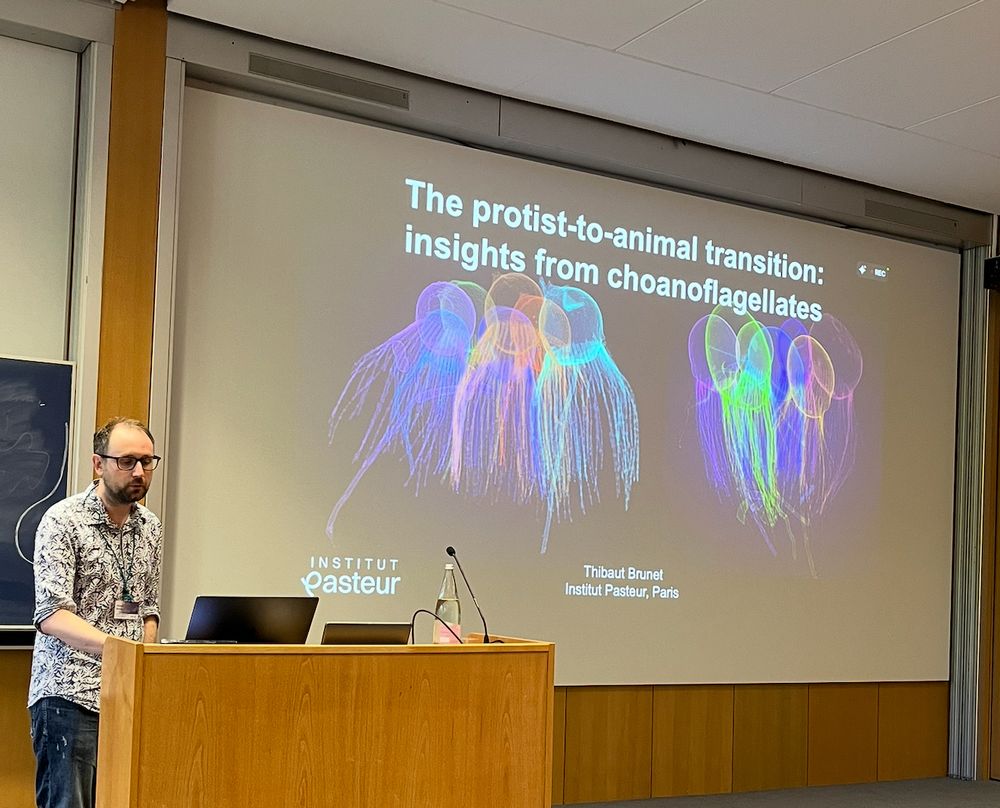
The DB Unit Summer School, "Transitions in Developing Systems," kicked off with an incredible talk by Thibaut Brunet @thibautbrunet.bsky.social from the Pasteur Institute @pasteur.fr on the fascinating transition from unicellularity to multicellularity in choanoflagellates #EMBLDevBio
July 2, 2025 at 2:28 PM
The DB Unit Summer School, "Transitions in Developing Systems," kicked off with an incredible talk by Thibaut Brunet @thibautbrunet.bsky.social from the Pasteur Institute @pasteur.fr on the fascinating transition from unicellularity to multicellularity in choanoflagellates #EMBLDevBio

Sponges and choanoflagellates, both eukaryotes have more common ancestor than non sponge animals.
Protists are only classified as protists because they're not bacteria or animals or plants.
Protists are only classified as protists because they're not bacteria or animals or plants.
June 28, 2025 at 12:51 AM
Sponges and choanoflagellates, both eukaryotes have more common ancestor than non sponge animals.
Protists are only classified as protists because they're not bacteria or animals or plants.
Protists are only classified as protists because they're not bacteria or animals or plants.
Sponges are basal animals, it doesn't imply sponges are least evolved. Sponges are eukaryotes who lack true tissue. You can separate or cut a sponge in many cells and it'll form back. Non sponge animals have a more common ancestor among themselves than sponges and choanoflagellates, protists.
June 28, 2025 at 12:51 AM
Sponges are basal animals, it doesn't imply sponges are least evolved. Sponges are eukaryotes who lack true tissue. You can separate or cut a sponge in many cells and it'll form back. Non sponge animals have a more common ancestor among themselves than sponges and choanoflagellates, protists.