



Conor McClune
@cmcclune.bsky.social
Plants, specialized metabolism, synthetic biology, protein evolution, and everything in between.
Postdoc at Sattley & Fordyce Labs, Stanford
Previously SynBio @ Voigt & Laub Labs, MIT
Postdoc at Sattley & Fordyce Labs, Stanford
Previously SynBio @ Voigt & Laub Labs, MIT
Pinned
Conor McClune
@cmcclune.bsky.social
· Jun 11
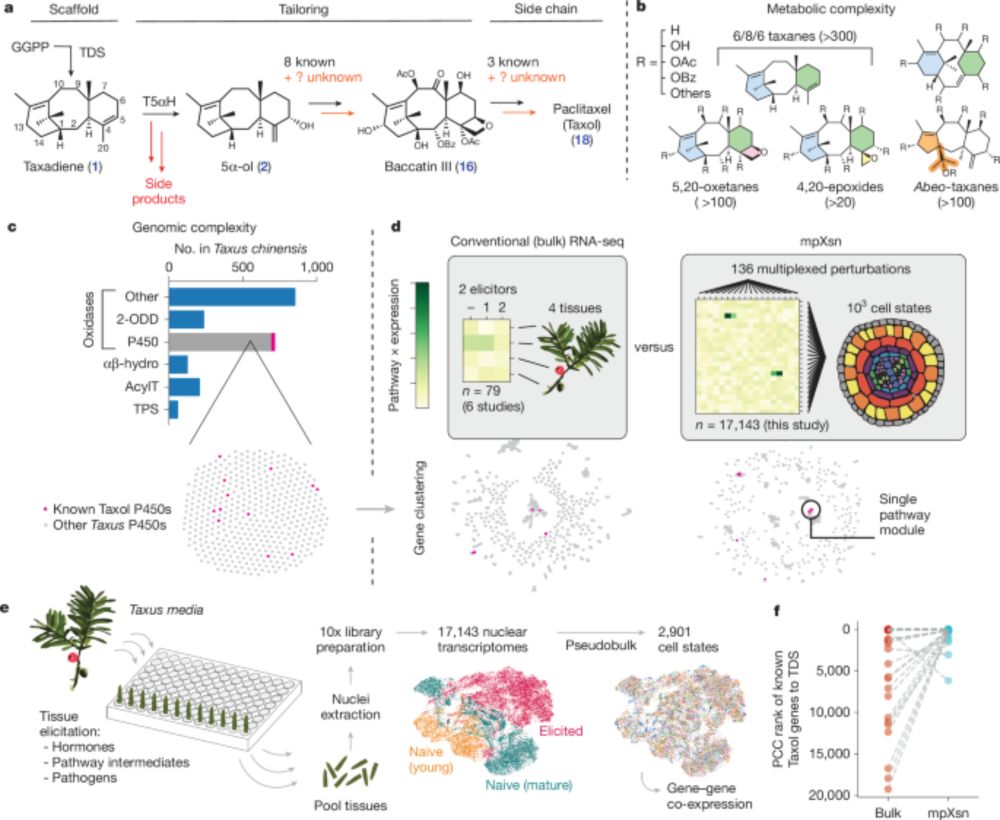
Discovery of FoTO1 and Taxol genes enables biosynthesis of baccatin III - Nature
An approach that combines single-nucleus RNA sequencing and multiplexed perturbation identifies genes that enable the biosynthesis of direct precursors of the anti-cancer drug Taxol, whose curren...
www.nature.com
Today in Nature we report a systematic strategy to activate & identify gene sets in plants. We identify 8 new genes from the yew tree's Taxol biosynthetic pathway, enabling us to engineer tobacco with 17- & 20-gene pathways to Taxol precursors baccatin III & deBz-deoxy-Taxol #SingleCell #secmet 🧬🧪🌾
Reposted by Conor McClune
Join the Reck-Peterson lab in NYC as a HHMI Research Technician! This role will support our new work on the cell biology of secondary metabolite production in filamentous fungi. Apply here: hhmi.wd1.myworkdayjobs.com/en-US/Extern...

Research Technician - Reck-Peterson Lab
Primary Work Address: 418 E 71st St #21, New York, NY, 10021 Current HHMI Employees, click here to apply via your Workday account. About the role: The Reck-Peterson lab studies the molecular mechanism...
hhmi.wd1.myworkdayjobs.com
December 22, 2025 at 2:09 PM
Join the Reck-Peterson lab in NYC as a HHMI Research Technician! This role will support our new work on the cell biology of secondary metabolite production in filamentous fungi. Apply here: hhmi.wd1.myworkdayjobs.com/en-US/Extern...
Reposted by Conor McClune

Do you know what happens when you touch a carnivorous sundew plant?
If the touch is strong and large enough, a cytosolic calcium wave will spread from the site of touch throughout the whole plant, but if you only touch one tentacle (see post below), the calcium wave will be local and less intense.
If the touch is strong and large enough, a cytosolic calcium wave will spread from the site of touch throughout the whole plant, but if you only touch one tentacle (see post below), the calcium wave will be local and less intense.
September 15, 2025 at 2:26 PM
Do you know what happens when you touch a carnivorous sundew plant?
If the touch is strong and large enough, a cytosolic calcium wave will spread from the site of touch throughout the whole plant, but if you only touch one tentacle (see post below), the calcium wave will be local and less intense.
If the touch is strong and large enough, a cytosolic calcium wave will spread from the site of touch throughout the whole plant, but if you only touch one tentacle (see post below), the calcium wave will be local and less intense.
Reposted by Conor McClune
Out in @science.org The crazy sequence of events from planting maize in dense fields. Density-dependent linalool release triggers release of compounds into the soil affecting microbes and plants.
Article: www.science.org/doi/10.1126/...
Perspective: www.science.org/doi/10.1126/...
#PlantScience
Article: www.science.org/doi/10.1126/...
Perspective: www.science.org/doi/10.1126/...
#PlantScience

Linalool-triggered plant-soil feedback drives defense adaptation in dense maize plantings
High planting density boosts crop yields but also heightens pest and pathogen risks. How plants adapt their defenses under these conditions remains unclear. In this study, we reveal that maize enhance...
www.science.org
August 15, 2025 at 11:05 AM
Out in @science.org The crazy sequence of events from planting maize in dense fields. Density-dependent linalool release triggers release of compounds into the soil affecting microbes and plants.
Article: www.science.org/doi/10.1126/...
Perspective: www.science.org/doi/10.1126/...
#PlantScience
Article: www.science.org/doi/10.1126/...
Perspective: www.science.org/doi/10.1126/...
#PlantScience
A truly enabling new approach by @taralowensohn.bsky.social Will Cody and @sattelylab.bsky.social to probe plant genetics at scale.
Single-gene-per-cell delivery coupled to an effective transcriptional selection system
www.biorxiv.org/content/10.1...
Single-gene-per-cell delivery coupled to an effective transcriptional selection system
www.biorxiv.org/content/10.1...

August 7, 2025 at 8:51 PM
A truly enabling new approach by @taralowensohn.bsky.social Will Cody and @sattelylab.bsky.social to probe plant genetics at scale.
Single-gene-per-cell delivery coupled to an effective transcriptional selection system
www.biorxiv.org/content/10.1...
Single-gene-per-cell delivery coupled to an effective transcriptional selection system
www.biorxiv.org/content/10.1...
Reposted by Conor McClune
@cmcclune.bsky.social will be at the GRC for Single-Cell Approaches in Plant Biology! Be on the lookout for his talk on Wednesday (8/13) at 9.10 am. Talk will be about some new approaches and discoveries recently published in Nature! www.nature.com/articles/s41... #grc #singlecell #plantbiology
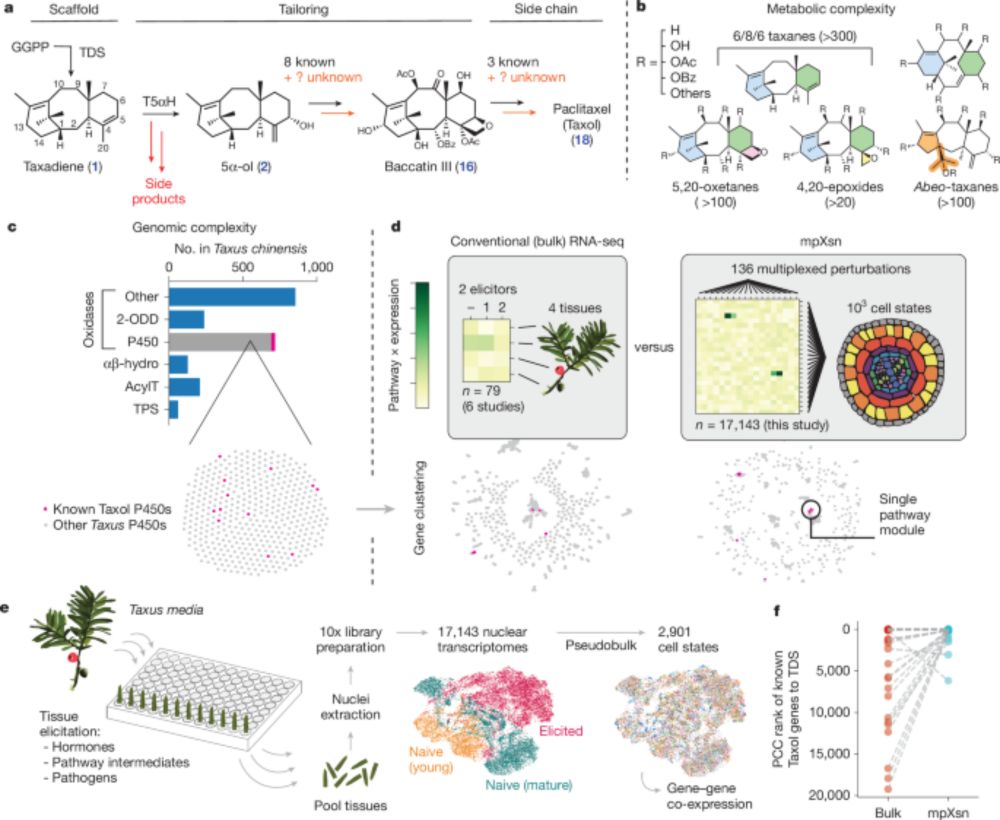
Discovery of FoTO1 and Taxol genes enables biosynthesis of baccatin III - Nature
An approach that combines single-nucleus RNA sequencing and multiplexed perturbation identifies genes that enable the biosynthesis of direct precursors of the anti-cancer drug Taxol, whose curren...
www.nature.com
August 7, 2025 at 5:44 PM
@cmcclune.bsky.social will be at the GRC for Single-Cell Approaches in Plant Biology! Be on the lookout for his talk on Wednesday (8/13) at 9.10 am. Talk will be about some new approaches and discoveries recently published in Nature! www.nature.com/articles/s41... #grc #singlecell #plantbiology
Reposted by Conor McClune

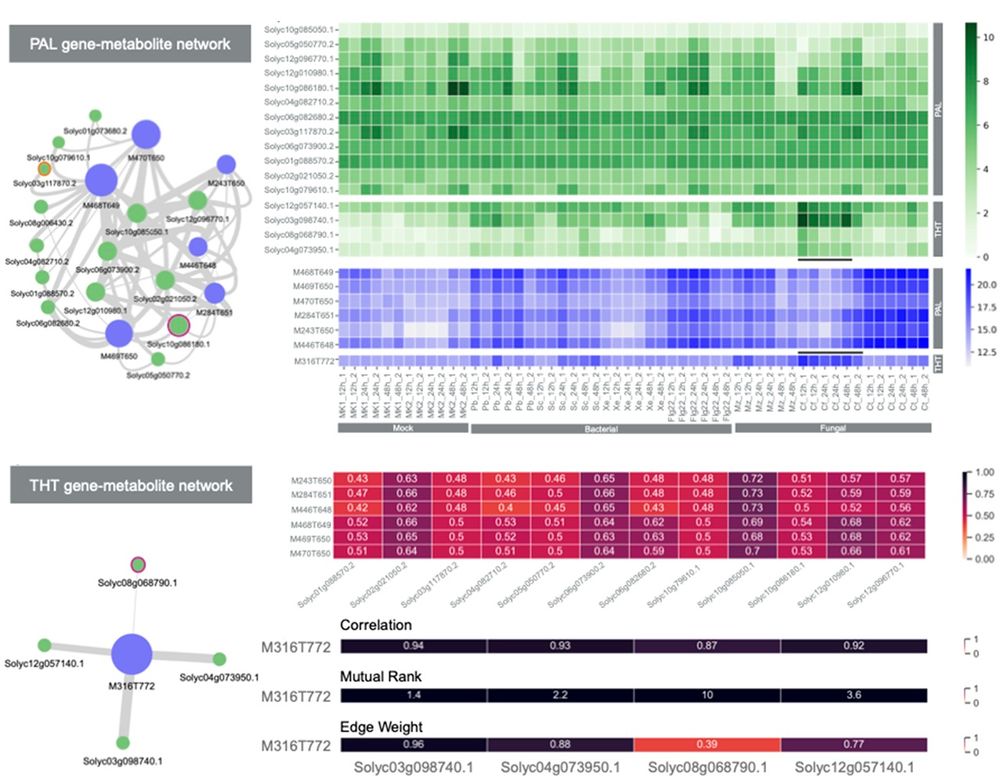
Elucidating #plant #Biosynthetic pathways: @jjjvanderhooft.bsky.social @marnixmedema.bsky.social &co develop #MEANtools, an unsupervised computational workflow that integrates #MultiOmics data to predict #metabolic pathways by linking transcripts to metabolites @plosbiology.org 🧪 plos.io/4odL94g
July 31, 2025 at 8:49 AM
Elucidating #plant #Biosynthetic pathways: @jjjvanderhooft.bsky.social @marnixmedema.bsky.social &co develop #MEANtools, an unsupervised computational workflow that integrates #MultiOmics data to predict #metabolic pathways by linking transcripts to metabolites @plosbiology.org 🧪 plos.io/4odL94g
Reposted by Conor McClune

#plants #trees #history #botany #art 🌲
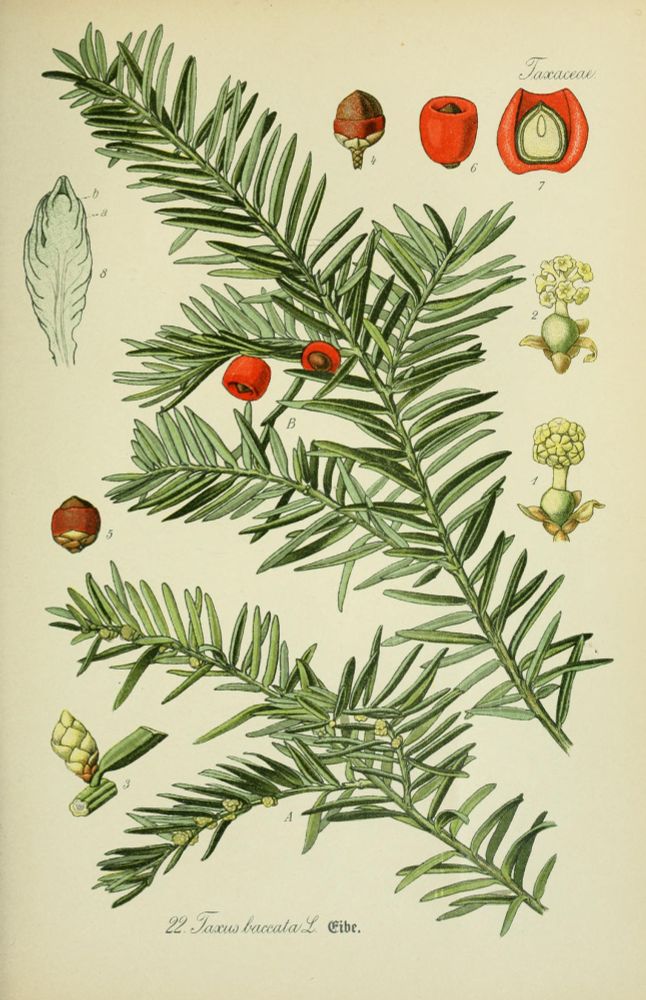
Taxus baccata - English Yew, Common Yew
Folk lore has it that the English used Churchyard Yew longbows - not true. Spanish Yew was straighter and better quality. (Confirmed by an Olympian archer I knew.)
Bows and trees:
www.longbow-archers.com/longbow.html
Taxus baccata - English Yew, Common Yew
Folk lore has it that the English used Churchyard Yew longbows - not true. Spanish Yew was straighter and better quality. (Confirmed by an Olympian archer I knew.)
Bows and trees:
www.longbow-archers.com/longbow.html
July 16, 2025 at 3:49 PM
Reposted by Conor McClune
Scientists, please take a moment to comment on these plans to limit animal testing in drug regulation and biomedical research. Use whatever experience you have to make your comments specific to you. The law requires regulators take these comments into account, so it might help. Mine is attached.

July 11, 2025 at 11:23 PM
Scientists, please take a moment to comment on these plans to limit animal testing in drug regulation and biomedical research. Use whatever experience you have to make your comments specific to you. The law requires regulators take these comments into account, so it might help. Mine is attached.
Reposted by Conor McClune
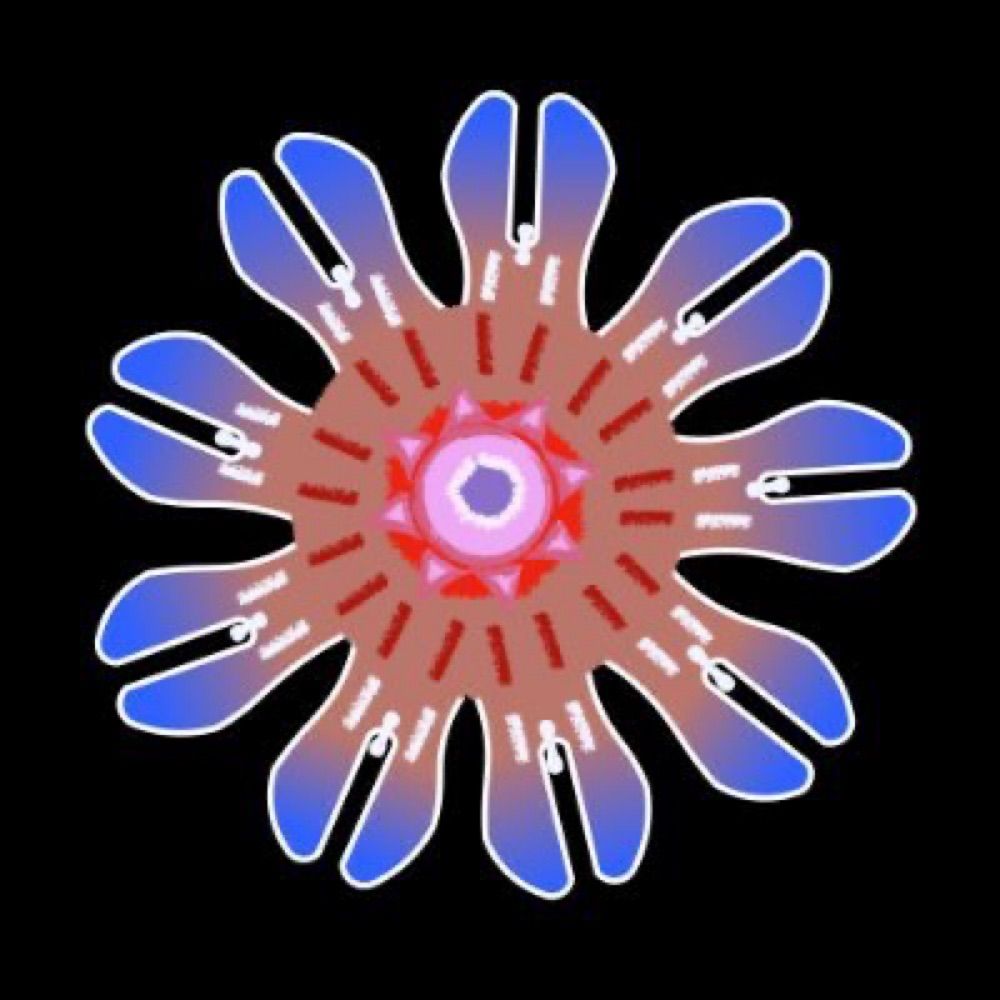
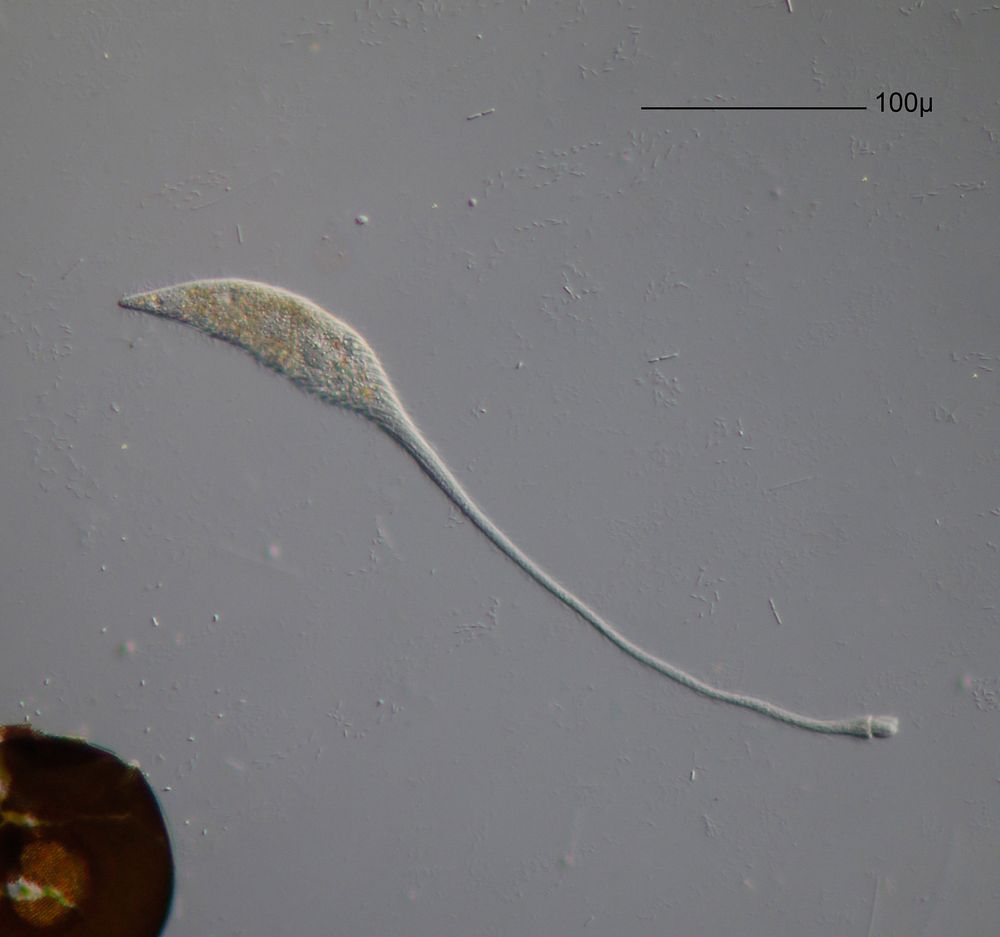
I just learned these this elephant-trunked-shaped cells, known as ciliate, put their sexy DNA into a special pocket (called a generative nucleus), and the rest of their DNA in a normal get-shit-done nucleus.
It has functional specialization nuclei.
Respectfully: holy shit 🧵🧪
It has functional specialization nuclei.
Respectfully: holy shit 🧵🧪
July 11, 2025 at 6:30 PM
I just learned these this elephant-trunked-shaped cells, known as ciliate, put their sexy DNA into a special pocket (called a generative nucleus), and the rest of their DNA in a normal get-shit-done nucleus.
It has functional specialization nuclei.
Respectfully: holy shit 🧵🧪
It has functional specialization nuclei.
Respectfully: holy shit 🧵🧪
Reposted by Conor McClune

I didn’t know this but apparently paclitaxel is still derived from the yew tree!? I had just assumed we had found a way to synthesize it.
www.nature.com/articles/s41... Discovery of FoTO1 and Taxol genes enables biosynthesis of baccatin III | Nature
www.nature.com/articles/s41... Discovery of FoTO1 and Taxol genes enables biosynthesis of baccatin III | Nature

Discovery of FoTO1 and Taxol genes enables biosynthesis of baccatin III - Nature
An approach that combines single-nucleus RNA sequencing and multiplexed perturbation identifies genes that enable the biosynthesis of direct precursors of the anti-cancer drug Taxol, whose curren...
www.nature.com
July 11, 2025 at 4:52 AM
I didn’t know this but apparently paclitaxel is still derived from the yew tree!? I had just assumed we had found a way to synthesize it.
www.nature.com/articles/s41... Discovery of FoTO1 and Taxol genes enables biosynthesis of baccatin III | Nature
www.nature.com/articles/s41... Discovery of FoTO1 and Taxol genes enables biosynthesis of baccatin III | Nature
Thank you Carolyn Bertozzi @carolynbertozzi.bskyverified.social for highlighting our Taxol work!
Check out this amazing new work from @sattelylab.bsky.social along with collaborator and @stanford-chemh.bsky.social Institute Scholar @pollyfordyce.bsky.social !
www.nature.com/articles/s41...
www.nature.com/articles/s41...
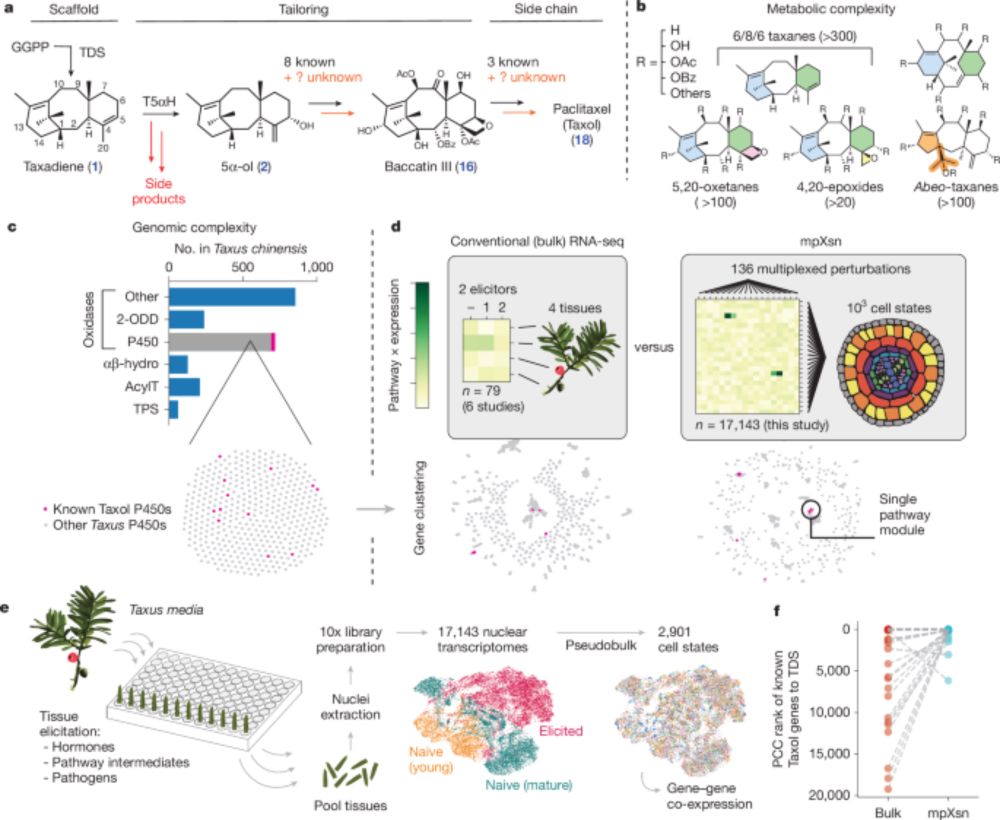
Discovery of FoTO1 and Taxol genes enables biosynthesis of baccatin III - Nature
An approach that combines single-nucleus RNA sequencing and multiplexed perturbation identifies genes that enable the biosynthesis of direct precursors of the anti-cancer drug Taxol, whose curren...
www.nature.com
July 11, 2025 at 3:02 PM
Thank you Carolyn Bertozzi @carolynbertozzi.bskyverified.social for highlighting our Taxol work!
Reposted by Conor McClune
Check out this amazing new work from @sattelylab.bsky.social along with collaborator and @stanford-chemh.bsky.social Institute Scholar @pollyfordyce.bsky.social !
www.nature.com/articles/s41...
www.nature.com/articles/s41...
Discovery of FoTO1 and Taxol genes enables biosynthesis of baccatin III - Nature
An approach that combines single-nucleus RNA sequencing and multiplexed perturbation identifies genes that enable the biosynthesis of direct precursors of the anti-cancer drug Taxol, whose curren...
www.nature.com
July 11, 2025 at 5:29 AM
Check out this amazing new work from @sattelylab.bsky.social along with collaborator and @stanford-chemh.bsky.social Institute Scholar @pollyfordyce.bsky.social !
www.nature.com/articles/s41...
www.nature.com/articles/s41...
Reposted by Conor McClune

A friend of my compared gutting of federal agencies to a wrecking a car: if you remove 30% of the parts of the car, it does not go 30% slower. It stops working.
March 20, 2025 at 12:45 AM
A friend of my compared gutting of federal agencies to a wrecking a car: if you remove 30% of the parts of the car, it does not go 30% slower. It stops working.
Reposted by Conor McClune

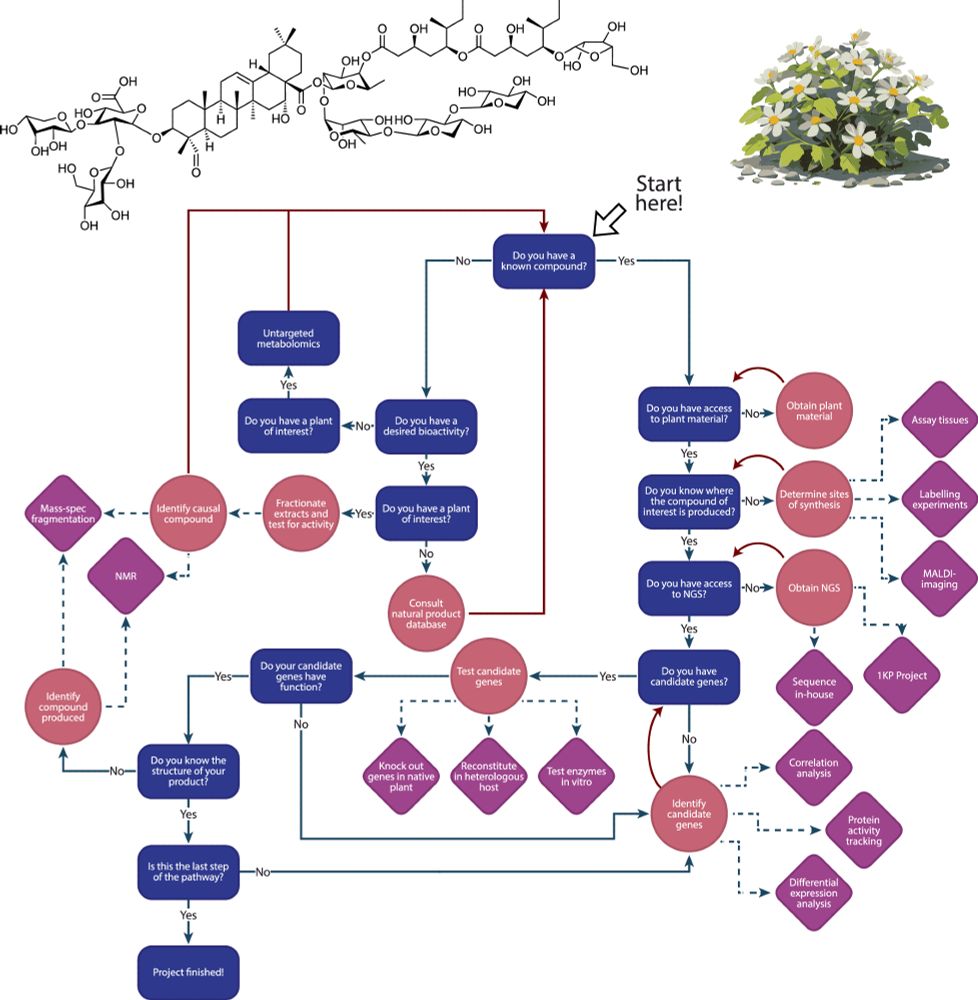
A million shades of green: understanding and harnessing plant metabolic diversity
Rocky Payet, Anne Osbourn et al presents a step-by-step guide to starting a project that characterises plant secondary metabolites
www.embopress.org/doi/full/10....
Rocky Payet, Anne Osbourn et al presents a step-by-step guide to starting a project that characterises plant secondary metabolites
www.embopress.org/doi/full/10....
July 4, 2025 at 9:34 AM
A million shades of green: understanding and harnessing plant metabolic diversity
Rocky Payet, Anne Osbourn et al presents a step-by-step guide to starting a project that characterises plant secondary metabolites
www.embopress.org/doi/full/10....
Rocky Payet, Anne Osbourn et al presents a step-by-step guide to starting a project that characterises plant secondary metabolites
www.embopress.org/doi/full/10....
Reposted by Conor McClune

Further advanced in synbio systems for expression of plant rubiscos in E. coli, exploring importance of Raf1 variants:
academic.oup.com/jxb/article-...
and accompanying perspective via @jxbotany.bsky.social doi.org/10.1093/jxb/...
academic.oup.com/jxb/article-...
and accompanying perspective via @jxbotany.bsky.social doi.org/10.1093/jxb/...
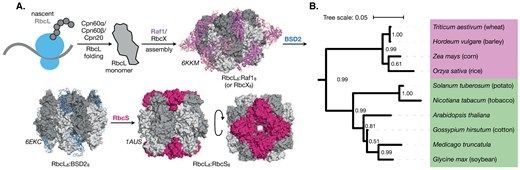
Effects of chaperone selectivity on the assembly of plant Rubisco orthologs in E. coli
We used an E. coli system to examine recognition of plant Rubisco chaperones for different Rubiscos. Identified factors influencing chaperone selectivity e
academic.oup.com
July 5, 2025 at 1:42 AM
Further advanced in synbio systems for expression of plant rubiscos in E. coli, exploring importance of Raf1 variants:
academic.oup.com/jxb/article-...
and accompanying perspective via @jxbotany.bsky.social doi.org/10.1093/jxb/...
academic.oup.com/jxb/article-...
and accompanying perspective via @jxbotany.bsky.social doi.org/10.1093/jxb/...
It makes sense that skin microbes would have an intimate relationship with our immune cells.
But engineering these bugs into topical vaccines still feels like sci-fi.
Congrats @djenetbousbaine.bsky.social on the well deserved prize
But engineering these bugs into topical vaccines still feels like sci-fi.
Congrats @djenetbousbaine.bsky.social on the well deserved prize
It’s truly an honor to receive this year’s
@science.org Noster Microbiome prize.
Here’s my essay on how we can engineer skin microbes to build topical vaccines:
@science.org Noster Microbiome prize.
Here’s my essay on how we can engineer skin microbes to build topical vaccines:

🎉 Congratulations to Djenet Bousbaine, winner of the 2025 NOSTER & Science Microbiome Prize for her work to illuminate how the immune system responds to the beneficial skin microbiome.
Learn more: scim.ag/4lVwpFx
Learn more: scim.ag/4lVwpFx
July 5, 2025 at 3:31 PM
It makes sense that skin microbes would have an intimate relationship with our immune cells.
But engineering these bugs into topical vaccines still feels like sci-fi.
Congrats @djenetbousbaine.bsky.social on the well deserved prize
But engineering these bugs into topical vaccines still feels like sci-fi.
Congrats @djenetbousbaine.bsky.social on the well deserved prize
Reposted by Conor McClune
Check out this prize-winning essay by postdoc @djenetbousbaine.bsky.social on her work with @mfgrp.bsky.social @stanford-chemh.bsky.social 👏
Check out the Noster prize winning essays @science.org The vaccine we all wear: Skin microbiota can be engineered into topical vaccines | Science www.science.org/doi/10.1126/...
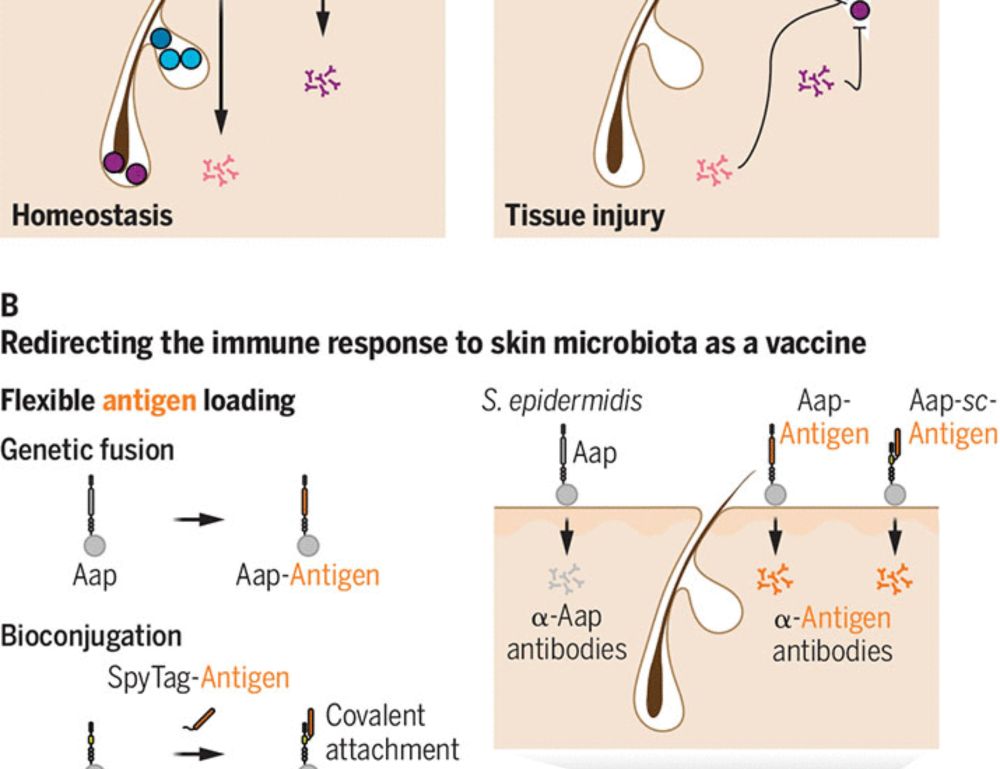
The vaccine we all wear: Skin microbiota can be engineered into topical vaccines
Skin microbiota can be engineered into topical vaccines
www.science.org
July 4, 2025 at 4:36 PM
Check out this prize-winning essay by postdoc @djenetbousbaine.bsky.social on her work with @mfgrp.bsky.social @stanford-chemh.bsky.social 👏
Reposted by Conor McClune
How plants sense injury in their barrier tissue, periderm? Painstakingly detailed and amazing work by post doc Hiroyuki Iida shows that wounding is sensed by the diffusion of two gases: ethylene and oxygen. @treebiocoe.bsky.social @erc.europa.eu 1/x 🧵 www.nature.com/articles/s41...
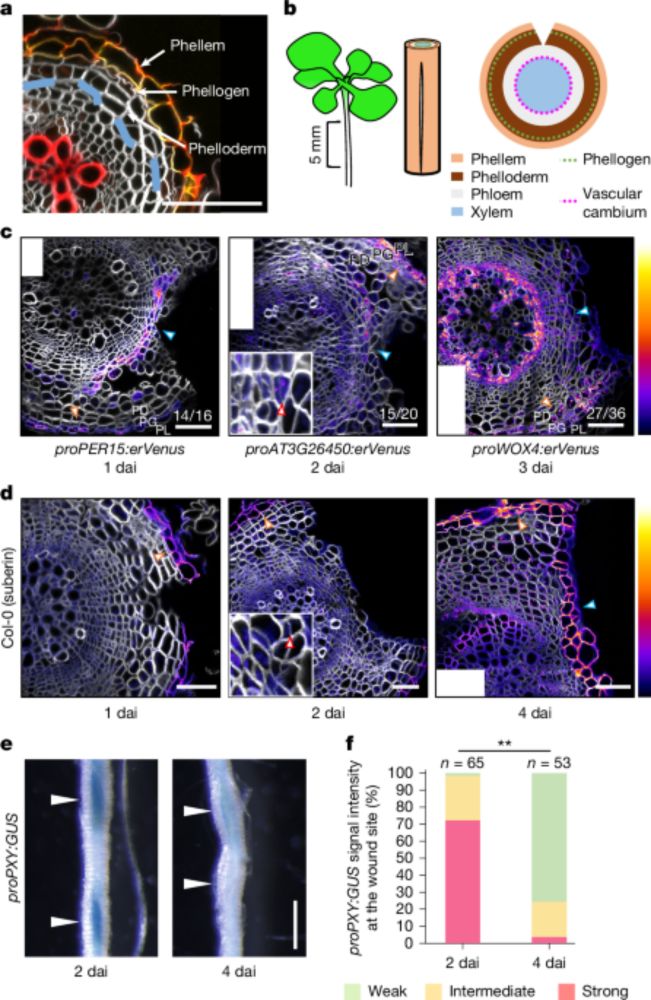
Plants monitor the integrity of their barrier by sensing gas diffusion - Nature
A study using Arabidopsis shows that plants can monitor the integrity of their outer barriers by sensing gas diffusion, enabling them to initiate wound repair to prevent water loss and pathogen entry.
www.nature.com
July 2, 2025 at 4:20 PM
How plants sense injury in their barrier tissue, periderm? Painstakingly detailed and amazing work by post doc Hiroyuki Iida shows that wounding is sensed by the diffusion of two gases: ethylene and oxygen. @treebiocoe.bsky.social @erc.europa.eu 1/x 🧵 www.nature.com/articles/s41...
Plant Science Research Weekly -- Elucidation and recreation of the biosynthetic pathway for taxol (Nature) @cmcclune.bsky.social (Summary by Mary Williams @PlantTeaching.bsky.social)
buff.ly/miccEK3
#PlantaePSRW
buff.ly/miccEK3
#PlantaePSRW

Elucidation and recreation of the biosynthetic pathway for taxol | Plantae
Paclitaxel (sold as Taxol) is taxane diterpene natural product of yew trees (Taxus spp.) and a potent stabilizer of microtubules that is effective in treatment of cancers. However…
buff.ly
July 2, 2025 at 4:46 PM
Reposted by Conor McClune

Plant Science Research Weekly -- Elucidation and recreation of the biosynthetic pathway for taxol (Nature) @cmcclune.bsky.social (Summary by Mary Williams @PlantTeaching.bsky.social)
buff.ly/miccEK3
#PlantaePSRW
buff.ly/miccEK3
#PlantaePSRW
Elucidation and recreation of the biosynthetic pathway for taxol | Plantae
Paclitaxel (sold as Taxol) is taxane diterpene natural product of yew trees (Taxus spp.) and a potent stabilizer of microtubules that is effective in treatment of cancers. However…
buff.ly
July 2, 2025 at 4:15 PM
Plant Science Research Weekly -- Elucidation and recreation of the biosynthetic pathway for taxol (Nature) @cmcclune.bsky.social (Summary by Mary Williams @PlantTeaching.bsky.social)
buff.ly/miccEK3
#PlantaePSRW
buff.ly/miccEK3
#PlantaePSRW
Reposted by Conor McClune

How 🆒 is this?!? www.cell.com/cell/abstrac...
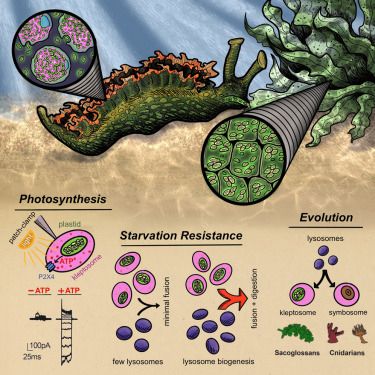
A host organelle integrates stolen chloroplasts for animal photosynthesis
Sea slugs steal foreign chloroplasts and store them in specialized organelles that
facilitate photosynthesis and eventual digestion to mediate starvation resistance.
www.cell.com
June 25, 2025 at 8:05 PM
How 🆒 is this?!? www.cell.com/cell/abstrac...
Reposted by Conor McClune

🔓Don't miss this #OpenAccess Highlight in our MS Metabolomics themed collection by Brett C. Covington & Mohammad R. Seyedsayamdost at Princeton University looking at the evolution of high-throughput mass spectrometry in screening for cryptic natural products #natprod

Unlocking hidden treasures: the evolution of high-throughput mass spectrometry in screening for cryptic natural products
Covering: 1994 to 2024 Historically, microbial natural product discovery has been predominantly guided by biological activity from crude microbial extracts with metabolite characterization proceeding…
pubs.rsc.org
June 24, 2025 at 2:36 PM
🔓Don't miss this #OpenAccess Highlight in our MS Metabolomics themed collection by Brett C. Covington & Mohammad R. Seyedsayamdost at Princeton University looking at the evolution of high-throughput mass spectrometry in screening for cryptic natural products #natprod
Great article in today’s Stanford Report on our recent work deciphering how yew trees produce Taxol
@sattelylab.bsky.social news.stanford.edu/stories/2025...
@sattelylab.bsky.social news.stanford.edu/stories/2025...
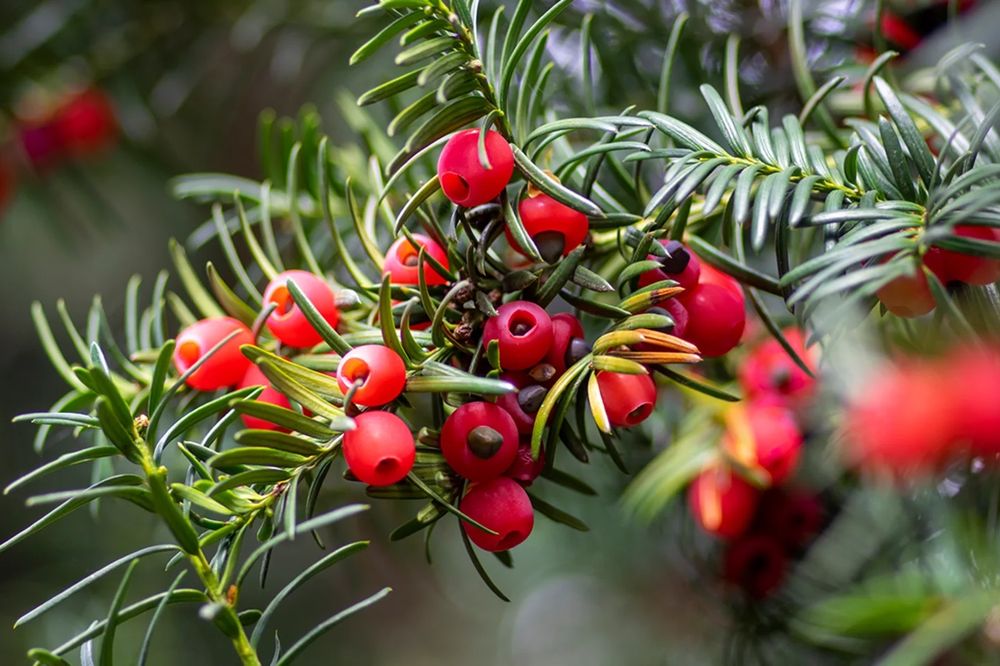
New insights in plant gene research could boost cancer drug production
A novel approach to analyzing yew tree genes has revealed key enzymes used to make Taxol, a chemotherapy drug that’s long been difficult and costly to produce.
news.stanford.edu
June 25, 2025 at 12:32 AM
Great article in today’s Stanford Report on our recent work deciphering how yew trees produce Taxol
@sattelylab.bsky.social news.stanford.edu/stories/2025...
@sattelylab.bsky.social news.stanford.edu/stories/2025...
Reposted by Conor McClune
Next preprint out from my work @oconnorlab.bsky.social @mpi-ce.bsky.social : the discovery or iridoid cyclase in asterids!
Thread below.
#PlantScience
#natprod
www.biorxiv.org/content/10.1...
Thread below.
#PlantScience
#natprod
www.biorxiv.org/content/10.1...
www.biorxiv.org
June 18, 2025 at 1:28 PM
Next preprint out from my work @oconnorlab.bsky.social @mpi-ce.bsky.social : the discovery or iridoid cyclase in asterids!
Thread below.
#PlantScience
#natprod
www.biorxiv.org/content/10.1...
Thread below.
#PlantScience
#natprod
www.biorxiv.org/content/10.1...
Reposted by Conor McClune
Exciting new work from Sattely lab with collaborator @pollyfordyce.bsky.social and coworkers @stanford-chemh.bsky.social, solving they biosynthesis of taxol!
www.nature.com/articles/s41...
www.nature.com/articles/s41...
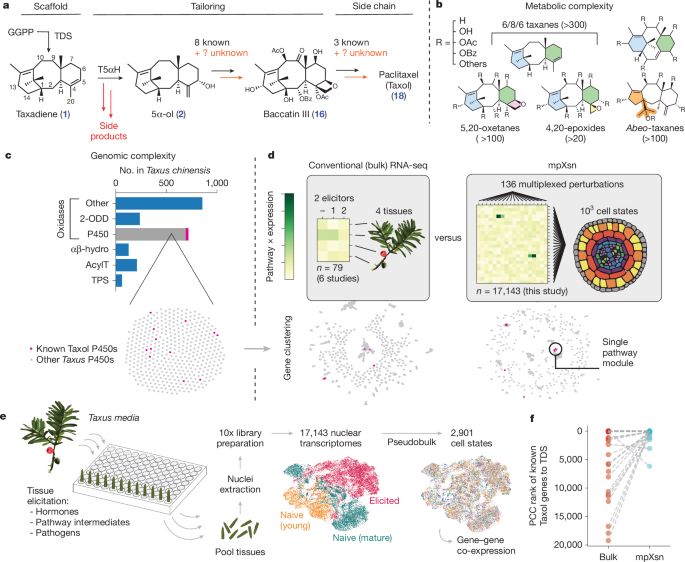
Discovery of FoTO1 and Taxol genes enables biosynthesis of baccatin III - Nature
An approach that combines single-nucleus RNA sequencing and multiplexed perturbation identifies genes that enable the biosynthesis of direct precursors of the anti-cancer drug Taxol, whose curren...
www.nature.com
June 19, 2025 at 6:01 AM
Exciting new work from Sattely lab with collaborator @pollyfordyce.bsky.social and coworkers @stanford-chemh.bsky.social, solving they biosynthesis of taxol!
www.nature.com/articles/s41...
www.nature.com/articles/s41...