



Subham Dey
@subhamjadavpur.bsky.social
Control Systems Engineer. Visiting fellow with NIMH.
Reposted by Subham Dey

Fascinating and ground breaking work. I don't think we've ever looked at sinle neuron activity in the human thalamus before.
Thalamus for vision BCIs
Scientists have recorded single neurons in the human LGN for the first time, revealing how it links the retina to visual cortex. When one eye is closed, neurons tuned to that eye reduce their activity, while neurons tuned to the open eye increase in spikerate
#neuroskyence
Scientists have recorded single neurons in the human LGN for the first time, revealing how it links the retina to visual cortex. When one eye is closed, neurons tuned to that eye reduce their activity, while neurons tuned to the open eye increase in spikerate
#neuroskyence

Effects of eye closure on the spiking activity of human lateral geniculate neurons - Nature Communications
The LGN is a critical stage between the retina and visual cortex, but the properties of human LGN neurons are not fully understood. Here the authors report that they closely resemble those in monkeys ...
www.nature.com
November 27, 2025 at 9:22 AM
Fascinating and ground breaking work. I don't think we've ever looked at sinle neuron activity in the human thalamus before.
Reposted by Subham Dey

Please share! Going to #SfN and looking for a postdoc in human neuroscience? We're hiring! If you have a background in Psychology, Neuroscience, Biomedical Engineering, or related areas, come talk to us about joining our lab at Georgia Tech (siplab.gatech.edu). #neuroscience #PsychSciSky
SIPLab
siplab.gatech.edu
November 11, 2025 at 9:28 PM
Please share! Going to #SfN and looking for a postdoc in human neuroscience? We're hiring! If you have a background in Psychology, Neuroscience, Biomedical Engineering, or related areas, come talk to us about joining our lab at Georgia Tech (siplab.gatech.edu). #neuroscience #PsychSciSky
Reposted by Subham Dey

Adopting an engineering mindset will help the field focus its research priorities, writes @timothyoleary.bsky.social.
#neuroskyence
www.thetransmitter.org/systems-neur...
#neuroskyence
www.thetransmitter.org/systems-neur...

Neuroscience needs engineers—for more reasons than you think
Adopting an engineering mindset will help the field focus its research priorities.
www.thetransmitter.org
November 10, 2025 at 6:56 PM
Adopting an engineering mindset will help the field focus its research priorities, writes @timothyoleary.bsky.social.
#neuroskyence
www.thetransmitter.org/systems-neur...
#neuroskyence
www.thetransmitter.org/systems-neur...
Reposted by Subham Dey
My co-authors have yet to move to Bluesky, so I'm pleased to announce our latest work has just been published in @nature.com Neuroscience. Amazing work led by Junheng Li, revealing that falling asleep follows a predictable bifurcation pattern #neuroskyence #sleep
www.nature.com/articles/s41...
www.nature.com/articles/s41...

Falling asleep follows a predictable bifurcation dynamic - Nature Neuroscience
Li et al. propose a conceptual framework to study the phenomenon of falling asleep based on electroencephalogram data. They show that a tipping point marks the brain’s nonlinear wake-to-sleep transiti...
www.nature.com
October 28, 2025 at 5:35 PM
My co-authors have yet to move to Bluesky, so I'm pleased to announce our latest work has just been published in @nature.com Neuroscience. Amazing work led by Junheng Li, revealing that falling asleep follows a predictable bifurcation pattern #neuroskyence #sleep
www.nature.com/articles/s41...
www.nature.com/articles/s41...
Reposted by Subham Dey
Positive affective contagion in bumble bees
This is impressive research in Science Magazine, but the word 'affect' feels like a stretch of what that word implies. Affect-like seems more consistent, in the way Nicky Clayton has used 'epsiodic-memory-like' in corvids
www.science.org/doi/10.1126/...
This is impressive research in Science Magazine, but the word 'affect' feels like a stretch of what that word implies. Affect-like seems more consistent, in the way Nicky Clayton has used 'epsiodic-memory-like' in corvids
www.science.org/doi/10.1126/...

Positive affective contagion in bumble bees
Affective contagion, a core component of empathy, has been widely characterized in social vertebrates but its existence in any invertebrate is unknown. Using a cognitive bias paradigm we demonstrate p...
www.science.org
October 24, 2025 at 11:34 AM
Positive affective contagion in bumble bees
This is impressive research in Science Magazine, but the word 'affect' feels like a stretch of what that word implies. Affect-like seems more consistent, in the way Nicky Clayton has used 'epsiodic-memory-like' in corvids
www.science.org/doi/10.1126/...
This is impressive research in Science Magazine, but the word 'affect' feels like a stretch of what that word implies. Affect-like seems more consistent, in the way Nicky Clayton has used 'epsiodic-memory-like' in corvids
www.science.org/doi/10.1126/...
Reposted by Subham Dey

Members of Congress can say they didn’t believe the data that said people would lose their healthcare, but real people are starting to experience the pain.
Ted Budd locked his door and refused to answer our calls today, but Moral Mondays will be back.
Ted Budd locked his door and refused to answer our calls today, but Moral Mondays will be back.
October 21, 2025 at 12:55 AM
Members of Congress can say they didn’t believe the data that said people would lose their healthcare, but real people are starting to experience the pain.
Ted Budd locked his door and refused to answer our calls today, but Moral Mondays will be back.
Ted Budd locked his door and refused to answer our calls today, but Moral Mondays will be back.
www.medrxiv.org/content/10.1... (People are trying to cure depression with tDCS, good luck then)

Does anodal tDCS over M1 really enhance motor sequence learning? A non-replication of earlier findings in a double-blind, pre-registered large-sample study in humans
Background Transcranial direct current stimulation (tDCS) is one of the most widely used noninvasive neuromodulation methods. Despite its popularity, some recent studies highlighted issues about the r...
www.medrxiv.org
October 17, 2025 at 2:13 AM
www.medrxiv.org/content/10.1... (People are trying to cure depression with tDCS, good luck then)
There is a reason why variants of Kalman filter like Unscented Kalman Filter, Cubature Quadrature Kalman Filter exists in literature. Still you find the Kalman filter at big ticket neuroscience journal papers. It seems neither the people nor the reviewers care at all.
October 17, 2025 at 2:12 AM
There is a reason why variants of Kalman filter like Unscented Kalman Filter, Cubature Quadrature Kalman Filter exists in literature. Still you find the Kalman filter at big ticket neuroscience journal papers. It seems neither the people nor the reviewers care at all.
Reposted by Subham Dey

Out today at Neuron, our experiments show that frontal cortical representation of economic variables is jointly determined by spatial organization and downstream
connectivity of neurons, revealing a structured, multi-scale code for economic variables. www.cell.com/neuron/fullt...
connectivity of neurons, revealing a structured, multi-scale code for economic variables. www.cell.com/neuron/fullt...

October 16, 2025 at 3:00 PM
Out today at Neuron, our experiments show that frontal cortical representation of economic variables is jointly determined by spatial organization and downstream
connectivity of neurons, revealing a structured, multi-scale code for economic variables. www.cell.com/neuron/fullt...
connectivity of neurons, revealing a structured, multi-scale code for economic variables. www.cell.com/neuron/fullt...
Reposted by Subham Dey

Thrilled to share that our work is now published in Science! ✨
We found a preference for visual objects in the mouse spatial navigation system where they dynamically refine head-direction coding. In short, objects boost our inner compass! 🧭
www.science.org/doi/10.1126/...
🧵1/
We found a preference for visual objects in the mouse spatial navigation system where they dynamically refine head-direction coding. In short, objects boost our inner compass! 🧭
www.science.org/doi/10.1126/...
🧵1/

September 11, 2025 at 8:14 PM
Thrilled to share that our work is now published in Science! ✨
We found a preference for visual objects in the mouse spatial navigation system where they dynamically refine head-direction coding. In short, objects boost our inner compass! 🧭
www.science.org/doi/10.1126/...
🧵1/
We found a preference for visual objects in the mouse spatial navigation system where they dynamically refine head-direction coding. In short, objects boost our inner compass! 🧭
www.science.org/doi/10.1126/...
🧵1/
Reposted by Subham Dey

Another way in which companies *could* save millions $$$ with AI is by replacing expensive CEOs with algorithms. Just saying.
September 6, 2025 at 4:50 PM
Another way in which companies *could* save millions $$$ with AI is by replacing expensive CEOs with algorithms. Just saying.
Reposted by Subham Dey
A cautionary tale for PhD's from lower-income countries who are on "stipends": often regarded as disposable, their vulnerability (precarious access to healthcare, social security, etc...) makes them prime targets for a "flexible" form of abuse that hides in plain sight. Let us not normalize this👇

"The day the paper was published should have been a moment of pride. Instead, it felt like a quiet erasure." #ScienceWorkingLife https://scim.ag/4p3eH5g

August 30, 2025 at 11:51 AM
A cautionary tale for PhD's from lower-income countries who are on "stipends": often regarded as disposable, their vulnerability (precarious access to healthcare, social security, etc...) makes them prime targets for a "flexible" form of abuse that hides in plain sight. Let us not normalize this👇
Reposted by Subham Dey

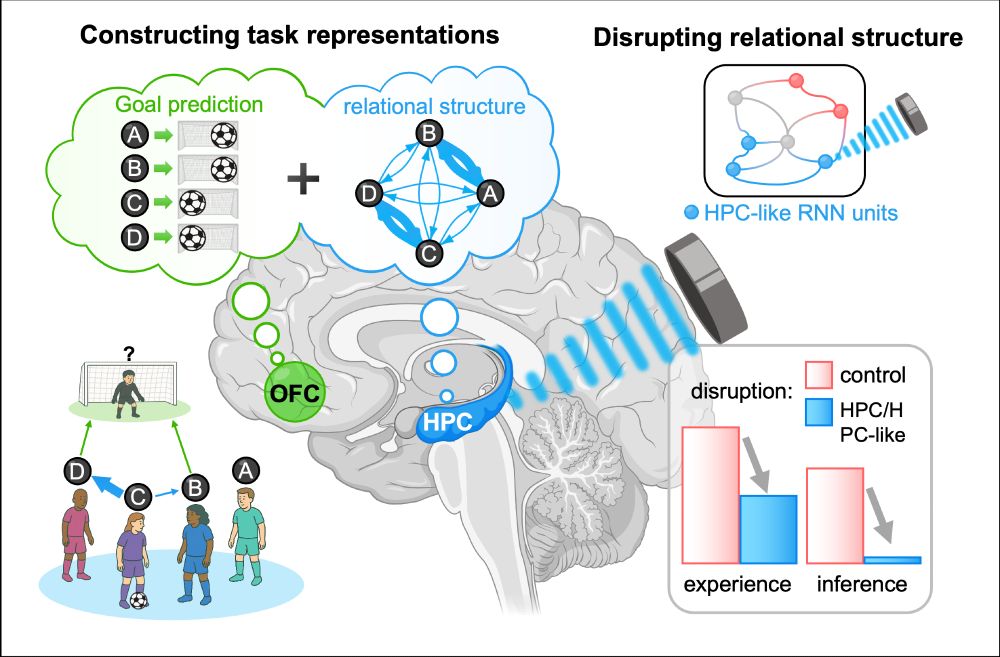
🚨We believe this is a major step forward in how we study hippocampus function in healthy humans.
Using novel behavioral tasks, fMRI, RL & RNN modeling, and transcranial ultrasound stimulation (TUS), we demonstrate the causal role of hippocampus in relational structure learning.
Using novel behavioral tasks, fMRI, RL & RNN modeling, and transcranial ultrasound stimulation (TUS), we demonstrate the causal role of hippocampus in relational structure learning.
August 28, 2025 at 2:00 PM
🚨We believe this is a major step forward in how we study hippocampus function in healthy humans.
Using novel behavioral tasks, fMRI, RL & RNN modeling, and transcranial ultrasound stimulation (TUS), we demonstrate the causal role of hippocampus in relational structure learning.
Using novel behavioral tasks, fMRI, RL & RNN modeling, and transcranial ultrasound stimulation (TUS), we demonstrate the causal role of hippocampus in relational structure learning.
Reposted by Subham Dey
My first paper with @naoshigeuchida.bsky.social is finally out in @natcomms.nature.com ! rdcu.be/eACGf
TL;DR: asymmetric learning rates can be induced by shifts in tonic dopamine giving rise to pessimistic/optimistic biases in agents or animals undergoing reinforcement learning .
TL;DR: asymmetric learning rates can be induced by shifts in tonic dopamine giving rise to pessimistic/optimistic biases in agents or animals undergoing reinforcement learning .

Tonic dopamine and biases in value learning linked through a biologically inspired reinforcement learning model
Nature Communications - Accurate future predictions are essential for guiding behavior, and disruptions in this process are associated with psychiatric disorders. Here the authors show that changes...
rdcu.be
August 13, 2025 at 9:55 PM
My first paper with @naoshigeuchida.bsky.social is finally out in @natcomms.nature.com ! rdcu.be/eACGf
TL;DR: asymmetric learning rates can be induced by shifts in tonic dopamine giving rise to pessimistic/optimistic biases in agents or animals undergoing reinforcement learning .
TL;DR: asymmetric learning rates can be induced by shifts in tonic dopamine giving rise to pessimistic/optimistic biases in agents or animals undergoing reinforcement learning .
Reposted by Subham Dey

🚨Very happy that my PhD work is now out in @nature.com!
We discovered that evolution, by acting in the midbrain, shifted the threshold to escape in Peromyscus mice, to fine-tune defensive strategies in different environments
www.nature.com/articles/s41...
This was a truly collaborative effort! 🧵⬇️
We discovered that evolution, by acting in the midbrain, shifted the threshold to escape in Peromyscus mice, to fine-tune defensive strategies in different environments
www.nature.com/articles/s41...
This was a truly collaborative effort! 🧵⬇️
July 23, 2025 at 3:06 PM
🚨Very happy that my PhD work is now out in @nature.com!
We discovered that evolution, by acting in the midbrain, shifted the threshold to escape in Peromyscus mice, to fine-tune defensive strategies in different environments
www.nature.com/articles/s41...
This was a truly collaborative effort! 🧵⬇️
We discovered that evolution, by acting in the midbrain, shifted the threshold to escape in Peromyscus mice, to fine-tune defensive strategies in different environments
www.nature.com/articles/s41...
This was a truly collaborative effort! 🧵⬇️
With adaptive deep brain stimulation getting FDA approved, we should see more closed loop control algorithms rather than proportional integral or on/off switching controllers. One method is called direct data driven model predictive control.
August 4, 2025 at 8:03 PM
With adaptive deep brain stimulation getting FDA approved, we should see more closed loop control algorithms rather than proportional integral or on/off switching controllers. One method is called direct data driven model predictive control.
Reposted by Subham Dey
We are looking for a Postdoc (up to 5 years) who wants to study neural mechanisms of spatial memory in honeybees.
This includes tetrode recordings in behaving honeybees.
Application Deadline is 1st of October 2025.
More details:
www.biozentrum.uni-wuerzburg.de/en/services/...
This includes tetrode recordings in behaving honeybees.
Application Deadline is 1st of October 2025.
More details:
www.biozentrum.uni-wuerzburg.de/en/services/...
Postdoctoral Position (f/m/d) at the Chair of Behavioral Physiology & Sociobiology
Biocenter of the University of Würzburg Am Hubland 97074 Würzburg
www.biozentrum.uni-wuerzburg.de
August 1, 2025 at 8:44 AM
We are looking for a Postdoc (up to 5 years) who wants to study neural mechanisms of spatial memory in honeybees.
This includes tetrode recordings in behaving honeybees.
Application Deadline is 1st of October 2025.
More details:
www.biozentrum.uni-wuerzburg.de/en/services/...
This includes tetrode recordings in behaving honeybees.
Application Deadline is 1st of October 2025.
More details:
www.biozentrum.uni-wuerzburg.de/en/services/...
Reposted by Subham Dey


nimhaiworkshopitaly.github.io. Please visit our workshop in Florence, Italy (CNS 2025).
NeuroXAI workshop
nimhaiworkshopitaly.github.io
July 5, 2025 at 10:12 AM
nimhaiworkshopitaly.github.io. Please visit our workshop in Florence, Italy (CNS 2025).
Reposted by Subham Dey

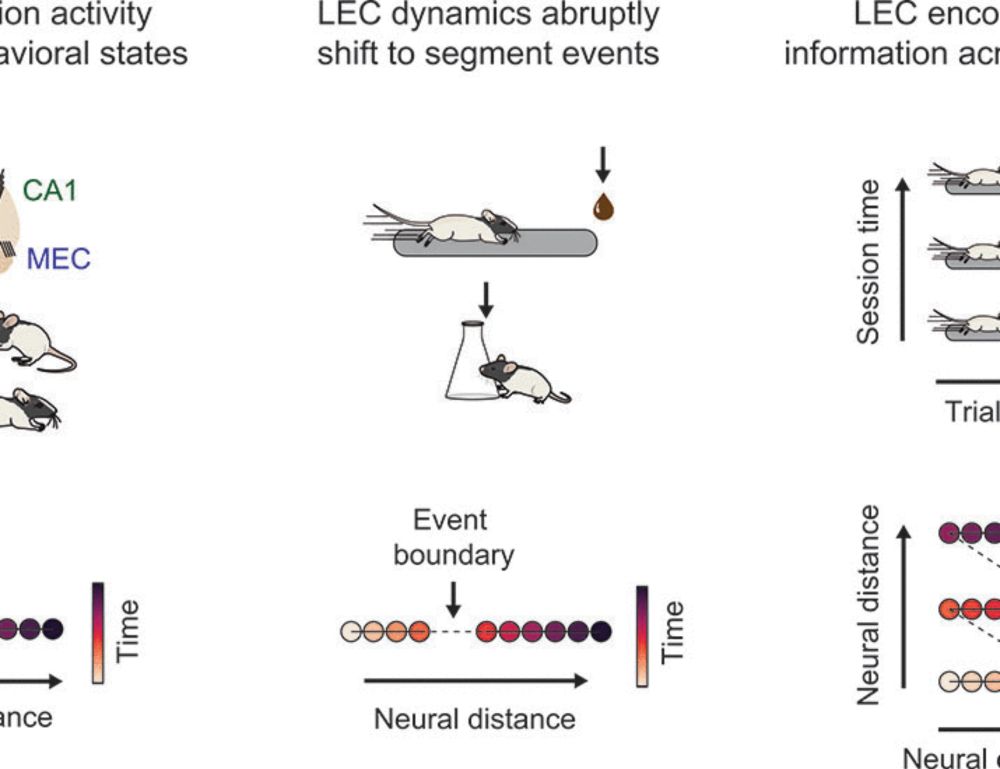
Your brain doesn’t just passively track time ⏳ - it structures it.
In @Science.org we show that activity in 🧠 memory circuits (LEC) drifts constantly, but makes sharp jumps at key moments, segmenting life into meaningful events. (1/2)
👉 www.science.org/doi/10.1126/...
In @Science.org we show that activity in 🧠 memory circuits (LEC) drifts constantly, but makes sharp jumps at key moments, segmenting life into meaningful events. (1/2)
👉 www.science.org/doi/10.1126/...
Event structure sculpts neural population dynamics in the lateral entorhinal cortex
Our experience of the world is a continuous stream of events that must be segmented and organized at multiple timescales. The neural mechanisms underlying this process remain unknown. In this work, we...
www.science.org
June 26, 2025 at 6:06 PM
Your brain doesn’t just passively track time ⏳ - it structures it.
In @Science.org we show that activity in 🧠 memory circuits (LEC) drifts constantly, but makes sharp jumps at key moments, segmenting life into meaningful events. (1/2)
👉 www.science.org/doi/10.1126/...
In @Science.org we show that activity in 🧠 memory circuits (LEC) drifts constantly, but makes sharp jumps at key moments, segmenting life into meaningful events. (1/2)
👉 www.science.org/doi/10.1126/...
Reposted by Subham Dey

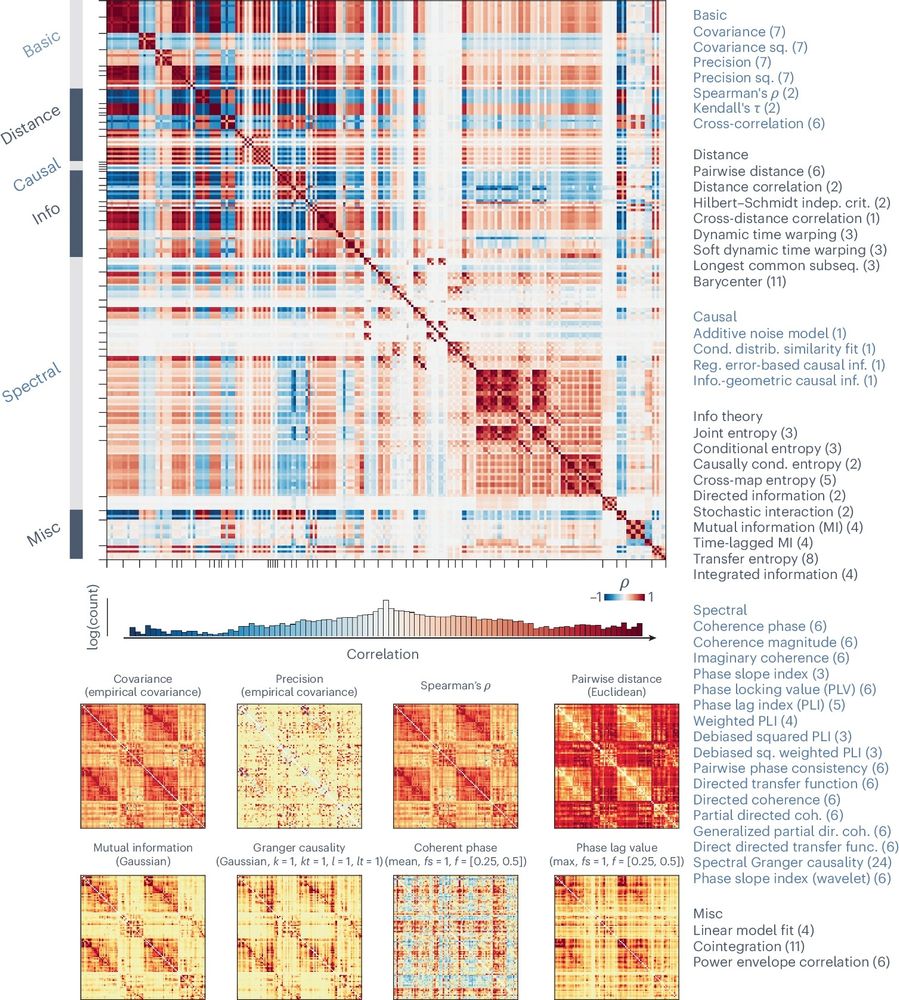
Benchmarking methods for mapping functional connectivity in the brain | doi.org/10.1038/s415...
What is the best measure of functional connectivity (FC)?
led by @zhenqi.bsky.social in @natmethods.nature.com ⤵️
What is the best measure of functional connectivity (FC)?
led by @zhenqi.bsky.social in @natmethods.nature.com ⤵️
June 20, 2025 at 7:57 PM
Benchmarking methods for mapping functional connectivity in the brain | doi.org/10.1038/s415...
What is the best measure of functional connectivity (FC)?
led by @zhenqi.bsky.social in @natmethods.nature.com ⤵️
What is the best measure of functional connectivity (FC)?
led by @zhenqi.bsky.social in @natmethods.nature.com ⤵️
Reposted by Subham Dey

Our new paper is out in Science.
We identified a subgroup of cholinergic neurons that mediate sensory modality-specific attention. They change their funcitonal properties within secs of behavioral context change.
Congrats to Bin for the great thesis, and the team!
www.science.org/doi/10.1126/...
We identified a subgroup of cholinergic neurons that mediate sensory modality-specific attention. They change their funcitonal properties within secs of behavioral context change.
Congrats to Bin for the great thesis, and the team!
www.science.org/doi/10.1126/...
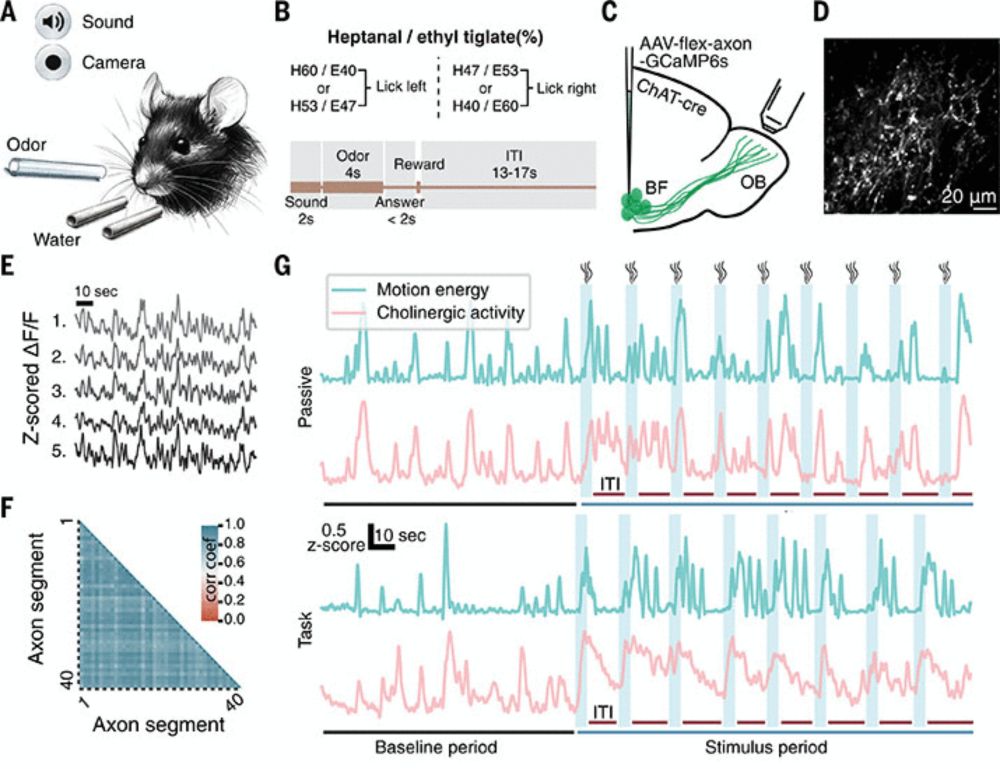
Cholinergic feedback for modality- and context-specific modulation of sensory representations
The brain’s ability to prioritize sensory information is crucial for adaptive behavior, yet its mechanisms remain unclear. We investigated basal forebrain cholinergic neurons modulating olfactory bulb...
www.science.org
June 20, 2025 at 3:32 PM
Our new paper is out in Science.
We identified a subgroup of cholinergic neurons that mediate sensory modality-specific attention. They change their funcitonal properties within secs of behavioral context change.
Congrats to Bin for the great thesis, and the team!
www.science.org/doi/10.1126/...
We identified a subgroup of cholinergic neurons that mediate sensory modality-specific attention. They change their funcitonal properties within secs of behavioral context change.
Congrats to Bin for the great thesis, and the team!
www.science.org/doi/10.1126/...
Reposted by Subham Dey

Thrilled to announce our new publication titled 'Decoding predicted future states from the brain's physics engine' with @emiecz.bsky.social, Cyn X. Fang, @nancykanwisher.bsky.social, @joshtenenbaum.bsky.social
www.science.org/doi/full/10....
(1/n)
www.science.org/doi/full/10....
(1/n)
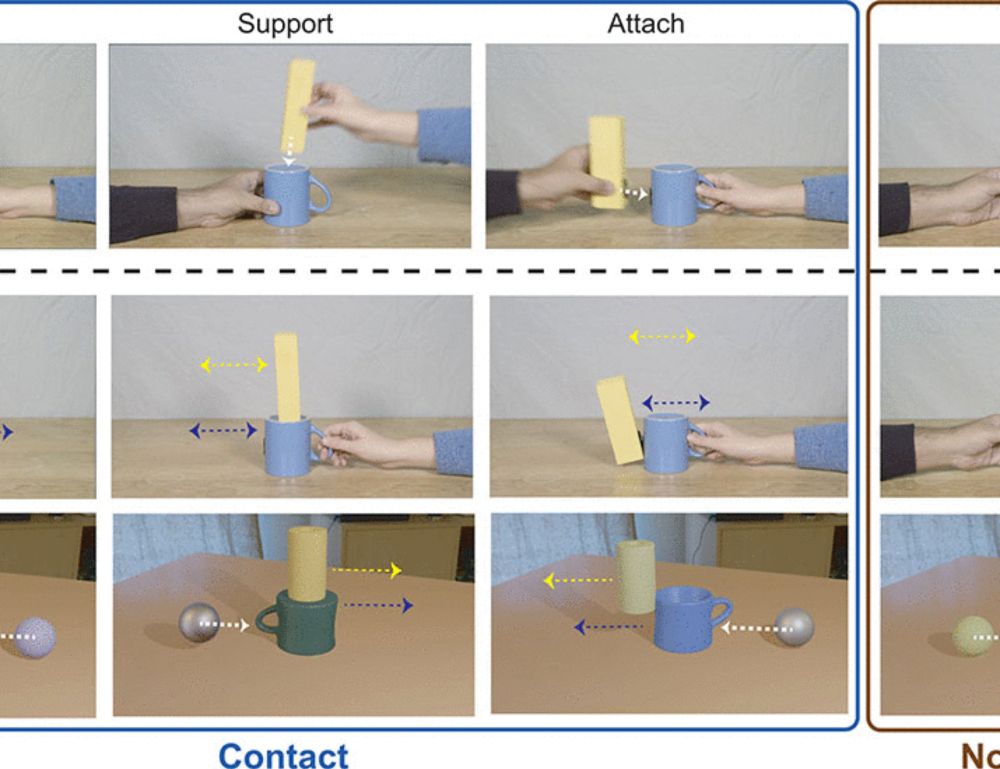
Decoding predicted future states from the brain’s “physics engine”
Using fMRI in humans, this study provides evidence for future state prediction in brain regions involved in physical reasoning.
www.science.org
June 17, 2025 at 6:23 PM
Thrilled to announce our new publication titled 'Decoding predicted future states from the brain's physics engine' with @emiecz.bsky.social, Cyn X. Fang, @nancykanwisher.bsky.social, @joshtenenbaum.bsky.social
www.science.org/doi/full/10....
(1/n)
www.science.org/doi/full/10....
(1/n)
Reposted by Subham Dey
Very happy to share the latest from my postdoc!
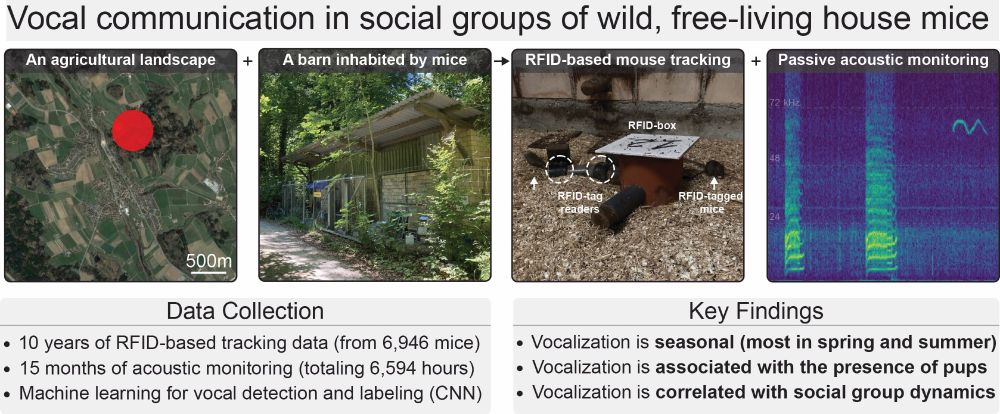
10 yrs of mouse social networks + 1.25 yrs of acoustic data ➡️ insight into vocalization & sociality in a wild population of your favorite lab model 🐁
paper: bit.ly/4n93yyD
data: bit.ly/4lfFBEk
code: bit.ly/4kNnMwx
#bioacoustics #neuroskyence
1/8
10 yrs of mouse social networks + 1.25 yrs of acoustic data ➡️ insight into vocalization & sociality in a wild population of your favorite lab model 🐁
paper: bit.ly/4n93yyD
data: bit.ly/4lfFBEk
code: bit.ly/4kNnMwx
#bioacoustics #neuroskyence
1/8
June 18, 2025 at 6:26 PM
Very happy to share the latest from my postdoc!
10 yrs of mouse social networks + 1.25 yrs of acoustic data ➡️ insight into vocalization & sociality in a wild population of your favorite lab model 🐁
paper: bit.ly/4n93yyD
data: bit.ly/4lfFBEk
code: bit.ly/4kNnMwx
#bioacoustics #neuroskyence
1/8
10 yrs of mouse social networks + 1.25 yrs of acoustic data ➡️ insight into vocalization & sociality in a wild population of your favorite lab model 🐁
paper: bit.ly/4n93yyD
data: bit.ly/4lfFBEk
code: bit.ly/4kNnMwx
#bioacoustics #neuroskyence
1/8
You have a nonlinear generative model for recorded neural data, then you again linearize it using koopman operators to design linear optimal control input. There are already ample works in the literature where you can design nonlinear energy efficient optimal controllers for nonlinear systems.
June 5, 2025 at 7:18 PM
You have a nonlinear generative model for recorded neural data, then you again linearize it using koopman operators to design linear optimal control input. There are already ample works in the literature where you can design nonlinear energy efficient optimal controllers for nonlinear systems.