



Kaiwen Sheng (盛楷文)
@kaiwensheng.bsky.social
PhD in BioE at @Stanford w/ Karl Deisseroth and Anish Mitra. Prev at @UCL, @PKU and @BAAI.
#neuroAI
#neuroAI
Reposted by Kaiwen Sheng (盛楷文)

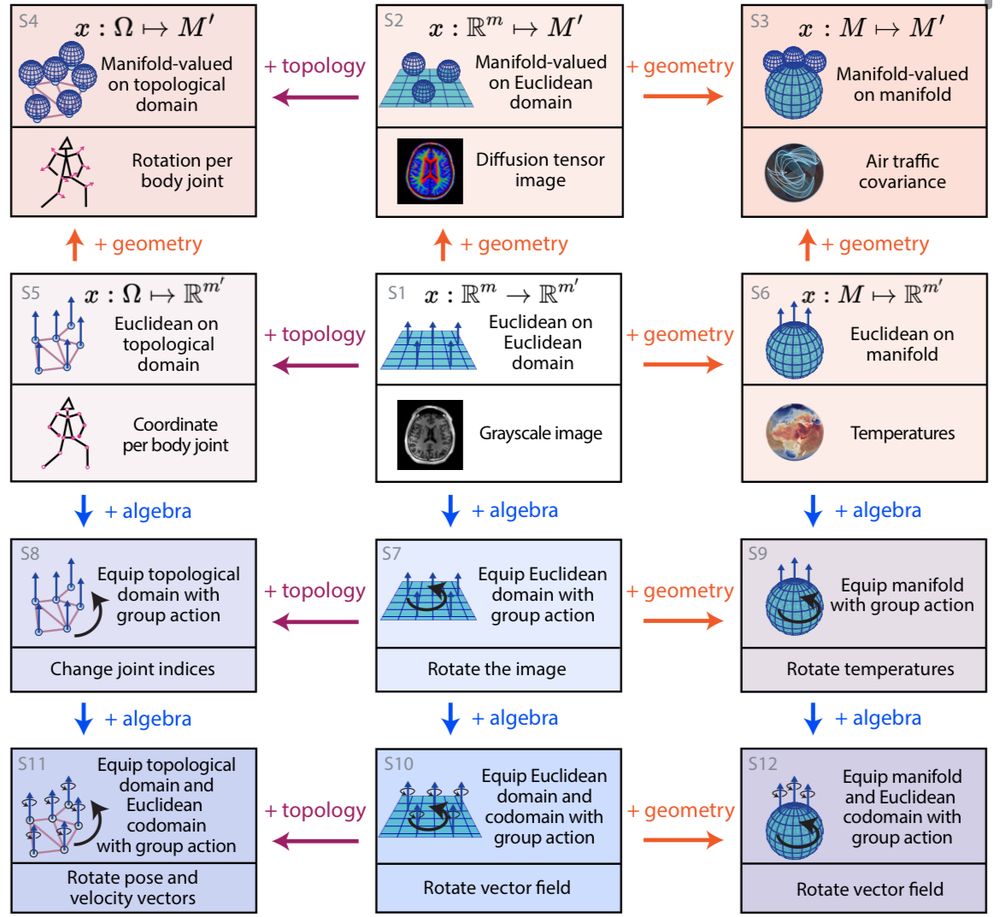
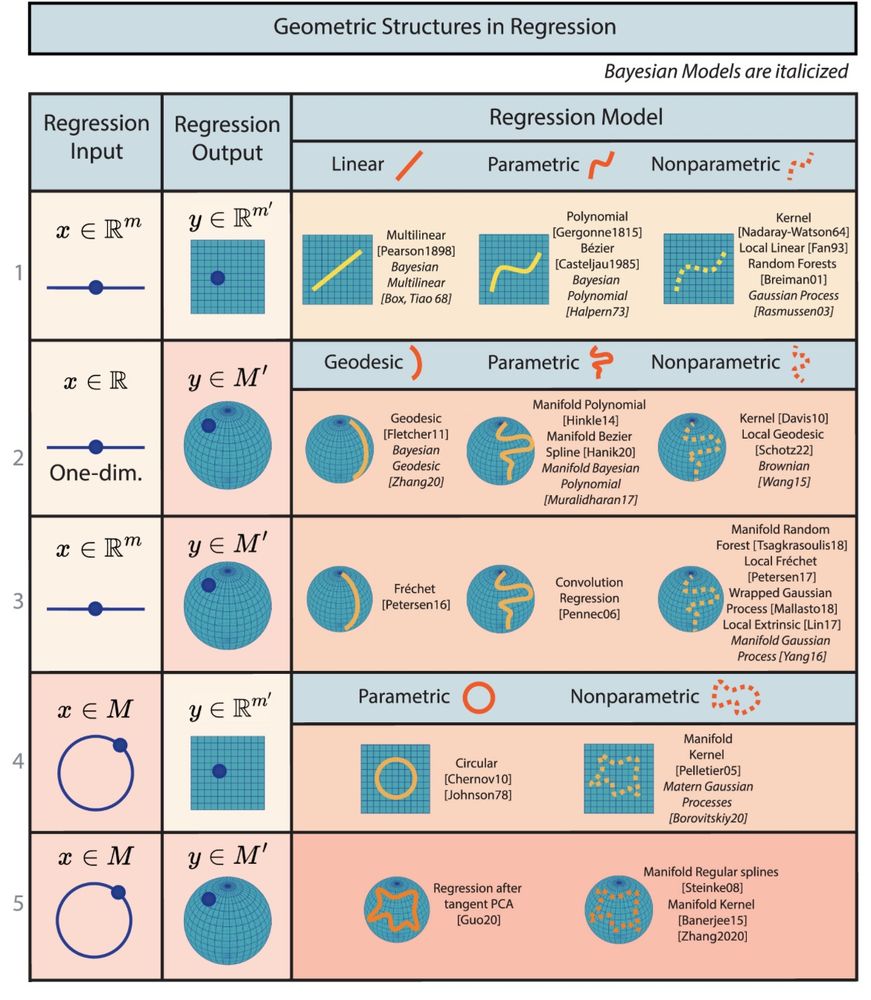
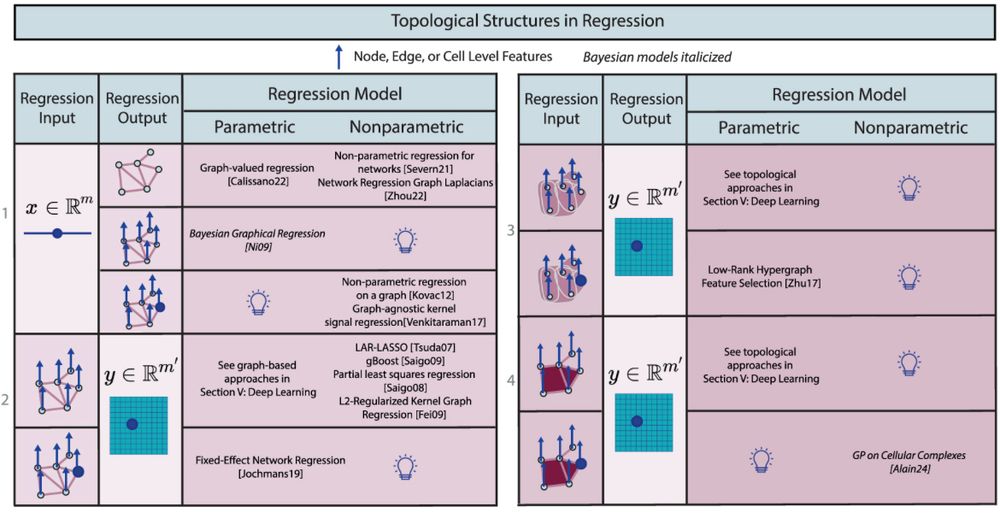
Our illustrated guide to non-Euclidian ML is finally published!
Check it out for
⭐️ gorgeous figures (with new additions!) on topology, algebra, and geometry in the field
⭐️ broken down tables for easy reading
⭐️ accessible text, additional refs, and more
iopscience.iop.org/article/10.1...
Check it out for
⭐️ gorgeous figures (with new additions!) on topology, algebra, and geometry in the field
⭐️ broken down tables for easy reading
⭐️ accessible text, additional refs, and more
iopscience.iop.org/article/10.1...
August 1, 2025 at 3:24 PM
Our illustrated guide to non-Euclidian ML is finally published!
Check it out for
⭐️ gorgeous figures (with new additions!) on topology, algebra, and geometry in the field
⭐️ broken down tables for easy reading
⭐️ accessible text, additional refs, and more
iopscience.iop.org/article/10.1...
Check it out for
⭐️ gorgeous figures (with new additions!) on topology, algebra, and geometry in the field
⭐️ broken down tables for easy reading
⭐️ accessible text, additional refs, and more
iopscience.iop.org/article/10.1...
Reposted by Kaiwen Sheng (盛楷文)

Very excited to release a new blog post that formalizes what it means for data to be compositional, and shows how compositionality can exist at multiple scales. Early days, but I think there may be significant implications for AI. Check it out! ericelmoznino.github.io/blog/2025/08...
Defining and quantifying compositional structure
What is compositionality? For those of us working in AI or cognitive neuroscience this question can appear easy at first, but becomes increasingly perplexing the more we think about it. We aren’t shor...
ericelmoznino.github.io
August 18, 2025 at 8:46 PM
Very excited to release a new blog post that formalizes what it means for data to be compositional, and shows how compositionality can exist at multiple scales. Early days, but I think there may be significant implications for AI. Check it out! ericelmoznino.github.io/blog/2025/08...
Reposted by Kaiwen Sheng (盛楷文)

It was an honor to write this, but also great fun. A chance to look back at the classics, and think about the path forward. #Physics is a beautiful human endeavor. journals.aps.org/prxlife/abst...
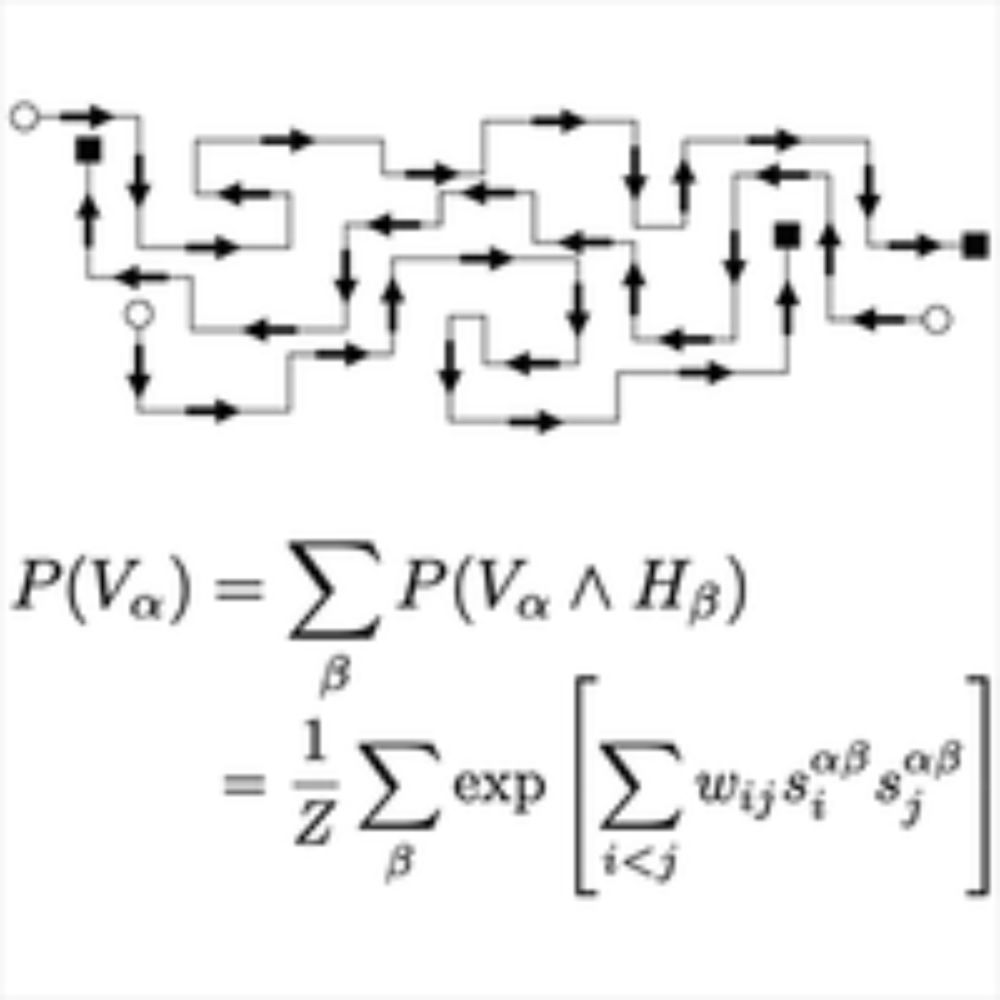
Emergence of Brains
This review traces how ideas from statistical physics evolved into foundational models of neural computation, shaping modern AI and culminating in the 2024 Nobel Prize in Physics.
journals.aps.org
August 9, 2025 at 2:19 PM
It was an honor to write this, but also great fun. A chance to look back at the classics, and think about the path forward. #Physics is a beautiful human endeavor. journals.aps.org/prxlife/abst...
Reposted by Kaiwen Sheng (盛楷文)
In neuroscience, we often try to understand systems by analyzing their representations — using tools like regression or RSA. But are these analyses biased towards discovering a subset of what a system represents? If you're interested in this question, check out our new commentary! Thread:
![What do representations tell us about a system? Image of a mouse with a scope showing a vector of activity patterns, and a neural network with a vector of unit activity patterns
Common analyses of neural representations: Encoding models (relating activity to task features) drawing of an arrow from a trace saying [on_____on____] to a neuron and spike train. Comparing models via neural predictivity: comparing two neural networks by their R^2 to mouse brain activity. RSA: assessing brain-brain or model-brain correspondence using representational dissimilarity matrices](https://cdn.bsky.app/img/feed_thumbnail/plain/did:plc:e6ewzleebkdi2y2bxhjxoknt/bafkreiav2io2ska33o4kizf57co5bboqyyfdpnozo2gxsicrfr5l7qzjcq@jpeg)
August 5, 2025 at 2:36 PM
In neuroscience, we often try to understand systems by analyzing their representations — using tools like regression or RSA. But are these analyses biased towards discovering a subset of what a system represents? If you're interested in this question, check out our new commentary! Thread:
Reposted by Kaiwen Sheng (盛楷文)

📢Alain Destexhe and colleagues from @neuropsi.bsky.social introduce a computational framework to study how molecular changes impact brain activity. #compneurosky #Neuroskyence www.nature.com/articles/s43...
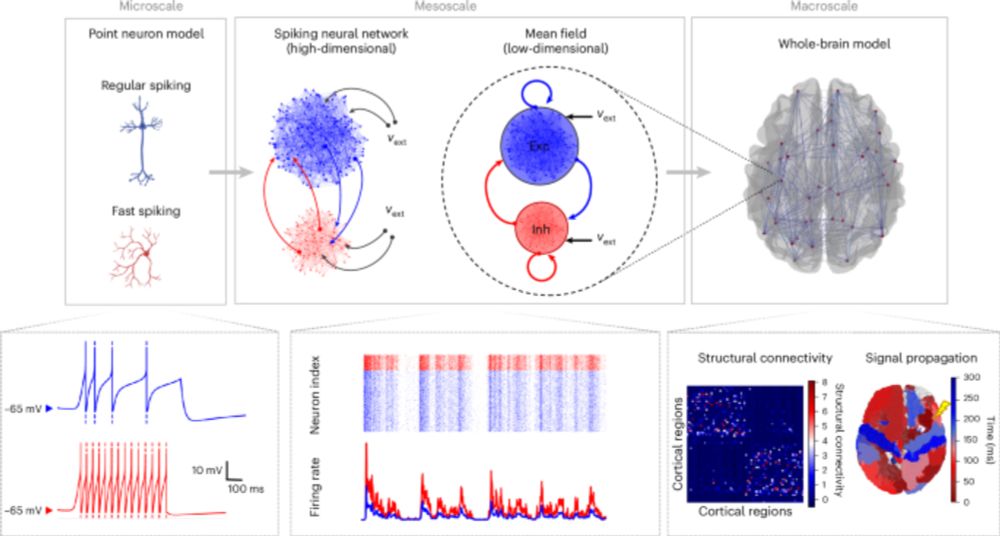
A computational approach to evaluate how molecular mechanisms impact large-scale brain activity - Nature Computational Science
A computational framework is introduced to study how molecular changes impact brain activity, using biophysically grounded mean-field models to evaluate how drugs acting on synaptic receptors lead to ...
www.nature.com
May 28, 2025 at 3:58 PM
📢Alain Destexhe and colleagues from @neuropsi.bsky.social introduce a computational framework to study how molecular changes impact brain activity. #compneurosky #Neuroskyence www.nature.com/articles/s43...
Reposted by Kaiwen Sheng (盛楷文)

Thrilled to announce our new publication titled 'Decoding predicted future states from the brain's physics engine' with @emiecz.bsky.social, Cyn X. Fang, @nancykanwisher.bsky.social, @joshtenenbaum.bsky.social
www.science.org/doi/full/10....
(1/n)
www.science.org/doi/full/10....
(1/n)
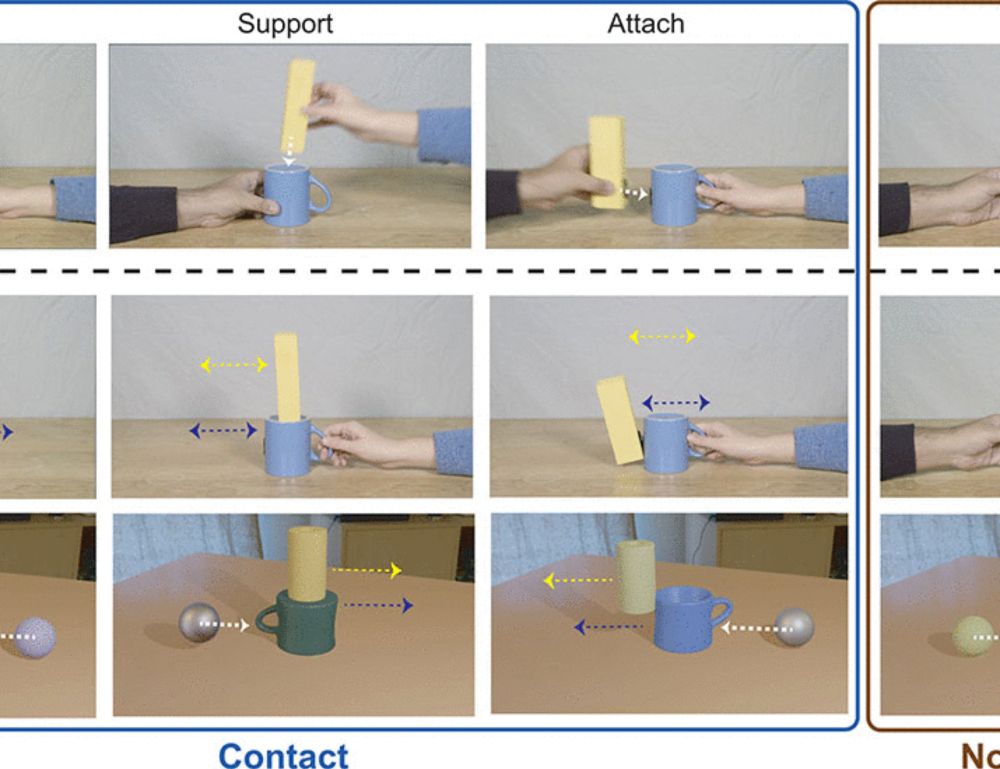
Decoding predicted future states from the brain’s “physics engine”
Using fMRI in humans, this study provides evidence for future state prediction in brain regions involved in physical reasoning.
www.science.org
June 17, 2025 at 6:23 PM
Thrilled to announce our new publication titled 'Decoding predicted future states from the brain's physics engine' with @emiecz.bsky.social, Cyn X. Fang, @nancykanwisher.bsky.social, @joshtenenbaum.bsky.social
www.science.org/doi/full/10....
(1/n)
www.science.org/doi/full/10....
(1/n)
Reposted by Kaiwen Sheng (盛楷文)

Reminder: don't do decoding!
When you have more noise in your data (neuroimaging) than you do in your labels (face, house), encoding is better than decoding.
Not to mention that encoding models make it easier to control for covariates.
When you have more noise in your data (neuroimaging) than you do in your labels (face, house), encoding is better than decoding.
Not to mention that encoding models make it easier to control for covariates.

June 18, 2025 at 6:55 PM
Reminder: don't do decoding!
When you have more noise in your data (neuroimaging) than you do in your labels (face, house), encoding is better than decoding.
Not to mention that encoding models make it easier to control for covariates.
When you have more noise in your data (neuroimaging) than you do in your labels (face, house), encoding is better than decoding.
Not to mention that encoding models make it easier to control for covariates.
Reposted by Kaiwen Sheng (盛楷文)

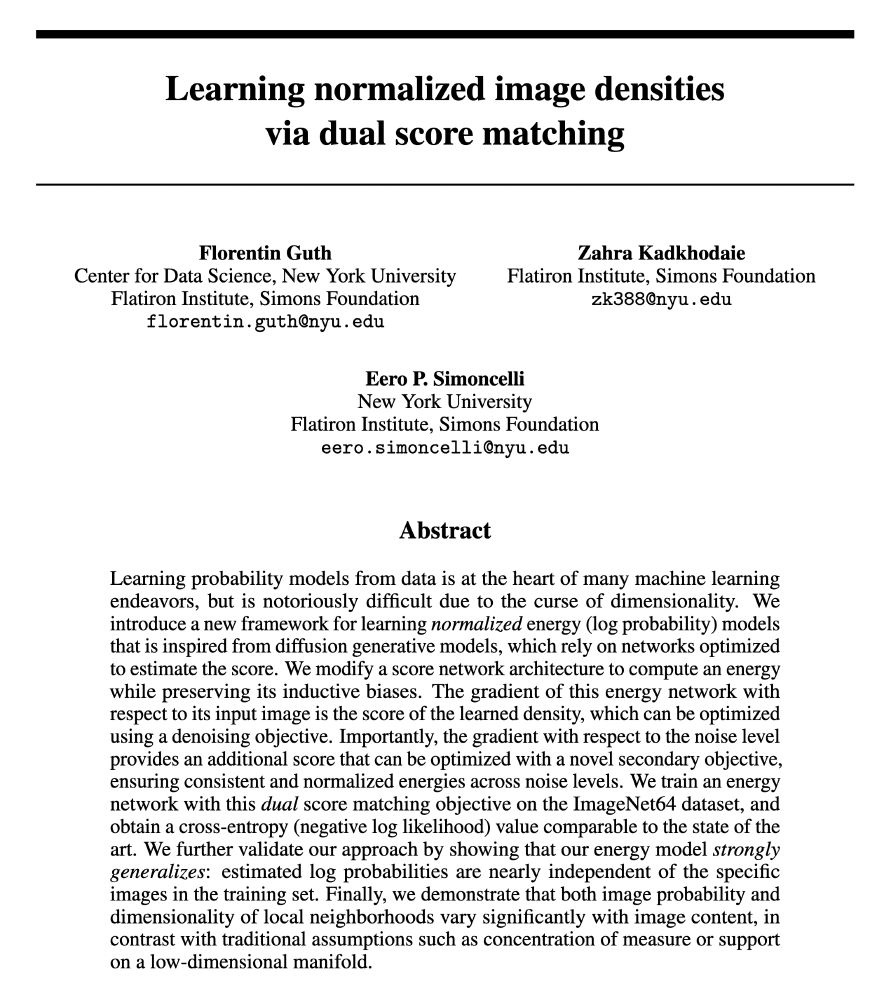
What is the probability of an image? What do the highest and lowest probability images look like? Do natural images lie on a low-dimensional manifold?
In a new preprint with Zahra Kadkhodaie and @eerosim.bsky.social, we develop a novel energy-based model in order to answer these questions: 🧵
In a new preprint with Zahra Kadkhodaie and @eerosim.bsky.social, we develop a novel energy-based model in order to answer these questions: 🧵
June 6, 2025 at 10:11 PM
What is the probability of an image? What do the highest and lowest probability images look like? Do natural images lie on a low-dimensional manifold?
In a new preprint with Zahra Kadkhodaie and @eerosim.bsky.social, we develop a novel energy-based model in order to answer these questions: 🧵
In a new preprint with Zahra Kadkhodaie and @eerosim.bsky.social, we develop a novel energy-based model in order to answer these questions: 🧵
Reposted by Kaiwen Sheng (盛楷文)
🚨Paper alert!🚨
TL;DR first: We used a pre-trained deep neural network to model fMRI data and to generate images predicted to elicit a large response for each many different parts of the brain. We aggregate these into an awesome interactive brain viewer: piecesofmind.psyc.unr.edu/activation_m...
TL;DR first: We used a pre-trained deep neural network to model fMRI data and to generate images predicted to elicit a large response for each many different parts of the brain. We aggregate these into an awesome interactive brain viewer: piecesofmind.psyc.unr.edu/activation_m...
Cortex Feature Visualization
piecesofmind.psyc.unr.edu
June 12, 2025 at 4:34 PM
🚨Paper alert!🚨
TL;DR first: We used a pre-trained deep neural network to model fMRI data and to generate images predicted to elicit a large response for each many different parts of the brain. We aggregate these into an awesome interactive brain viewer: piecesofmind.psyc.unr.edu/activation_m...
TL;DR first: We used a pre-trained deep neural network to model fMRI data and to generate images predicted to elicit a large response for each many different parts of the brain. We aggregate these into an awesome interactive brain viewer: piecesofmind.psyc.unr.edu/activation_m...
Reposted by Kaiwen Sheng (盛楷文)

New paper: "Large Language Models and Emergence: A Complex Systems Perspective" (D. Krakauer, J. Krakauer, M. Mitchell).
We look at claims of "emergent capabilities" & "emergent intelligence" in LLMs from the perspective of what emergence means in complexity science.
arxiv.org/pdf/2506.11135
We look at claims of "emergent capabilities" & "emergent intelligence" in LLMs from the perspective of what emergence means in complexity science.
arxiv.org/pdf/2506.11135
arxiv.org
June 16, 2025 at 1:15 PM
New paper: "Large Language Models and Emergence: A Complex Systems Perspective" (D. Krakauer, J. Krakauer, M. Mitchell).
We look at claims of "emergent capabilities" & "emergent intelligence" in LLMs from the perspective of what emergence means in complexity science.
arxiv.org/pdf/2506.11135
We look at claims of "emergent capabilities" & "emergent intelligence" in LLMs from the perspective of what emergence means in complexity science.
arxiv.org/pdf/2506.11135
Reposted by Kaiwen Sheng (盛楷文)

Reposted by Kaiwen Sheng (盛楷文)

Multiday imaging of CA1 neurons during learning reveals that the representation stabilizes as the number of readily retrievable, information-rich and stable place cells increases, and suggests novel mechanisms of hippocampal memory formation
www.nature.com/articles/s41...
www.nature.com/articles/s41...
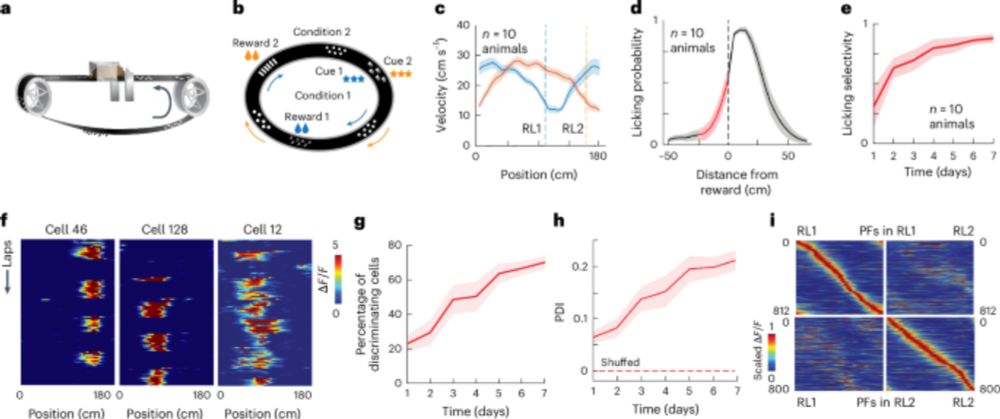
Formation of an expanding memory representation in the hippocampus - Nature Neuroscience
Multiday imaging of CA1 neurons during learning reveals that the representation stabilizes as the number of readily retrievable, information-rich and stable place cells increases and suggests novel me...
www.nature.com
June 10, 2025 at 9:58 PM
Multiday imaging of CA1 neurons during learning reveals that the representation stabilizes as the number of readily retrievable, information-rich and stable place cells increases, and suggests novel mechanisms of hippocampal memory formation
www.nature.com/articles/s41...
www.nature.com/articles/s41...
Reposted by Kaiwen Sheng (盛楷文)
Our new story. Now also posted by the official side. :)
Activity patterns drift. Representational maps are preserved.
Even after single neuron ablations, representational maps are recovered within days.
Activity patterns drift. Representational maps are preserved.
Even after single neuron ablations, representational maps are recovered within days.
How homeostatic mechanisms protect the representational map of sounds after neuron loss in mouse auditory cortex
www.nature.com/articles/s41...
www.nature.com/articles/s41...

Homeostasis of a representational map in the neocortex - Nature Neuroscience
This study investigates how homeostatic mechanisms endow sensory representations in the auditory cortex with resilience against neuron loss. The map of sounds has the ability to recover after microabl...
www.nature.com
June 12, 2025 at 3:47 PM
Our new story. Now also posted by the official side. :)
Activity patterns drift. Representational maps are preserved.
Even after single neuron ablations, representational maps are recovered within days.
Activity patterns drift. Representational maps are preserved.
Even after single neuron ablations, representational maps are recovered within days.
Reposted by Kaiwen Sheng (盛楷文)

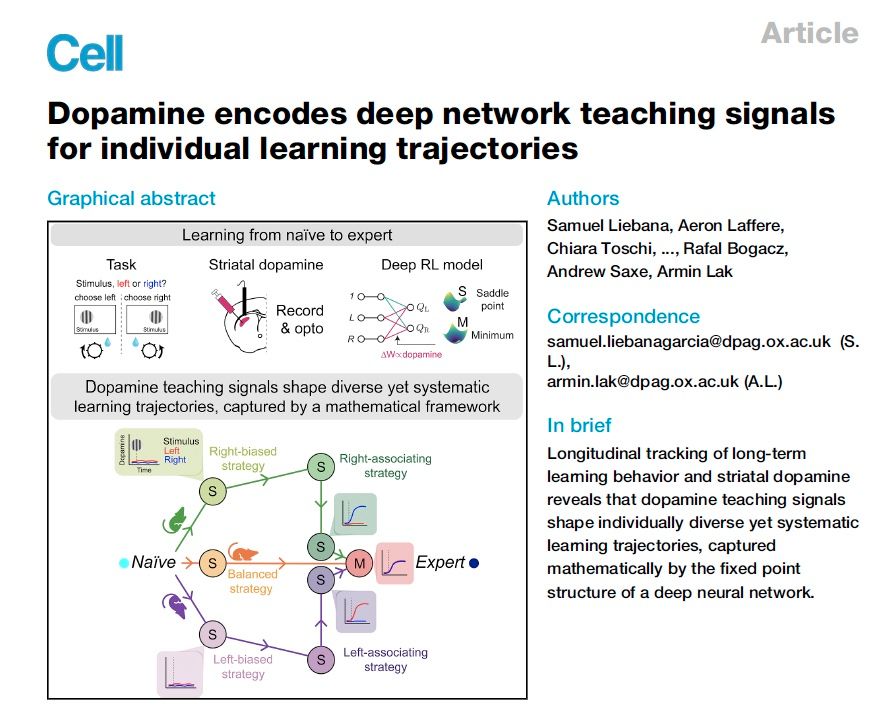
Our work, out at Cell, shows that the brain’s dopamine signals teach each individual a unique learning trajectory. Collaborative experiment-theory effort, led by Sam Liebana in the lab. The first experiment my lab started just shy of 6y ago & v excited to see it out: www.cell.com/cell/fulltex...
June 11, 2025 at 3:18 PM
Our work, out at Cell, shows that the brain’s dopamine signals teach each individual a unique learning trajectory. Collaborative experiment-theory effort, led by Sam Liebana in the lab. The first experiment my lab started just shy of 6y ago & v excited to see it out: www.cell.com/cell/fulltex...
Reposted by Kaiwen Sheng (盛楷文)
Ilya Sutskever asks “Why can’t digital computers do the same [as AI]?”
The reason is that the brain isn’t digital. Digital AI needs nuclear plants. The brain runs on 20W. Analog computing is vastly more efficient—and the brain constantly generates the raw material: waves.
youtu.be/zuZ2zaotrJs?...
The reason is that the brain isn’t digital. Digital AI needs nuclear plants. The brain runs on 20W. Analog computing is vastly more efficient—and the brain constantly generates the raw material: waves.
youtu.be/zuZ2zaotrJs?...

Ilya Sutskever, U of T honorary degree recipient, June 6, 2025
YouTube video by University of Toronto
youtu.be
June 9, 2025 at 6:57 PM
Ilya Sutskever asks “Why can’t digital computers do the same [as AI]?”
The reason is that the brain isn’t digital. Digital AI needs nuclear plants. The brain runs on 20W. Analog computing is vastly more efficient—and the brain constantly generates the raw material: waves.
youtu.be/zuZ2zaotrJs?...
The reason is that the brain isn’t digital. Digital AI needs nuclear plants. The brain runs on 20W. Analog computing is vastly more efficient—and the brain constantly generates the raw material: waves.
youtu.be/zuZ2zaotrJs?...
Reposted by Kaiwen Sheng (盛楷文)

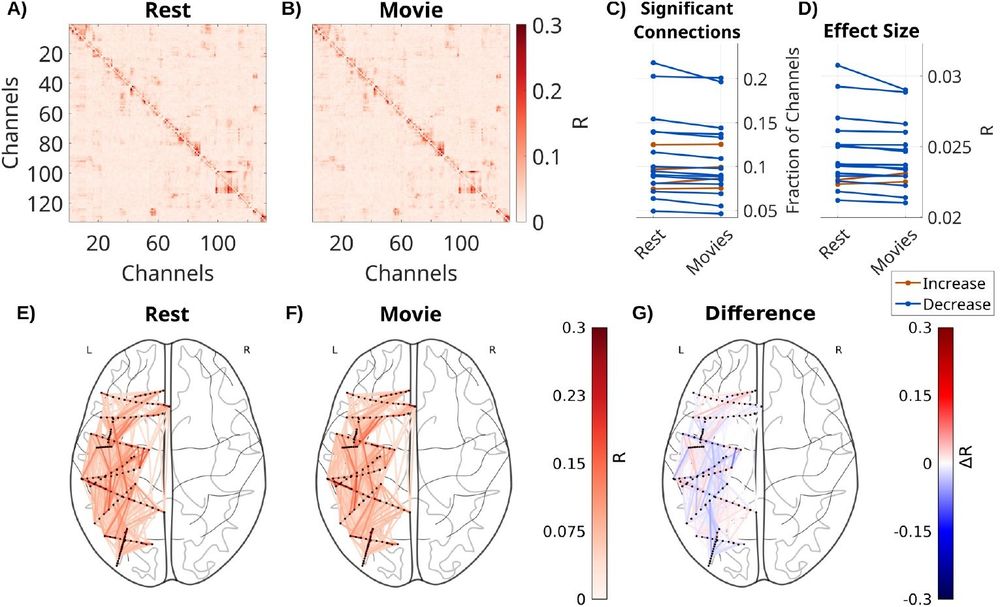
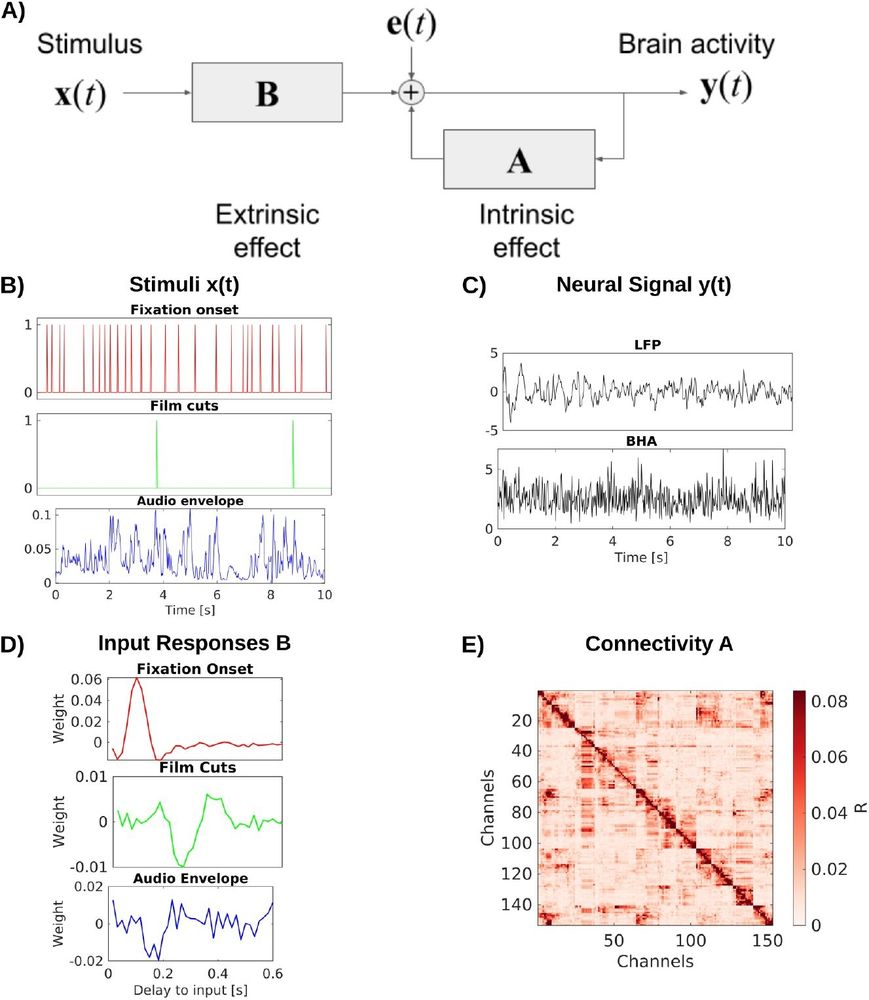
Evidence in support of the "Brain from the inside out":
Response to movies is dominated by intrinsic brain dynamics. The dynamic itself is barely alternatered by the task of watching movies.
Human intracranial recordings from 5000 electrodes, now out in eLife.
elifesciences.org/reviewed-pre...
Response to movies is dominated by intrinsic brain dynamics. The dynamic itself is barely alternatered by the task of watching movies.
Human intracranial recordings from 5000 electrodes, now out in eLife.
elifesciences.org/reviewed-pre...
June 9, 2025 at 10:53 PM
Evidence in support of the "Brain from the inside out":
Response to movies is dominated by intrinsic brain dynamics. The dynamic itself is barely alternatered by the task of watching movies.
Human intracranial recordings from 5000 electrodes, now out in eLife.
elifesciences.org/reviewed-pre...
Response to movies is dominated by intrinsic brain dynamics. The dynamic itself is barely alternatered by the task of watching movies.
Human intracranial recordings from 5000 electrodes, now out in eLife.
elifesciences.org/reviewed-pre...
Reposted by Kaiwen Sheng (盛楷文)

The firing of neural populations is high-dim even if their subthreshold activity is low-dim! This work by @bio-emergent.bsky.social and @haydari.bsky.social shows how, with a solvable model, a data analysis technique, and data from mouse visual cortex: www.biorxiv.org/content/10.1...

High-dimensional neuronal activity from low-dimensional latent dynamics: a solvable model
Computation in recurrent networks of neurons has been hypothesized to occur at the level of low-dimensional latent dynamics, both in artificial systems and in the brain. This hypothesis seems at odds ...
www.biorxiv.org
June 9, 2025 at 11:49 AM
The firing of neural populations is high-dim even if their subthreshold activity is low-dim! This work by @bio-emergent.bsky.social and @haydari.bsky.social shows how, with a solvable model, a data analysis technique, and data from mouse visual cortex: www.biorxiv.org/content/10.1...
Reposted by Kaiwen Sheng (盛楷文)

New preprint! 🧠🤖
How do we build neural decoders that are:
⚡️ fast enough for real-time use
🎯 accurate across diverse tasks
🌍 generalizable to new sessions, subjects, and even species?
We present POSSM, a hybrid SSM architecture that optimizes for all three of these axes!
🧵1/7
How do we build neural decoders that are:
⚡️ fast enough for real-time use
🎯 accurate across diverse tasks
🌍 generalizable to new sessions, subjects, and even species?
We present POSSM, a hybrid SSM architecture that optimizes for all three of these axes!
🧵1/7

June 6, 2025 at 5:40 PM
New preprint! 🧠🤖
How do we build neural decoders that are:
⚡️ fast enough for real-time use
🎯 accurate across diverse tasks
🌍 generalizable to new sessions, subjects, and even species?
We present POSSM, a hybrid SSM architecture that optimizes for all three of these axes!
🧵1/7
How do we build neural decoders that are:
⚡️ fast enough for real-time use
🎯 accurate across diverse tasks
🌍 generalizable to new sessions, subjects, and even species?
We present POSSM, a hybrid SSM architecture that optimizes for all three of these axes!
🧵1/7
Reposted by Kaiwen Sheng (盛楷文)


Reposted by Kaiwen Sheng (盛楷文)

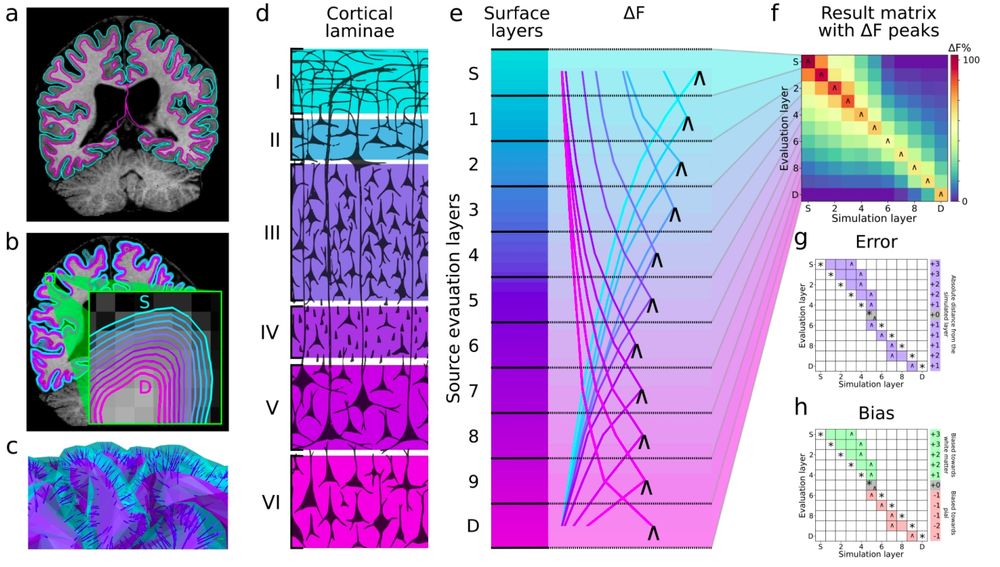
🚨🚨🚨PREPRINT ALERT🚨🚨🚨
Neural dynamics across cortical layers are key to brain computations - but non-invasively, we’ve been limited to rough "deep vs. superficial" distinctions. What if we told you that it is possible to achieve full (TRUE!) laminar (I, II, III, IV, V, VI) precision with MEG!
Neural dynamics across cortical layers are key to brain computations - but non-invasively, we’ve been limited to rough "deep vs. superficial" distinctions. What if we told you that it is possible to achieve full (TRUE!) laminar (I, II, III, IV, V, VI) precision with MEG!
June 2, 2025 at 11:55 AM
🚨🚨🚨PREPRINT ALERT🚨🚨🚨
Neural dynamics across cortical layers are key to brain computations - but non-invasively, we’ve been limited to rough "deep vs. superficial" distinctions. What if we told you that it is possible to achieve full (TRUE!) laminar (I, II, III, IV, V, VI) precision with MEG!
Neural dynamics across cortical layers are key to brain computations - but non-invasively, we’ve been limited to rough "deep vs. superficial" distinctions. What if we told you that it is possible to achieve full (TRUE!) laminar (I, II, III, IV, V, VI) precision with MEG!
Reposted by Kaiwen Sheng (盛楷文)

📣 New paper alert — To be presented at ICML 2025!
arxiv.org/abs/2405.08719
What does it really mean for a simulator to be misspecified, if our goal is to estimate parameters with calibrated uncertainty?
A 🧵on our new method, RoPE, and what it means for real-world SBI ⬇️
arxiv.org/abs/2405.08719
What does it really mean for a simulator to be misspecified, if our goal is to estimate parameters with calibrated uncertainty?
A 🧵on our new method, RoPE, and what it means for real-world SBI ⬇️

Addressing Misspecification in Simulation-based Inference through Data-driven Calibration
Driven by steady progress in deep generative modeling, simulation-based inference (SBI) has emerged as the workhorse for inferring the parameters of stochastic simulators. However, recent work has dem...
arxiv.org
June 2, 2025 at 11:18 AM
📣 New paper alert — To be presented at ICML 2025!
arxiv.org/abs/2405.08719
What does it really mean for a simulator to be misspecified, if our goal is to estimate parameters with calibrated uncertainty?
A 🧵on our new method, RoPE, and what it means for real-world SBI ⬇️
arxiv.org/abs/2405.08719
What does it really mean for a simulator to be misspecified, if our goal is to estimate parameters with calibrated uncertainty?
A 🧵on our new method, RoPE, and what it means for real-world SBI ⬇️
Reposted by Kaiwen Sheng (盛楷文)
Our EEG-Foundation Challenge, on more than 3,000 subjects, is accepted at #Neurips 2025, go check it out:
eeg2025.github.io
Led by B Aristimunha D Truong P Guetschel and SY Shirazi!
eeg2025.github.io
Led by B Aristimunha D Truong P Guetschel and SY Shirazi!
EEG Challenge (2025)
From Cross-Task to learning subject invariance representation in EEG decoding
eeg2025.github.io
May 30, 2025 at 3:24 PM
Our EEG-Foundation Challenge, on more than 3,000 subjects, is accepted at #Neurips 2025, go check it out:
eeg2025.github.io
Led by B Aristimunha D Truong P Guetschel and SY Shirazi!
eeg2025.github.io
Led by B Aristimunha D Truong P Guetschel and SY Shirazi!
Reposted by Kaiwen Sheng (盛楷文)

The Neural Architecture of Dream Recall Frequency: Insights from Interindividual Variations in Brain Structure and Function https://www.biorxiv.org/content/10.1101/2025.05.20.655114v1
May 21, 2025 at 9:15 PM
The Neural Architecture of Dream Recall Frequency: Insights from Interindividual Variations in Brain Structure and Function https://www.biorxiv.org/content/10.1101/2025.05.20.655114v1
Reposted by Kaiwen Sheng (盛楷文)
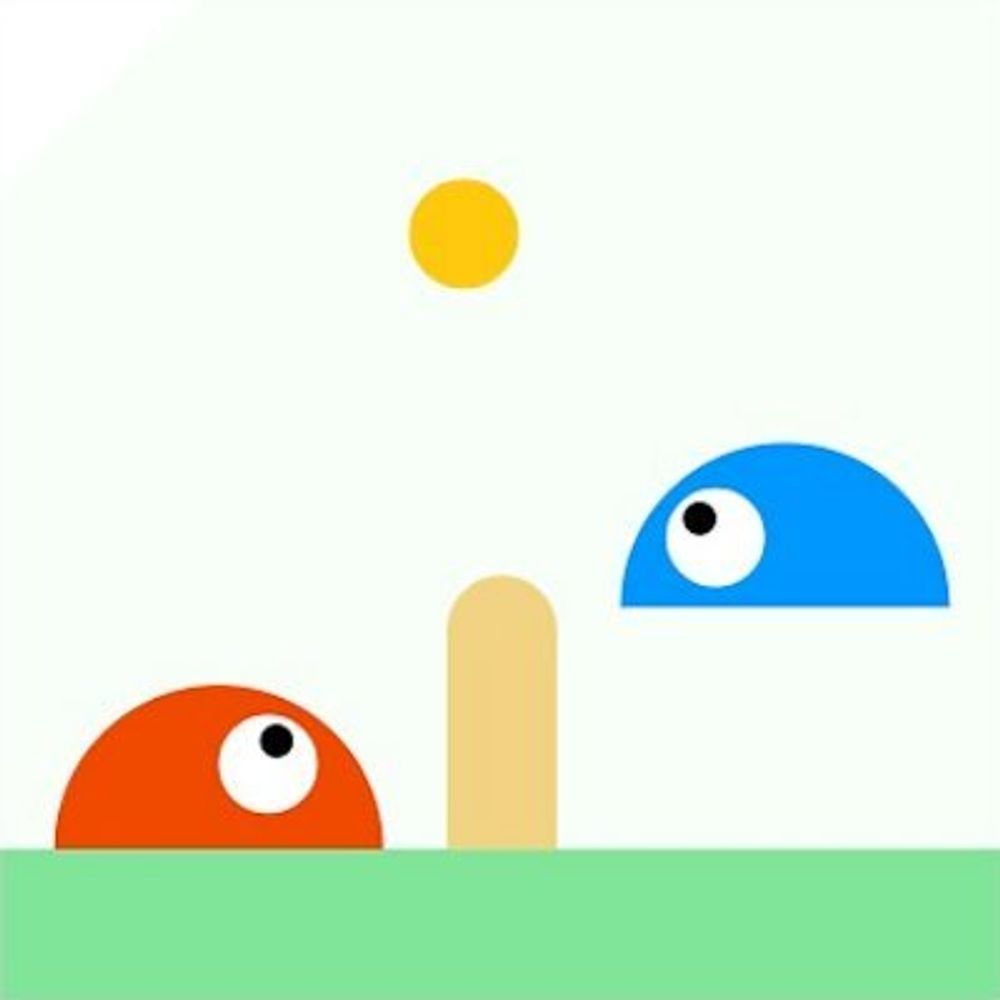
New Paper: Continuous Thought Machines
pub.sakana.ai/ctm/
Neurons in brains use timing and synchronization in the way that they compute, but this is largely ignored in modern neural nets. We believe neural timing is key for the flexibility and adaptability of biological intelligence.
Thread ↓
pub.sakana.ai/ctm/
Neurons in brains use timing and synchronization in the way that they compute, but this is largely ignored in modern neural nets. We believe neural timing is key for the flexibility and adaptability of biological intelligence.
Thread ↓
May 12, 2025 at 2:38 AM
New Paper: Continuous Thought Machines
pub.sakana.ai/ctm/
Neurons in brains use timing and synchronization in the way that they compute, but this is largely ignored in modern neural nets. We believe neural timing is key for the flexibility and adaptability of biological intelligence.
Thread ↓
pub.sakana.ai/ctm/
Neurons in brains use timing and synchronization in the way that they compute, but this is largely ignored in modern neural nets. We believe neural timing is key for the flexibility and adaptability of biological intelligence.
Thread ↓
Reposted by Kaiwen Sheng (盛楷文)
(1/6) Thrilled to share our triple-N dataset (Non-human Primate Neural Responses to Natural Scenes)! It captures thousands of high-level visual neuron responses in macaques to natural scenes using #Neuropixels.
May 11, 2025 at 1:33 PM
(1/6) Thrilled to share our triple-N dataset (Non-human Primate Neural Responses to Natural Scenes)! It captures thousands of high-level visual neuron responses in macaques to natural scenes using #Neuropixels.