



Megan NY Lee
@meganleeny.bsky.social
PhD student @ ETH Zürich/Eawag | microbial systems ecology 🧫
Reposted by Megan NY Lee

Pretty cool! Engineered periplasmic binding proteins+fluorophore sensors (for sugars+AAs) are used to report real-time extracellular metabolite dynamics in E. coli + many others species after 24h in plate readers, showing hierarchical substrate use.
journals.asm.org/doi/full/10....
journals.asm.org/doi/full/10....

Real-time simultaneous monitoring of multiple analytes in bacterial cultures | Applied and Environmental Microbiology
Real-time monitoring of metabolites in bacterial cultures is crucial for advancing our understanding of microbial physiology, metabolic fluxes, and dynamic responses to environmental changes. This capability enables researchers to capture transient metabolic states that are often missed in endpoint measurements. The use of engineered periplasmic binding proteins as biosensors for this real-time metabolite monitoring represents a groundbreaking approach. By leveraging the natural specificity and high affinity of PBPs for small molecules, these biosensors can be engineered to detect a wide range of metabolites with exceptional sensitivity and temporal resolution. The integration of PBP-based biosensors into microbial research not only enhances our ability to study real-time metabolism but also provides a versatile tool for optimizing industrial bioprocesses and exploring bacterial infections and complex microbial ecosystems
journals.asm.org
December 8, 2025 at 3:37 PM
Pretty cool! Engineered periplasmic binding proteins+fluorophore sensors (for sugars+AAs) are used to report real-time extracellular metabolite dynamics in E. coli + many others species after 24h in plate readers, showing hierarchical substrate use.
journals.asm.org/doi/full/10....
journals.asm.org/doi/full/10....
Reposted by Megan NY Lee

I am recruiting graduate students for Fall 2026! The Microbial Ecosystems Lab @hot-mes-asu.bsky.social at ASU studies microbial interactions, spatial ecology, and imaging-driven microbiome science. If you love microbes, microfluidics, or single-cell analysis, let’s talk! www.microbialeco.systems
December 2, 2025 at 7:10 PM
I am recruiting graduate students for Fall 2026! The Microbial Ecosystems Lab @hot-mes-asu.bsky.social at ASU studies microbial interactions, spatial ecology, and imaging-driven microbiome science. If you love microbes, microfluidics, or single-cell analysis, let’s talk! www.microbialeco.systems
Reposted by Megan NY Lee

New preprint from our lab www.biorxiv.org/content/10.1...! Andrea Dos Santos and Clément Vulin combine experiments and models showing how adding glucose can strengthen negative interactions between microbial species. This can be used in tandem with antibiotic treatment to inhibit pathogens!

December 2, 2025 at 1:12 PM
New preprint from our lab www.biorxiv.org/content/10.1...! Andrea Dos Santos and Clément Vulin combine experiments and models showing how adding glucose can strengthen negative interactions between microbial species. This can be used in tandem with antibiotic treatment to inhibit pathogens!
Reposted by Megan NY Lee

Thrilled to share our new work uncovering how membrane transporters determine resource-size preferences in gut bacteria, and showing that deleting a single protein domain can shift a transporter’s preference from long to short fructans. www.biorxiv.org/content/10.1...

Niche partitioning by resource size in the gut microbiome
Niche partitioning promotes diversity of the human gut microbiota. However, the molecular basis of resource specialization and niche separation in the gut remains poorly understood. Here we show that ...
www.biorxiv.org
November 17, 2025 at 10:43 PM
Thrilled to share our new work uncovering how membrane transporters determine resource-size preferences in gut bacteria, and showing that deleting a single protein domain can shift a transporter’s preference from long to short fructans. www.biorxiv.org/content/10.1...
Reposted by Megan NY Lee

Strain displacement in microbiomes via ecological competition
Cool @natmicrobiol.nature.com publication by @erikbakkeren.bsky.social
@vit-pi.bsky.social @meganleeny.bsky.social @microscape.bsky.social & Kevin Foster
www.nature.com/articles/s41...
Cool @natmicrobiol.nature.com publication by @erikbakkeren.bsky.social
@vit-pi.bsky.social @meganleeny.bsky.social @microscape.bsky.social & Kevin Foster
www.nature.com/articles/s41...

Strain displacement in microbiomes via ecological competition - Nature Microbiology
Mathematical modelling and experimental tests reveal principles that govern displacement of a resident strain by an invader in microbial communities.
www.nature.com
November 7, 2025 at 2:19 PM
Strain displacement in microbiomes via ecological competition
Cool @natmicrobiol.nature.com publication by @erikbakkeren.bsky.social
@vit-pi.bsky.social @meganleeny.bsky.social @microscape.bsky.social & Kevin Foster
www.nature.com/articles/s41...
Cool @natmicrobiol.nature.com publication by @erikbakkeren.bsky.social
@vit-pi.bsky.social @meganleeny.bsky.social @microscape.bsky.social & Kevin Foster
www.nature.com/articles/s41...
Reposted by Megan NY Lee

#Perspective
Estrela and Huang discuss nutrient starvation in the context of the gut microbiome, outlining what is known and highlighting key questions for future research to address knowledge gaps.
#MicroSky #MicrobiomeSky 🦠
www.nature.com/articles/s41...
Estrela and Huang discuss nutrient starvation in the context of the gut microbiome, outlining what is known and highlighting key questions for future research to address knowledge gaps.
#MicroSky #MicrobiomeSky 🦠
www.nature.com/articles/s41...

How nutrient starvation impacts the gut microbiome - Nature Microbiology
In this Perspective, Estrela and Huang discuss nutrient starvation in the context of the gut microbiome, outlining what is known and highlighting key questions for future research to address knowledge gaps.
www.nature.com
October 1, 2025 at 5:56 PM
#Perspective
Estrela and Huang discuss nutrient starvation in the context of the gut microbiome, outlining what is known and highlighting key questions for future research to address knowledge gaps.
#MicroSky #MicrobiomeSky 🦠
www.nature.com/articles/s41...
Estrela and Huang discuss nutrient starvation in the context of the gut microbiome, outlining what is known and highlighting key questions for future research to address knowledge gaps.
#MicroSky #MicrobiomeSky 🦠
www.nature.com/articles/s41...
Reposted by Megan NY Lee

🎉🏅We congratulate 🌟Megan Lee 🌟 @eawag.bsky.social, winner of the FEBS Letters #PosterPrize at the EMBO/FEBS Lecture Course 'The New #Microbiology', recently held in Spetses, Greece! 🎉👏👏👏
#EMBOnewMicrobiology
#EMBOnewMicrobiology

September 19, 2025 at 11:46 AM
🎉🏅We congratulate 🌟Megan Lee 🌟 @eawag.bsky.social, winner of the FEBS Letters #PosterPrize at the EMBO/FEBS Lecture Course 'The New #Microbiology', recently held in Spetses, Greece! 🎉👏👏👏
#EMBOnewMicrobiology
#EMBOnewMicrobiology
Reposted by Megan NY Lee

Longstanding collaboration with Scott Manalis where we have developed technology to measure single cell growth rates of bacteria in native seawater with some very surprising results.
www.biorxiv.org/content/10.1...
www.biorxiv.org/content/10.1...
August 11, 2025 at 4:56 PM
Longstanding collaboration with Scott Manalis where we have developed technology to measure single cell growth rates of bacteria in native seawater with some very surprising results.
www.biorxiv.org/content/10.1...
www.biorxiv.org/content/10.1...
Reposted by Megan NY Lee

As a junior researcher who is at the doorstep of the journal publishing system this post resonates with me a lot. Journal publishing looks like a historical contingency that's kept alive by the career promises that Nature publications make.
thescientistpapers.substack.com/p/how-to-be-...
thescientistpapers.substack.com/p/how-to-be-...

How to be a scientist in a post-journal world
When we created this site to write about things in science that need to be fixed, we chose not to start with publishing, even though it has been our preoccupation for decades.
thescientistpapers.substack.com
September 9, 2025 at 8:25 AM
As a junior researcher who is at the doorstep of the journal publishing system this post resonates with me a lot. Journal publishing looks like a historical contingency that's kept alive by the career promises that Nature publications make.
thescientistpapers.substack.com/p/how-to-be-...
thescientistpapers.substack.com/p/how-to-be-...
Reposted by Megan NY Lee
“release rates are negatively correlated with the value of metabolites, and that this relationship explains more variability in release rates than other frequently associated factors” - bioRxiv from @saramitri.bsky.social group👇🏼

Microbes release lower-value metabolites at higher rates https://www.biorxiv.org/content/10.1101/2025.08.19.671024v1
August 20, 2025 at 4:27 AM
“release rates are negatively correlated with the value of metabolites, and that this relationship explains more variability in release rates than other frequently associated factors” - bioRxiv from @saramitri.bsky.social group👇🏼
Reposted by Megan NY Lee

Challenges in interpreting functional redundancy and quantifying functional selection in microbial communities
www.cell.com/cell-systems...
www.cell.com/cell-systems...

Challenges in interpreting functional redundancy and quantifying functional selection in microbial communities
Microbiomes can exhibit low variability in functional profile despite high variability
in taxonomic composition, often interpreted as indicating selection for functions.
We show that reduced functiona...
www.cell.com
August 10, 2025 at 1:51 PM
Challenges in interpreting functional redundancy and quantifying functional selection in microbial communities
www.cell.com/cell-systems...
www.cell.com/cell-systems...
Reposted by Megan NY Lee
Habitat filtering more than microbiota origin controls microbiome transplant outcomes in soil
#ISMEJournal by Senka Causevic et al from Jan Roelof van der Meer at @dmf-unil.bsky.social
academic.oup.com/ismej/advanc...
#ISMEJournal by Senka Causevic et al from Jan Roelof van der Meer at @dmf-unil.bsky.social
academic.oup.com/ismej/advanc...
Habitat filtering more than microbiota origin controls microbiome transplant outcomes in soil
Abstract. Human activities cause a global loss of soil microbiome diversity and functionality. One way to reverse this trend is through microbiota transpla
academic.oup.com
August 4, 2025 at 9:13 AM
Habitat filtering more than microbiota origin controls microbiome transplant outcomes in soil
#ISMEJournal by Senka Causevic et al from Jan Roelof van der Meer at @dmf-unil.bsky.social
academic.oup.com/ismej/advanc...
#ISMEJournal by Senka Causevic et al from Jan Roelof van der Meer at @dmf-unil.bsky.social
academic.oup.com/ismej/advanc...
Reposted by Megan NY Lee

Published in Nature today! Here, we sought to systematically ask how natural community's metabolism changes with the environment. A simple consumer-resource model can predict N-cycle metabolism (nitrate use) and, more importantly, the mechanism behind its change.
www.nature.com/articles/s41...
www.nature.com/articles/s41...
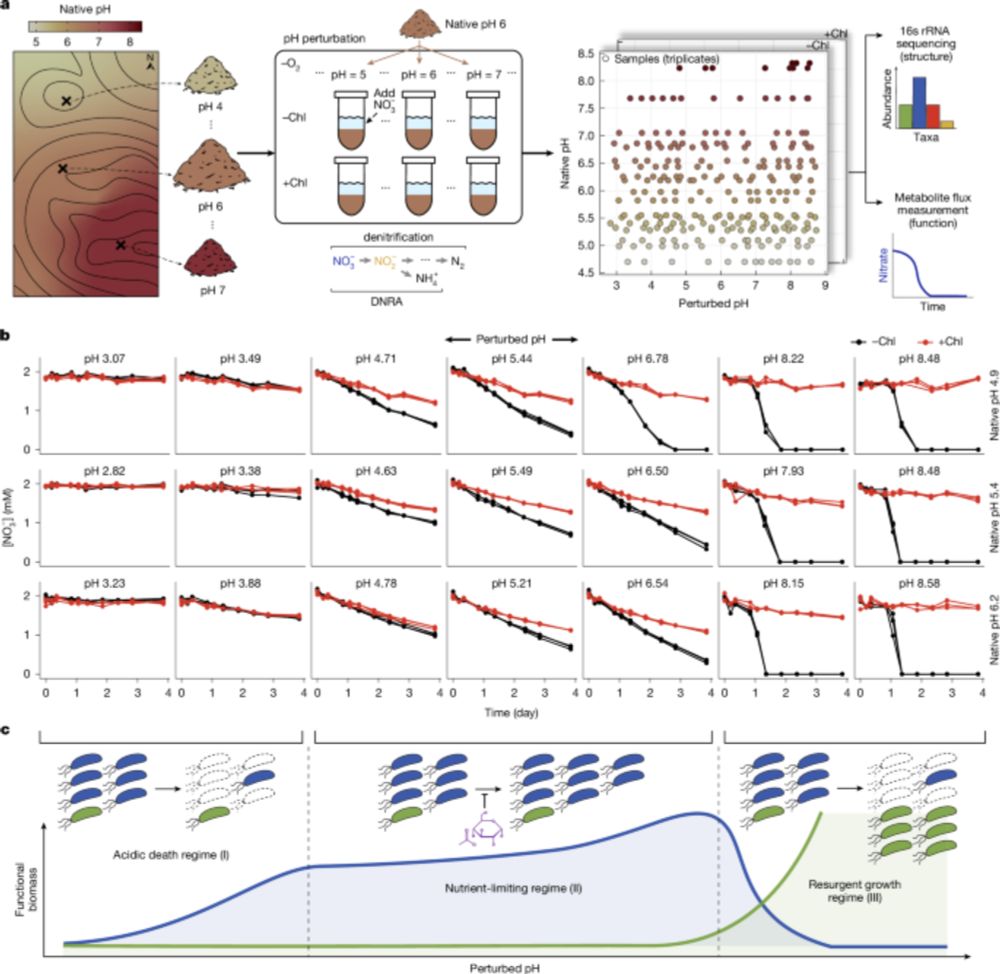
Functional regimes define soil microbiome response to environmental change - Nature
Experimental perturbation of soil pH leads to a generalizable model of the soil microcosm comprising three functional regimes with distinct mechanisms linking environmental change to metabolite dynami...
www.nature.com
July 16, 2025 at 3:19 PM
Published in Nature today! Here, we sought to systematically ask how natural community's metabolism changes with the environment. A simple consumer-resource model can predict N-cycle metabolism (nitrate use) and, more importantly, the mechanism behind its change.
www.nature.com/articles/s41...
www.nature.com/articles/s41...
Reposted by Megan NY Lee
Excited to share our new work! We found that bacteria can turn antagonism into a foraging strategy - by killing their neighbours, and eating their remains 🧫🔬💥
Thrilled to share our new paper in @science.org describing our discovery that bacteria can switch from competitors to bonafide predators when resources run dry—arming nanoscale “spears” (T6SS) to stab & consume neighbours.
www.science.org/doi/10.1126/...
#MicroSKy #Microbiology
www.science.org/doi/10.1126/...
#MicroSKy #Microbiology
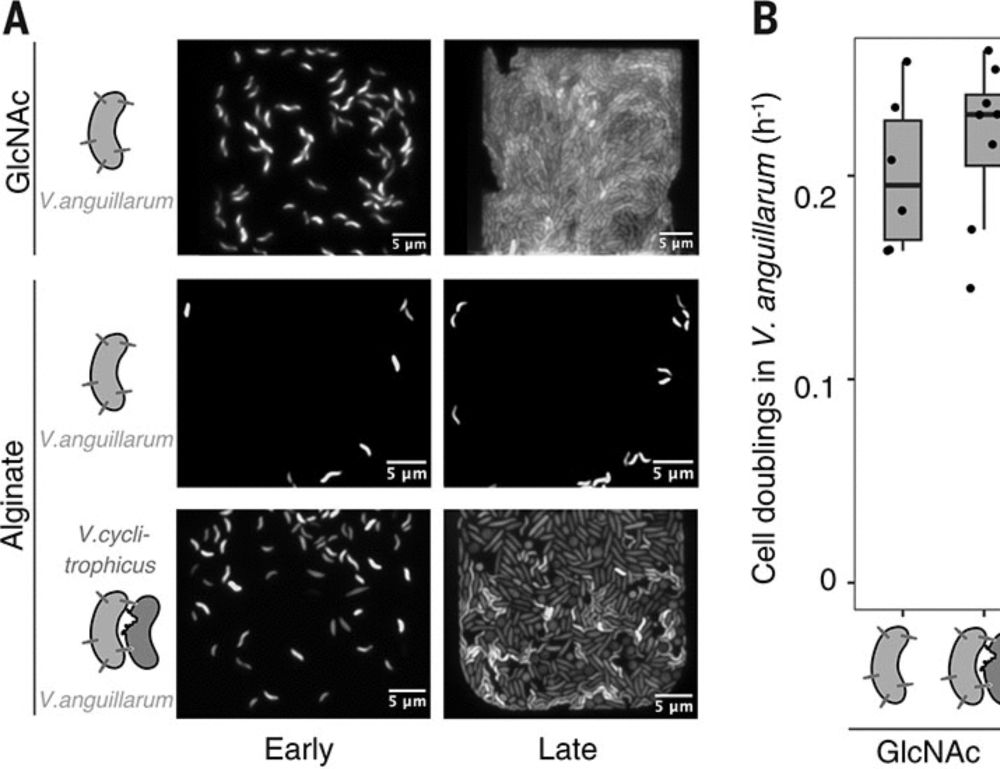
Antagonism as a foraging strategy in microbial communities
In natural habitats, nutrient availability limits bacterial growth. We discovered that bacteria can overcome this limitation by acquiring nutrients by lysing neighboring cells through contact-dependen...
www.science.org
June 13, 2025 at 7:18 AM
Excited to share our new work! We found that bacteria can turn antagonism into a foraging strategy - by killing their neighbours, and eating their remains 🧫🔬💥
Reposted by Megan NY Lee

Please read about how we think microbial metabolism might help us understand microbiomes a bit better!
Also, please appreciate the mountain goat in Fig 1 ⛰️🐐 and that it also represents my joy for trail running and the mountains 😁
Also, please appreciate the mountain goat in Fig 1 ⛰️🐐 and that it also represents my joy for trail running and the mountains 😁

Metabolic ecology of microbiomes: Nutrient competition, host benefits, and community engineering
Review by Erik Bakkeren, Vit Piskovsky, and Kevin R. Foster
www.cell.com/cell-host-mi...
Review by Erik Bakkeren, Vit Piskovsky, and Kevin R. Foster
www.cell.com/cell-host-mi...
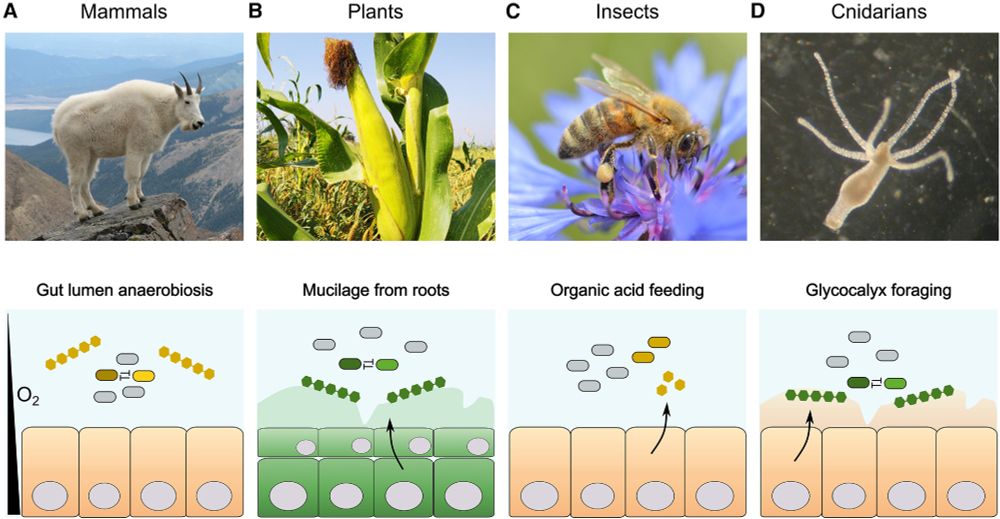
June 11, 2025 at 5:08 PM
Please read about how we think microbial metabolism might help us understand microbiomes a bit better!
Also, please appreciate the mountain goat in Fig 1 ⛰️🐐 and that it also represents my joy for trail running and the mountains 😁
Also, please appreciate the mountain goat in Fig 1 ⛰️🐐 and that it also represents my joy for trail running and the mountains 😁
Reposted by Megan NY Lee

#Bacteria use weapons to outcompete rivals, but what happens if they're transferred? @prokaryota.bsky.social @jdpal.bsky.social &co show that HGT of toxin #plasmids is rare but recipients can thrive under relaxed nutrient competition, reshaping bacterial warfare @plosbiology.org 🧪 plos.io/43vC3X7
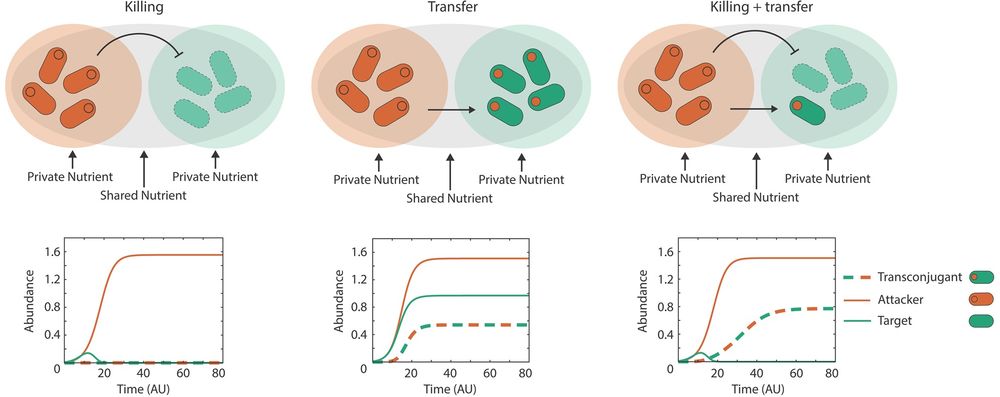
May 22, 2025 at 9:00 AM
#Bacteria use weapons to outcompete rivals, but what happens if they're transferred? @prokaryota.bsky.social @jdpal.bsky.social &co show that HGT of toxin #plasmids is rare but recipients can thrive under relaxed nutrient competition, reshaping bacterial warfare @plosbiology.org 🧪 plos.io/43vC3X7
Reposted by Megan NY Lee

Check out our new preprint!
We systematically map proteomic and metabolomic interactions between >100 pairs of gut bacteria, detecting metabolic interactions and functionally-related clusters of proteins.
www.biorxiv.org/content/10.1...
@kiranrpatil.bsky.social
We systematically map proteomic and metabolomic interactions between >100 pairs of gut bacteria, detecting metabolic interactions and functionally-related clusters of proteins.
www.biorxiv.org/content/10.1...
@kiranrpatil.bsky.social

Interspecies interactions drive bacterial proteome reorganisation and emergent metabolism
Species in microbial communities must respond to the presence of others to stave off resource competition or to capitalise on new resources that may become available due to additional metabolic activi...
www.biorxiv.org
May 15, 2025 at 10:13 AM
Check out our new preprint!
We systematically map proteomic and metabolomic interactions between >100 pairs of gut bacteria, detecting metabolic interactions and functionally-related clusters of proteins.
www.biorxiv.org/content/10.1...
@kiranrpatil.bsky.social
We systematically map proteomic and metabolomic interactions between >100 pairs of gut bacteria, detecting metabolic interactions and functionally-related clusters of proteins.
www.biorxiv.org/content/10.1...
@kiranrpatil.bsky.social
Reposted by Megan NY Lee
How does metabolic dependency evolve at the single cell level? 🔄
In our new preprint, Divvya Ramesh combines microfluidics, microscopy and modelling to show that the benefits of gene loss are highly context dependent.
Check it out here: www.biorxiv.org/content/10.1...
In our new preprint, Divvya Ramesh combines microfluidics, microscopy and modelling to show that the benefits of gene loss are highly context dependent.
Check it out here: www.biorxiv.org/content/10.1...
www.biorxiv.org
May 13, 2025 at 11:22 AM
How does metabolic dependency evolve at the single cell level? 🔄
In our new preprint, Divvya Ramesh combines microfluidics, microscopy and modelling to show that the benefits of gene loss are highly context dependent.
Check it out here: www.biorxiv.org/content/10.1...
In our new preprint, Divvya Ramesh combines microfluidics, microscopy and modelling to show that the benefits of gene loss are highly context dependent.
Check it out here: www.biorxiv.org/content/10.1...
Reposted by Megan NY Lee

Is killing animals an effective way to regulate populations?
“What does the science say? The answers and the caveats vary, case by case”
“In the majority of cases, lethal control doesn’t do what people expect and want”
www.pnas.org/doi/10.1073/...
“What does the science say? The answers and the caveats vary, case by case”
“In the majority of cases, lethal control doesn’t do what people expect and want”
www.pnas.org/doi/10.1073/...

Is killing animals an effective way to regulate populations? | PNAS
Is killing animals an effective way to regulate populations?
www.pnas.org
April 25, 2025 at 1:11 PM
Is killing animals an effective way to regulate populations?
“What does the science say? The answers and the caveats vary, case by case”
“In the majority of cases, lethal control doesn’t do what people expect and want”
www.pnas.org/doi/10.1073/...
“What does the science say? The answers and the caveats vary, case by case”
“In the majority of cases, lethal control doesn’t do what people expect and want”
www.pnas.org/doi/10.1073/...
Reposted by Megan NY Lee

Paradox of the Sub‐Plankton: Plausible Mechanisms and Open Problems Underlying Strain‐Level Diversity in Microbial Communities enviromicro-journals.onlinelibrary.wiley.com/doi/10.1111/... #jcampubs

Paradox of the Sub‐Plankton: Plausible Mechanisms and Open Problems Underlying Strain‐Level Diversity in Microbial Communities
“Paradox of the sub-plankton: Plausible mechanisms and open problems underlying strain-level diversity in microbial communities” by Akshit Goyal* and Griffin Chure*. This work highlights the limitati...
enviromicro-journals.onlinelibrary.wiley.com
April 24, 2025 at 2:56 PM
Paradox of the Sub‐Plankton: Plausible Mechanisms and Open Problems Underlying Strain‐Level Diversity in Microbial Communities enviromicro-journals.onlinelibrary.wiley.com/doi/10.1111/... #jcampubs
Reposted by Megan NY Lee
Excited about microbiomes and want to study them at the single-cell level? Join our team to pioneer research using microfluidics paired with automated timelapse microscopy. We're hiring motivated postdocs to push the boundaries of microbial ecology!
Apply now: apply.interfolio.com/165601
Apply now: apply.interfolio.com/165601
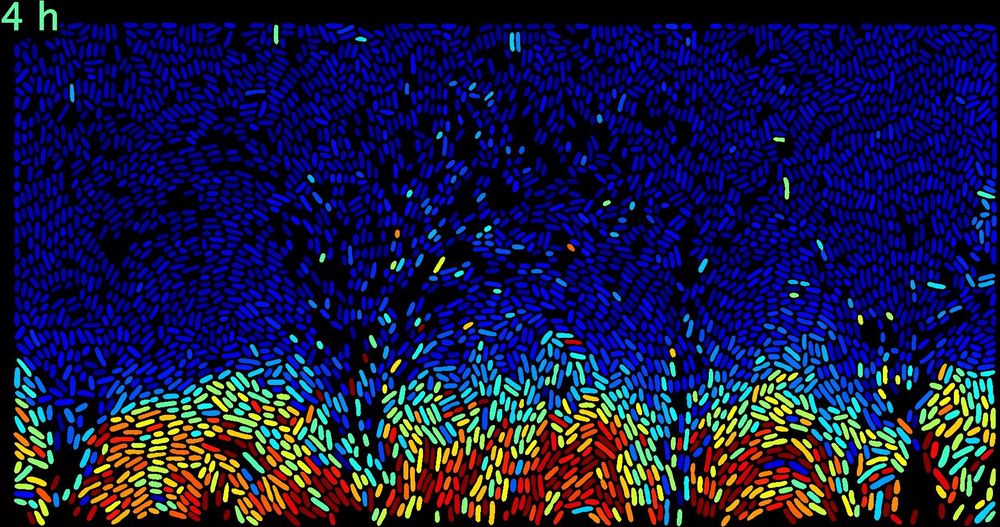
March 30, 2025 at 6:07 PM
Excited about microbiomes and want to study them at the single-cell level? Join our team to pioneer research using microfluidics paired with automated timelapse microscopy. We're hiring motivated postdocs to push the boundaries of microbial ecology!
Apply now: apply.interfolio.com/165601
Apply now: apply.interfolio.com/165601
Reposted by Megan NY Lee

It’s increasingly clear that the language of microbial communities is one of resources. Conserved metabolism leads to regular, reliable resource flows across ecosystems—from the gut to wastewater. In complex communities, one serious challenge is: who is eating what?
March 24, 2025 at 8:27 PM
It’s increasingly clear that the language of microbial communities is one of resources. Conserved metabolism leads to regular, reliable resource flows across ecosystems—from the gut to wastewater. In complex communities, one serious challenge is: who is eating what?
Reposted by Megan NY Lee

New research
Even under optimistic scenarios for carbon sequestration in pasture soils, grass-fed beef is *more* carbon intensive than industrial beef
And 3 to 40 times as carbon intensive as most plant and animal alternatives
www.pnas.org/doi/full/10....
Even under optimistic scenarios for carbon sequestration in pasture soils, grass-fed beef is *more* carbon intensive than industrial beef
And 3 to 40 times as carbon intensive as most plant and animal alternatives
www.pnas.org/doi/full/10....
PNAS
Proceedings of the National Academy of Sciences (PNAS), a peer reviewed journal of the National Academy of Sciences (NAS) - an authoritative source of high-impact, original research that broadly spans...
www.pnas.org
March 18, 2025 at 10:28 AM
New research
Even under optimistic scenarios for carbon sequestration in pasture soils, grass-fed beef is *more* carbon intensive than industrial beef
And 3 to 40 times as carbon intensive as most plant and animal alternatives
www.pnas.org/doi/full/10....
Even under optimistic scenarios for carbon sequestration in pasture soils, grass-fed beef is *more* carbon intensive than industrial beef
And 3 to 40 times as carbon intensive as most plant and animal alternatives
www.pnas.org/doi/full/10....
Reposted by Megan NY Lee

What happens if you introduce 🦠vs 🦠🦠🦠 into a microbial community? Are larger microbial populations more likely to establish?
Check out new work led by @goldmandoran.bsky.social that used experiments and theory to dive deep into this simple question. ⬇️
www.pnas.org/doi/10.1073/...
Check out new work led by @goldmandoran.bsky.social that used experiments and theory to dive deep into this simple question. ⬇️
www.pnas.org/doi/10.1073/...
March 11, 2025 at 4:06 PM
What happens if you introduce 🦠vs 🦠🦠🦠 into a microbial community? Are larger microbial populations more likely to establish?
Check out new work led by @goldmandoran.bsky.social that used experiments and theory to dive deep into this simple question. ⬇️
www.pnas.org/doi/10.1073/...
Check out new work led by @goldmandoran.bsky.social that used experiments and theory to dive deep into this simple question. ⬇️
www.pnas.org/doi/10.1073/...
Reposted by Megan NY Lee
Community stability is usually assessed by invading single species from rare and measuring relative fitness. However does this hold up when multiple species invade from rare? We test this using our super stable microbial community 👇🏻
Estimates of microbial community stability using relative invader growth rates are robust across levels of invader species richness
#ISMEComms by @mcastd.bsky.social, @padpadpadpad.bsky.social and Angus Buckling
academic.oup.com/ismecommun/a...
#ISMEComms by @mcastd.bsky.social, @padpadpadpad.bsky.social and Angus Buckling
academic.oup.com/ismecommun/a...

Estimates of microbial community stability using relative invader growth rates are robust across levels of invader species richness
Abstract. A key feature of natural communities is that the species within them stably coexist. A common metric used to test community stability is the abil
academic.oup.com
March 3, 2025 at 1:05 PM
Community stability is usually assessed by invading single species from rare and measuring relative fitness. However does this hold up when multiple species invade from rare? We test this using our super stable microbial community 👇🏻