



Nikita Gudimchuk
@nikitagudimchuk.bsky.social
Studying cytoskeleton and mitosis, focused on tubulin and microtubules. Curious about bacterial division and Ftsz. Interested in computational modeling, all kinds of microscopy, experimental and theoretical biophysics, bio- and med- chemisty
Reposted by Nikita Gudimchuk

What a gem from @dudinlab.bsky.social @gautamdey.bsky.social @centriolelab.bsky.social in Cell! Expansion microscopy atlas of >200 eukaryotes comparing cytoskeletal architectures revealing structures not seen before. Stunning visualisation! Exactly the kind of transformative cell biology we need.
October 31, 2025 at 5:45 PM
What a gem from @dudinlab.bsky.social @gautamdey.bsky.social @centriolelab.bsky.social in Cell! Expansion microscopy atlas of >200 eukaryotes comparing cytoskeletal architectures revealing structures not seen before. Stunning visualisation! Exactly the kind of transformative cell biology we need.
Reposted by Nikita Gudimchuk

Narozna et al @gorbskylab.bsky.social uncover a high-frequency, chromosome 12-specific mis-segregation error in iPSCs. Eroded 12p arms lead to bridging & micronucleation, enabling widespread trisomy 12. A slight growth advantage allows trisomic cells to persist & dominate rupress.org/jcb/article/...

August 13, 2025 at 5:15 PM
Narozna et al @gorbskylab.bsky.social uncover a high-frequency, chromosome 12-specific mis-segregation error in iPSCs. Eroded 12p arms lead to bridging & micronucleation, enabling widespread trisomy 12. A slight growth advantage allows trisomic cells to persist & dominate rupress.org/jcb/article/...
Reposted by Nikita Gudimchuk

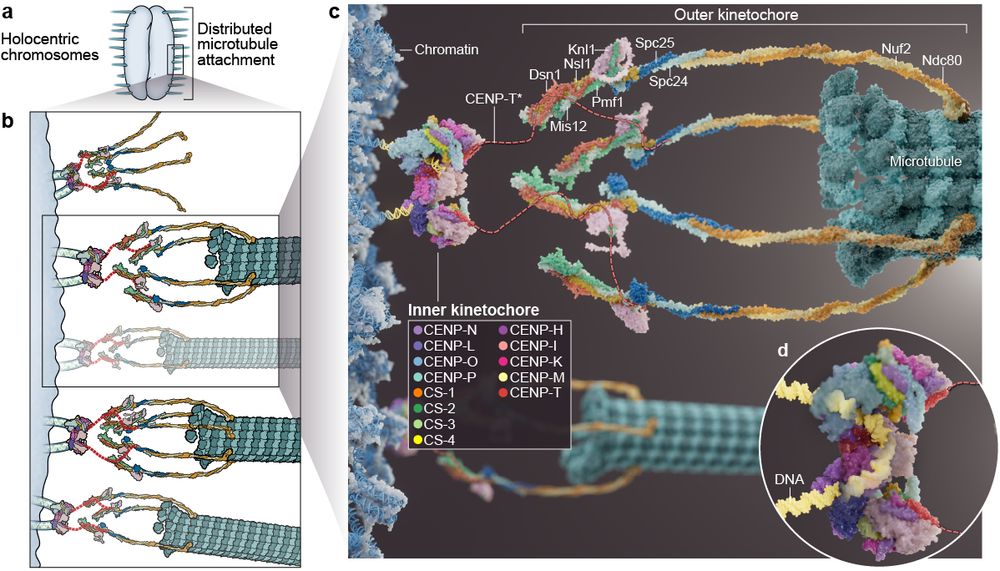
Happy to share our latest work on the structure and assembly of holocentric kinetochores! Huge thanks to Ines for a very fruitful collaboration, Claudio for all the support, and congratulations to Christine and all co-authors!
www.biorxiv.org/content/10.1...
www.biorxiv.org/content/10.1...
July 15, 2025 at 4:36 PM
Happy to share our latest work on the structure and assembly of holocentric kinetochores! Huge thanks to Ines for a very fruitful collaboration, Claudio for all the support, and congratulations to Christine and all co-authors!
www.biorxiv.org/content/10.1...
www.biorxiv.org/content/10.1...
Reposted by Nikita Gudimchuk

New preprint from the lab - the first paper made (almost) entirely here @qmul.bsky.social
We report how human outer kinetochore complexes Ndc80 and Ska form cooperative oligomers, that together stabilise microtubule ends against shortening.
www.biorxiv.org/content/10.1...
Key results below: (1/7)
We report how human outer kinetochore complexes Ndc80 and Ska form cooperative oligomers, that together stabilise microtubule ends against shortening.
www.biorxiv.org/content/10.1...
Key results below: (1/7)
Microtubule end stabilisation by cooperative oligomers of Ska and Ndc80 complexes
During mitosis, properly aligned chromosomes stabilise microtubule ends with the help of kinetochores to ensure timely segregation of chromosomes. Microtubule-binding components of the human outer kinetochore, such as Ndc80 and Ska complexes, are present in multiple copies and together bind several microtubule ends, creating a highly multivalent binding interface. Whereas Ndc80:Ndc80 and Ndc80:microtubule binding is crucial for interface stability, Ndc80 alone in absence of Ska is unable to support stable kinetochore-attachments. Using cryoET, we demonstrate that oligomeric Ndc80:Ska assemblies stabilise microtubule ends against shortening by strengthening lateral contacts between tubulin protofilaments at microtubule plus-ends. We further identify a point mutation within the SKA1 microtubule-binding domain that does not affect microtubule-binding of individual Ska molecules, but does abolish Ska:Ska interactions. Finally, we report that oligomerisation of Ska, in a cooperative fashion together with the Ndc80, is necessary to maintain stable microtubule attachments both in vivo and in vitro. ### Competing Interest Statement The authors have declared no competing interest. BBSRC, BB/X014975/1, BB/W019698/1 Wellcome Trust, https://ror.org/029chgv08, 308895/Z/23/Z
www.biorxiv.org
July 7, 2025 at 9:39 AM
New preprint from the lab - the first paper made (almost) entirely here @qmul.bsky.social
We report how human outer kinetochore complexes Ndc80 and Ska form cooperative oligomers, that together stabilise microtubule ends against shortening.
www.biorxiv.org/content/10.1...
Key results below: (1/7)
We report how human outer kinetochore complexes Ndc80 and Ska form cooperative oligomers, that together stabilise microtubule ends against shortening.
www.biorxiv.org/content/10.1...
Key results below: (1/7)
Reposted by Nikita Gudimchuk

it never gets old...... #microtubule dynamics - the fireworks of EB comets #microscopy
November 9, 2024 at 3:04 AM
it never gets old...... #microtubule dynamics - the fireworks of EB comets #microscopy
Reposted by Nikita Gudimchuk
Excited to share our latest work in @pnas.org! Combining simulations and cryo-ET, we reveal how microtubules decide between growth and shortening. doi.org/10.1073/pnas... @maksimkalutskii.bsky.social @vladimirvolkov.bsky.social @compbiophys.bsky.social @mpi-nat.bsky.social @qmul.ac.uk @dundee.ac.uk.
June 3, 2025 at 9:08 AM
Excited to share our latest work in @pnas.org! Combining simulations and cryo-ET, we reveal how microtubules decide between growth and shortening. doi.org/10.1073/pnas... @maksimkalutskii.bsky.social @vladimirvolkov.bsky.social @compbiophys.bsky.social @mpi-nat.bsky.social @qmul.ac.uk @dundee.ac.uk.
Reposted by Nikita Gudimchuk
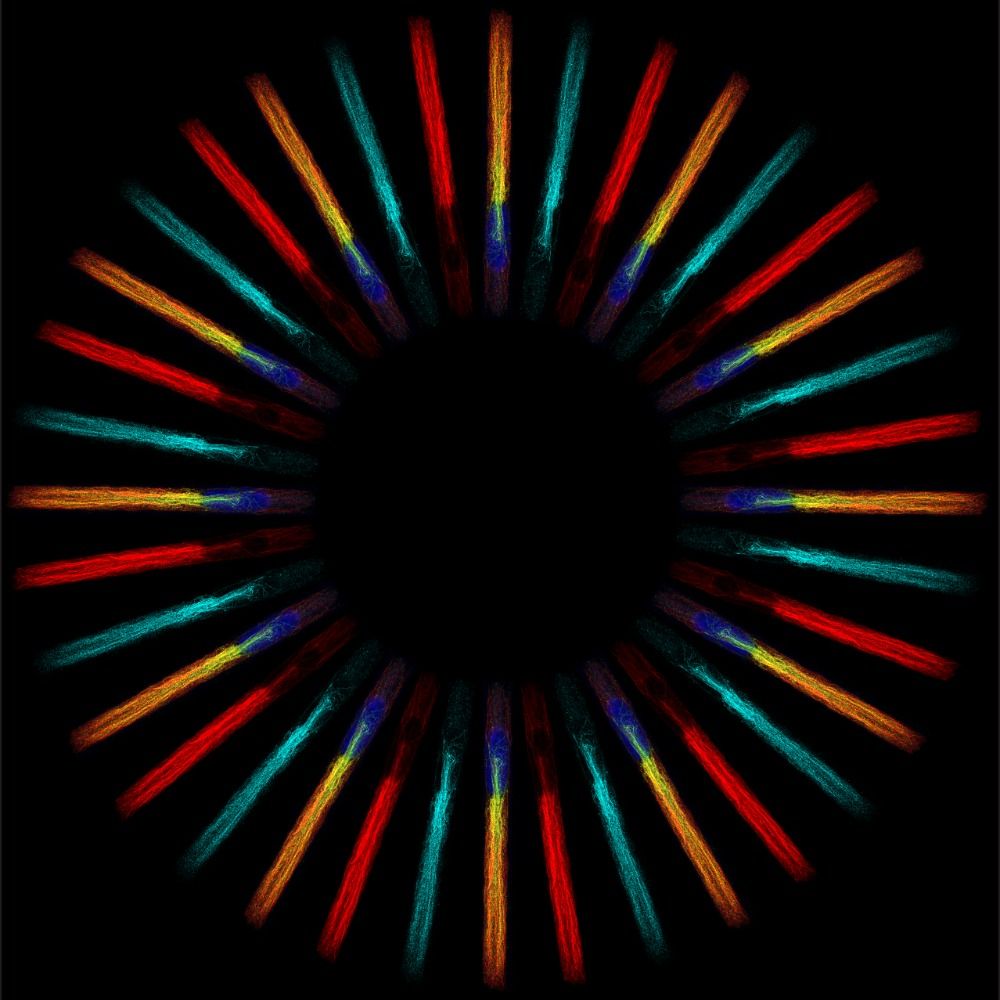
Check out our latest research now out @embojournal.org. Huge shout-out to our postdocs Susana Eibes and Bhagya Lakshmi and the rest of the team for their amazing work! 1/11

How does natural compound #parthenolide exert its #antimitotic activity?
Marin Barisic and coworkers @barisiclab.bsky.social find it not to target microtubules, but to instead modify #kinetochore protein BUGZ to prevent spindle attachment and chromosome congression
www.embopress.org/doi/full/10....
Marin Barisic and coworkers @barisiclab.bsky.social find it not to target microtubules, but to instead modify #kinetochore protein BUGZ to prevent spindle attachment and chromosome congression
www.embopress.org/doi/full/10....

May 27, 2025 at 6:17 PM
Check out our latest research now out @embojournal.org. Huge shout-out to our postdocs Susana Eibes and Bhagya Lakshmi and the rest of the team for their amazing work! 1/11
Reposted by Nikita Gudimchuk
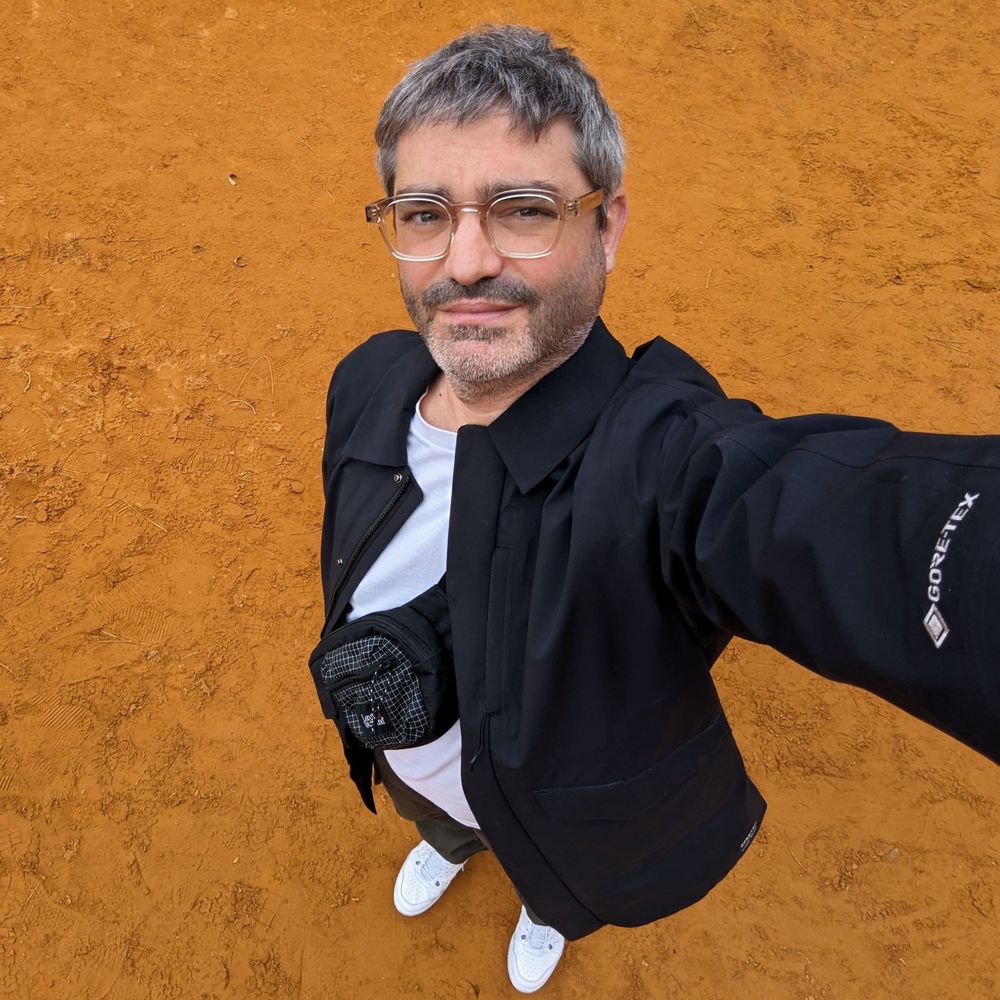
Great new method to assess the size and shape of biomolecules. Also, the figures are incredibly beautiful 🤩

May 9, 2025 at 9:39 AM
Great new method to assess the size and shape of biomolecules. Also, the figures are incredibly beautiful 🤩
Reposted by Nikita Gudimchuk
This time-lapse captures 17 hours of axonal growth from a chicken dorsal root ganglion explant, visualized through the actin cytoskeleton using live confocal imaging.
I just submitted this video to the Nikon Small World in Motion competition. Today is the last day to upload yours! 😉
🧪
I just submitted this video to the Nikon Small World in Motion competition. Today is the last day to upload yours! 😉
🧪
April 30, 2025 at 7:16 AM
This time-lapse captures 17 hours of axonal growth from a chicken dorsal root ganglion explant, visualized through the actin cytoskeleton using live confocal imaging.
I just submitted this video to the Nikon Small World in Motion competition. Today is the last day to upload yours! 😉
🧪
I just submitted this video to the Nikon Small World in Motion competition. Today is the last day to upload yours! 😉
🧪
Reposted by Nikita Gudimchuk

Alex Long, the last postdoc from my lab at Stanford, is starting her own lab, continuing her beautiful work on evolutionary cell biology using chytrid fungi as a model. Check it out! alonglab.org

Long Research Group
Long Research Group - Univ. Kentucky
alonglab.org
March 28, 2025 at 2:28 PM
Alex Long, the last postdoc from my lab at Stanford, is starting her own lab, continuing her beautiful work on evolutionary cell biology using chytrid fungi as a model. Check it out! alonglab.org
Reposted by Nikita Gudimchuk
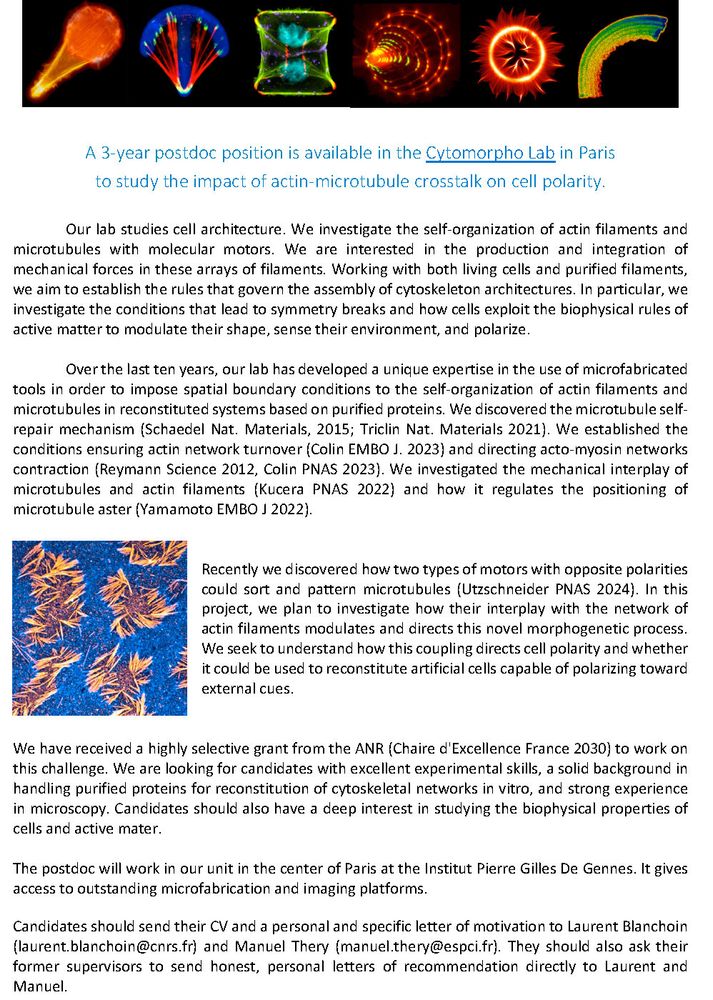
Unique opportunity to join the CytoMorpho Lab (in Paris ❤️) as a postdoc to work on the self-organization and polarization of reconstituted networks made of microtubules, motors and actin filaments in vitro. Experience required.
Please Repost 🙏 thanks !
Please Repost 🙏 thanks !
March 5, 2025 at 5:20 PM
Unique opportunity to join the CytoMorpho Lab (in Paris ❤️) as a postdoc to work on the self-organization and polarization of reconstituted networks made of microtubules, motors and actin filaments in vitro. Experience required.
Please Repost 🙏 thanks !
Please Repost 🙏 thanks !
Reposted by Nikita Gudimchuk
It would only be appropriate to post about the #geometrynodes #microtubule here too. For a full introduction, I have prepared the world's least professional youtube video.
www.youtube.com/watch?v=AYUy...
www.youtube.com/watch?v=AYUy...
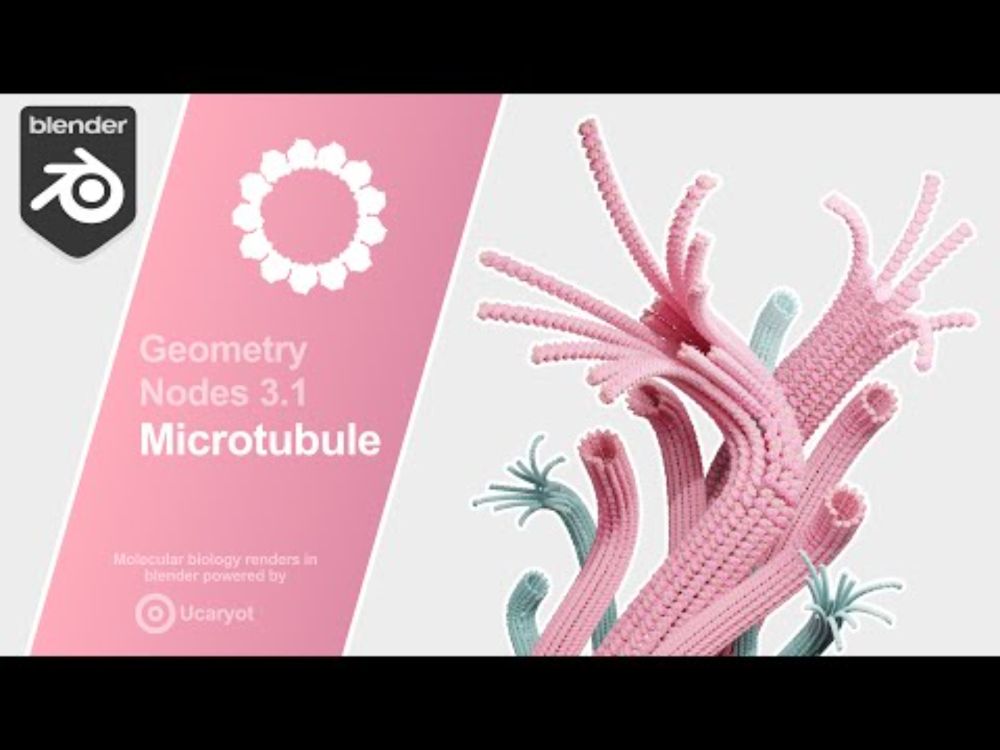
Procedural Microtubule | Blender 3.1 Geometry Nodes
YouTube video by Nemo Andrea
www.youtube.com
March 7, 2025 at 10:04 PM
It would only be appropriate to post about the #geometrynodes #microtubule here too. For a full introduction, I have prepared the world's least professional youtube video.
www.youtube.com/watch?v=AYUy...
www.youtube.com/watch?v=AYUy...
In our new preprint: biorxiv.org/content/10.1... we find that the tilted stalk of the NDC80 complex—a crucial component of the kinetochore—may be responsible for its asymmetric grip on microtubules. This conclusion may also extend to other MAPs. #Microtubule #Biophysics #Kinetochore

March 1, 2025 at 7:01 PM
In our new preprint: biorxiv.org/content/10.1... we find that the tilted stalk of the NDC80 complex—a crucial component of the kinetochore—may be responsible for its asymmetric grip on microtubules. This conclusion may also extend to other MAPs. #Microtubule #Biophysics #Kinetochore
Reposted by Nikita Gudimchuk
Attention structural biologists!!! #CYTOSKELETON has a #specialissue that we are putting together on the "Structures of #microtubule and microtubule-related proteins". Submission deadline is April 1, 2025. Submit today. It is #FREE to publish in CYTOSKELETON.

February 20, 2025 at 4:47 PM
Attention structural biologists!!! #CYTOSKELETON has a #specialissue that we are putting together on the "Structures of #microtubule and microtubule-related proteins". Submission deadline is April 1, 2025. Submit today. It is #FREE to publish in CYTOSKELETON.