


Shamphavi Sivabalasarma
@sshamphavi.bsky.social
PhD student at university of Freiburg in @archaellum´s lab; @sfb1381. Working with archaea and archaeal cell surface structures
Pinned
Happy to share that our story on the bacterial archaellum was published today in @natmicrobiol.nature.com
www.nature.com/articles/s41...
Congrats to the authors: @sshamphavi.bsky.social @loumollat.bsky.social @mariejoest.bsky.social Najwa Taib and @sgribaldo.bsky.social
www.nature.com/articles/s41...
Congrats to the authors: @sshamphavi.bsky.social @loumollat.bsky.social @mariejoest.bsky.social Najwa Taib and @sgribaldo.bsky.social
Bacteria with archaella, who would have thought that this existed. Happy to share that it does 🎉and we just published it today in @natmicrobiol.nature.com 🎉🥳. Congrats to everyone involved! 🦠
Reposted by Shamphavi Sivabalasarma
Congrats! It has been a pleasure to have you in the lab and I am lokking forward seeing what you will achieve in the future!
January 15, 2026 at 12:03 PM
Congrats! It has been a pleasure to have you in the lab and I am lokking forward seeing what you will achieve in the future!
Finally done! Huge thanks to @sfb1381.bsky.social @archaellum.bsky.social at the @biologyunifreiburg.bsky.social and @uni-freiburg.de and all my collaborators over the last years. It was a lot of fun 🎉🎉🎊 and now soon off to new challenges!

Huge congratulations 🎉 on the first PhD defense in our SFB in 2026:
Shamphavi Sivabalasarma successfully defended her thesis at the University of Freiburg.
All the best for the future, Dr. Sivabalasarma!
@sshamphavi.bsky.social
@sgbmfreiburg.bsky.social
@biologyunifreiburg.bsky.social
Shamphavi Sivabalasarma successfully defended her thesis at the University of Freiburg.
All the best for the future, Dr. Sivabalasarma!
@sshamphavi.bsky.social
@sgbmfreiburg.bsky.social
@biologyunifreiburg.bsky.social

January 15, 2026 at 12:00 PM
Finally done! Huge thanks to @sfb1381.bsky.social @archaellum.bsky.social at the @biologyunifreiburg.bsky.social and @uni-freiburg.de and all my collaborators over the last years. It was a lot of fun 🎉🎉🎊 and now soon off to new challenges!
Reposted by Shamphavi Sivabalasarma

How did eukaryotic cells with complex architecture evolve from simpler prokaryotic cells? DNA analyses offer possible answers
go.nature.com/4sEMwLH
go.nature.com/4sEMwLH

Genomic clues to the origin of eukaryotic cells
How did eukaryotic cells with complex architecture evolve from simpler prokaryotic cells? DNA analyses offer possible answers.
go.nature.com
January 14, 2026 at 4:51 PM
How did eukaryotic cells with complex architecture evolve from simpler prokaryotic cells? DNA analyses offer possible answers
go.nature.com/4sEMwLH
go.nature.com/4sEMwLH
Nice to see our story on the bacterial archaellum as one of the #editorpicks of 2025!
As the year ends, we decided to select our favorite papers of 2025
Turns out, it is impossible as we love them all!
So, we picked 'some' that exhibit the range of microbiology highlighted through the columns of Nature Microbiology.
Here is a glimpse into #EditorPicks of 2025
#MicroSky 🦠
Turns out, it is impossible as we love them all!
So, we picked 'some' that exhibit the range of microbiology highlighted through the columns of Nature Microbiology.
Here is a glimpse into #EditorPicks of 2025
#MicroSky 🦠
December 20, 2025 at 10:26 AM
Nice to see our story on the bacterial archaellum as one of the #editorpicks of 2025!
Reposted by Shamphavi Sivabalasarma

A big thanks to all the authors, reviewers, and readers of Nature Microbiology for their love and support throughout the year.
We are on a break & will be back on Jan 2nd, in what will be a very special year for us!
In the meantime, enjoy a collage made by @francoismayer.bsky.social
#MicroSky 🦠
We are on a break & will be back on Jan 2nd, in what will be a very special year for us!
In the meantime, enjoy a collage made by @francoismayer.bsky.social
#MicroSky 🦠

December 19, 2025 at 8:46 PM
A big thanks to all the authors, reviewers, and readers of Nature Microbiology for their love and support throughout the year.
We are on a break & will be back on Jan 2nd, in what will be a very special year for us!
In the meantime, enjoy a collage made by @francoismayer.bsky.social
#MicroSky 🦠
We are on a break & will be back on Jan 2nd, in what will be a very special year for us!
In the meantime, enjoy a collage made by @francoismayer.bsky.social
#MicroSky 🦠
Reposted by Shamphavi Sivabalasarma

1. As we recently joined BlueSky, we want to repost this story for all newcomers!
We sat down with @radler92.bsky.social to get more insight into the unique videos from his recent preprint on Promethearchaeota (formerly Asgard archaea).
doi.org/10.1101/2025...
(Videos and info below)
We sat down with @radler92.bsky.social to get more insight into the unique videos from his recent preprint on Promethearchaeota (formerly Asgard archaea).
doi.org/10.1101/2025...
(Videos and info below)

Dynamic protrusions mediate unique crawling motility in Asgard Archaea (Promethearchaeota)
Crawling motility is a hallmark of eukaryotic cells and requires a dynamic actin cytoskeleton, regulated adhesion, and spatially organized signalling pathways1–3. Asgard archaea (phylum Promethearchae...
doi.org
December 18, 2025 at 2:08 PM
1. As we recently joined BlueSky, we want to repost this story for all newcomers!
We sat down with @radler92.bsky.social to get more insight into the unique videos from his recent preprint on Promethearchaeota (formerly Asgard archaea).
doi.org/10.1101/2025...
(Videos and info below)
We sat down with @radler92.bsky.social to get more insight into the unique videos from his recent preprint on Promethearchaeota (formerly Asgard archaea).
doi.org/10.1101/2025...
(Videos and info below)
Reposted by Shamphavi Sivabalasarma
Calling all archaeal enthusiasts! 🔬🔥 From molecular machines to microbial communities, Archaea never fail to surprise us!
We are excited to announce the 2026 EMBO Workshop on the Molecular Biology of Archaea, 6–10 July in Cambridge, UK!
Sign up here: meetings.embo.org/event/26-arc...
#ArchaeaSky
We are excited to announce the 2026 EMBO Workshop on the Molecular Biology of Archaea, 6–10 July in Cambridge, UK!
Sign up here: meetings.embo.org/event/26-arc...
#ArchaeaSky

December 16, 2025 at 2:18 PM
Calling all archaeal enthusiasts! 🔬🔥 From molecular machines to microbial communities, Archaea never fail to surprise us!
We are excited to announce the 2026 EMBO Workshop on the Molecular Biology of Archaea, 6–10 July in Cambridge, UK!
Sign up here: meetings.embo.org/event/26-arc...
#ArchaeaSky
We are excited to announce the 2026 EMBO Workshop on the Molecular Biology of Archaea, 6–10 July in Cambridge, UK!
Sign up here: meetings.embo.org/event/26-arc...
#ArchaeaSky
Reposted by Shamphavi Sivabalasarma

Are you a long-time fan of Archaea, an extremophile-phile, or are you simply curious?
Either way, we have good news.
We’re delighted to announce the 2026 EMBO Workshop on Archaea, 6–10 July.
Sign up: meetings.embo.org/event/26-arc...
We look forward to seeing you in Cambridge, UK.
Please repost!
Either way, we have good news.
We’re delighted to announce the 2026 EMBO Workshop on Archaea, 6–10 July.
Sign up: meetings.embo.org/event/26-arc...
We look forward to seeing you in Cambridge, UK.
Please repost!
Molecular Biology of Archaea: Life Through the Prism of Archaea
In 1977, Woese and colleagues revealed Archaea as a distinct domain of life. Building on this insight, the discovery of Asgard archaea has strengthened the view that many hallmarks of eukaryotic cell…
meetings.embo.org
December 16, 2025 at 12:00 PM
Are you a long-time fan of Archaea, an extremophile-phile, or are you simply curious?
Either way, we have good news.
We’re delighted to announce the 2026 EMBO Workshop on Archaea, 6–10 July.
Sign up: meetings.embo.org/event/26-arc...
We look forward to seeing you in Cambridge, UK.
Please repost!
Either way, we have good news.
We’re delighted to announce the 2026 EMBO Workshop on Archaea, 6–10 July.
Sign up: meetings.embo.org/event/26-arc...
We look forward to seeing you in Cambridge, UK.
Please repost!
Reposted by Shamphavi Sivabalasarma
Like last year, I compiled a little collage of all our monthly issue covers published in @natmicrobiol.nature.com Another year full of new discoveries, stunning advances and marvelous #microbiology. Thanks to all our authors for all their hard work in pushing the field of microbiology forward.

December 8, 2025 at 5:24 PM
Like last year, I compiled a little collage of all our monthly issue covers published in @natmicrobiol.nature.com Another year full of new discoveries, stunning advances and marvelous #microbiology. Thanks to all our authors for all their hard work in pushing the field of microbiology forward.
Reposted by Shamphavi Sivabalasarma
Asgard on the move ! Watch our videos!
Biorxiv.org/content/10.1101/2025.11.30.690169v1
Biorxiv.org/content/10.1101/2025.11.30.690169v1

Dynamic protrusions mediate unique crawling motility in Asgard Archaea (Promethearchaeota)
Crawling motility is a hallmark of eukaryotic cells and requires a dynamic actin cytoskeleton, regulated adhesion, and spatially organized signalling pathways1–3. Asgard archaea (phylum Promethearchae...
Biorxiv.org
December 3, 2025 at 8:22 PM
Asgard on the move ! Watch our videos!
Biorxiv.org/content/10.1101/2025.11.30.690169v1
Biorxiv.org/content/10.1101/2025.11.30.690169v1
Reposted by Shamphavi Sivabalasarma

Ever since publishing our observations of the predatory behaviour of Ca. Nha. antarcticus people have asked me why it would want to kill its host. My perspective discussing the ecological factors that I believe led to this behaviour is out now in mSystems:
doi.org/10.1128/msystems.01475-25
doi.org/10.1128/msystems.01475-25

Nutrient availability affects optimal growth strategy in predatory DPANN | mSystems
The bacterial and archaeal domains each possess a major clade that appears to be predominantly
host-associated (1–3). These two lineages, Patescibacteriota and DPANN archaea (named for the Diapherotri...
doi.org
November 18, 2025 at 5:30 PM
Ever since publishing our observations of the predatory behaviour of Ca. Nha. antarcticus people have asked me why it would want to kill its host. My perspective discussing the ecological factors that I believe led to this behaviour is out now in mSystems:
doi.org/10.1128/msystems.01475-25
doi.org/10.1128/msystems.01475-25
Reposted by Shamphavi Sivabalasarma

Pleased to share our review on S-layers with @bupbuse.bsky.social, Andriko von Kügelgen, and @tbharat-lab.bsky.social, where we explore recent advances and argue that deeper insight into S-layers is key to deciphering microbial interactions and community organization. @mpi-bio-fml.bsky.social
Assembly, architecture and functional roles of microbial surface layers
Review article published in @natrevmicro.nature.com with @bupbuse.bsky.social, Andriko von Kügelgen and @vikramalva.bsky.social.
S-layers are everywhere!
www.nature.com/articles/s41...
Review article published in @natrevmicro.nature.com with @bupbuse.bsky.social, Andriko von Kügelgen and @vikramalva.bsky.social.
S-layers are everywhere!
www.nature.com/articles/s41...

Assembly, architecture and functional roles of microbial surface layers - Nature Reviews Microbiology
Surface layers (S-layers) are ubiquitous protein assemblies that coat prokaryotic cells, with their functional roles increasingly coming into focus. In this Review, Isbilir and colleagues discuss rece...
www.nature.com
November 13, 2025 at 9:16 PM
Pleased to share our review on S-layers with @bupbuse.bsky.social, Andriko von Kügelgen, and @tbharat-lab.bsky.social, where we explore recent advances and argue that deeper insight into S-layers is key to deciphering microbial interactions and community organization. @mpi-bio-fml.bsky.social
Reposted by Shamphavi Sivabalasarma

1/6
PhD /PostDoc positions available. Exploration of physiological functions of the cell fusogen Fusexin1 in Archaea.
In a collaborative project between the Albers lab (Freiburg) and the Podbilewicz lab (Technion) starting in January 2026.
PhD /PostDoc positions available. Exploration of physiological functions of the cell fusogen Fusexin1 in Archaea.
In a collaborative project between the Albers lab (Freiburg) and the Podbilewicz lab (Technion) starting in January 2026.

November 12, 2025 at 7:53 AM
1/6
PhD /PostDoc positions available. Exploration of physiological functions of the cell fusogen Fusexin1 in Archaea.
In a collaborative project between the Albers lab (Freiburg) and the Podbilewicz lab (Technion) starting in January 2026.
PhD /PostDoc positions available. Exploration of physiological functions of the cell fusogen Fusexin1 in Archaea.
In a collaborative project between the Albers lab (Freiburg) and the Podbilewicz lab (Technion) starting in January 2026.
Reposted by Shamphavi Sivabalasarma

An Asgard archaeon with internal membrane compartments
Brilliant study led by @fmacleod.bsky.social and Andriko von Kügelgen. Tight collaboration with @buzzbaum.bsky.social and lab. Congrats to all authors!
www.biorxiv.org/content/10.1...
Brilliant study led by @fmacleod.bsky.social and Andriko von Kügelgen. Tight collaboration with @buzzbaum.bsky.social and lab. Congrats to all authors!
www.biorxiv.org/content/10.1...

November 7, 2025 at 10:44 AM
An Asgard archaeon with internal membrane compartments
Brilliant study led by @fmacleod.bsky.social and Andriko von Kügelgen. Tight collaboration with @buzzbaum.bsky.social and lab. Congrats to all authors!
www.biorxiv.org/content/10.1...
Brilliant study led by @fmacleod.bsky.social and Andriko von Kügelgen. Tight collaboration with @buzzbaum.bsky.social and lab. Congrats to all authors!
www.biorxiv.org/content/10.1...
Reposted by Shamphavi Sivabalasarma
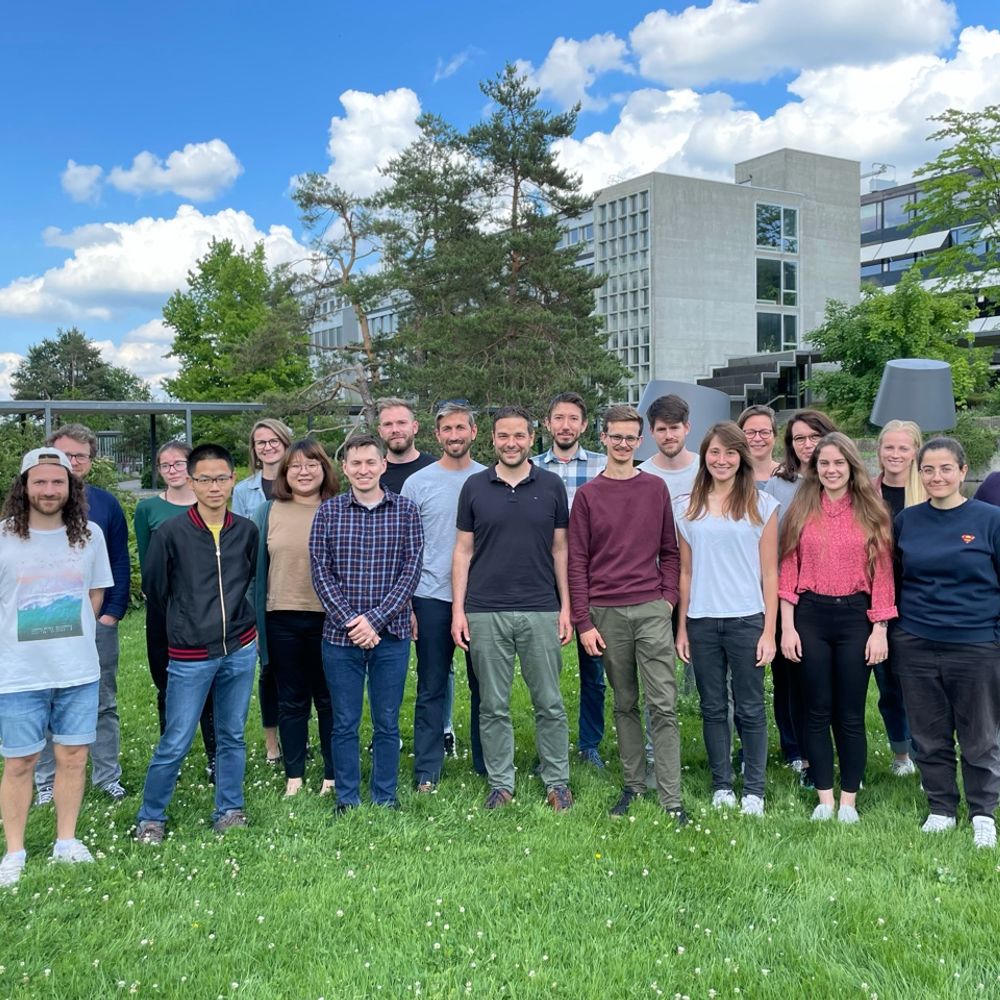
🥳 Today marks the start of the lab of former postdoc @florianwollweber.bsky.social at @embl.org Grenoble!
www.embl.org/groups/wollw...
Florian-- we will miss you dearly and wish you much success!
With us, Florian applied multiscale imaging 🔬to Asgard archaea ...👇
www.embl.org/groups/wollw...
Florian-- we will miss you dearly and wish you much success!
With us, Florian applied multiscale imaging 🔬to Asgard archaea ...👇


November 1, 2025 at 12:41 PM
🥳 Today marks the start of the lab of former postdoc @florianwollweber.bsky.social at @embl.org Grenoble!
www.embl.org/groups/wollw...
Florian-- we will miss you dearly and wish you much success!
With us, Florian applied multiscale imaging 🔬to Asgard archaea ...👇
www.embl.org/groups/wollw...
Florian-- we will miss you dearly and wish you much success!
With us, Florian applied multiscale imaging 🔬to Asgard archaea ...👇
Reposted by Shamphavi Sivabalasarma
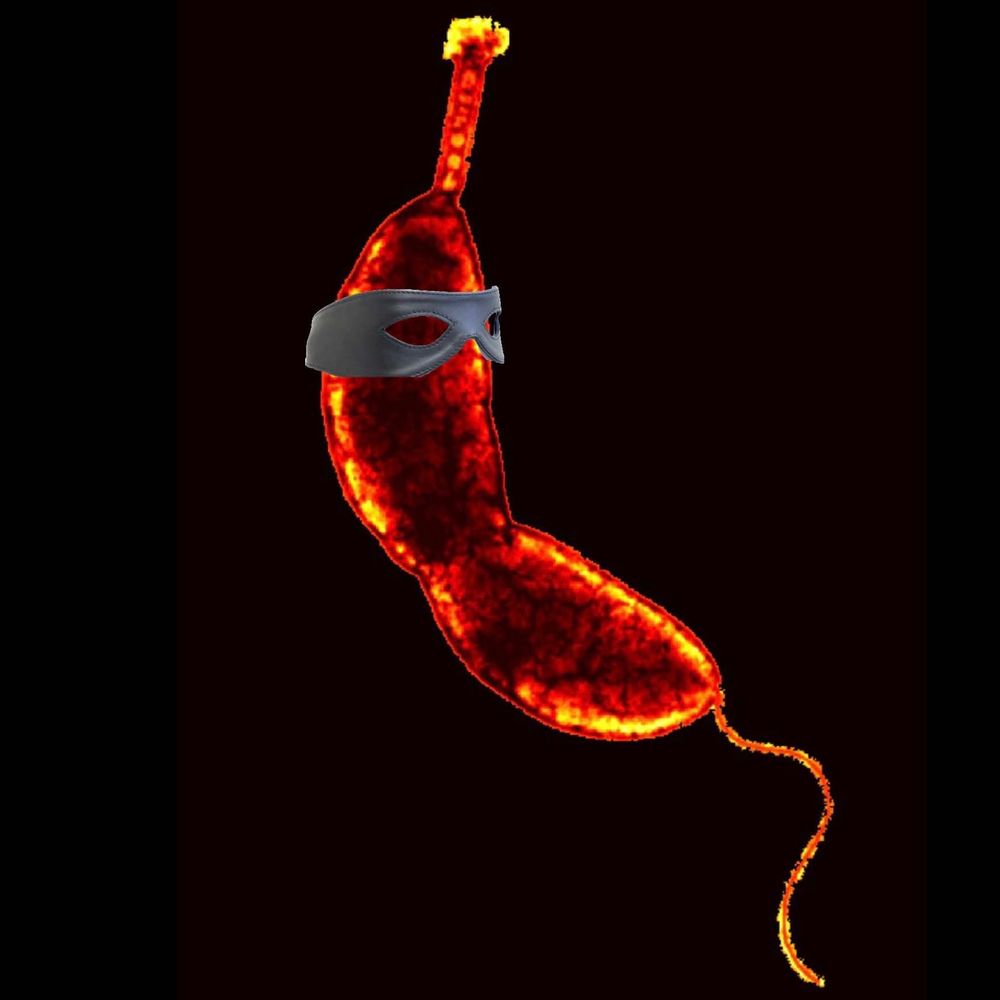
Forgot to post the recently published version of this paper on the role of a minor pilin-like protein in surface sensing journals.asm.org/doi/10.1128/...
October 31, 2025 at 6:54 PM
Forgot to post the recently published version of this paper on the role of a minor pilin-like protein in surface sensing journals.asm.org/doi/10.1128/...
Reposted by Shamphavi Sivabalasarma
Lab’s first paper is out!! We show the first structures of #Asgard #chromatin by #cryo-EM 🧬❄️
Asgard histones form closed and open hypernucleosomes. Closed are conserved across #Archaea, while open resemble eukaryotic H3–H4 octasomes and are Asgard-specific. More here: www.cell.com/molecular-ce...
Asgard histones form closed and open hypernucleosomes. Closed are conserved across #Archaea, while open resemble eukaryotic H3–H4 octasomes and are Asgard-specific. More here: www.cell.com/molecular-ce...

October 28, 2025 at 3:07 PM
Lab’s first paper is out!! We show the first structures of #Asgard #chromatin by #cryo-EM 🧬❄️
Asgard histones form closed and open hypernucleosomes. Closed are conserved across #Archaea, while open resemble eukaryotic H3–H4 octasomes and are Asgard-specific. More here: www.cell.com/molecular-ce...
Asgard histones form closed and open hypernucleosomes. Closed are conserved across #Archaea, while open resemble eukaryotic H3–H4 octasomes and are Asgard-specific. More here: www.cell.com/molecular-ce...
Reposted by Shamphavi Sivabalasarma

Structural phylogenetics unravels the evolutionary diversification of communication systems in gram-positive bacteria and their viruses | Nature Structural & Molecular Biology https://www.nature.com/articles/s41594-025-01649-8

Structural phylogenetics unravels the evolutionary diversification of communication systems in gram-positive bacteria and their viruses - Nature Structural & Molecular Biology
Using a new method called FoldTree, the authors compare proteins on the basis of their shape to construct more accurate family trees over long evolutionary timescales and capture distant relationships where sequence information becomes less reliable.
www.nature.com
October 17, 2025 at 10:46 AM
Structural phylogenetics unravels the evolutionary diversification of communication systems in gram-positive bacteria and their viruses | Nature Structural & Molecular Biology https://www.nature.com/articles/s41594-025-01649-8
Reposted by Shamphavi Sivabalasarma
Our Pyrodictium cannulae paper is out in its final form! Cannulae assemble into calcium-stabilized tubular filaments stable at 100 °C—a unique archaeal cell–cell connection. Led brilliantly by @mikesleutel.bsky.social & @vinceconticello.bsky.social.
www.nature.com/articles/s41467-025-64120-8
www.nature.com/articles/s41467-025-64120-8

October 14, 2025 at 2:25 PM
Our Pyrodictium cannulae paper is out in its final form! Cannulae assemble into calcium-stabilized tubular filaments stable at 100 °C—a unique archaeal cell–cell connection. Led brilliantly by @mikesleutel.bsky.social & @vinceconticello.bsky.social.
www.nature.com/articles/s41467-025-64120-8
www.nature.com/articles/s41467-025-64120-8
Reposted by Shamphavi Sivabalasarma
🧐Checkout our preprint revealing the stepwise firing💥 mechanism of a Contractile Injection System @xujwet.bsky.social[email protected] trapped the complex by structure-guided engineering🧪 in multiple intermediate states and imaged them by multimodal #cryoEM❄️🔬
www.biorxiv.org/content/10.1...
www.biorxiv.org/content/10.1...

October 8, 2025 at 9:18 PM
🧐Checkout our preprint revealing the stepwise firing💥 mechanism of a Contractile Injection System @xujwet.bsky.social[email protected] trapped the complex by structure-guided engineering🧪 in multiple intermediate states and imaged them by multimodal #cryoEM❄️🔬
www.biorxiv.org/content/10.1...
www.biorxiv.org/content/10.1...
Reposted by Shamphavi Sivabalasarma
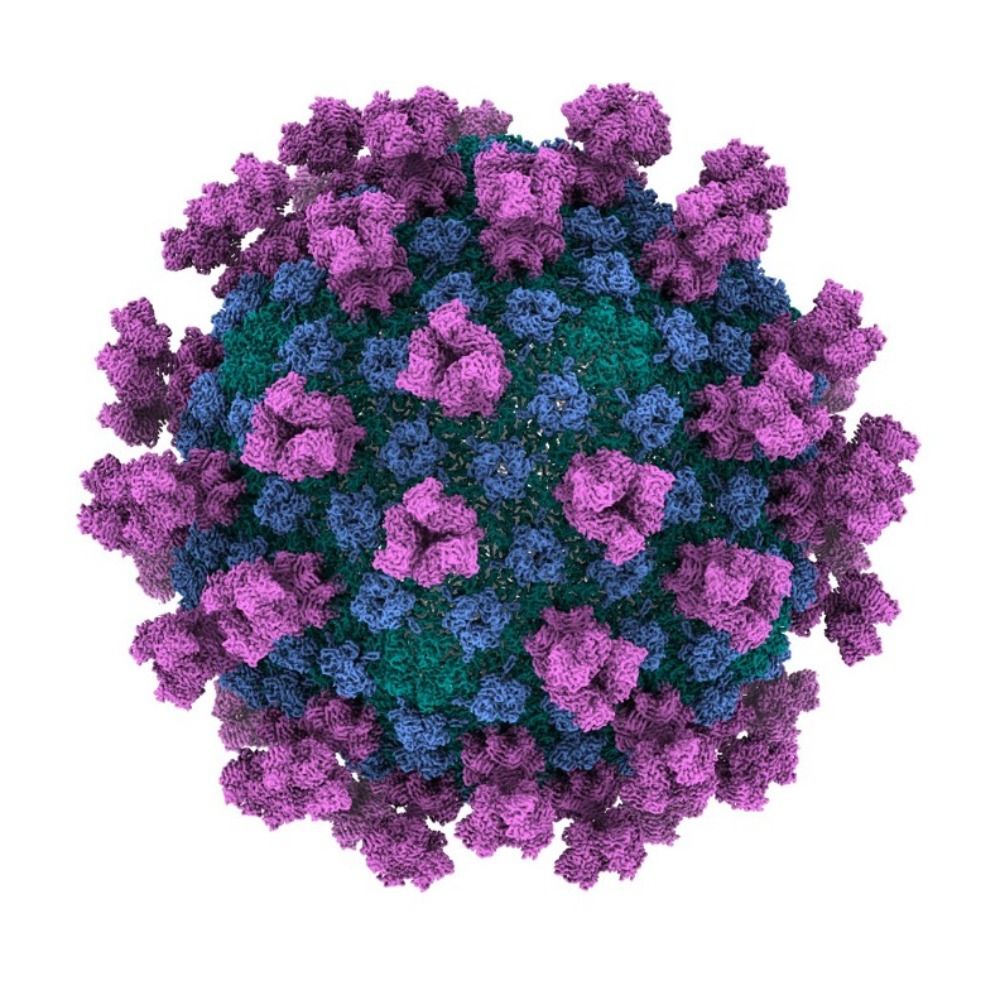
Out in Science Advances: Our #cryoEM structure of HFTV1, a virus infecting the halophile #archaea. *First full atomic structure (containing all structural proteins) of any tailed virus!* Congrats and thanks to all co-authors and our fantastic collaborators! www.science.org/doi/10.1126/...

Cryo-EM resolves the structure of the archaeal dsDNA virus HFTV1 from head to tail
This structure of an archaeal tailed virus (arTV) provides detailed insights into arTV assembly and infection mechanisms.
www.science.org
October 6, 2025 at 11:31 AM
Out in Science Advances: Our #cryoEM structure of HFTV1, a virus infecting the halophile #archaea. *First full atomic structure (containing all structural proteins) of any tailed virus!* Congrats and thanks to all co-authors and our fantastic collaborators! www.science.org/doi/10.1126/...
Reposted by Shamphavi Sivabalasarma
Look at this nice cover: beautiful archaella, image made by @sshamphavi.bsky.social !
Thanks also to Marta Rodeiguez for keeping the EM im shape in @ottlab.bsky.social lab!
At @biologyunifreiburg.bsky.social at @uni-freiburg.de @sfb1381.bsky.social @cibss.bsky.social
Thanks also to Marta Rodeiguez for keeping the EM im shape in @ottlab.bsky.social lab!
At @biologyunifreiburg.bsky.social at @uni-freiburg.de @sfb1381.bsky.social @cibss.bsky.social
Some keen Observations in Our October issue!
🦠 Cancer microbiome
🌊 Marine microbes in warming oceans
🌐 broad-range phages
🧬 genetically minimised Salmonella
🔧 Viral infection mechanisms
🧪 Oxaloacetate antiviral defence
and more, here: www.nature.com/nmicrobiol/v...
🦠 Cancer microbiome
🌊 Marine microbes in warming oceans
🌐 broad-range phages
🧬 genetically minimised Salmonella
🔧 Viral infection mechanisms
🧪 Oxaloacetate antiviral defence
and more, here: www.nature.com/nmicrobiol/v...
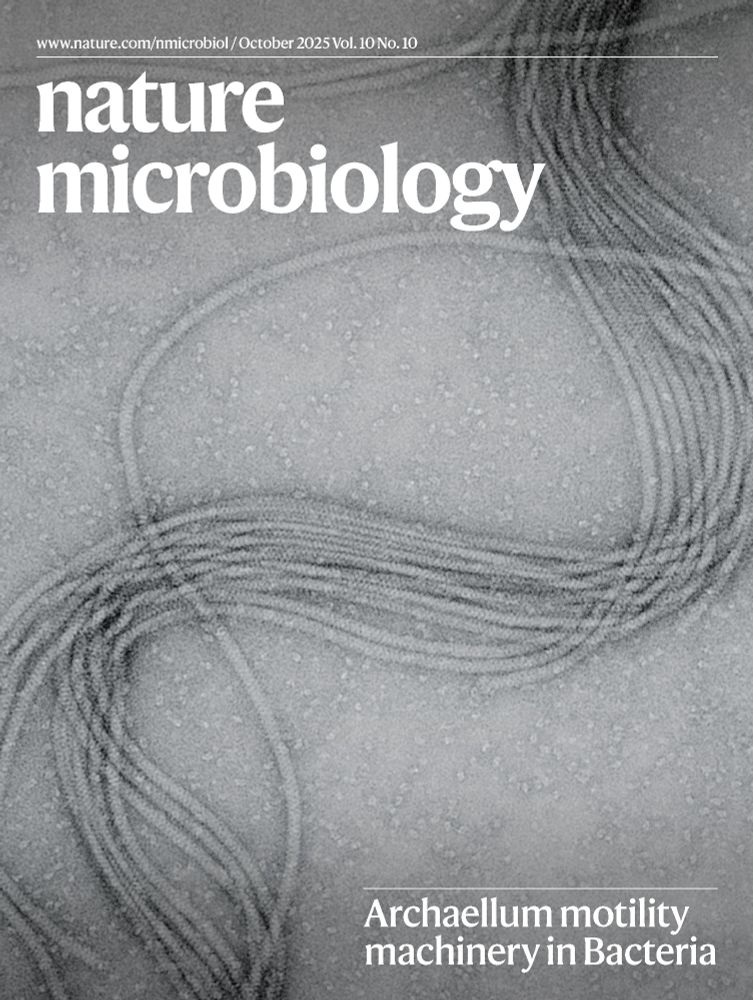
October 2, 2025 at 8:28 AM
Look at this nice cover: beautiful archaella, image made by @sshamphavi.bsky.social !
Thanks also to Marta Rodeiguez for keeping the EM im shape in @ottlab.bsky.social lab!
At @biologyunifreiburg.bsky.social at @uni-freiburg.de @sfb1381.bsky.social @cibss.bsky.social
Thanks also to Marta Rodeiguez for keeping the EM im shape in @ottlab.bsky.social lab!
At @biologyunifreiburg.bsky.social at @uni-freiburg.de @sfb1381.bsky.social @cibss.bsky.social
Reposted by Shamphavi Sivabalasarma
Our October issue is out now!
The images are negatively stained electron micrographs taken from archaella bundles isolated from the archaeon Sulfolobus acidocaldarius.
Check the issue out here:
www.nature.com/nmicrobiol/v...
The images are negatively stained electron micrographs taken from archaella bundles isolated from the archaeon Sulfolobus acidocaldarius.
Check the issue out here:
www.nature.com/nmicrobiol/v...

October 1, 2025 at 9:26 PM
Our October issue is out now!
The images are negatively stained electron micrographs taken from archaella bundles isolated from the archaeon Sulfolobus acidocaldarius.
Check the issue out here:
www.nature.com/nmicrobiol/v...
The images are negatively stained electron micrographs taken from archaella bundles isolated from the archaeon Sulfolobus acidocaldarius.
Check the issue out here:
www.nature.com/nmicrobiol/v...
Beautiful archaellum filaments on the cover 😍🦠 Thanks to the Imaging Facility within MIAP at @biologyunifreiburg.bsky.social that made it possible! Curious how we got there? check our latest publication: www.nature.com/articles/s41...
October 1, 2025 at 6:07 PM
Beautiful archaellum filaments on the cover 😍🦠 Thanks to the Imaging Facility within MIAP at @biologyunifreiburg.bsky.social that made it possible! Curious how we got there? check our latest publication: www.nature.com/articles/s41...
Reposted by Shamphavi Sivabalasarma

Spinning into new evolutionary territory🌀🦠: The latest @natmicrobiol.nature.com paper from the lab of our Speaker Sonja Albers uncovers bacterial species with an ATP-driven archaellum for motility. Great work from @sshamphavi.bsky.social and our Cryo-EM facility
Happy to share that our story on the bacterial archaellum was published today in @natmicrobiol.nature.com
www.nature.com/articles/s41...
Congrats to the authors: @sshamphavi.bsky.social @loumollat.bsky.social @mariejoest.bsky.social Najwa Taib and @sgribaldo.bsky.social
www.nature.com/articles/s41...
Congrats to the authors: @sshamphavi.bsky.social @loumollat.bsky.social @mariejoest.bsky.social Najwa Taib and @sgribaldo.bsky.social
September 18, 2025 at 2:23 PM
Spinning into new evolutionary territory🌀🦠: The latest @natmicrobiol.nature.com paper from the lab of our Speaker Sonja Albers uncovers bacterial species with an ATP-driven archaellum for motility. Great work from @sshamphavi.bsky.social and our Cryo-EM facility