




Whitney Ringwald
@whitneyringwald.bsky.social
Assistant Professor at University of Minnesota | Studying the processes underlying personality & psychopathology in everyday life
Lab website: ringwaldlab.psych.umn.edu
Lab website: ringwaldlab.psych.umn.edu
Reposted by Whitney Ringwald


New study out! These results show how our personality is infused in everything we do, even down to our mundane, everyday experiences and passing thoughts.
New paperAlert! We show that generative AI can quantitatively assess personality from brief, open-ended text—with surprising accuracy. 🧠✨
Preprint: osf.io/preprints/ps...
Postprint (pending mod approval): osf.io/preprints/ps...
1/10
Preprint: osf.io/preprints/ps...
Postprint (pending mod approval): osf.io/preprints/ps...
1/10
OSF
osf.io
February 4, 2026 at 1:55 PM
New study out! These results show how our personality is infused in everything we do, even down to our mundane, everyday experiences and passing thoughts.
The trope “I’m an introverted extravert” is a great illustration of a) the inherently contextual nature of personality and b) limits of even our best trait models.
January 30, 2026 at 1:51 PM
The trope “I’m an introverted extravert” is a great illustration of a) the inherently contextual nature of personality and b) limits of even our best trait models.
Reposted by Whitney Ringwald
First post of the year, new paper out today: we present possibly the biggest case of systematic Measurement Schmeasurement in tech use. It seems that most studies on gaming (videogame) addiction/disorder haven't measured gaming after all. This research took years, so long 🧵 doi.org/10.1098/rsos...

Confusion in gaming disorder measurement
Abstract. Measurement is important for the scientific programmes of addictive behaviours. In the present study, we investigated the measurement of gaming d
doi.org
January 28, 2026 at 9:56 AM
First post of the year, new paper out today: we present possibly the biggest case of systematic Measurement Schmeasurement in tech use. It seems that most studies on gaming (videogame) addiction/disorder haven't measured gaming after all. This research took years, so long 🧵 doi.org/10.1098/rsos...
Reposted by Whitney Ringwald
The Personality Interest Group Including Espresso journal club (PIG-IE) at the University of Illinois at Urbana-Champaign now has a public reading schedule: pig-ie-reading-vote.lovable.app/schedule. 1/

PIG-IE Reading List
The Personality Interest Group—Including Espresso Reading List
pig-ie-reading-vote.lovable.app
January 22, 2026 at 6:42 PM
The Personality Interest Group Including Espresso journal club (PIG-IE) at the University of Illinois at Urbana-Champaign now has a public reading schedule: pig-ie-reading-vote.lovable.app/schedule. 1/
Reposted by Whitney Ringwald

I kept reading EMA studies claiming to test etiological theories of AUD, but I realized they never actually measured how people experience AUD in their daily lives. So we set out to see what we could learn with existing data.
1/19
journals.sagepub.com/doi/10.1177/...
1/19
journals.sagepub.com/doi/10.1177/...

Seven Symptoms Over Nearly 4,000 Days: Item-Level Variability in the Psychometric Properties of Daily Alcohol Use Disorder Symptoms in Young Adult Drinkers - Kevin M. King, Dahyeon Kang, Megan E. Schu...
People experience symptoms of alcohol use disorders (AUD) in their daily lives, including more impairment-based symptoms (e.g., hazardous use, interpersonal pro...
journals.sagepub.com
January 19, 2026 at 8:21 PM
I kept reading EMA studies claiming to test etiological theories of AUD, but I realized they never actually measured how people experience AUD in their daily lives. So we set out to see what we could learn with existing data.
1/19
journals.sagepub.com/doi/10.1177/...
1/19
journals.sagepub.com/doi/10.1177/...
So much for telehealth expanding access to care to rural and poor communities …

#Telemental health accounted for 27.8% of US adult outpatient mental health visits in 2021–2022, with higher use among younger adults, high-income, privately insured, urban residents, and those receiving #psychotherapy.
ja.ma/4bCzyb8
ja.ma/4bCzyb8

January 17, 2026 at 4:27 PM
So much for telehealth expanding access to care to rural and poor communities …
Reposted by Whitney Ringwald

I am recruiting a Postdoc to join my lab at UMN. If you or someone you know is interested in studying individual differences in brain and cognitive aging, check out the listing and my website in my bio and apply!
I appreciate RTs to help get the word out as well :)
I appreciate RTs to help get the word out as well :)
January 9, 2026 at 9:13 PM
I am recruiting a Postdoc to join my lab at UMN. If you or someone you know is interested in studying individual differences in brain and cognitive aging, check out the listing and my website in my bio and apply!
I appreciate RTs to help get the word out as well :)
I appreciate RTs to help get the word out as well :)
Reposted by Whitney Ringwald

Excited to see this paper now in print at JPSP! doi.org/10.1037/pspp...
You can find the postprint version here: osf.io/8c6sz_v2
Thanks again to @berndschaefer.bsky.social (shared 1st author 🙏), Cornelia Wrzus, Yannick Roos and @drichter77.bsky.social for the great collaboration!
You can find the postprint version here: osf.io/8c6sz_v2
Thanks again to @berndschaefer.bsky.social (shared 1st author 🙏), Cornelia Wrzus, Yannick Roos and @drichter77.bsky.social for the great collaboration!
January 7, 2026 at 3:33 PM
Excited to see this paper now in print at JPSP! doi.org/10.1037/pspp...
You can find the postprint version here: osf.io/8c6sz_v2
Thanks again to @berndschaefer.bsky.social (shared 1st author 🙏), Cornelia Wrzus, Yannick Roos and @drichter77.bsky.social for the great collaboration!
You can find the postprint version here: osf.io/8c6sz_v2
Thanks again to @berndschaefer.bsky.social (shared 1st author 🙏), Cornelia Wrzus, Yannick Roos and @drichter77.bsky.social for the great collaboration!
Reposted by Whitney Ringwald

How likely is ‘likely’? Does ‘likely’ have a higher probability than ‘probable’? I put together a quick quiz so you can see how you interpret probability phrases, then see how you compare with others: probability.kucharski.io

January 3, 2026 at 4:15 PM
How likely is ‘likely’? Does ‘likely’ have a higher probability than ‘probable’? I put together a quick quiz so you can see how you interpret probability phrases, then see how you compare with others: probability.kucharski.io
Reposted by Whitney Ringwald

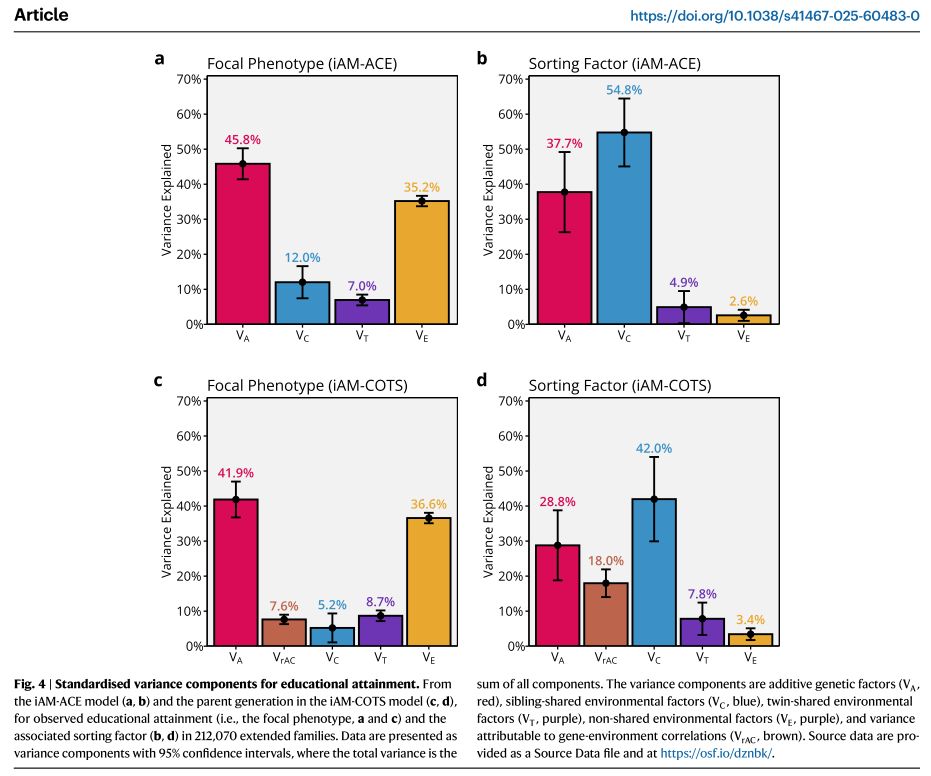
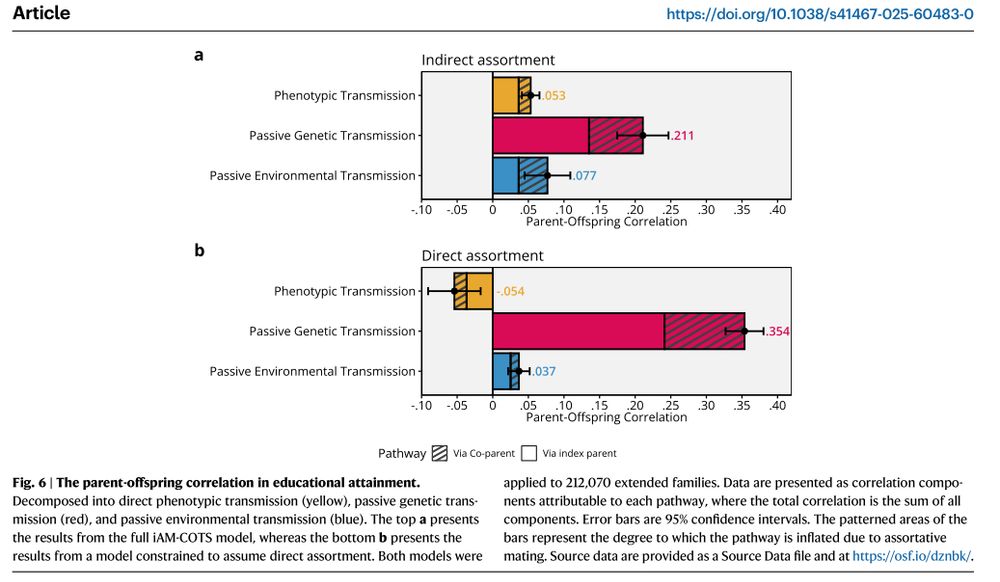
Last week, our new paper on indirect assortative mating was published.🍾 Let’s take a closer look at what this means, why it matters, and what we found (🧵/32):
www.nature.com/articles/s41...
www.nature.com/articles/s41...
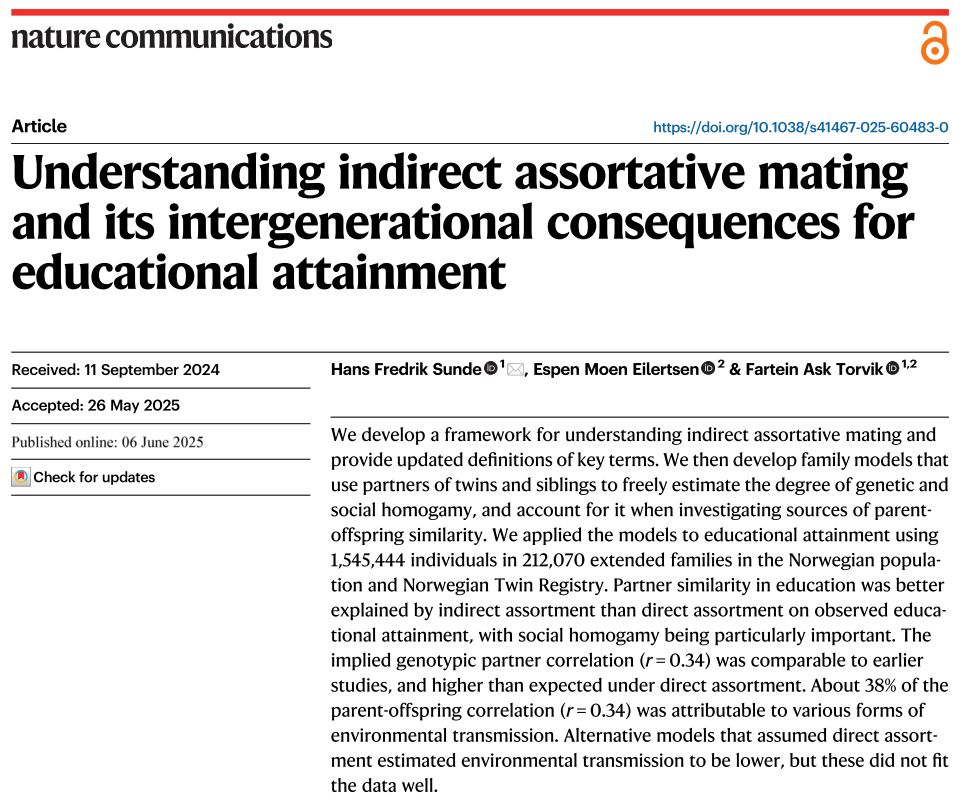
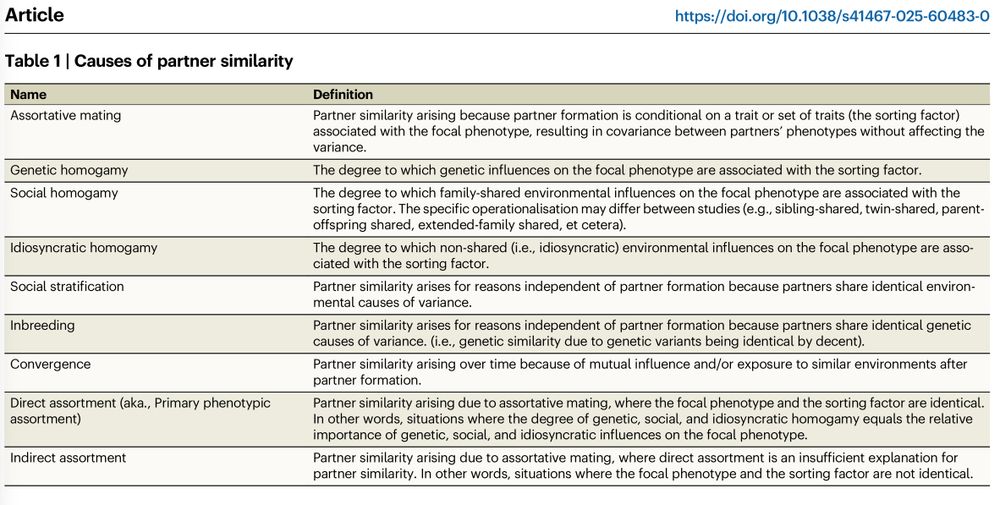
June 11, 2025 at 9:52 PM
Last week, our new paper on indirect assortative mating was published.🍾 Let’s take a closer look at what this means, why it matters, and what we found (🧵/32):
www.nature.com/articles/s41...
www.nature.com/articles/s41...
Reposted by Whitney Ringwald

"Most top achievers (Nobel laureates and world-class musicians, athletes, chess players) demonstrated lower performance than many peers during their early years. Across the highest adult performance, peak performance is negatively correlated with early performance" www.science.org/doi/10.1126/...

Recent discoveries on the acquisition of the highest levels of human performance
Scientists have long debated the origins of exceptional human achievements. This literature review summarizes recent evidence from multiple domains on the acquisition of world-class performance. We re...
www.science.org
December 20, 2025 at 6:30 AM
"Most top achievers (Nobel laureates and world-class musicians, athletes, chess players) demonstrated lower performance than many peers during their early years. Across the highest adult performance, peak performance is negatively correlated with early performance" www.science.org/doi/10.1126/...
Reposted by Whitney Ringwald
Have you wondered why higher bipolar polygenic scores (BP PGS) seem to predict better outcomes among people with psychosis? Here’s why (1/6) 🧪#PsychSciSky
#ThisWeekInNPP
Inconsistent clinical associations of bipolar disorder (BP) polygenic risk score (PRS) largely reflect collider bias from case- & treatment-based sampling, which distorts correlations between scores & alters BP-PRS links to outcomes 🧠🧬 / @kgjonas.bsky.social
Inconsistent clinical associations of bipolar disorder (BP) polygenic risk score (PRS) largely reflect collider bias from case- & treatment-based sampling, which distorts correlations between scores & alters BP-PRS links to outcomes 🧠🧬 / @kgjonas.bsky.social

The impact of collider bias on genetic prediction in psychotic disorders - Neuropsychopharmacology
Neuropsychopharmacology - The impact of collider bias on genetic prediction in psychotic disorders
www.nature.com
December 18, 2025 at 7:50 PM
Have you wondered why higher bipolar polygenic scores (BP PGS) seem to predict better outcomes among people with psychosis? Here’s why (1/6) 🧪#PsychSciSky
Reposted by Whitney Ringwald


Reposted by Whitney Ringwald

Call for papers: Emotion special issue on Affect Dynamics Across Multiple Timescales (moments→days→years) and links to mental and physical health. Letters of intent due Jan 15, 2026. Details/submission:
www.apa.org/pubs/journal...
Please share with colleagues/trainees. @affectscience.bsky.social
www.apa.org/pubs/journal...
Please share with colleagues/trainees. @affectscience.bsky.social
www.apa.org
December 13, 2025 at 3:24 PM
Call for papers: Emotion special issue on Affect Dynamics Across Multiple Timescales (moments→days→years) and links to mental and physical health. Letters of intent due Jan 15, 2026. Details/submission:
www.apa.org/pubs/journal...
Please share with colleagues/trainees. @affectscience.bsky.social
www.apa.org/pubs/journal...
Please share with colleagues/trainees. @affectscience.bsky.social
Reposted by Whitney Ringwald

🚨New research drop!🚨
Gather around, one last bit of research to announce before the year ends! This is one that has been incubating for awhile, but the methods have finally caught up with my theorizing!
The title is: The Hidden Structure in Reality TV
1/6
Gather around, one last bit of research to announce before the year ends! This is one that has been incubating for awhile, but the methods have finally caught up with my theorizing!
The title is: The Hidden Structure in Reality TV
1/6

two women speaking into microphones in front of a sign that says mtv movie awards
ALT: two women speaking into microphones in front of a sign that says mtv movie awards
media.tenor.com
December 12, 2025 at 9:01 PM
🚨New research drop!🚨
Gather around, one last bit of research to announce before the year ends! This is one that has been incubating for awhile, but the methods have finally caught up with my theorizing!
The title is: The Hidden Structure in Reality TV
1/6
Gather around, one last bit of research to announce before the year ends! This is one that has been incubating for awhile, but the methods have finally caught up with my theorizing!
The title is: The Hidden Structure in Reality TV
1/6
Reposted by Whitney Ringwald

🔥 New viewpoint paper accepted at Journal of Psychopathology and Clinical Science!
I propose a behavioral conceptualization of personality functioning (PF) that reframes the construct in terms of learned self-related repertoires rather than inferred inner structures.
I propose a behavioral conceptualization of personality functioning (PF) that reframes the construct in terms of learned self-related repertoires rather than inferred inner structures.
December 12, 2025 at 9:41 AM
🔥 New viewpoint paper accepted at Journal of Psychopathology and Clinical Science!
I propose a behavioral conceptualization of personality functioning (PF) that reframes the construct in terms of learned self-related repertoires rather than inferred inner structures.
I propose a behavioral conceptualization of personality functioning (PF) that reframes the construct in terms of learned self-related repertoires rather than inferred inner structures.
Reposted by Whitney Ringwald

For more context, see also the @nature.com News & Views article about this work, where I unpack what it means when genetic risk for psychiatric disorders overlaps with normal-range traits, including some positive associations with education-related outcomes: rdcu.be/eT4U7

December 10, 2025 at 5:42 PM
For more context, see also the @nature.com News & Views article about this work, where I unpack what it means when genetic risk for psychiatric disorders overlaps with normal-range traits, including some positive associations with education-related outcomes: rdcu.be/eT4U7
Reposted by Whitney Ringwald

1/4 Thrilled to be sharing new work published today in Nature describing the third wave of results from the PGC Cross-Disorder Group. This reflects a massive group effort to examine shared and unique genetic signal across >1 million cases for 14 psychiatric disorders. www.nature.com/articles/s41...

Mapping the genetic landscape across 14 psychiatric disorders - Nature
Genomic analyses applied to 14 childhood- and adult-onset psychiatric disorders identifies five underlying genomic factors that explain the majority of the genetic variance of the individual disorders...
www.nature.com
December 10, 2025 at 4:22 PM
1/4 Thrilled to be sharing new work published today in Nature describing the third wave of results from the PGC Cross-Disorder Group. This reflects a massive group effort to examine shared and unique genetic signal across >1 million cases for 14 psychiatric disorders. www.nature.com/articles/s41...
Reposted by Whitney Ringwald

New preprint alert🚨
We often rely on 0-10 scales to assess suicide urges in EMA and clinical settings. But we rarely ask a surprisingly important question:
What do these numbers mean?
In our new paper, we examine what these ratings mean and how consistently people use them.
More info ⬇️
We often rely on 0-10 scales to assess suicide urges in EMA and clinical settings. But we rarely ask a surprisingly important question:
What do these numbers mean?
In our new paper, we examine what these ratings mean and how consistently people use them.
More info ⬇️

Examining the Content and Consistency of Suicidal Thoughts using Large Language Models: https://osf.io/8jx4u
December 9, 2025 at 4:23 PM
New preprint alert🚨
We often rely on 0-10 scales to assess suicide urges in EMA and clinical settings. But we rarely ask a surprisingly important question:
What do these numbers mean?
In our new paper, we examine what these ratings mean and how consistently people use them.
More info ⬇️
We often rely on 0-10 scales to assess suicide urges in EMA and clinical settings. But we rarely ask a surprisingly important question:
What do these numbers mean?
In our new paper, we examine what these ratings mean and how consistently people use them.
More info ⬇️
The main points about the instability of LLM answers and limits on “meta cognition“ are important but also their (purported) love of octopus, crows, and mint chocolate ice cream is just delightful.

LLMs overwhelming choose octopus as their favorite animal. But if asked 2nd-favorite animal first, they *also* choose octopus and say corvids are their top favorite, then mistakenly deny that their answers are affected by question order. Link to full blog post in thread.

December 6, 2025 at 12:38 PM
The main points about the instability of LLM answers and limits on “meta cognition“ are important but also their (purported) love of octopus, crows, and mint chocolate ice cream is just delightful.
Reposted by Whitney Ringwald

We should probably be placing incarcerated people in prisons closest to their homes.
Why?
Assigning individuals to prisons closer to their home reduces recidivism.
Really?
Yep. Being placed close to one's home increases social contacts that appear to reduce reoffending.
Why?
Assigning individuals to prisons closer to their home reduces recidivism.
Really?
Yep. Being placed close to one's home increases social contacts that appear to reduce reoffending.


December 4, 2025 at 1:46 PM
We should probably be placing incarcerated people in prisons closest to their homes.
Why?
Assigning individuals to prisons closer to their home reduces recidivism.
Really?
Yep. Being placed close to one's home increases social contacts that appear to reduce reoffending.
Why?
Assigning individuals to prisons closer to their home reduces recidivism.
Really?
Yep. Being placed close to one's home increases social contacts that appear to reduce reoffending.
What a useful study! Thank you!

The first preprint from the SHARE study is out! 🥳 We compared the effects of three different incentives (a bulk payment, a bulk payment with personalized feedback, and payment per beep) on data quantity, data quality, and participant experiences in a student sample.
The effect of incentive type on data quality and quantity in an experience sampling study in a student population: https://osf.io/pc924
December 3, 2025 at 11:53 AM
What a useful study! Thank you!
Reposted by Whitney Ringwald

New paper in press at JPSP! An adversarial collaboration focusing on a large-scale test of how strongly implicit racial attitudes predict discriminatory behavior. Pre-print here: osf.io/preprints/ps...

December 2, 2025 at 2:14 PM
New paper in press at JPSP! An adversarial collaboration focusing on a large-scale test of how strongly implicit racial attitudes predict discriminatory behavior. Pre-print here: osf.io/preprints/ps...
Reposted by Whitney Ringwald

🚨 SynthNet is out 🚨
Researchers propose new constructs and measures faster than anyone can track. We (@anniria.bsky.social @ruben.the100.ci) built a search engine to check what already exists and help identify redundancies; indexing 74,000 scales from ~31,500 instruments in APA PsycTests. 🧵1/3
Researchers propose new constructs and measures faster than anyone can track. We (@anniria.bsky.social @ruben.the100.ci) built a search engine to check what already exists and help identify redundancies; indexing 74,000 scales from ~31,500 instruments in APA PsycTests. 🧵1/3
November 26, 2025 at 11:42 AM
🚨 SynthNet is out 🚨
Researchers propose new constructs and measures faster than anyone can track. We (@anniria.bsky.social @ruben.the100.ci) built a search engine to check what already exists and help identify redundancies; indexing 74,000 scales from ~31,500 instruments in APA PsycTests. 🧵1/3
Researchers propose new constructs and measures faster than anyone can track. We (@anniria.bsky.social @ruben.the100.ci) built a search engine to check what already exists and help identify redundancies; indexing 74,000 scales from ~31,500 instruments in APA PsycTests. 🧵1/3