



Chong Xie
@chongxie7.bsky.social
IMPRS-GS PhD student in genome organization and Transcription | Akis Papantonis's lab @UMG Göttingen
Reposted by Chong Xie

Preprint alert! 🥸
Yajie Zhu (PhD graduate) and Mariano Barbieri (postdoc, @spp2202.bsky.social Accelerator award) produced a package that will classify loops in your #3Dgenomics data based on (whichever) epigenomic data you have available. Keep reading...
1/n
www.biorxiv.org/content/10.6...
Yajie Zhu (PhD graduate) and Mariano Barbieri (postdoc, @spp2202.bsky.social Accelerator award) produced a package that will classify loops in your #3Dgenomics data based on (whichever) epigenomic data you have available. Keep reading...
1/n
www.biorxiv.org/content/10.6...
LoopBin – a VaDE-based neural network for chromatin loop classification
Classifying chromatin loops from 3D genomics data according to their epigenetic and structural attributes is important for inferring their functional roles. Currently, such classification typically relies on the manual intersection of epigenomic signal peaks and loop anchor locations. To automate this, remove peak-calling biases and include information inherent to 3D genomics signal structure, we developed LoopBin, a framework based on a variational deep embedding (VaDE) neural network. We applied LoopBin to kilobase-resolution Micro-C data and segmented tens of thousands of loops into clusters with distinct features using minimal histone modification and transcription factor-binding data. These features were indicative of apparently distinct biological function by each subgroup of loops. Therefore, LoopBin can provide insights into the dynamic shifts in loop classification that can occur upon perturbation of cell homeostasis or signaling. ### Competing Interest Statement The authors have declared no competing interest.
www.biorxiv.org
January 21, 2026 at 9:05 AM
Preprint alert! 🥸
Yajie Zhu (PhD graduate) and Mariano Barbieri (postdoc, @spp2202.bsky.social Accelerator award) produced a package that will classify loops in your #3Dgenomics data based on (whichever) epigenomic data you have available. Keep reading...
1/n
www.biorxiv.org/content/10.6...
Yajie Zhu (PhD graduate) and Mariano Barbieri (postdoc, @spp2202.bsky.social Accelerator award) produced a package that will classify loops in your #3Dgenomics data based on (whichever) epigenomic data you have available. Keep reading...
1/n
www.biorxiv.org/content/10.6...
Reposted by Chong Xie

Preprint alert: Jiangyuan Liu developed a new workflow for chromatin loop calling across Hi-C datasets, e.g., during differentiation. Most loops are shared between datasets/cell states. Important work for all interested in chromatin loops and how to identify them!
www.biorxiv.org/content/10.6...
www.biorxiv.org/content/10.6...
www.biorxiv.org
January 21, 2026 at 11:20 AM
Preprint alert: Jiangyuan Liu developed a new workflow for chromatin loop calling across Hi-C datasets, e.g., during differentiation. Most loops are shared between datasets/cell states. Important work for all interested in chromatin loops and how to identify them!
www.biorxiv.org/content/10.6...
www.biorxiv.org/content/10.6...
Reposted by Chong Xie

Nature research paper: An expanded registry of candidate cis-regulatory elements
go.nature.com/4pAbARf
go.nature.com/4pAbARf

An expanded registry of candidate cis-regulatory elements - Nature
The existing ENCODE registry of candidate human and mouse cis-regulatory elements is expanded with the addition of new ENCODE data, integrating new functional data as well as new cell and tissue types.
go.nature.com
January 9, 2026 at 4:25 PM
Nature research paper: An expanded registry of candidate cis-regulatory elements
go.nature.com/4pAbARf
go.nature.com/4pAbARf
Reposted by Chong Xie

Takao Ono, Tatsuya Hirano et al. show that #condensin II collaborates with #cohesin to establish and maintain #chromosome territories, revealing a cooperative mechanism supporting large-scale #genome organization in #interphase. rupress.org/jcb/article/...
#CellCycle #Biochemistry #Chromatin
#CellCycle #Biochemistry #Chromatin

January 9, 2026 at 6:30 PM
Takao Ono, Tatsuya Hirano et al. show that #condensin II collaborates with #cohesin to establish and maintain #chromosome territories, revealing a cooperative mechanism supporting large-scale #genome organization in #interphase. rupress.org/jcb/article/...
#CellCycle #Biochemistry #Chromatin
#CellCycle #Biochemistry #Chromatin
Reposted by Chong Xie

Reposted by Chong Xie
A major output of the 4D Nucleome project appeared today. This is the joint effort of many scientists working together and (publicly) sharing data and results for several years. We hope this is of interest to many genome biologists!
www.nature.com/articles/s41...
www.nature.com/articles/s41...

An integrated view of the structure and function of the human 4D nucleome - Nature
The 4D Nucleome Project demonstrates the use of genomic assays and computational methods to measure genome folding and then predict genomic structure from DNA sequence, facilitatin...
www.nature.com
December 17, 2025 at 8:59 PM
A major output of the 4D Nucleome project appeared today. This is the joint effort of many scientists working together and (publicly) sharing data and results for several years. We hope this is of interest to many genome biologists!
www.nature.com/articles/s41...
www.nature.com/articles/s41...
Reposted by Chong Xie

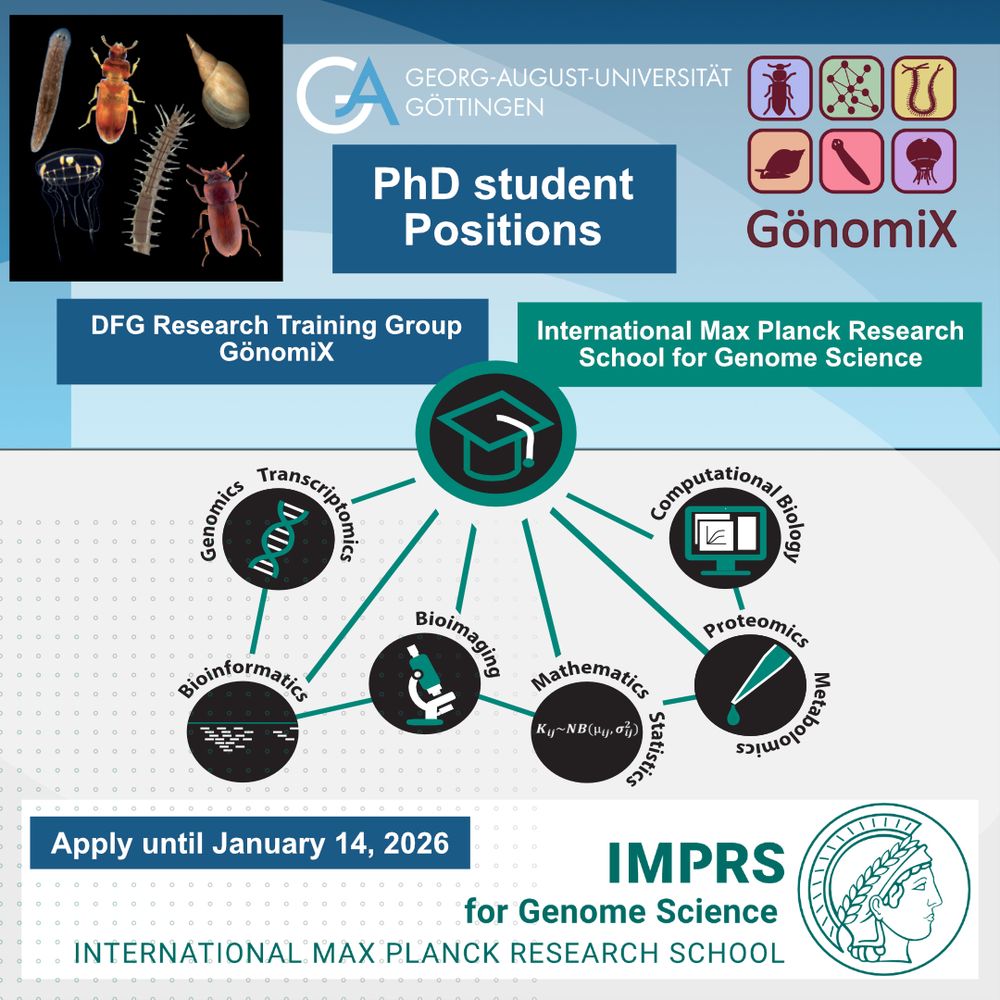
Want to shape the future of genome science? 🧬 PhD positions available at Max Planck Institute & Uni Göttingen (IMPRS-GS/GönomiX)! Join a vibrant, interdisciplinary research community. Apply by Jan 14, 2026: www.uni-goettingen.de/de/applicati... #GenomeScience #Research
November 28, 2025 at 12:23 PM
Want to shape the future of genome science? 🧬 PhD positions available at Max Planck Institute & Uni Göttingen (IMPRS-GS/GönomiX)! Join a vibrant, interdisciplinary research community. Apply by Jan 14, 2026: www.uni-goettingen.de/de/applicati... #GenomeScience #Research
Reposted by Chong Xie

Wonderful to see the beautiful preprint from Sabate et al now published - TADs are also dynamic structures in human cells, with remarkably similar parameters between mESCs and HCT116 cells
www.nature.com/articles/s41...
www.nature.com/articles/s41...

November 15, 2025 at 5:24 PM
Wonderful to see the beautiful preprint from Sabate et al now published - TADs are also dynamic structures in human cells, with remarkably similar parameters between mESCs and HCT116 cells
www.nature.com/articles/s41...
www.nature.com/articles/s41...
Reposted by Chong Xie

Sequential verification of transcription by Integrator and Restrictor

Sequential verification of transcription by Integrator and Restrictor
Estell and Łazowski et al. show that Integrator and Restrictor form distinct pathways for early attenuation of RNA polymerase II: Integrator acts at the promoter-proximal pause site, whereas Restrictor acts over a downstream “restriction zone.” For transcription to proceed, CDK7/9 oppose Integrator, while U1 snRNP counteracts both Integrator and Restrictor.
dlvr.it
November 7, 2025 at 11:58 PM
Sequential verification of transcription by Integrator and Restrictor
Reposted by Chong Xie

New Online! DNA looping regulates transcription

DNA looping regulates transcription
Nature Reviews Molecular Cell Biology, Published online: 03 November 2025; doi:10.1038/s41580-025-00924-2Siyuan (Steven) Wang discusses a 1984 study that reported that transcriptional regulation (in this case, in bacteria) depends on the formation of DNA loops.
bit.ly
November 3, 2025 at 11:09 AM
New Online! DNA looping regulates transcription
Reposted by Chong Xie

🎯 We are so thrilled our new paper @narjournal.bsky.social is out! Fantastic collab with the labs of Gordon Hager NIH & Franck Dequiedt. Heaviest lifting from Greg Fettweiss, Kaustub Wagh, Diana Stavreva & Alba Jiménez-Panizo. Big thanks to Andrea Alegre-Marti JdC 🥳✨️
academic.oup.com/nar/article/...
academic.oup.com/nar/article/...

May 16, 2025 at 3:06 PM
🎯 We are so thrilled our new paper @narjournal.bsky.social is out! Fantastic collab with the labs of Gordon Hager NIH & Franck Dequiedt. Heaviest lifting from Greg Fettweiss, Kaustub Wagh, Diana Stavreva & Alba Jiménez-Panizo. Big thanks to Andrea Alegre-Marti JdC 🥳✨️
academic.oup.com/nar/article/...
academic.oup.com/nar/article/...
Reposted by Chong Xie

Epigenetics Update - Deciphering histone mark-specific fine-scale chromatin organization at high resolution with Micro-C-ChIP go.nature.com/43sr811
#Epigenetics #Chromatin
---
Discover the breakthrough at epigenometech.com
#Epigenetics #Chromatin
---
Discover the breakthrough at epigenometech.com

October 27, 2025 at 12:35 PM
Epigenetics Update - Deciphering histone mark-specific fine-scale chromatin organization at high resolution with Micro-C-ChIP go.nature.com/43sr811
#Epigenetics #Chromatin
---
Discover the breakthrough at epigenometech.com
#Epigenetics #Chromatin
---
Discover the breakthrough at epigenometech.com
Reposted by Chong Xie
Our collab w. V Goel, @nicholas-aboreden.bsky.social , J Jusuf, G Blobel, L Mirny, @irate-physicist.bsky.social out in @natsmb.nature.com www.nature.com/articles/s41...
Was co-submitted with @allanaschooley.bsky.social @jobdekker.bsky.social whose paper should also come out soon
Brief thread 👇
Was co-submitted with @allanaschooley.bsky.social @jobdekker.bsky.social whose paper should also come out soon
Brief thread 👇
October 20, 2025 at 6:36 PM
Our collab w. V Goel, @nicholas-aboreden.bsky.social , J Jusuf, G Blobel, L Mirny, @irate-physicist.bsky.social out in @natsmb.nature.com www.nature.com/articles/s41...
Was co-submitted with @allanaschooley.bsky.social @jobdekker.bsky.social whose paper should also come out soon
Brief thread 👇
Was co-submitted with @allanaschooley.bsky.social @jobdekker.bsky.social whose paper should also come out soon
Brief thread 👇
Reposted by Chong Xie

New online: Dynamics of microcompartment formation at the mitosis-to-G1 transition

Dynamics of microcompartment formation at the mitosis-to-G1 transition
Nature Structural & Molecular Biology, Published online: 17 October 2025; doi:10.1038/s41594-025-01687-2Goel et al. produce high-resolution three-dimensional genome structure mapping from mitosis to G1 phase to show unseen interactions between enhancers and promoters in prometaphase. Polymer modeling indicates the interactions are facilitated by chromosome compaction.
go.nature.com
October 17, 2025 at 9:59 AM
New online: Dynamics of microcompartment formation at the mitosis-to-G1 transition
Reposted by Chong Xie
Biochemical reconstitution of sister chromatid cohesion establishment during DNA replication

Biochemical reconstitution of sister chromatid cohesion establishment during DNA replication
Genome inheritance during cell divisions relies on replicated sister DNAs being connected by cohesin rings. Minamino et al. reconstitute sister chromatid cohesion establishment during DNA replication using purified budding yeast proteins. The experiments yield molecular insight into more than one way in which sister chromatid cohesion can be built.
dlvr.it
October 2, 2025 at 3:19 PM
Biochemical reconstitution of sister chromatid cohesion establishment during DNA replication
Reposted by Chong Xie
New work from my lab with the Brown lab on how genome folding changes during motor neuron maturation, and how this process goes awry in ALS motor neurons. Led by Dr. Ozgun Uyan.
www.biorxiv.org/content/10.1...
www.biorxiv.org/content/10.1...

Dynamic changes in chromosome and nuclear architecture during maturation of normal and ALS C9orf72 motor neurons
We have investigated changes in chromosome conformation, nuclear organization, and transcription during differentiation and maturation of control and mutant motor neurons harboring hexanucleotide expa...
www.biorxiv.org
September 23, 2025 at 9:13 PM
New work from my lab with the Brown lab on how genome folding changes during motor neuron maturation, and how this process goes awry in ALS motor neurons. Led by Dr. Ozgun Uyan.
www.biorxiv.org/content/10.1...
www.biorxiv.org/content/10.1...
Reposted by Chong Xie

🍰Interested in reading more about the study? Here's the N&Vs article written by Ann Dean.
👉https://rdcu.be/eHUxZ
bit.ly/424Iel9
👉https://rdcu.be/eHUxZ
bit.ly/424Iel9

RNA-binding proteins pull in chromatin loops - Nature Cell Biology
During development as cells exit a pluripotent state, chromatin looping interactions are strengthened, but the mechanism for this is unknown. A study now shows that CTCF–RBP interactions increase upon differentiation of embryonic stem cells to neural stem cells, and that the non-coding RNA Pantr1 collaborates with CTCF and RBPs to contract the genome.
bit.ly
September 24, 2025 at 6:41 AM
🍰Interested in reading more about the study? Here's the N&Vs article written by Ann Dean.
👉https://rdcu.be/eHUxZ
bit.ly/424Iel9
👉https://rdcu.be/eHUxZ
bit.ly/424Iel9
Reposted by Chong Xie

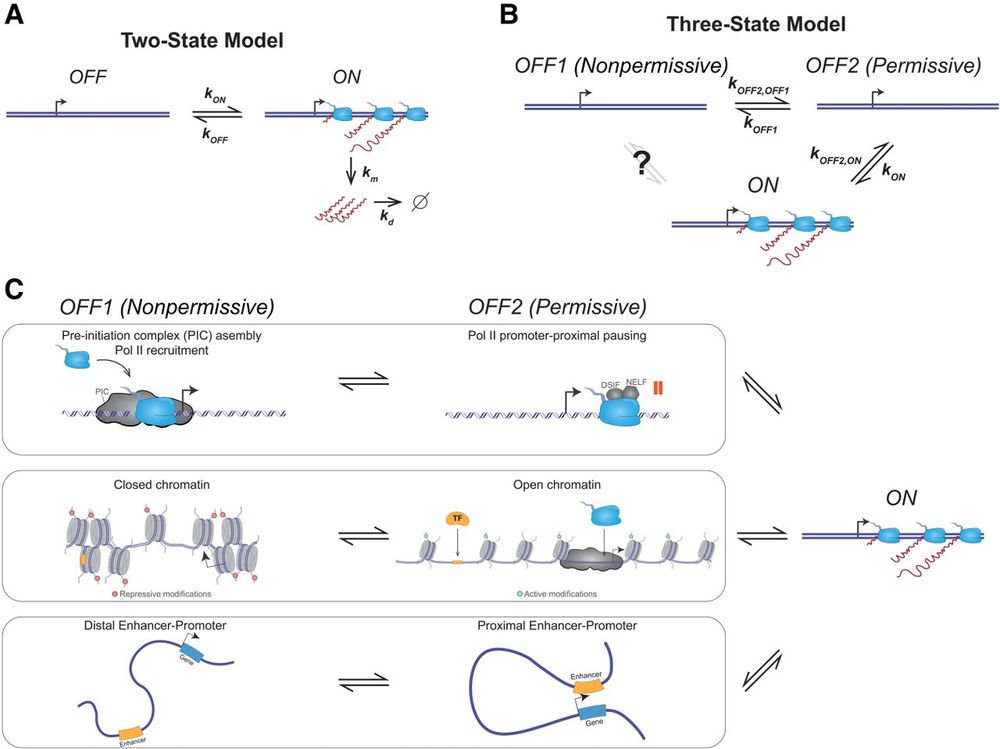
REVIEW: Timing is everything: transcription bursting in development
By Jee Min Kim and Daniel Larson
➡️ https://tinyurl.com/gd352465
#transcription #molecularbiology #transcriptionbursting #embryonicdevelopment #stemcell #differentiation #mRNA #development #molecularmechanism
By Jee Min Kim and Daniel Larson
➡️ https://tinyurl.com/gd352465
#transcription #molecularbiology #transcriptionbursting #embryonicdevelopment #stemcell #differentiation #mRNA #development #molecularmechanism
September 8, 2025 at 3:06 PM
REVIEW: Timing is everything: transcription bursting in development
By Jee Min Kim and Daniel Larson
➡️ https://tinyurl.com/gd352465
#transcription #molecularbiology #transcriptionbursting #embryonicdevelopment #stemcell #differentiation #mRNA #development #molecularmechanism
By Jee Min Kim and Daniel Larson
➡️ https://tinyurl.com/gd352465
#transcription #molecularbiology #transcriptionbursting #embryonicdevelopment #stemcell #differentiation #mRNA #development #molecularmechanism
Reposted by Chong Xie

(1/n) DNA-PAINT imaging inside the nucleus at single antibody resolution using TIRF? Ultrathin sectioning makes it happen!
Grateful to share my postdoctoral work introducing “tomographic & kinetically-enhanced DNA-PAINT” or in brief: tkPAINT. Out in @pnas.org!
doi.org/10.1073/pnas...
👇🧵
Grateful to share my postdoctoral work introducing “tomographic & kinetically-enhanced DNA-PAINT” or in brief: tkPAINT. Out in @pnas.org!
doi.org/10.1073/pnas...
👇🧵

August 13, 2025 at 2:19 PM
(1/n) DNA-PAINT imaging inside the nucleus at single antibody resolution using TIRF? Ultrathin sectioning makes it happen!
Grateful to share my postdoctoral work introducing “tomographic & kinetically-enhanced DNA-PAINT” or in brief: tkPAINT. Out in @pnas.org!
doi.org/10.1073/pnas...
👇🧵
Grateful to share my postdoctoral work introducing “tomographic & kinetically-enhanced DNA-PAINT” or in brief: tkPAINT. Out in @pnas.org!
doi.org/10.1073/pnas...
👇🧵
Reposted by Chong Xie
Congratulations to Masahiro Nagano on his new paper on STAG3-cohesin.
STAG3-cohesin has a much shorter residence time which leads to altered 3D genome organization and STAG3-cohesin is important for male germ cell differentiation.
www.nature.com/articles/s41...
STAG3-cohesin has a much shorter residence time which leads to altered 3D genome organization and STAG3-cohesin is important for male germ cell differentiation.
www.nature.com/articles/s41...

August 26, 2025 at 4:18 PM
Congratulations to Masahiro Nagano on his new paper on STAG3-cohesin.
STAG3-cohesin has a much shorter residence time which leads to altered 3D genome organization and STAG3-cohesin is important for male germ cell differentiation.
www.nature.com/articles/s41...
STAG3-cohesin has a much shorter residence time which leads to altered 3D genome organization and STAG3-cohesin is important for male germ cell differentiation.
www.nature.com/articles/s41...
Reposted by Chong Xie
Online Now: Single-stranded DNA-binding proteins are essential components of the architectural LDB1 protein complex Online now:

Single-stranded DNA-binding proteins are essential components of the architectural LDB1 protein complex
Wang et al. show that the architectural protein LDB1 forms a complex with single-stranded DNA-binding proteins (SSBPs) in vitro and in vivo. SSBP3 stabilizes LDB1 self-interactions to support chromatin loop formation.
dlvr.it
August 12, 2025 at 7:14 PM
Online Now: Single-stranded DNA-binding proteins are essential components of the architectural LDB1 protein complex Online now:
Reposted by Chong Xie
Killing liquid condensates with a micropeptide toward modulating condensatopathies

Killing liquid condensates with a micropeptide toward modulating condensatopathies
In a recent Nature article, Zhang et al. develop a non-natural micropeptide killswitch that modulates the material properties and biomolecular composition of target condensates, enabling direct regulation of cellular processes in condensatopathies.
dlvr.it
August 11, 2025 at 7:14 PM
Killing liquid condensates with a micropeptide toward modulating condensatopathies
Reposted by Chong Xie

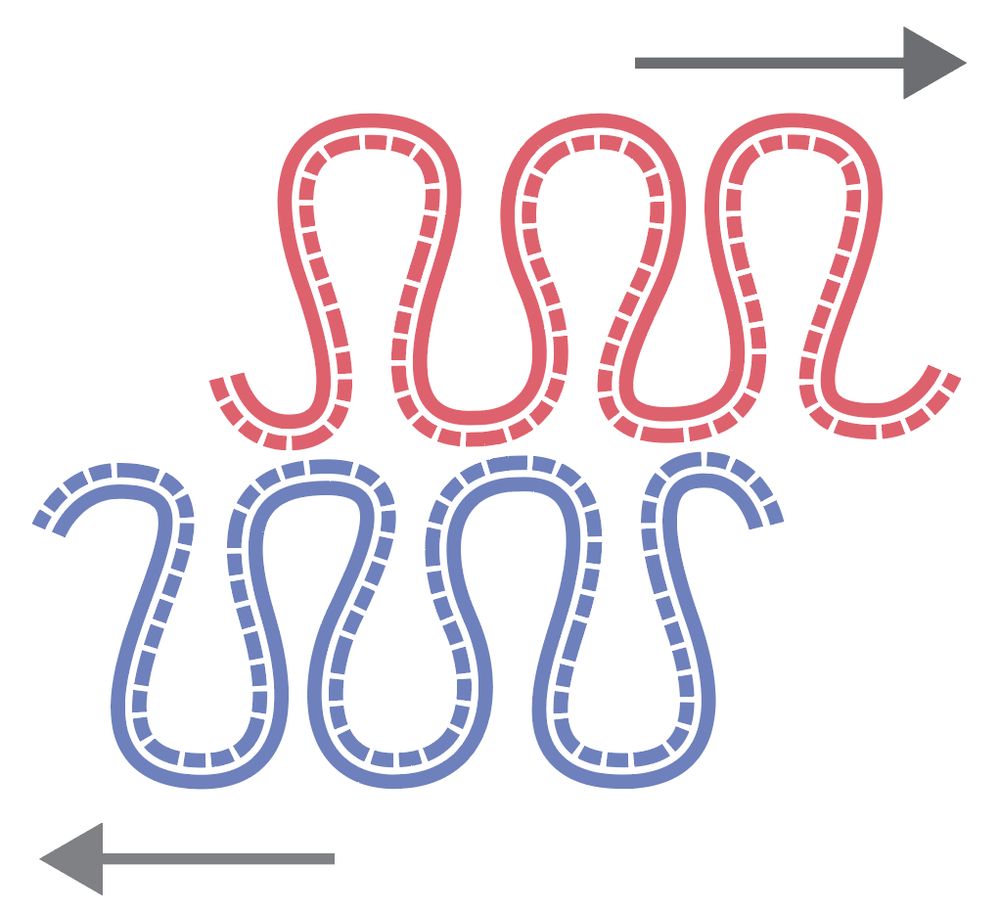
We found a new asymmetry in the large-scale chromosome structure: sister chromatids are systematically shifted by hundreds of kb in the 5′→3′ direction of their inherited strands! The work was led by Flavia Corsi, in close collaboration with the Daniel Gerlich lab.
www.biorxiv.org/content/10.1...
1/
www.biorxiv.org/content/10.1...
1/
July 15, 2025 at 8:11 AM
We found a new asymmetry in the large-scale chromosome structure: sister chromatids are systematically shifted by hundreds of kb in the 5′→3′ direction of their inherited strands! The work was led by Flavia Corsi, in close collaboration with the Daniel Gerlich lab.
www.biorxiv.org/content/10.1...
1/
www.biorxiv.org/content/10.1...
1/
Reposted by Chong Xie
Online Now: Reconciling competing models on the roles of condensates and soluble complexes in transcription factor function Online now:

Reconciling competing models on the roles of condensates and soluble complexes in transcription factor function
Bremer et al. compare two competing models for how transcription factors mediate gene regulation: via phase separation or via soluble complex formation. They demonstrate that Gcn4 sequence variants can function as soluble complexes as well as heterotypic condensates but that condensates formed by variants with high affinities can dampen activities.
dlvr.it
July 3, 2025 at 11:32 AM
Online Now: Reconciling competing models on the roles of condensates and soluble complexes in transcription factor function Online now:
Reposted by Chong Xie

New online! Structural variants in the 3D genome as drivers of disease
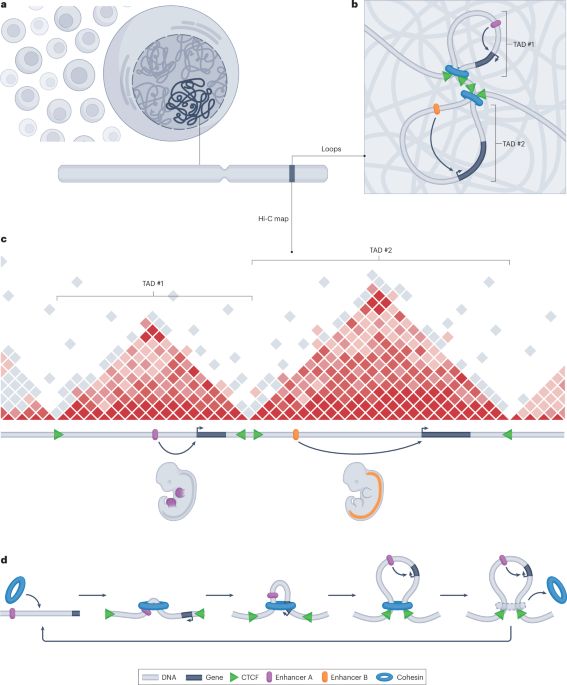
Structural variants in the 3D genome as drivers of disease
Nature Reviews Genetics, Published online: 30 June 2025; doi:10.1038/s41576-025-00862-xDisruption of the 3D genome caused by structural variation contributes to developmental disorders and cancer. The authors review the causes and molecular and clinical consequences of position effects arising from disruptions to the genome architecture.
www.nature.com
June 30, 2025 at 11:30 AM
New online! Structural variants in the 3D genome as drivers of disease