




Carlos E Lourenco (Caê)
@caerib.bsky.social
Professor of Marketing at FGV-EAESP. Opinion my own. RT/❤️ != endorsement. #AI #rstats
Reposted by Carlos E Lourenco (Caê)
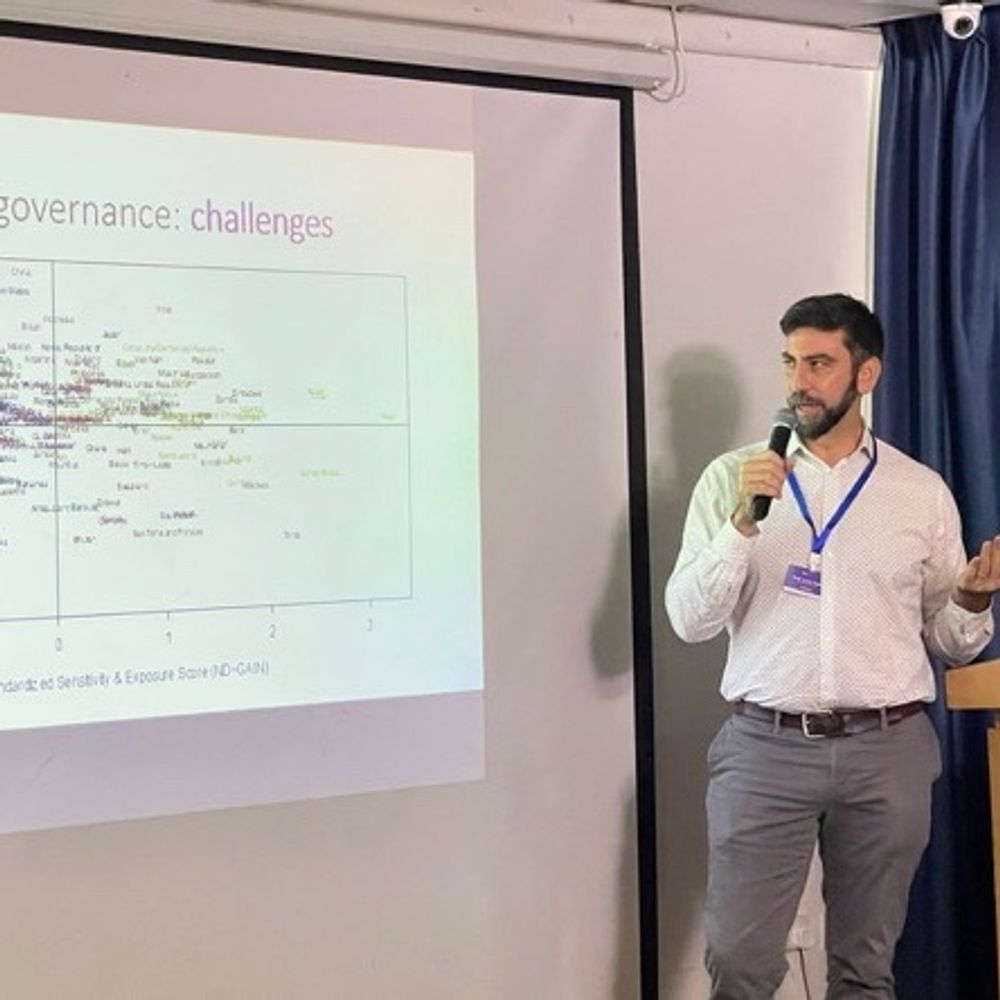
This is an impressive project. My reaction to what it shows though is that survey experiments have gotten out of hand in polisci. I will blog more on this, but I do not think survey experiments are emblematic of the credibility revolution. Some are already interpreting as such, which is a problem.

New paper! @william-dinneen.bsky.social @guygrossman.bsky.social Yiqing Xu and I use GPT to code 91k articles from 174 polisci journals (2003–2023)and track research designs, transparency practices, and citations. How has the credibility revolution reshaped the discipline? doi.org/10.31235/osf...
🧵
🧵

December 3, 2025 at 4:34 AM
This is an impressive project. My reaction to what it shows though is that survey experiments have gotten out of hand in polisci. I will blog more on this, but I do not think survey experiments are emblematic of the credibility revolution. Some are already interpreting as such, which is a problem.
Reposted by Carlos E Lourenco (Caê)
A blog post giving a more thorough take on survey experiments and the credibility revolution: cyrussamii.com?p=4168
December 3, 2025 at 5:23 PM
A blog post giving a more thorough take on survey experiments and the credibility revolution: cyrussamii.com?p=4168
Reposted by Carlos E Lourenco (Caê)

"Meta-meta-analyses trade precision & rigor for expediency. If your aim is rigor, there’s no substitute for doing the hard work."
Preach!
I once read a #meta-analysis that mistook SE for SD. Since then I am suspicious of all such studies.
Do the hard work!
matthewbjane.github.io/blog-posts/b...
Preach!
I once read a #meta-analysis that mistook SE for SD. Since then I am suspicious of all such studies.
Do the hard work!
matthewbjane.github.io/blog-posts/b...
When Evidence Synthesis Obscures: A Critique of Meta-Meta-Analyses – Matthew B. Jané
Meta-analyses are often seen as the gold standard of evidence synthesis–systematic, quantitative, and rigorous (at least when done well). So it’s no surprise that some researchers have taken things a ...
matthewbjane.github.io
May 26, 2025 at 5:18 AM
"Meta-meta-analyses trade precision & rigor for expediency. If your aim is rigor, there’s no substitute for doing the hard work."
Preach!
I once read a #meta-analysis that mistook SE for SD. Since then I am suspicious of all such studies.
Do the hard work!
matthewbjane.github.io/blog-posts/b...
Preach!
I once read a #meta-analysis that mistook SE for SD. Since then I am suspicious of all such studies.
Do the hard work!
matthewbjane.github.io/blog-posts/b...
Reposted by Carlos E Lourenco (Caê)

[2025-12-01] 📚 Updates in #CML
(1) Counterfactual Explanation for Multivariate Time Series Forecasting with Exogenous Variables
(2) A Sensitivity Approach to Causal Inference Under Limited Overlap
🔍 More at researchtrend.ai/communities/CML
(1) Counterfactual Explanation for Multivariate Time Series Forecasting with Exogenous Variables
(2) A Sensitivity Approach to Causal Inference Under Limited Overlap
🔍 More at researchtrend.ai/communities/CML
December 1, 2025 at 3:41 AM
Reposted by Carlos E Lourenco (Caê)

On the reading list it goes!
New paper out in Synthese—a metaphysical theory of causation designed to explain statistical causal inference. Basically a summary of a 100,000-word book (Causation: Science, Statistics and Metaphysics) that'll go into production with CUP soon. Watch this space link.springer.com/article/10.1...

Causal inference and the metaphysics of causation - Synthese
The techniques of causal inference are widely used throughout the non-experimental sciences to derive causal conclusions from probabilistic premises. This poses a philosophical question. What in the n...
link.springer.com
November 30, 2025 at 3:36 PM
On the reading list it goes!
Reposted by Carlos E Lourenco (Caê)

New paper out in Synthese—a metaphysical theory of causation designed to explain statistical causal inference. Basically a summary of a 100,000-word book (Causation: Science, Statistics and Metaphysics) that'll go into production with CUP soon. Watch this space link.springer.com/article/10.1...
Causal inference and the metaphysics of causation - Synthese
The techniques of causal inference are widely used throughout the non-experimental sciences to derive causal conclusions from probabilistic premises. This poses a philosophical question. What in the n...
link.springer.com
November 30, 2025 at 2:03 PM
New paper out in Synthese—a metaphysical theory of causation designed to explain statistical causal inference. Basically a summary of a 100,000-word book (Causation: Science, Statistics and Metaphysics) that'll go into production with CUP soon. Watch this space link.springer.com/article/10.1...
Reposted by Carlos E Lourenco (Caê)
Until tech gives more agency to citizens, smart cities are a dumb idea for democracy. "While cities may disclose how they collect data, they rarely offer ways to opt out." "Residents want agency" #privacy #AIEthics
spectrum.ieee.org/smart-city-p...
spectrum.ieee.org/smart-city-p...

Data Walks Reveal Residents' Mixed Feelings on Privacy
How do Long Beach residents feel about data collection in their city? Gwen Shaffer's data walks reveal surprising insights.
spectrum.ieee.org
November 30, 2025 at 4:21 PM
Until tech gives more agency to citizens, smart cities are a dumb idea for democracy. "While cities may disclose how they collect data, they rarely offer ways to opt out." "Residents want agency" #privacy #AIEthics
spectrum.ieee.org/smart-city-p...
spectrum.ieee.org/smart-city-p...
Reposted by Carlos E Lourenco (Caê)

The default prior for the intercept in both {rstanarm} and {brms} are very wide.
Counterintuitively - being on the logit scale, this is actually translates to a **strong** prior that p(y=1) is near 1 or near 0.
Always check your priors!
#rstats
Counterintuitively - being on the logit scale, this is actually translates to a **strong** prior that p(y=1) is near 1 or near 0.
Always check your priors!
#rstats


November 18, 2025 at 2:01 PM
The default prior for the intercept in both {rstanarm} and {brms} are very wide.
Counterintuitively - being on the logit scale, this is actually translates to a **strong** prior that p(y=1) is near 1 or near 0.
Always check your priors!
#rstats
Counterintuitively - being on the logit scale, this is actually translates to a **strong** prior that p(y=1) is near 1 or near 0.
Always check your priors!
#rstats
Reposted by Carlos E Lourenco (Caê)

A quick (1000 words) read to enjoy with your morning coffee or afternoon tea:
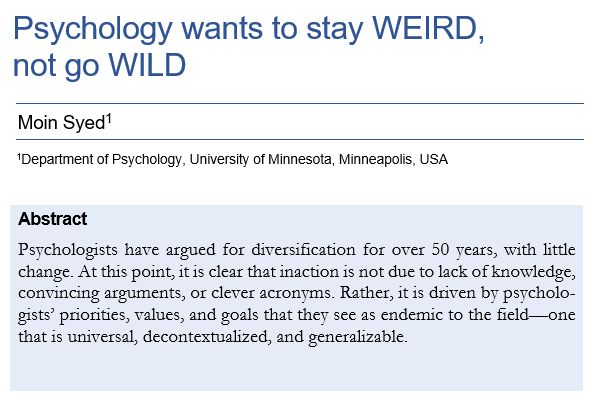
"Psychology wants to stay WEIRD, not go WILD"
Why hasn't psychology diversified it samples, methods, theories, etc.? Because it doesn't want to. osf.io/preprints/ps...
"Psychology wants to stay WEIRD, not go WILD"
Why hasn't psychology diversified it samples, methods, theories, etc.? Because it doesn't want to. osf.io/preprints/ps...
November 13, 2025 at 2:59 PM
A quick (1000 words) read to enjoy with your morning coffee or afternoon tea:
"Psychology wants to stay WEIRD, not go WILD"
Why hasn't psychology diversified it samples, methods, theories, etc.? Because it doesn't want to. osf.io/preprints/ps...
"Psychology wants to stay WEIRD, not go WILD"
Why hasn't psychology diversified it samples, methods, theories, etc.? Because it doesn't want to. osf.io/preprints/ps...
Reposted by Carlos E Lourenco (Caê)


Reposted by Carlos E Lourenco (Caê)

#statstab #458 Causal inference for observational data using {modelbased}
Thoughts: IPW, g-computation, and more. Learning OS and ways to compute ATE for (more accurate, but still not great) inference.
#gcomputation #ipw #iptw #observational #inference
easystats.github.io/modelbased/a...
Thoughts: IPW, g-computation, and more. Learning OS and ways to compute ATE for (more accurate, but still not great) inference.
#gcomputation #ipw #iptw #observational #inference
easystats.github.io/modelbased/a...
Case Study: Causal inference for observational data using modelbased
easystats.github.io
November 12, 2025 at 8:23 PM
#statstab #458 Causal inference for observational data using {modelbased}
Thoughts: IPW, g-computation, and more. Learning OS and ways to compute ATE for (more accurate, but still not great) inference.
#gcomputation #ipw #iptw #observational #inference
easystats.github.io/modelbased/a...
Thoughts: IPW, g-computation, and more. Learning OS and ways to compute ATE for (more accurate, but still not great) inference.
#gcomputation #ipw #iptw #observational #inference
easystats.github.io/modelbased/a...
Reposted by Carlos E Lourenco (Caê)

We'll start sending this week's issue today at 9am PT / 12pm ET / 6pm CET
Join 4k+ of top researchers and practitioners for free at CausalPython.io
3/3
#CausalSky
Join 4k+ of top researchers and practitioners for free at CausalPython.io
3/3
#CausalSky

Causal Python || Your go-to resource for learning about Causality in Python
A page where you can learn about causal inference in Python, causal discovery in Python and causal structure learning in Python. How to causal inference in Python?
CausalPython.io
November 2, 2025 at 10:20 AM
We'll start sending this week's issue today at 9am PT / 12pm ET / 6pm CET
Join 4k+ of top researchers and practitioners for free at CausalPython.io
3/3
#CausalSky
Join 4k+ of top researchers and practitioners for free at CausalPython.io
3/3
#CausalSky
Reposted by Carlos E Lourenco (Caê)
Can Game Theory Help Us with Causal Discovery?
What's Your Guess?
In this week's issue of Causal Python Weekly, expect a solid mix of history, fresh discoveries, and good teaching:
1/
#CausalSky #EconSky #StatSky #MLSky #EpiSky
What's Your Guess?
In this week's issue of Causal Python Weekly, expect a solid mix of history, fresh discoveries, and good teaching:
1/
#CausalSky #EconSky #StatSky #MLSky #EpiSky

November 2, 2025 at 10:19 AM
Can Game Theory Help Us with Causal Discovery?
What's Your Guess?
In this week's issue of Causal Python Weekly, expect a solid mix of history, fresh discoveries, and good teaching:
1/
#CausalSky #EconSky #StatSky #MLSky #EpiSky
What's Your Guess?
In this week's issue of Causal Python Weekly, expect a solid mix of history, fresh discoveries, and good teaching:
1/
#CausalSky #EconSky #StatSky #MLSky #EpiSky
Reposted by Carlos E Lourenco (Caê)

We were wrong about the strength of more personalized instruments! Vignette instruments had the largest treatment effects on emotions that we studied, except for anger. Images (we looked photographs from affective image inventories) tended to work well, too.
(9/17)
(9/17)

August 13, 2025 at 6:16 PM
We were wrong about the strength of more personalized instruments! Vignette instruments had the largest treatment effects on emotions that we studied, except for anger. Images (we looked photographs from affective image inventories) tended to work well, too.
(9/17)
(9/17)
Reposted by Carlos E Lourenco (Caê)
This paper:
1. Shows that the big challenges in emotions experiments are instrumental variable challenges: weak instruments, violations of the exclusion restriction, compliance.
2. Identifies emotion manipulations that work even in online surveys.
(4/17)
1. Shows that the big challenges in emotions experiments are instrumental variable challenges: weak instruments, violations of the exclusion restriction, compliance.
2. Identifies emotion manipulations that work even in online surveys.
(4/17)
August 13, 2025 at 6:16 PM
This paper:
1. Shows that the big challenges in emotions experiments are instrumental variable challenges: weak instruments, violations of the exclusion restriction, compliance.
2. Identifies emotion manipulations that work even in online surveys.
(4/17)
1. Shows that the big challenges in emotions experiments are instrumental variable challenges: weak instruments, violations of the exclusion restriction, compliance.
2. Identifies emotion manipulations that work even in online surveys.
(4/17)
Reposted by Carlos E Lourenco (Caê)
🚨 Updated working paper!
Ekin Dursun and I ask what instruments best manipulate emotions on surveys (osf.io/56h4g).
We find that vignettes really work! They have large effects on emotions of interest & smaller effects on emotions *not* of interest.
But as always, it's complicated.👇
(1/17)
Ekin Dursun and I ask what instruments best manipulate emotions on surveys (osf.io/56h4g).
We find that vignettes really work! They have large effects on emotions of interest & smaller effects on emotions *not* of interest.
But as always, it's complicated.👇
(1/17)

August 13, 2025 at 6:16 PM
🚨 Updated working paper!
Ekin Dursun and I ask what instruments best manipulate emotions on surveys (osf.io/56h4g).
We find that vignettes really work! They have large effects on emotions of interest & smaller effects on emotions *not* of interest.
But as always, it's complicated.👇
(1/17)
Ekin Dursun and I ask what instruments best manipulate emotions on surveys (osf.io/56h4g).
We find that vignettes really work! They have large effects on emotions of interest & smaller effects on emotions *not* of interest.
But as always, it's complicated.👇
(1/17)
Reposted by Carlos E Lourenco (Caê)

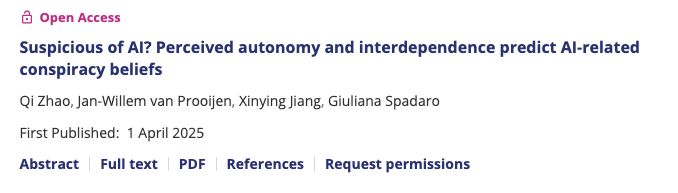
New paper online!🎉
We introduce a new concept: AI-related conspiracy theory, which claims that powerful humans use AI for malicious purposes or AI itself eventually controls humans.
Yes, this is inspired by the movie “the Matrix”.👻
bpspsychub.onlinelibrary.wiley.com/doi/full/10....
We introduce a new concept: AI-related conspiracy theory, which claims that powerful humans use AI for malicious purposes or AI itself eventually controls humans.
Yes, this is inspired by the movie “the Matrix”.👻
bpspsychub.onlinelibrary.wiley.com/doi/full/10....
April 1, 2025 at 5:30 PM
New paper online!🎉
We introduce a new concept: AI-related conspiracy theory, which claims that powerful humans use AI for malicious purposes or AI itself eventually controls humans.
Yes, this is inspired by the movie “the Matrix”.👻
bpspsychub.onlinelibrary.wiley.com/doi/full/10....
We introduce a new concept: AI-related conspiracy theory, which claims that powerful humans use AI for malicious purposes or AI itself eventually controls humans.
Yes, this is inspired by the movie “the Matrix”.👻
bpspsychub.onlinelibrary.wiley.com/doi/full/10....
Reposted by Carlos E Lourenco (Caê)

ICYMI: Thanh Liêm Nguyen's deep dive into applying causal inference to measure the effect of product unavailability on retail sales at Carrefour.

Analysis of Sales Shift in Retail with Causal Impact: A Case Study at Carrefour | Towards Data Science
Applying causal inference to measure the effect of product unavailability on retail sales at Carrefour
towardsdatascience.com
October 13, 2025 at 4:48 PM
ICYMI: Thanh Liêm Nguyen's deep dive into applying causal inference to measure the effect of product unavailability on retail sales at Carrefour.
Reposted by Carlos E Lourenco (Caê)

Not sure it’s quite what you want but making the point that big data doesn’t guard against bias
declaredesign.org/blog/posts/w...
declaredesign.org/blog/posts/w...
With great power comes great responsibility – DeclareDesign
declaredesign.org
October 13, 2025 at 5:24 PM
Not sure it’s quite what you want but making the point that big data doesn’t guard against bias
declaredesign.org/blog/posts/w...
declaredesign.org/blog/posts/w...
Reposted by Carlos E Lourenco (Caê)

Reposted by Carlos E Lourenco (Caê)

Not your focus, but you might want to pair it, at least as recommended reading, with the recent Stewart/Sperling piece on IBE IN JOP. I for one find John D. Huber's points here very important, too: goodauthority.org/news/is-theo...

Is theory getting lost in the "identification revolution"?
The following is a guest post from Columbia University political scientist John Huber, and is a slightly modified version of […]
goodauthority.org
October 13, 2025 at 6:20 PM
Not your focus, but you might want to pair it, at least as recommended reading, with the recent Stewart/Sperling piece on IBE IN JOP. I for one find John D. Huber's points here very important, too: goodauthority.org/news/is-theo...
Reposted by Carlos E Lourenco (Caê)

Wow. Fantastic. This seems exactly like what I am looking for thanks!
For others:
www.journals.uchicago.edu/doi/full/10....
For others:
www.journals.uchicago.edu/doi/full/10....
University of Chicago Press Journals: Cookie absent
www.journals.uchicago.edu
October 13, 2025 at 5:52 PM
Wow. Fantastic. This seems exactly like what I am looking for thanks!
For others:
www.journals.uchicago.edu/doi/full/10....
For others:
www.journals.uchicago.edu/doi/full/10....
Reposted by Carlos E Lourenco (Caê)
Colleagues: What’s your favorite, accessible resource (reading, video, slide deck) to convince students that regression on observational data—even with many controls—is not often causal. (Quasi-)experimental designs are preferred for causal inference.
October 13, 2025 at 5:22 PM
Colleagues: What’s your favorite, accessible resource (reading, video, slide deck) to convince students that regression on observational data—even with many controls—is not often causal. (Quasi-)experimental designs are preferred for causal inference.
Reposted by Carlos E Lourenco (Caê)

🚨New Preprint: We develop a novel task that probes counterfactual thinking without using counterfactual language, and that teases apart genuine counterfactual thinking from related forms of thinking. Using this task, we find that the ability for counterfactual thinking emerges around 5 years of age.

October 13, 2025 at 7:58 PM
🚨New Preprint: We develop a novel task that probes counterfactual thinking without using counterfactual language, and that teases apart genuine counterfactual thinking from related forms of thinking. Using this task, we find that the ability for counterfactual thinking emerges around 5 years of age.
Reposted by Carlos E Lourenco (Caê)

Congratulations to Joel Mokyr, Philippe Aghion, and Peter Howitt for their well-deserved Nobel Prize in economics!
Their groundbreaking work opened the black box of innovation in relation to economic growth, both being core features of modern economies and human wellbeing
#EconSky
Their groundbreaking work opened the black box of innovation in relation to economic growth, both being core features of modern economies and human wellbeing
#EconSky

The Sveriges Riksbank Prize in Economic Sciences in Memory of Alfred Nobel 2025
The Sveriges Riksbank Prize in Economic Sciences in Memory of Alfred Nobel 2025 was awarded "for having explained innovation-driven economic growth" with one half to Joel Mokyr "for having identified ...
www.nobelprize.org
October 13, 2025 at 5:01 PM
Congratulations to Joel Mokyr, Philippe Aghion, and Peter Howitt for their well-deserved Nobel Prize in economics!
Their groundbreaking work opened the black box of innovation in relation to economic growth, both being core features of modern economies and human wellbeing
#EconSky
Their groundbreaking work opened the black box of innovation in relation to economic growth, both being core features of modern economies and human wellbeing
#EconSky