



R. Saravanan
@sarava.net
Climate scientist, Professor, and Dept. Head at Texas A&M University.
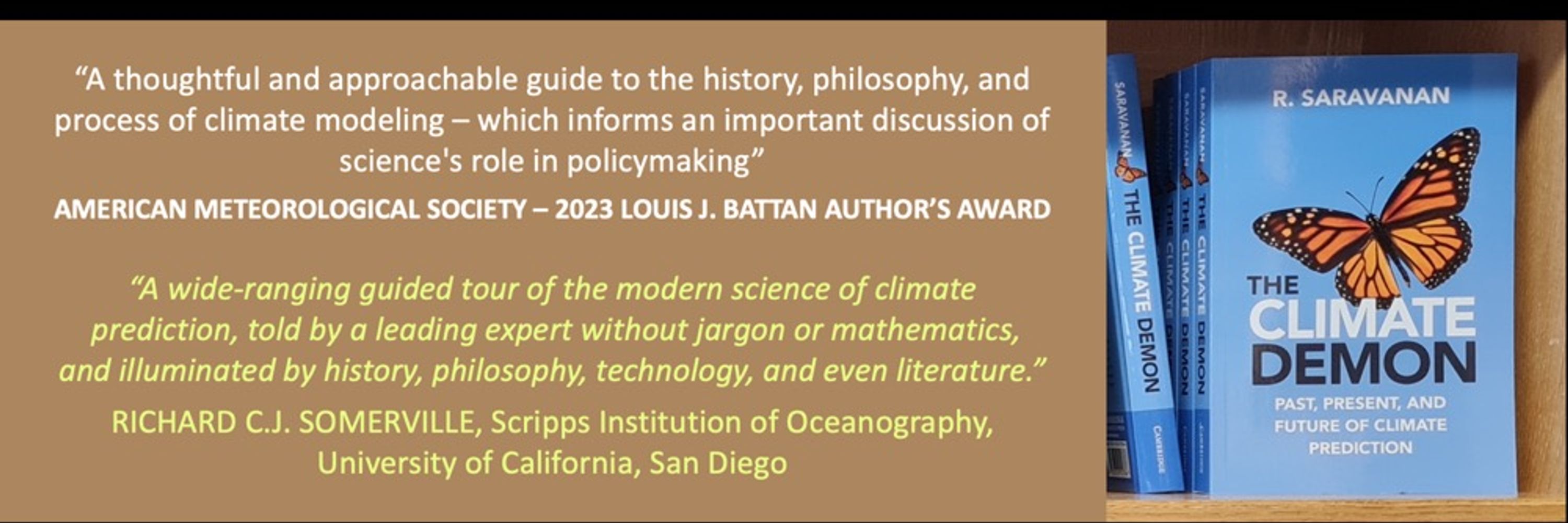
Author: ClimateDemon.com Now-and-then-blogger: https://Metamodel.blog Code: https://github.com/mitotic Bluesky-client: https://skylimit.dev
More: https://r.saravanan.us/about
Author: ClimateDemon.com Now-and-then-blogger: https://Metamodel.blog Code: https://github.com/mitotic Bluesky-client: https://skylimit.dev
More: https://r.saravanan.us/about
Reposted by R. Saravanan

New on AMS Headlines 🗞️: Recent disastrous floods triggered by extreme rainfall highlight the need to scale up early actions.
An article in #BulletinAMS highlights the potential of forecasts and warning thresholds to trigger action by decision-makers: https://bit.ly/4b4FrxB
An article in #BulletinAMS highlights the potential of forecasts and warning thresholds to trigger action by decision-makers: https://bit.ly/4b4FrxB

From Early Warning to Early Action
Key messages from “The Value of Precipitation Forecasts to Anticipate Floods,” by Tim Busker (Vrije Universiteit Amsterdam), Bart van den Hurk, Hans de Moel, and Jeroen C. J. H. Aerts.
bit.ly
January 17, 2026 at 6:56 PM
New on AMS Headlines 🗞️: Recent disastrous floods triggered by extreme rainfall highlight the need to scale up early actions.
An article in #BulletinAMS highlights the potential of forecasts and warning thresholds to trigger action by decision-makers: https://bit.ly/4b4FrxB
An article in #BulletinAMS highlights the potential of forecasts and warning thresholds to trigger action by decision-makers: https://bit.ly/4b4FrxB
I wasn't referring to climate econometrics specifically (IANAE) but to the basic premise behind W. Nordhaus's arguments and to more recent papers like this one:
www.nber.org/papers/w32450
www.nber.org/papers/w32450

The Macroeconomic Impact of Climate Change: Global vs. Local Temperature
Founded in 1920, the NBER is a private, non-profit, non-partisan organization dedicated to conducting economic research and to disseminating research findings among academics, public policy makers, an...
www.nber.org
January 16, 2026 at 9:56 PM
I wasn't referring to climate econometrics specifically (IANAE) but to the basic premise behind W. Nordhaus's arguments and to more recent papers like this one:
www.nber.org/papers/w32450
www.nber.org/papers/w32450
Less seriously, what's common to these 3 questions (2 of them won a Nobel prize)
1. How many angels can dance on the head of a pin?
2. How many roads must a man walk down before you call him a man?
3. What is the Social Cost of Carbon?
With enough assumptions, we can always obtain a numeric answer!
1. How many angels can dance on the head of a pin?
2. How many roads must a man walk down before you call him a man?
3. What is the Social Cost of Carbon?
With enough assumptions, we can always obtain a numeric answer!
January 16, 2026 at 9:44 PM
Less seriously, what's common to these 3 questions (2 of them won a Nobel prize)
1. How many angels can dance on the head of a pin?
2. How many roads must a man walk down before you call him a man?
3. What is the Social Cost of Carbon?
With enough assumptions, we can always obtain a numeric answer!
1. How many angels can dance on the head of a pin?
2. How many roads must a man walk down before you call him a man?
3. What is the Social Cost of Carbon?
With enough assumptions, we can always obtain a numeric answer!
In the climate model world, we use ensembles of alternative climate realizations to correlate global avg T with local climate trends (averaging out internal variability), which shows more robust relationships. But this approach won't work with a single realization of past economic data. 6/6
January 16, 2026 at 9:16 PM
In the climate model world, we use ensembles of alternative climate realizations to correlate global avg T with local climate trends (averaging out internal variability), which shows more robust relationships. But this approach won't work with a single realization of past economic data. 6/6
Economic analyses based on past relationships of impacts to global avg T are very shaky because global avg T is not a good predictor of regional climate trends in a single realization of climate (the one that we live in). 5/
January 16, 2026 at 9:16 PM
Economic analyses based on past relationships of impacts to global avg T are very shaky because global avg T is not a good predictor of regional climate trends in a single realization of climate (the one that we live in). 5/
But SCC numbers are often bandied about without the context of their assumptions. The non-stationarity of economic relationships does not help the cause.
Economic analysis based on past relationships is perhaps most useful when focused on local T and rainfall and their impact on specific sectors 4/
Economic analysis based on past relationships is perhaps most useful when focused on local T and rainfall and their impact on specific sectors 4/
January 16, 2026 at 9:16 PM
But SCC numbers are often bandied about without the context of their assumptions. The non-stationarity of economic relationships does not help the cause.
Economic analysis based on past relationships is perhaps most useful when focused on local T and rainfall and their impact on specific sectors 4/
Economic analysis based on past relationships is perhaps most useful when focused on local T and rainfall and their impact on specific sectors 4/
In physics-based climate modeling, we try to minimize the role of assumptions. The stationarity of the laws of physics helps us in this regard. To some degree (pun intended), we can discuss climate predictions (e.g., global avg T) without referring to assumptions (excepting emission scenarios).
3/
3/
January 16, 2026 at 9:16 PM
In physics-based climate modeling, we try to minimize the role of assumptions. The stationarity of the laws of physics helps us in this regard. To some degree (pun intended), we can discuss climate predictions (e.g., global avg T) without referring to assumptions (excepting emission scenarios).
3/
3/
with reasonable error bounds, I was initially excited that economics could provide numbers for SCC. But I soon realized that the numbers were highly contingent on assumptions (not just discount rate) with extremely wide (unreasonable?) error bounds. 2/
January 16, 2026 at 9:16 PM
with reasonable error bounds, I was initially excited that economics could provide numbers for SCC. But I soon realized that the numbers were highly contingent on assumptions (not just discount rate) with extremely wide (unreasonable?) error bounds. 2/
I am not an economist, but over time I have become very skeptical of long-term (multi-decadal to centennial) economic predictions, especially those used to estimate the social cost of carbon (SCC). As a climate modeler who thinks aggregate properties of long-term climate can be predicted 1/
January 16, 2026 at 9:16 PM
I am not an economist, but over time I have become very skeptical of long-term (multi-decadal to centennial) economic predictions, especially those used to estimate the social cost of carbon (SCC). As a climate modeler who thinks aggregate properties of long-term climate can be predicted 1/
Reposted by R. Saravanan

Preprint out today in ESDD.
SRM's biggest risk is us.
'Peak-shaving' is a best-case scenario, with strong governance and international cooperation.
We propose a framework for messier geoengineering futures, which look more like, you know, the news. /1
egusphere.copernicus.org/preprints/20...
SRM's biggest risk is us.
'Peak-shaving' is a best-case scenario, with strong governance and international cooperation.
We propose a framework for messier geoengineering futures, which look more like, you know, the news. /1
egusphere.copernicus.org/preprints/20...

Robust assessment of Solar Radiation Modification risks and uncertainties must include shocks and societal feedbacks
Abstract. Conventional climate scenarios omit fast-timescale human-system dynamics like policy rollback or economic shocks. The climate system's slow response to GHG emissions allows these `fast' ter...
egusphere.copernicus.org
January 15, 2026 at 12:54 PM
Preprint out today in ESDD.
SRM's biggest risk is us.
'Peak-shaving' is a best-case scenario, with strong governance and international cooperation.
We propose a framework for messier geoengineering futures, which look more like, you know, the news. /1
egusphere.copernicus.org/preprints/20...
SRM's biggest risk is us.
'Peak-shaving' is a best-case scenario, with strong governance and international cooperation.
We propose a framework for messier geoengineering futures, which look more like, you know, the news. /1
egusphere.copernicus.org/preprints/20...
- As discussed above, the so-called "hot models" predict fairly strong warming trends
- I don't fully buy into the pejorative "hot model" characterization, because it assumes that a collection of fairly simple statistical models can estimate the "true" climate sensitivity from recent/paleo data 3/3
- I don't fully buy into the pejorative "hot model" characterization, because it assumes that a collection of fairly simple statistical models can estimate the "true" climate sensitivity from recent/paleo data 3/3
January 14, 2026 at 6:59 PM
- As discussed above, the so-called "hot models" predict fairly strong warming trends
- I don't fully buy into the pejorative "hot model" characterization, because it assumes that a collection of fairly simple statistical models can estimate the "true" climate sensitivity from recent/paleo data 3/3
- I don't fully buy into the pejorative "hot model" characterization, because it assumes that a collection of fairly simple statistical models can estimate the "true" climate sensitivity from recent/paleo data 3/3
- Global average T variability includes more than El Niño/La Niña, i.e., with other internal variability modes that are less well defined/understood
- A better question is whether observed T variability is within the model projection envelope, as addressed in this post: 2/
bsky.app/profile/haus...
- A better question is whether observed T variability is within the model projection envelope, as addressed in this post: 2/
bsky.app/profile/haus...

I have a new update to climate model-observation comparisons over at The Climate Brink, covering CMIP3, CMIP5, and CMIP6. Models perform well globally. The latest generation shows too much long-term warming but better reproduces recent trends: www.theclimatebrink....

January 14, 2026 at 6:59 PM
- Global average T variability includes more than El Niño/La Niña, i.e., with other internal variability modes that are less well defined/understood
- A better question is whether observed T variability is within the model projection envelope, as addressed in this post: 2/
bsky.app/profile/haus...
- A better question is whether observed T variability is within the model projection envelope, as addressed in this post: 2/
bsky.app/profile/haus...
Slightly contrarian view:
- Worrying about annual variations of global average T is a bit like checking your retirement account balance everyday and fretting about it. Climate change is a long-term (multi-decadal) trend, not the daily/monthly/annual variation. 1/
- Worrying about annual variations of global average T is a bit like checking your retirement account balance everyday and fretting about it. Climate change is a long-term (multi-decadal) trend, not the daily/monthly/annual variation. 1/
January 14, 2026 at 6:59 PM
Slightly contrarian view:
- Worrying about annual variations of global average T is a bit like checking your retirement account balance everyday and fretting about it. Climate change is a long-term (multi-decadal) trend, not the daily/monthly/annual variation. 1/
- Worrying about annual variations of global average T is a bit like checking your retirement account balance everyday and fretting about it. Climate change is a long-term (multi-decadal) trend, not the daily/monthly/annual variation. 1/
Reposted by R. Saravanan

🚨 Publication alert! Very happy to see our paper "Unlocking the benefits of transparent and reusable science for climate risk management" out in PNAS today. With @crispapoll.bsky.social @jdossgollin.bsky.social @bobkopp.net and many others.
www.pnas.org/doi/10.1073/...
www.pnas.org/doi/10.1073/...

January 14, 2026 at 5:10 PM
🚨 Publication alert! Very happy to see our paper "Unlocking the benefits of transparent and reusable science for climate risk management" out in PNAS today. With @crispapoll.bsky.social @jdossgollin.bsky.social @bobkopp.net and many others.
www.pnas.org/doi/10.1073/...
www.pnas.org/doi/10.1073/...
Reposted by R. Saravanan

Most economists disagree with extreme voices on debates about climate risks, and yet we keep providing fuel to both sides. This article tries to explain why.
www.theatlantic.com/science/2026...
www.theatlantic.com/science/2026...

The Climate Question That Economists Cannot Answer
Models can predict catastrophic or modest damages from climate change, but not which of these futures is coming.
www.theatlantic.com
January 14, 2026 at 5:38 PM
Most economists disagree with extreme voices on debates about climate risks, and yet we keep providing fuel to both sides. This article tries to explain why.
www.theatlantic.com/science/2026...
www.theatlantic.com/science/2026...
Reposted by R. Saravanan

Convection ≠ Overturning: Why Labrador Sea convection doesn’t drive the AMOC: A simple explanation 🌊🧪 ocean2climate.org/2026/01/10/w...

Why Labrador Sea Convection Doesn’t Drive The AMOC: A Simple Explanation
The oceanography community is deeply engaged in a debate about how much weight the Labrador Sea actually carries in maintaining the Atlantic Overturning Circulation (AMOC) system. According to the …
ocean2climate.org
January 10, 2026 at 5:36 PM
Convection ≠ Overturning: Why Labrador Sea convection doesn’t drive the AMOC: A simple explanation 🌊🧪 ocean2climate.org/2026/01/10/w...
Reposted by R. Saravanan

Leaving the IPCC and UNFCCC is Bad for the United States
Mutilateralism matters for normal Americans
rogerpielkejr.substack.com/p/leaving-th...
Mutilateralism matters for normal Americans
rogerpielkejr.substack.com/p/leaving-th...

Leaving the IPCC and UNFCCC is Bad for the United States
Mutilateralism matters for normal Americans
rogerpielkejr.substack.com
January 8, 2026 at 2:09 PM
Leaving the IPCC and UNFCCC is Bad for the United States
Mutilateralism matters for normal Americans
rogerpielkejr.substack.com/p/leaving-th...
Mutilateralism matters for normal Americans
rogerpielkejr.substack.com/p/leaving-th...

Quick question: The Call for Proposals says "Your proposal should be 500 words or less"
But the form entry for Proposal Description says "Describe your content in 2-5 sentences".
Which is correct?
Thx
But the form entry for Proposal Description says "Describe your content in 2-5 sentences".
Which is correct?
Thx
January 7, 2026 at 4:40 PM
Quick question: The Call for Proposals says "Your proposal should be 500 words or less"
But the form entry for Proposal Description says "Describe your content in 2-5 sentences".
Which is correct?
Thx
But the form entry for Proposal Description says "Describe your content in 2-5 sentences".
Which is correct?
Thx
Reposted by R. Saravanan

Congress appears to have a bipartisan budget plan that would reject most of the Trump Administration's desired cuts to federal atmospheric science agencies and programs. Details on what Congress is planning for NOAA, NASA and NSF in 2026 - and will OMB follow through? tinyurl.com/bddutn9m

Bipartisan budget plan rejects most of the administration's desired cuts for major federal earth and atmospheric science agencies
NOAA Office of Oceanic and Atmospheric Research continues to be funded; Congress restates support of key satellite programs and mandates no more than 5% cuts to NSF science areas
tinyurl.com
January 6, 2026 at 9:35 PM
Congress appears to have a bipartisan budget plan that would reject most of the Trump Administration's desired cuts to federal atmospheric science agencies and programs. Details on what Congress is planning for NOAA, NASA and NSF in 2026 - and will OMB follow through? tinyurl.com/bddutn9m
Reposted by R. Saravanan

Unbelievable. The National Weather Service issued a wind warning supported by a hazard map showing places that **do not exist***.

Wait a minute...why is NWS throwing out genAI generated slop on their socials?
This is a horrible look and doesn't help keep people safe or aware of the forecast.
This is a horrible look and doesn't help keep people safe or aware of the forecast.

January 5, 2026 at 3:59 PM
Unbelievable. The National Weather Service issued a wind warning supported by a hazard map showing places that **do not exist***.
Reposted by R. Saravanan

My favorite advice for blogging remains that you should hit publish while you are still actively unhappy with what you have written, because the only alternative is a huge folder full of drafts and never publishing anything at all
December 28, 2025 at 9:24 AM
My favorite advice for blogging remains that you should hit publish while you are still actively unhappy with what you have written, because the only alternative is a huge folder full of drafts and never publishing anything at all
Amidst all the hype, one area where ML (prefer that to AI) has been a leap forward is weather forecasting. The ECMWF ML model
"outperforms state-of-the-art physics-based models for many measures, including tropical cyclone tracks, with gains of up to 20%."
www.ecmwf.int/en/about/med...
"outperforms state-of-the-art physics-based models for many measures, including tropical cyclone tracks, with gains of up to 20%."
www.ecmwf.int/en/about/med...
ECMWF’s AI forecasts become operational
ECMWF has taken the Artificial Intelligence Forecasting System (AIFS) into operations today, 25 February 2025, to run side by side with its traditional physics-based Integrated Forecasting System (IFS) to advance numerical weather prediction.
www.ecmwf.int
December 27, 2025 at 8:29 PM
Amidst all the hype, one area where ML (prefer that to AI) has been a leap forward is weather forecasting. The ECMWF ML model
"outperforms state-of-the-art physics-based models for many measures, including tropical cyclone tracks, with gains of up to 20%."
www.ecmwf.int/en/about/med...
"outperforms state-of-the-art physics-based models for many measures, including tropical cyclone tracks, with gains of up to 20%."
www.ecmwf.int/en/about/med...
Reposted by R. Saravanan

Shale drillers have turned the Permian Basin of West Texas and New Mexico into a pressure cooker that is literally bursting at the seams.

America’s Biggest Oil Field Is Turning Into a Pressure Cooker
Drillers’ injection of wastewater is creating mayhem across the Permian Basin, raising concern about the future of fossil-fuel production there.
on.wsj.com
December 26, 2025 at 11:27 AM
Shale drillers have turned the Permian Basin of West Texas and New Mexico into a pressure cooker that is literally bursting at the seams.
The Other Suggested Reviewers box is even funnier...
December 24, 2025 at 6:03 PM
The Other Suggested Reviewers box is even funnier...