



Lukas Jarzembowski
@lukaszfrydryk.bsky.social
PhD student in the Niemeyer Lab at Saarland University
Reposted by Lukas Jarzembowski

New paper out 🔥!
Small promoter, big potential🧬 We show that the ultra-compact Calm1 promoter efficiently targets human neurons in brain organoids and is a promising alternative to hSyn for AAV gene delivery.
Huge thanks to everyone who contributed to this work!
🧠 📄: www.nature.com/articles/s41...
Small promoter, big potential🧬 We show that the ultra-compact Calm1 promoter efficiently targets human neurons in brain organoids and is a promising alternative to hSyn for AAV gene delivery.
Huge thanks to everyone who contributed to this work!
🧠 📄: www.nature.com/articles/s41...

Compact Calm1 promoter enables AAV mediated neuron-targeted expression in human iPSC-derived brain organoids - Scientific Reports
Scientific Reports - Compact Calm1 promoter enables AAV mediated neuron-targeted expression in human iPSC-derived brain organoids
www.nature.com
January 5, 2026 at 12:37 PM
New paper out 🔥!
Small promoter, big potential🧬 We show that the ultra-compact Calm1 promoter efficiently targets human neurons in brain organoids and is a promising alternative to hSyn for AAV gene delivery.
Huge thanks to everyone who contributed to this work!
🧠 📄: www.nature.com/articles/s41...
Small promoter, big potential🧬 We show that the ultra-compact Calm1 promoter efficiently targets human neurons in brain organoids and is a promising alternative to hSyn for AAV gene delivery.
Huge thanks to everyone who contributed to this work!
🧠 📄: www.nature.com/articles/s41...
Reposted by Lukas Jarzembowski

The latest version of our collaboration with Katalin Torok and her lab is up. We report some new glutamate sensors. Great work from Sara Bertelli in Berlin and the whole team in London (Holly & Oanh particularly).
www.biorxiv.org/content/10.1...
1/6
1/6

iGlu3Fast and iGlu3Slow, improved fluorescent reporters for detection of spontaneous glutamate activity in the brain
The genetically-encoded fluorescent glutamate sensor, iGluSnFR3, characterised by a high dynamic range and rapid on-kinetics, is an attractive sensor for glutamate imaging in the central nervous syste...
www.biorxiv.org
October 12, 2025 at 4:24 PM
The latest version of our collaboration with Katalin Torok and her lab is up. We report some new glutamate sensors. Great work from Sara Bertelli in Berlin and the whole team in London (Holly & Oanh particularly).
www.biorxiv.org/content/10.1...
1/6
1/6
Reposted by Lukas Jarzembowski

On the first day of the Christmas holidays, I got... a new preprint out! Challenging the reproducibility of our manual presynaptic actin nanostructure identification: www.biorxiv.org/content/10.6...
(data from Bingham et al. @jcb.org 2023 doi.org/10.1083/jcb....) with @flevet.bsky.social
(data from Bingham et al. @jcb.org 2023 doi.org/10.1083/jcb....) with @flevet.bsky.social

December 22, 2025 at 6:49 PM
On the first day of the Christmas holidays, I got... a new preprint out! Challenging the reproducibility of our manual presynaptic actin nanostructure identification: www.biorxiv.org/content/10.6...
(data from Bingham et al. @jcb.org 2023 doi.org/10.1083/jcb....) with @flevet.bsky.social
(data from Bingham et al. @jcb.org 2023 doi.org/10.1083/jcb....) with @flevet.bsky.social
Reposted by Lukas Jarzembowski

Organelles do NOT have a single uniform pH.
And if you think they must, because “protons diffuse fast,” this paper is for you.
A thread on why that assumption is wrong; and what we found instead. 🧵 1/n
And if you think they must, because “protons diffuse fast,” this paper is for you.
A thread on why that assumption is wrong; and what we found instead. 🧵 1/n

Organelles harbour pH gradients https://www.biorxiv.org/content/10.64898/2025.12.12.694065v1
December 17, 2025 at 12:46 AM
Organelles do NOT have a single uniform pH.
And if you think they must, because “protons diffuse fast,” this paper is for you.
A thread on why that assumption is wrong; and what we found instead. 🧵 1/n
And if you think they must, because “protons diffuse fast,” this paper is for you.
A thread on why that assumption is wrong; and what we found instead. 🧵 1/n
Reposted by Lukas Jarzembowski

Vaults. They are cell biology's greatest puzzle! This preprint from Martin Beck's lab shows them docked on ER membranes with a ribosome inside. What on earth is going on there??
#CellBiology #WTFology
www.biorxiv.org/content/10.6...
#CellBiology #WTFology
www.biorxiv.org/content/10.6...

The vault associates with membranes in situ
The eukaryotic vault particle is a giant ribonucleoprotein complex that assembles into an iconic barrel-like cage. Its cellular function has remained elusive despite extensive characterization. Using ...
www.biorxiv.org
December 16, 2025 at 6:35 AM
Vaults. They are cell biology's greatest puzzle! This preprint from Martin Beck's lab shows them docked on ER membranes with a ribosome inside. What on earth is going on there??
#CellBiology #WTFology
www.biorxiv.org/content/10.6...
#CellBiology #WTFology
www.biorxiv.org/content/10.6...
Reposted by Lukas Jarzembowski
It’s FINALLY out! 🎉🚀 We have been working on PhotoFiTT for a long time, and it’s now published, introducing a quantitative framework to measure phototoxicity and optimise live-cell microscopy experiments. So excited to finally share the last version! 🔬✨ #PhotoFiTT doi.org/10.1038/s414...


December 15, 2025 at 2:58 PM
It’s FINALLY out! 🎉🚀 We have been working on PhotoFiTT for a long time, and it’s now published, introducing a quantitative framework to measure phototoxicity and optimise live-cell microscopy experiments. So excited to finally share the last version! 🔬✨ #PhotoFiTT doi.org/10.1038/s414...
Reposted by Lukas Jarzembowski

This #Preprint reports that B6 (but not wild mice) have a truncated PDL2, missing an active intracellular signalling domain:
"Surprisingly, in C57BL/6J (B6) mice PD-L2 has only a 5-amino acid intracellular domain, and the same is true for several other laboratory mouse strains"
#Immunology
"Surprisingly, in C57BL/6J (B6) mice PD-L2 has only a 5-amino acid intracellular domain, and the same is true for several other laboratory mouse strains"
#Immunology

PD-L2 Regulates Natural Antibody and IL-10 Secretion by B-1 cells
B-1 cells are innate-like lymphocytes that play a critical role in homeostasis by secreting natural antibodies, typically IgM, and immunosuppressive molecules such as IL-10. However, the regulation of...
www.biorxiv.org
December 15, 2025 at 6:03 AM
This #Preprint reports that B6 (but not wild mice) have a truncated PDL2, missing an active intracellular signalling domain:
"Surprisingly, in C57BL/6J (B6) mice PD-L2 has only a 5-amino acid intracellular domain, and the same is true for several other laboratory mouse strains"
#Immunology
"Surprisingly, in C57BL/6J (B6) mice PD-L2 has only a 5-amino acid intracellular domain, and the same is true for several other laboratory mouse strains"
#Immunology
Reposted by Lukas Jarzembowski
A reminder to use the right P2A sequence to produce separate proteins - the images are from a GPCR-P2A-mCherry construct using a P2A variant without (upper row) and with (lower row) a preceding GSG linker.

December 12, 2025 at 5:55 PM
A reminder to use the right P2A sequence to produce separate proteins - the images are from a GPCR-P2A-mCherry construct using a P2A variant without (upper row) and with (lower row) a preceding GSG linker.
Reposted by Lukas Jarzembowski

Textbooks said neurons don’t burn fatty acids for energy🤔. Our study delivers the first in vivo demonstration that fatty acid oxidation in defined memory neurons fuels memory formation.
Closing chapter of my PhD 🥳, out today in Nature Metabolism💥 @natmetabolism.nature.com
Closing chapter of my PhD 🥳, out today in Nature Metabolism💥 @natmetabolism.nature.com

Neuronal fatty acid oxidation fuels memory after intensive learning in Drosophila - Nature Metabolism
Neurons are shown to use fatty acid β-oxidation as a fuel source for memory formation upon intensive learning in Drosophila, challenging the view that neurons are unable to use fatty acids for energy ...
www.nature.com
December 10, 2025 at 11:13 AM
Textbooks said neurons don’t burn fatty acids for energy🤔. Our study delivers the first in vivo demonstration that fatty acid oxidation in defined memory neurons fuels memory formation.
Closing chapter of my PhD 🥳, out today in Nature Metabolism💥 @natmetabolism.nature.com
Closing chapter of my PhD 🥳, out today in Nature Metabolism💥 @natmetabolism.nature.com
Reposted by Lukas Jarzembowski

Preprint drop! 🚨 Rhobin-tag your proteins and watch Saci glow at high temps! 🔥 Bright, photostable, live-cell imaging made possible with JF dyes. Huge thanks to @samjlord.bsky.social @acharlesorszag.bsky.social @mullinslab.bsky.social and Bo Huang lab at UCSF.😊
www.biorxiv.org/content/10.1...
www.biorxiv.org/content/10.1...

De novo designed bright, hyperstable rhodamine binders for fluorescence microscopy
De novo protein design has emerged as a powerful strategy with the promise to create new tools. The practical performance of designed fluorophore binders, however, has remained far from meeting fluore...
www.biorxiv.org
June 25, 2025 at 5:57 PM
Preprint drop! 🚨 Rhobin-tag your proteins and watch Saci glow at high temps! 🔥 Bright, photostable, live-cell imaging made possible with JF dyes. Huge thanks to @samjlord.bsky.social @acharlesorszag.bsky.social @mullinslab.bsky.social and Bo Huang lab at UCSF.😊
www.biorxiv.org/content/10.1...
www.biorxiv.org/content/10.1...
Reposted by Lukas Jarzembowski
SO HAPPY to share our new paper in @currentbiology.bsky.social! Using volumetric EM, we found daily shifts in synapses, vesicles, and mitochondria that accompany neuronal remodeling, linking structural plasticity to changes in how s-LNv neurons influence their targets
www.cell.com/current-biol...
www.cell.com/current-biol...

Daily ultrastructural remodeling of clock neurons
A cluster of Drosophila clock neurons remodel their axonal arbors daily. Using volumetric
electron microscopy at different times of day, Ispizua, Rodriguez-Caron, and colleagues
reveal ultrastructural...
www.cell.com
November 19, 2025 at 5:03 PM
SO HAPPY to share our new paper in @currentbiology.bsky.social! Using volumetric EM, we found daily shifts in synapses, vesicles, and mitochondria that accompany neuronal remodeling, linking structural plasticity to changes in how s-LNv neurons influence their targets
www.cell.com/current-biol...
www.cell.com/current-biol...
Reposted by Lukas Jarzembowski

Thrilled to share "in situ APEX activation" (iAPEX), a proximity labeling technology for subcellular #proteomics applied to primary #cilia. iAPEX uses an enzymatic cascade, in which a D-amino acid oxidase locally produces H2O2 to activate ascorbate peroxidase.
www.nature.com/articles/s41...
www.nature.com/articles/s41...

An enzymatic cascade enables sensitive and specific proximity labeling proteomics in challenging biological systems - Nature Communications
Proximity labeling allows proteomic mapping of subcellular structures. Here, Sroka et al. develop in situ APEX activation (iAPEX) to overcome limitations of labeling specificity and H2O2 toxicity, app...
www.nature.com
November 14, 2025 at 8:07 PM
Thrilled to share "in situ APEX activation" (iAPEX), a proximity labeling technology for subcellular #proteomics applied to primary #cilia. iAPEX uses an enzymatic cascade, in which a D-amino acid oxidase locally produces H2O2 to activate ascorbate peroxidase.
www.nature.com/articles/s41...
www.nature.com/articles/s41...
Reposted by Lukas Jarzembowski

Ever wondered if analyzing your images by using intensity Z-projections impacts your data?
Happy to announce my guest article in Microscopy & Analysis on that topic. It's a very short read but worth for everyone dealing with image analysis!
buff.ly/KJ147tI
#Microscopy #ZProjection #ImageAnalysis
Happy to announce my guest article in Microscopy & Analysis on that topic. It's a very short read but worth for everyone dealing with image analysis!
buff.ly/KJ147tI
#Microscopy #ZProjection #ImageAnalysis


November 10, 2025 at 4:05 PM
Ever wondered if analyzing your images by using intensity Z-projections impacts your data?
Happy to announce my guest article in Microscopy & Analysis on that topic. It's a very short read but worth for everyone dealing with image analysis!
buff.ly/KJ147tI
#Microscopy #ZProjection #ImageAnalysis
Happy to announce my guest article in Microscopy & Analysis on that topic. It's a very short read but worth for everyone dealing with image analysis!
buff.ly/KJ147tI
#Microscopy #ZProjection #ImageAnalysis
Reposted by Lukas Jarzembowski

Have you heard of #ANGEL?
Not this 😇, but ALFA Nanobody-Guided Endogenous Labeling #ANGEL - the new approach published by Wang et al. in @natchembio.nature.com Build on our ALFA® System, it enables direct fluorescent readout of #CRISPR knock-ins.
📄Full paper here: bit.ly/47XgK48
Not this 😇, but ALFA Nanobody-Guided Endogenous Labeling #ANGEL - the new approach published by Wang et al. in @natchembio.nature.com Build on our ALFA® System, it enables direct fluorescent readout of #CRISPR knock-ins.
📄Full paper here: bit.ly/47XgK48

ALFA nanobody-guided endogenous labeling - Nature Chemical Biology
Small peptide tags (like ALFA) cause minimal disruption of proteins, but they typically lack fluorescence, which would enable knockin screening. Now, antigen-stabilizing fluorescent protein-fused nano...
bit.ly
November 6, 2025 at 1:28 PM
Have you heard of #ANGEL?
Not this 😇, but ALFA Nanobody-Guided Endogenous Labeling #ANGEL - the new approach published by Wang et al. in @natchembio.nature.com Build on our ALFA® System, it enables direct fluorescent readout of #CRISPR knock-ins.
📄Full paper here: bit.ly/47XgK48
Not this 😇, but ALFA Nanobody-Guided Endogenous Labeling #ANGEL - the new approach published by Wang et al. in @natchembio.nature.com Build on our ALFA® System, it enables direct fluorescent readout of #CRISPR knock-ins.
📄Full paper here: bit.ly/47XgK48
Reposted by Lukas Jarzembowski

The Python Software Foundation was recommended for a $1.5M grant from the National Science Foundation. The terms of the award said PSF could not work on DEI, whether or not the grant funding was used for it.
PSF therefore declined the funding.
Science suffers, but commitment to core values remains
PSF therefore declined the funding.
Science suffers, but commitment to core values remains

TLDR; The PSF has made the decision to put our community and our shared diversity, equity, and inclusion values ahead of seeking $1.5M in new revenue. Please read and share. pyfound.blogspot.com/2025/10/NSF-...
🧵
🧵

The official home of the Python Programming Language
www.python.org
October 27, 2025 at 5:31 PM
The Python Software Foundation was recommended for a $1.5M grant from the National Science Foundation. The terms of the award said PSF could not work on DEI, whether or not the grant funding was used for it.
PSF therefore declined the funding.
Science suffers, but commitment to core values remains
PSF therefore declined the funding.
Science suffers, but commitment to core values remains
Reposted by Lukas Jarzembowski

mStayRose is published in JBC 🥳🎉
Congratulations @wsctt.bsky.social @sporemohan.bsky.social and team for the monumental effort to make a non-natural amino acid incorporating fluorescent protein accessible. It's based on mStayGold, bright, and photostable:
www.jbc.org/article/S002...
Congratulations @wsctt.bsky.social @sporemohan.bsky.social and team for the monumental effort to make a non-natural amino acid incorporating fluorescent protein accessible. It's based on mStayGold, bright, and photostable:
www.jbc.org/article/S002...
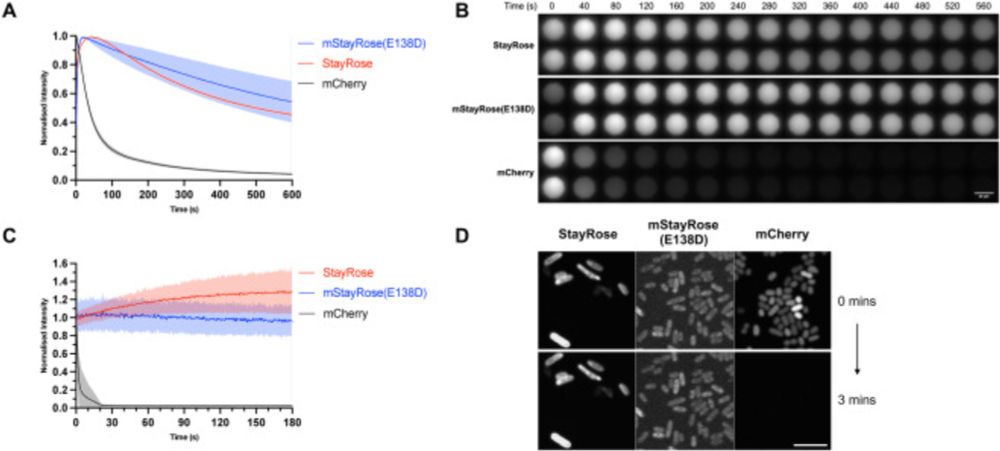
StayRose: a photostable StayGold derivative red-shifted by genetic code expansion
Photobleaching of fluorescent proteins often limits the acquisition of high-quality
images in microscopy. StayGold, a novel dimeric green fluorescent protein recently
monomerised through sequence engi...
www.jbc.org
October 22, 2025 at 4:58 PM
mStayRose is published in JBC 🥳🎉
Congratulations @wsctt.bsky.social @sporemohan.bsky.social and team for the monumental effort to make a non-natural amino acid incorporating fluorescent protein accessible. It's based on mStayGold, bright, and photostable:
www.jbc.org/article/S002...
Congratulations @wsctt.bsky.social @sporemohan.bsky.social and team for the monumental effort to make a non-natural amino acid incorporating fluorescent protein accessible. It's based on mStayGold, bright, and photostable:
www.jbc.org/article/S002...
Reposted by Lukas Jarzembowski

🧠 The Lipid #Brain Atlas is out now! If you think #lipids are boring and membranes are all the same, prepare to be surprised. Led by @lucafusarbassini.bsky.social with Giovanni D'Angelo's lab, we mapped membrane lipids in the mouse brain at high resolution.
www.biorxiv.org/cgi/content/...
www.biorxiv.org/cgi/content/...

October 16, 2025 at 6:23 AM
🧠 The Lipid #Brain Atlas is out now! If you think #lipids are boring and membranes are all the same, prepare to be surprised. Led by @lucafusarbassini.bsky.social with Giovanni D'Angelo's lab, we mapped membrane lipids in the mouse brain at high resolution.
www.biorxiv.org/cgi/content/...
www.biorxiv.org/cgi/content/...
Reposted by Lukas Jarzembowski

#lipidtime alert!
This preprint by Kenji Maeda (cannot find him here) & colleagues is mandatory reading by everybody with even a cursory interest in lipid biology:
www.biorxiv.org/content/10.1...
This preprint by Kenji Maeda (cannot find him here) & colleagues is mandatory reading by everybody with even a cursory interest in lipid biology:
www.biorxiv.org/content/10.1...

Lipid Landscape of human cells
Eukaryotic cells synthesise thousands of lipid species, yet the principles that organise them across compartments remain unclear. Here we introduce PAP-SL, parallel (immuno)affinity purification coupl...
www.biorxiv.org
October 9, 2025 at 3:18 PM
#lipidtime alert!
This preprint by Kenji Maeda (cannot find him here) & colleagues is mandatory reading by everybody with even a cursory interest in lipid biology:
www.biorxiv.org/content/10.1...
This preprint by Kenji Maeda (cannot find him here) & colleagues is mandatory reading by everybody with even a cursory interest in lipid biology:
www.biorxiv.org/content/10.1...
Reposted by Lukas Jarzembowski

15 years in the making, we confirmed that mitochondria - the powerhouse of the cell - have an unusual localization in patients who experience psychosis (including schizophrenia and bipolar disorders). You’ll never guess what kind of patient cells we used to make this discovery… 🧵

October 10, 2025 at 4:47 PM
15 years in the making, we confirmed that mitochondria - the powerhouse of the cell - have an unusual localization in patients who experience psychosis (including schizophrenia and bipolar disorders). You’ll never guess what kind of patient cells we used to make this discovery… 🧵
Reposted by Lukas Jarzembowski
This is a beautiful piece of work - makes so many new approaches possible. Congrats to everybody involved!

Molecular Recording with HaloTag?
H2O2, GSH, Trx, LAP?
→ multiplexable reagents record diverse enzyme activities ratiometrically, without signal loss
@biorxivpreprint.bsky.social
preprint: doi.org/10.1101/2025...
CHalo Crew again programming with HaloTag!
#chembio #fluorescence #wednesday
H2O2, GSH, Trx, LAP?
→ multiplexable reagents record diverse enzyme activities ratiometrically, without signal loss
@biorxivpreprint.bsky.social
preprint: doi.org/10.1101/2025...
CHalo Crew again programming with HaloTag!
#chembio #fluorescence #wednesday

October 1, 2025 at 5:22 PM
This is a beautiful piece of work - makes so many new approaches possible. Congrats to everybody involved!
Reposted by Lukas Jarzembowski
Very exciting work. Shows how interfering with the levels of one lipid class leads to changes of other lipids that are not directly metabolically connected as the cell tries to maintain both lipid flux balance and biophysical membrane properties.

How do cells sense & respond to lipid imbalances? What happens when a disease-relevant enzyme is blocked? Shiying Huang investigates phosphoinositide lipids with the Balla lab & discovers an integrated cellular response that boosts alternate lipid synthesis pathways! www.biorxiv.org/content/10.1...


October 3, 2025 at 1:37 PM
Very exciting work. Shows how interfering with the levels of one lipid class leads to changes of other lipids that are not directly metabolically connected as the cell tries to maintain both lipid flux balance and biophysical membrane properties.
Reposted by Lukas Jarzembowski

I’m happy to share some plugins I’ve been developping this summer: "Channels and Contrast" and LUTs Manager!
I can’t find new bugs and ideas by now so I need your help to please test them in your machines and report bugs, feedbacks and ideas! forum.image.sc/t/looking-fo...
I can’t find new bugs and ideas by now so I need your help to please test them in your machines and report bugs, feedbacks and ideas! forum.image.sc/t/looking-fo...

October 4, 2025 at 11:50 AM
I’m happy to share some plugins I’ve been developping this summer: "Channels and Contrast" and LUTs Manager!
I can’t find new bugs and ideas by now so I need your help to please test them in your machines and report bugs, feedbacks and ideas! forum.image.sc/t/looking-fo...
I can’t find new bugs and ideas by now so I need your help to please test them in your machines and report bugs, feedbacks and ideas! forum.image.sc/t/looking-fo...
Reposted by Lukas Jarzembowski

⚠️ Half of commercial antibodies miss their target!
So how do you pick the right one for your experiment?
Here’s the solution 👉
Antibody characterization data (all tested in KO cells) are now available at:
🔗 onlygoodantibodies.co.uk
Tested by @ycharos.bsky.social & @oga-community.bsky.social
So how do you pick the right one for your experiment?
Here’s the solution 👉
Antibody characterization data (all tested in KO cells) are now available at:
🔗 onlygoodantibodies.co.uk
Tested by @ycharos.bsky.social & @oga-community.bsky.social
OGA - Only Good Antibodies Community
onlygoodantibodies.co.uk
September 29, 2025 at 6:34 PM
⚠️ Half of commercial antibodies miss their target!
So how do you pick the right one for your experiment?
Here’s the solution 👉
Antibody characterization data (all tested in KO cells) are now available at:
🔗 onlygoodantibodies.co.uk
Tested by @ycharos.bsky.social & @oga-community.bsky.social
So how do you pick the right one for your experiment?
Here’s the solution 👉
Antibody characterization data (all tested in KO cells) are now available at:
🔗 onlygoodantibodies.co.uk
Tested by @ycharos.bsky.social & @oga-community.bsky.social
Reposted by Lukas Jarzembowski

Everyone who does quantitative microscopy should read this! It’s amazing how many ways we can bias our imaging experiments without realizing we’re doing it.

In 2019, Anna Jost & @jencwaters.bsky.social reviewed best practices for validating quantitative #microscopy methods & discuss strategies to avoid unconscious bias in imaging experiments rupress.org/jcb/article/...
📕 In #Reproducibility & Best Practices in Cell Biology: rupress.org/jcb/collecti...
📕 In #Reproducibility & Best Practices in Cell Biology: rupress.org/jcb/collecti...

September 11, 2025 at 8:40 PM
Everyone who does quantitative microscopy should read this! It’s amazing how many ways we can bias our imaging experiments without realizing we’re doing it.
Reposted by Lukas Jarzembowski
Announcing our new PA biosensor, PILS-Nir1 – seen here in HeLa cells during PLC activation #lipidtime #phospholipids
Read the OA paper in JCB
Read the OA paper in JCB
September 10, 2025 at 7:56 PM
Announcing our new PA biosensor, PILS-Nir1 – seen here in HeLa cells during PLC activation #lipidtime #phospholipids
Read the OA paper in JCB
Read the OA paper in JCB