Alexander Wuttke
kunkakom.bsky.social
Alexander Wuttke
@kunkakom.bsky.social

Digitalization & Pol Behavior LMU_Muenchen | Democracy and Populist Attitudes | Open Science | 🚵‍♂️🐶

Political science 63%
Communication & Media Studies 7%

Reposted by Alexander Wuttke

“Follow the Science”? Only when there’s good gatekeeping!

Open Access: doi.org/10.1007/s112...

Reposted by Alexander Wuttke

If you’re not using the For you feed you’re missing out
i wonder how much of this is people using the For You feed which does a much better job at finding “your” cluster
The discussions about LLMs today have been fascinating. Genuinely healthy conversations (imo). I have no idea how public perception within the dev community here changed so much over the last 30 days.

Reposted by Alexander Wuttke

I launched version 3.0 of my browser extension "Lazy Scholar", a free in-browser research assistant. It opens automatically when you load an academic article.

See: lazyscholar.org/2026/01/10/l...
The datasets from our @protestinstitut.bsky.social project ‘20 years of protest survey data’ are finally online for scientific re-use. We processed 30+ datasets, covering protests on peace, climate, trade, migration, equality & more. Now available @gesis.org 👇

search.gesis.org?source=%7B%2...
GESIS-Suche
search.gesis.org

Interesting.
Very happy to see this out in CPS! We study class identities and their social and political relevance over several decades in Britain, Denmark, Norway, and the US. A small thread:

journals.sagepub.com/eprint/SIRW4...
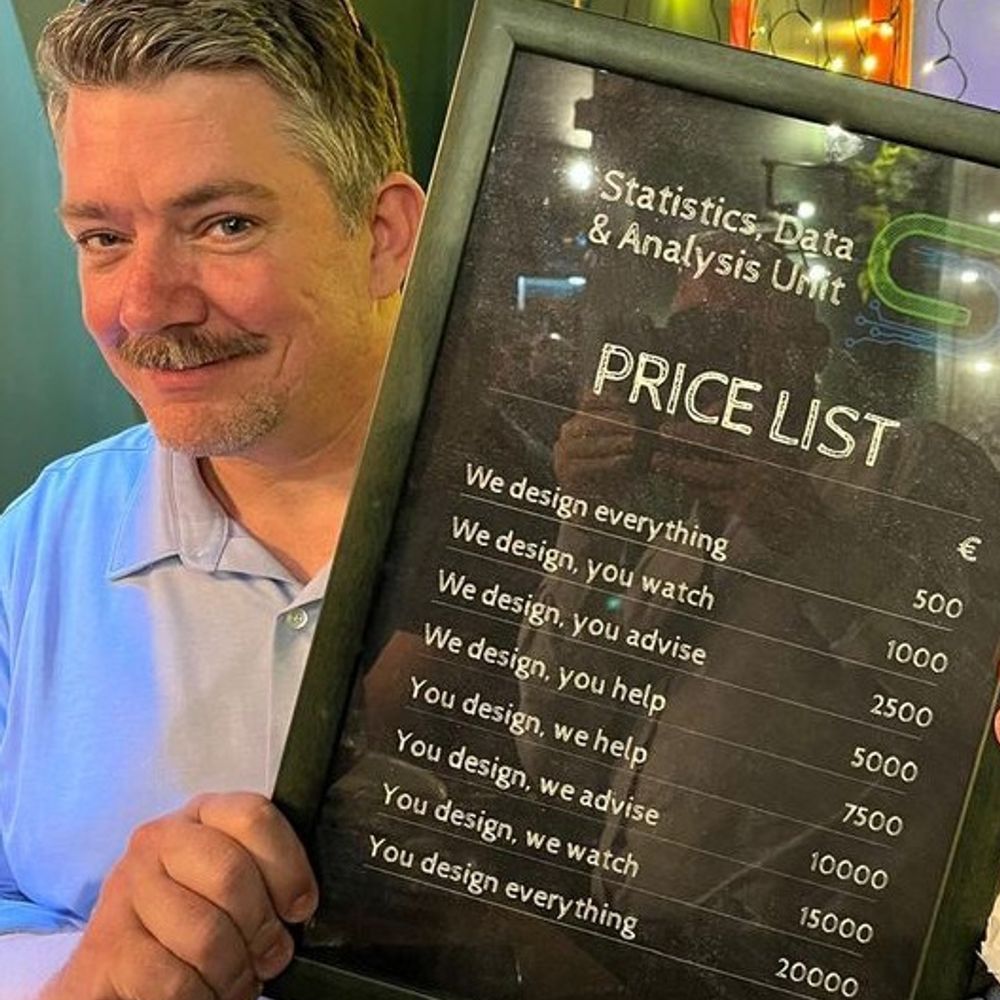
A hope for 2026 is that this perspective piece with @wiringthebrain.bsky.social & @deevybee.bsky.social will serve as a template for others who are similarly frustrated with with exaggerated claims and double speak around so much of research. It's ok to point out that the emperor has no clothes!
The link between the gut #microbiome and autism is not backed by science, researchers say.

Read the full opinion piece in @cp-neuron.bsky.social: spkl.io/63322AbxpA

@wiringthebrain.bsky.social, @statsepi.bsky.social, & @deevybee.bsky.social
Populists and socialists are more likely than other politicians to come from lower-class families, and social democrats to have less educated parents. Yet both groups are just as likely to have highly educated and higher class friends and partners journals.sagepub.com/doi/abs/10.1...
Are socialists and populists better connected to the working class? Comparing politicians’ intimate social ties in 13 countries - Nino Junius, Stefaan Walgrave, 2025
Populist and social democrat parties often claim to better represent lower socio-economic status (SES) citizens, yet existing research shows their elected polit...
journals.sagepub.com

Reposted by Alexander Wuttke

Currently in FirstView: In “Political DEBATE: Efficient Zero-Shot and Few-Shot Classifiers for Political Text,” Michael Burnham, Kayla Kahn, Ryan Yang Wang, and Rachel Peng introduce DEBATE, a new open source foundation model for classifying political documents.

📨 Apply with CV, writing sample & cover letter to [email protected]

⏰ Deadline: apply as early as possible, rolling review, latest: Jan 31, 2026
job-portal.lmu.de/jobposting/7...
PhD Student:in (m/w/d)
job-portal.lmu.de

Who should apply?
MA/MSc in political science, communication, psychology, or related fields.
Strong quantitative skills & interest in experiments, political psychlogy and democracy research

Ideally, command of German and English

What we offer
• Work on a high-profile consortium project
• Clear path to international publications
• Strong interdisciplinary collaboration (LMU + TUM)
• Supportive, collegial research culture
• Competitive salary TV-L E13 (75%)
• Based at LMU Munich, excellent research conditions &quality of life

You’ll work on a large-scale randomized field experiment (panel study, ~800 participants) evaluating how AI-supported political conversations affect empathy, reactance & openness over time.

Focus on:
• experimental design
• political psychology
• R (Python a plus)
🧵 PhD position (75%) in Political Behavior / Political Communication / CSS
📍 LMU Munich | ⏳ 3 years | 🗓 start March–May 2026

We’re hiring for DemocraGPT, a @bidt.bsky.social-funded project developing an AI-based training for difficult conversations in times of growing polarization

Herzlichen Glückwunsch und viel Erfolg
Nicht Algorithmen oder Plattformen allein sind schuld an der zunehmenden Polarisierung – es ist komplexer. @ajungherr.bsky.social erforscht, u. a. am bidt, wie digitale Medien politische Kommunikation verändern.

Mehr zu seiner Person & Forschung im Porträt: www.bidt.digital/im-portraet-...

Can reflecting on past democratic backsliding episodes “inoculate” citizens into vigilant liberal democrats? Drawing on the Slovak case, @movadek.bsky.social & I will find out: our registered report is in-principle accepted @thejop.bsky.social & survey results forthcoming! See tinyurl.com/uv5wybhs
🧑‍🎓Can democracy promotion strengthen support for democracy in terrorism-affected regions?

➡️ Using a randomized experiment in Burkina Faso, S Yameogo @anjaneundorf.bsky.social & @aykutozturk.bsky.social find that democracy promotion videos boost democratic support www.cambridge.org/core/journal...
Sie haben auch schon ein paar Pläne für die Zeit nach „der Machtübernahme“, nämlich: „Volksfeindliche Medien verbieten.“ Denn: „Die Zeit, in der das deutsche Volk sich erhebt wird kommen. Es ist unsere Zeit!!!“

steady.page/de/vernunft-...
„…dann stellen wir sie an die Wand.“
Ein Dokument wie ein Fiebertraum: Die „Akte AfD“ führt uns vor Augen, woran wir uns schon gewöhnt haben.
steady.page
"40 percent of MRI signals do not correspond to actual brain activity"; "Since tens of thousands of fMRI studies worldwide are based on this assumption, our results could lead to opposite interpretations in many of them.”
www.tum.de/en/news-and-...
40 percent of MRI signals misinterpreted
Interpretation of numerous MRI data may be incorrect: blood flow is not a reliable indicator of brain activity.
www.tum.de
Jede demokratische Partei müsse sich fragen, ob sie mit einer Partei kooperieren will, die die Demokratie abschaffen will - ob sie "mit dem Teufel ins Bett geht", sagt Voßkuhle. Die AfD wolle den "Parlamentarismus westlicher Prägung abschaffen" (…).

Erstaunlich deutliche Worte vom Ex- BVerfG-Präsi.
Ex-Verfassungsrichter Voßkuhle sieht deutsche Demokratie in Gefahr
Der frühere Präsident des Bundesverfassungsgerichts, Voßkuhle, sieht die deutsche Demokratie bedroht. Überall auf der Welt kämen totalitäre Systeme auf, sagte er dem Tagesspiegel. Deutschland sei da k...
www.tagesschau.de

Thank you!

This one?
Like an app not for research narrowly understood but for learning?
notewave.app
Feynman AI
Feynman AI creates notes, mind maps, quizzes, and flashcards from audio, PDFs, and more. Master any topic with Feynman AI using the Feynman technique for deeper learning. Learn smarter, not harder, le...
notewave.app
The sale pitch for this AI Scientist "Kosmos" as presented in this Podcast just seems like a big HARKing exercise. Yes, just look at the data long enough and you'll find "something".

Has anybody made any experiences with AI scientists models? Recommendations?
pca.st/episode/58aa...

Where Is All the A.I.-Driven Scientific Progress?
pca.st
Survey experiments have become a popular methodology among social scientists. Has it been effective?

In POQ, Rauf et al. study the efficacy of 100 survey experiments. Their results show that a majority of hypotheses were not supported.

Read now: doi.org/10.1093/poq/...

Congratulations!

Reposted by Alexander Wuttke

I’m vocally skeptical of silicon samples, yet vocally impressed by SurveyBot3000.

The difference: this does not rely on magic beans or assumed omniscience, it is trained and validated against a large corpus of highly relevant data and makes specific predictions with known accuracy and precision.
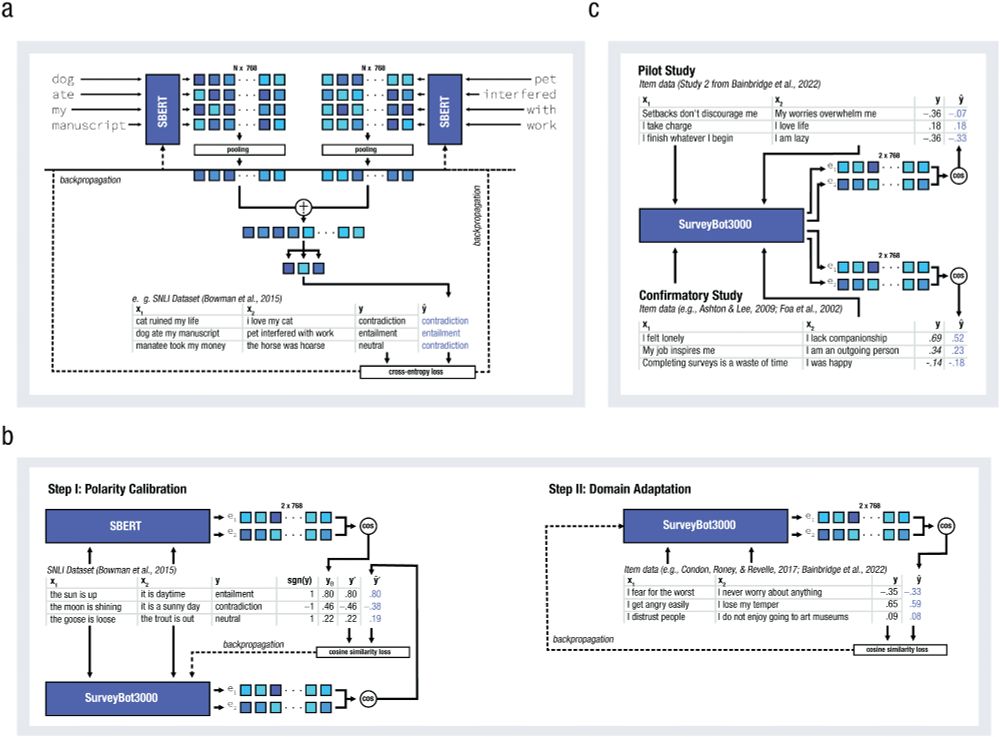
Finally, @bjoernhommel.bsky.social's and my paper introducing the SurveyBot3000 is officially out in AMPPS. It's a fine-tuned language model that guesstimates correlations between survey items from text alone. Not perfectly, but useful for search, for example.
journals.sagepub.com/doi/10.1177/...

Reposted by Alexander Wuttke

We took pains to avoid overfitting. In addition to the standard training/test/holdout divide, we also ran a registered report follow up and locked down the predictions before we collected data. Accuracy was indeed a tad attenuated r=.71 -> .59.
Finally, @bjoernhommel.bsky.social's and my paper introducing the SurveyBot3000 is officially out in AMPPS. It's a fine-tuned language model that guesstimates correlations between survey items from text alone. Not perfectly, but useful for search, for example.
journals.sagepub.com/doi/10.1177/...

Same.
And users start to recognize when others change their profile pictures...